
Posterior pituitary hormones — MCQs

An investigator is studying a drug that acts on a G protein-coupled receptor in the pituitary gland. Binding of the drug to this receptor leads to increased production of inositol triphosphate (IP3) in the basophilic cells of the anterior pituitary. Administration of this drug every 90 minutes is most likely to be beneficial in the treatment of which of the following conditions?
A 72-year-old man is brought in by ambulance to the hospital after being found down at home. On presentation, he appears cachectic and is found to be confused. Specifically, he does not answer questions appropriately and is easily distracted. His wife says that he has been losing weight over the last 3 months and he has a 40 pack-year history of smoking. His serum sodium is found to be 121 mEq/L and his urine osmolality is found to be 415 mOsm/kg. Chest radiograph shows a large central mass in the right lung. Which of the following treatments would be effective in addressing this patient's serum abnormality?
A 39-year-old man comes to the physician because of frequent urination for the past 2 months. He has been urinating 10–12 times during the day and 3–4 times during the night. He says he is drinking a lot of water to compensate for any dehydration. He has no history of serious illness and takes no medications. Vital signs are within normal limits. Physical examination shows no abnormalities. He is concerned he may have diabetes mellitus like his parents. Laboratory studies show: Hemoglobin 14.3 g/dL Serum Na+ 149 mEq/L K+ 3.9 mEq/L Cl- 102 mEq/L Glucose 90 mg/dL Osmolality 306 mOsmol/kg H2O Urine Osmolality 210 mOsmol/kg H2O A water deprivation test is conducted. After 2 hours of fluid restriction, his plasma osmolality is 315 mOsmol/kg H2O and his urine osmolality is 210 mOsmol/kg H2O. One hour after an ADH analog injection, his plasma osmolality is 276 mOsmol/kg H2O and his urine osmolality is 425 mOsmol/kg H2O. Which of the following is the most appropriate next step in management?
A 29-year-old patient presents to her primary care physician with persistent amenorrhea and inability to breastfeed over the last 5 months. She says that she has also been very tired since her baby was born and this fatigue was accompanied by an inability to deal with cold weather despite having no problem with cold prior to becoming pregnant. She has gained an additional 5 pounds since delivery. Review of her hospital records reveals that she had a vaginal delivery that was complicated by severe hemorrhage and episodes of hypotension. Which of the following hormone levels is most likely to be normal in this patient?
A 42-year-old woman comes to the physician because of urinary leakage over the last year. She reports involuntarily losing small amounts of urine after experiencing a sudden need to void. She has difficulty making it to the bathroom in time, and only feels comfortable going out into public if she has documented the location of all nearby restrooms. She also has begun to wake up at night to urinate. These symptoms have persisted despite 6 months of bladder training and weight loss and reducing soda and coffee intake. Physical examination shows no abnormalities. The most appropriate pharmacotherapy for this patient is a drug that has which of the following mechanisms of action?
Five minutes after initiating a change of position and oxygen inhalation, the oxytocin infusion is discontinued. A repeat CTG that is done 10 minutes later shows recurrent variable decelerations and a total of 3 uterine contractions in 10 minutes. Which of the following is the most appropriate next step in management?
A 65-year-old woman is brought to the emergency department by her husband who found her lying unconscious at home. He says that the patient has been complaining of progressively worsening weakness and confusion for the past week. Her past medical history is significant for hypertension, systemic lupus erythematosus, and trigeminal neuralgia. Her medications include metoprolol, valsartan, prednisone, and carbamazepine. On admission, blood pressure is 130/70 mm Hg, pulse rate is 100 /min, respiratory rate is 17/min, and temperature is 36.5°C (97.7ºF). She regained consciousness while on the way to the hospital but is still drowsy and disoriented. Physical examination is normal. Finger-stick glucose level is 110 mg/dl. Other laboratory studies show: Na+ 120 mEq/L (136—145 mEq/L) K+ 3.5 mEq/L (3.5—5.0 mEq/L) CI- 107 mEq/L (95—105 mEq/L) Creatinine 0.8 mg/dL (0.6—1.2 mg/dL) Serum osmolality 250 mOsm/kg (275—295 mOsm/kg) Urine Na+ 70 mEq/L Urine osmolality 350 mOsm/kg She is admitted to the hospital for further management. Which of the following is the next best step in the management of this patient's condition?
A neurophysiologist describes the mechanism of a specific type of synaptic transmission to his students. While illustrating this, he points out that when the action potential reaches the presynaptic terminal of a chemical synapse, the voltage-gated Ca2+ channels open. Ca2+ ions trigger the release of neurotransmitters from vesicles in the presynaptic terminal. In this type of synaptic transmission, increased cytosolic Ca2+ levels cause the release of a neurotransmitter from small vesicles with dense cores. Which of the following neurotransmitters is most likely to be the one that is released into the synaptic cleft in this type of synapse?
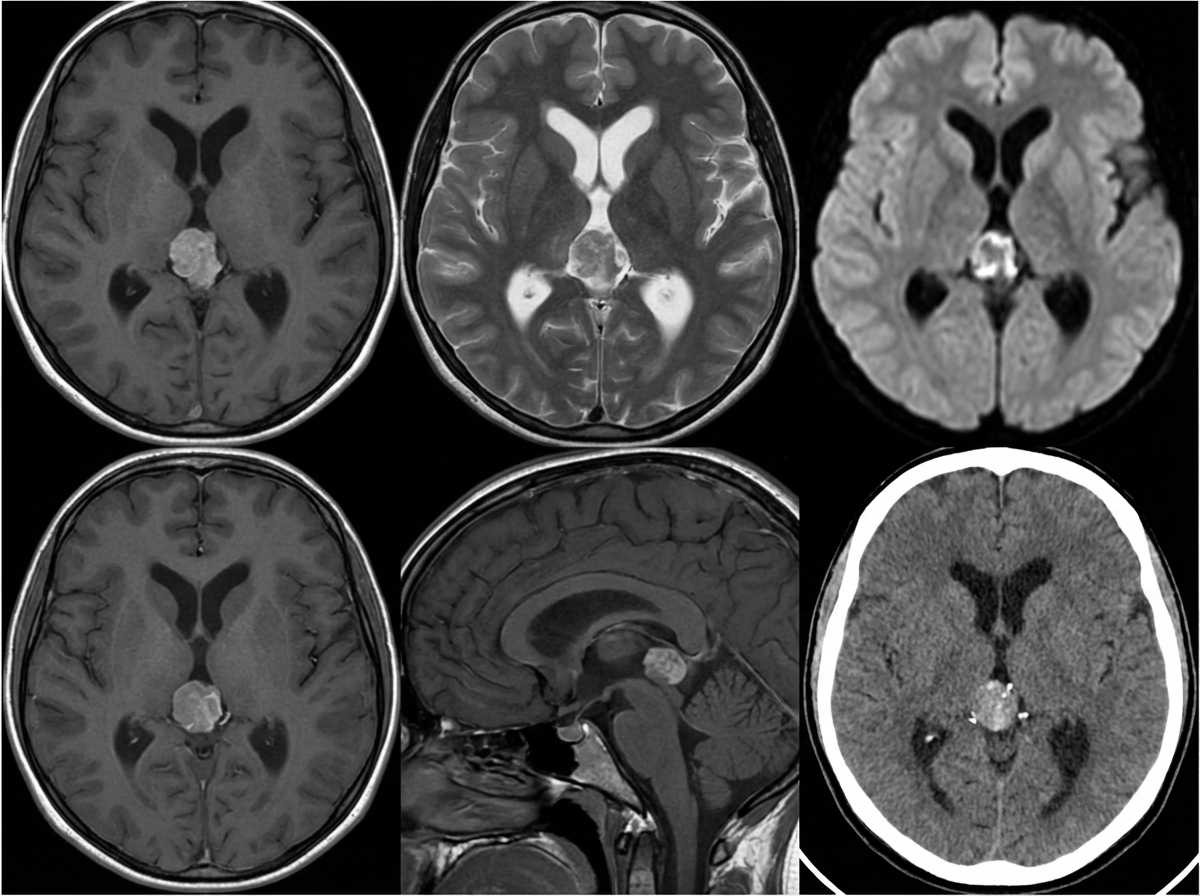
A 10-year-old girl is brought to the physician by her parents due to 2 months of a progressively worsening headache. The headaches were initially infrequent and her parents attributed them to stress from a recent move. However, over the last week the headaches have gotten significantly worse and she had one episode of vomiting this morning when she woke up. Her medical history is remarkable for a hospitalization during infancy for bacterial meningitis. On physical exam, the patient has difficulty looking up. The lower portion of her pupil is covered by the lower eyelid and there is sclera visible below the upper eyelid. A magnetic resonance imaging (MRI) of the brain is shown. Which of the following is the most likely diagnosis?
A 42-year-old man who is employed as a construction worker presents to his primary care physician with complaints of moderate headaches and profuse sweating. He reports the need to carry up to 3 additional shirt changes to work because they drench quickly even with tasks of low physical exertion. His coworkers have commented about his changing glove and boot sizes, which have increased at least 4 times since he joined the company 10 years ago. Physical examination is unremarkable except for blood pressure of 160/95 mm Hg, hyperhidrosis, noticeably large pores, hypertrichosis, widely spaced teeth, and prognathism. Which of the following best explains the patient’s clinical manifestations?
Want unlimited practice?
Get full access to all questions, explanations, and performance tracking.
Scan to download app