
DRESS syndrome and severe cutaneous reactions — MCQs

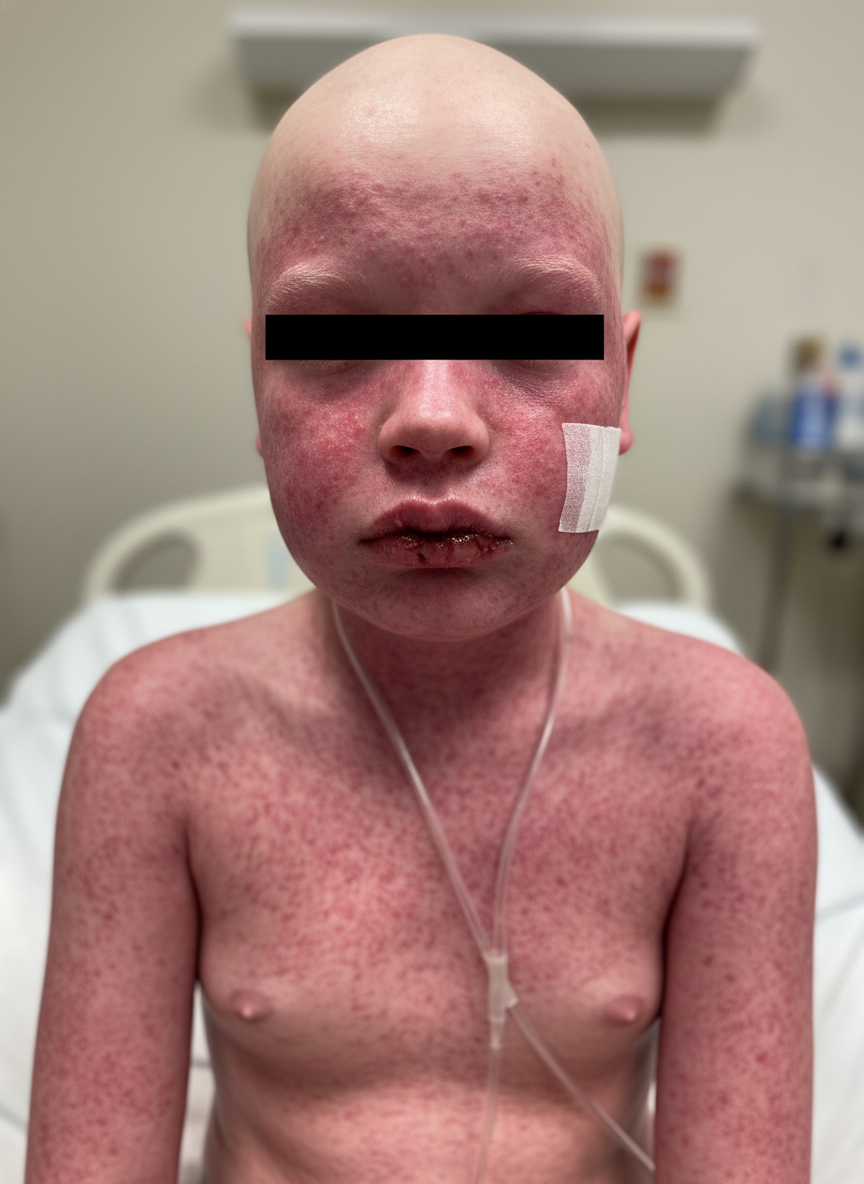
A 10-year-old boy presents with a painful rash for 1 day. He says that the reddish, purple rash started on his forearm but has now spread to his abdomen. He says there is a burning pain in the area where the rash is located. He also says he has had a stuffy nose for several days. Past medical history is significant for asthma and epilepsy, medically managed. Current medications are a daily chewable multivitamin, albuterol, budesonide, and lamotrigine. On physical examination, there is a red-purple maculopapular rash present on upper extremities and torso. There are some blisters present over the rash, as shown in the image, which is also present in the oral mucosa. Which of the following is the most likely cause of this patient’s symptoms?
A 42-year-old man who is employed as a construction worker presents to his primary care physician with complaints of moderate headaches and profuse sweating. He reports the need to carry up to 3 additional shirt changes to work because they drench quickly even with tasks of low physical exertion. His coworkers have commented about his changing glove and boot sizes, which have increased at least 4 times since he joined the company 10 years ago. Physical examination is unremarkable except for blood pressure of 160/95 mm Hg, hyperhidrosis, noticeably large pores, hypertrichosis, widely spaced teeth, and prognathism. Which of the following best explains the patient’s clinical manifestations?
A 13-year-old boy is brought to the emergency department because of vomiting, diarrhea, abdominal pain, and dizziness for the past 3 hours with fever, chills, and muscle pain for the last day. He had presented 5 days ago for an episode of epistaxis caused by nasal picking and was treated with placement of anterior nasal packing. His parents report that the bleeding stopped, but they forgot to remove the nasal pack. His temperature is 40.0°C (104.0°F), pulse is 124/min, respirations are 28/min, and blood pressure is 96/68 mm Hg. He looks confused, and physical exam shows conjunctival and oropharyngeal hyperemia with a diffuse, erythematous, macular rash over the body that involves the palms and the soles. Removal of the anterior nasal pack shows hyperemia with purulent discharge from the underlying mucosa. Laboratory studies show: Total white blood cell count 30,000/mm3 (30 x 109/L) Differential count Neutrophils 90% Lymphocytes 8% Monocytes 1% Eosinophils 1% Basophils 0% Platelet count 95,000/mm3 (95 x 109/L) Serum creatine phosphokinase 400 IU/L What is the most likely diagnosis for this patient?
A 47-year-old man presents to the emergency department due to a rash. He states the rash started last night and is very concerning to him. The patient cannot remember being exposed to any environmental stimuli such as new detergents or poison ivy. The patient recently started following with a primary care provider who is helping him manage his arthritis and a new onset cough. His temperature is 99.5°F (37.5°C), blood pressure is 127/68 mmHg, pulse is 125/min, respirations are 18/min, and oxygen saturation is 98% on room air. Physical exam is notable for the findings of coalescing erythematous macules, bullae, desquamation, and mucositis only on the upper half of his back. Cardiopulmonary exam and abdominal exam are within normal limits. Inspection of the patient’s oropharynx reveals ulcers and erythema. Which of the following is the most likely diagnosis?
A 10-year-old boy from Sri Lanka suffers from an autosomal dominant condition, the hallmark of which is hyperimmunoglobulinemia E and eosinophilia. He suffers from recurrent infections and takes antibiotic chemoprophylaxis. A STAT3 mutation analysis has been performed to confirm the diagnosis of Job syndrome. I. Eosinophilia II. Eczema III. Hay fever IV. Atopic dermatitis V. Recurrent skin and lung infections VI. Bronchial asthma What combination of symptoms above is characteristic of this condition?
One week after starting a new medication, a 16-year-old girl is brought to the emergency department by her mother because of a painful, blistering rash. She has a history of bipolar disorder. Her temperature is 39°C (102°F). Physical examination shows numerous coalescing bullae with epidermal detachment covering the face, trunk, and extremities. There are hemorrhagic erosions on the hard palate and buccal mucosa. When lateral pressure is applied to healthy-appearing skin at the edge of a bulla, a blister starts to form. Which of the following drugs is most likely responsible for this patient's current condition?
A 55-year-old male presents with complaints of intermittent facial flushing. He also reports feeling itchy after showering. On review of systems, the patient says he has been having new onset headaches recently. On physical exam, his vital signs, including O2 saturation, are normal. He has an abnormal abdominal mass palpable in the left upper quadrant. A complete blood count reveals: WBCs 6500/microliter; Hgb 18.2 g/dL; Platelets 385,000/microliter. Which of the following is most likely responsible for his presentation?
A 19-year-old man with a history of generalized tonic-clonic seizures comes to the physician for a routine health maintenance examination. He is a known user of intravenous cocaine. His vital signs are within normal limits. Physical examination shows multiple hyperpigmented lines along the forearms. Oral examination shows marked overgrowth of friable, ulcerated gingival mucosa. Which of the following is the most likely cause of this patient's oral examination findings?
A 3-year-old boy presents to the emergency department with a fever and a rash. This morning the patient was irritable and had a fever which gradually worsened throughout the day. He also developed a rash prior to presentation. He was previously healthy and is not currently taking any medications. His temperature is 102.0°F (38.9°C), blood pressure is 90/50 mmHg, pulse is 160/min, respirations are 17/min, and oxygen saturation is 98% on room air. Physical exam is notable for a scarlatiniform rash with flaccid blisters that rupture easily, covering more than 60% of the patient’s body surface. The lesions surround the mouth but do not affect the mucosa, and palpation of the rash is painful. Which of the following is the most likely diagnosis?
A 52-year-old man presents for a routine checkup. Past medical history is remarkable for stage 1 systemic hypertension and hepatitis A infection diagnosed 10 years ago. He takes aspirin, rosuvastatin, enalapril daily, and a magnesium supplement every once in a while. He is planning to visit Ecuador for a week-long vacation and is concerned about malaria prophylaxis before his travel. The physician advised taking 1 primaquine pill every day while he is there and for 7 consecutive days after leaving Ecuador. On the third day of his trip, the patient develops an acute onset headache, dizziness, shortness of breath, and fingertips and toes turning blue. His blood pressure is 135/80 mm Hg, heart rate is 94/min, respiratory rate is 22/min, temperature is 36.9℃ (98.4℉), and blood oxygen saturation is 97% in room air. While drawing blood for his laboratory workup, the nurse notes that his blood has a chocolate brown color. Which of the following statements best describes the etiology of this patient’s most likely condition?
Want unlimited practice?
Get full access to all questions, explanations, and performance tracking.
Scan to download app