
Inhalational anesthetics — MCQs

A 17-year-old male presents with altered mental status. He was recently admitted to the hospital due to a tibial fracture suffered while playing soccer. His nurse states that he is difficult to arouse. His temperature is 98.6 deg F (37 deg C), blood pressure is 130/80 mm Hg, pulse is 60/min, and respirations are 6/min. Exam is notable for pinpoint pupils and significant lethargy. Which of the following describes the mechanism of action of the drug likely causing this patient's altered mental status?
Two hours after undergoing elective cholecystectomy with general anesthesia, a 41-year-old woman is evaluated for decreased mental status. BMI is 36.6 kg/m2. Respirations are 18/min and blood pressure is 126/73 mm Hg. Physical examination shows the endotracheal tube in normal position. She does not respond to sternal rub and gag reflex is absent. Arterial blood gas analysis on room air shows normal PO2 and PCO2 levels. Which of the following anesthetic properties is the most likely cause of these findings?
A group of researchers is studying various inhaled substances to determine their anesthetic properties. In particular, they are trying to identify an anesthetic with fast onset and quick recovery for use in emergencies. They determine the following data: Inhalational anesthetic Blood-gas partition coefficient A 0.15 B 0.92 C 5.42 Which of the following statements is accurate with regard to these inhaled anesthetic substances?
In a randomized controlled trial studying a new treatment, the primary endpoint (mortality) occurred in 14.4% of the treatment group and 16.7% of the control group. Which of the following represents the number of patients needed to treat to save one life, based on the primary endpoint?
A previously healthy 44-year-old man is brought by his coworkers to the emergency department 45 minutes after he became light-headed and collapsed while working in the boiler room of a factory. He did not lose consciousness. His coworkers report that 30 minutes prior to collapsing, he told them he was nauseous and had a headache. The patient appears sweaty and lethargic. He is not oriented to time, place, or person. The patient’s vital signs are as follows: temperature 41°C (105.8°F); heart rate 133/min; respiratory rate 22/min; and blood pressure 90/52 mm Hg. Examination shows equal and reactive pupils. Deep tendon reflexes are 2+ bilaterally. His neck is supple. A 0.9% saline infusion is administered. A urinary catheter is inserted and dark brown urine is collected. The patient’s laboratory test results are as follows: Laboratory test Blood Hemoglobin 15 g/dL Leukocyte count 18,000/mm3 Platelet count 51,000/mm3 Serum Na+ 149 mEq/L K+ 5.0 mEq/L Cl- 98 mEq/L Urea nitrogen 42 mg/dL Glucose 88 mg/dL Creatinine 1.8 mg/dL Aspartate aminotransferase (AST, GOT) 210 Alanine aminotransferase (ALT, GPT) 250 Creatine kinase 86,000 U/mL Which of the following is the most appropriate next step in patient management?
You are a resident on an anesthesiology service and are considering using nitrous oxide to assist in placing a laryngeal mask airway (LMA) in your patient, who is about to undergo a minor surgical procedure. You remember that nitrous oxide has a very high minimal alveolar concentration (MAC) compared to other anesthetics. This means that nitrous oxide has:
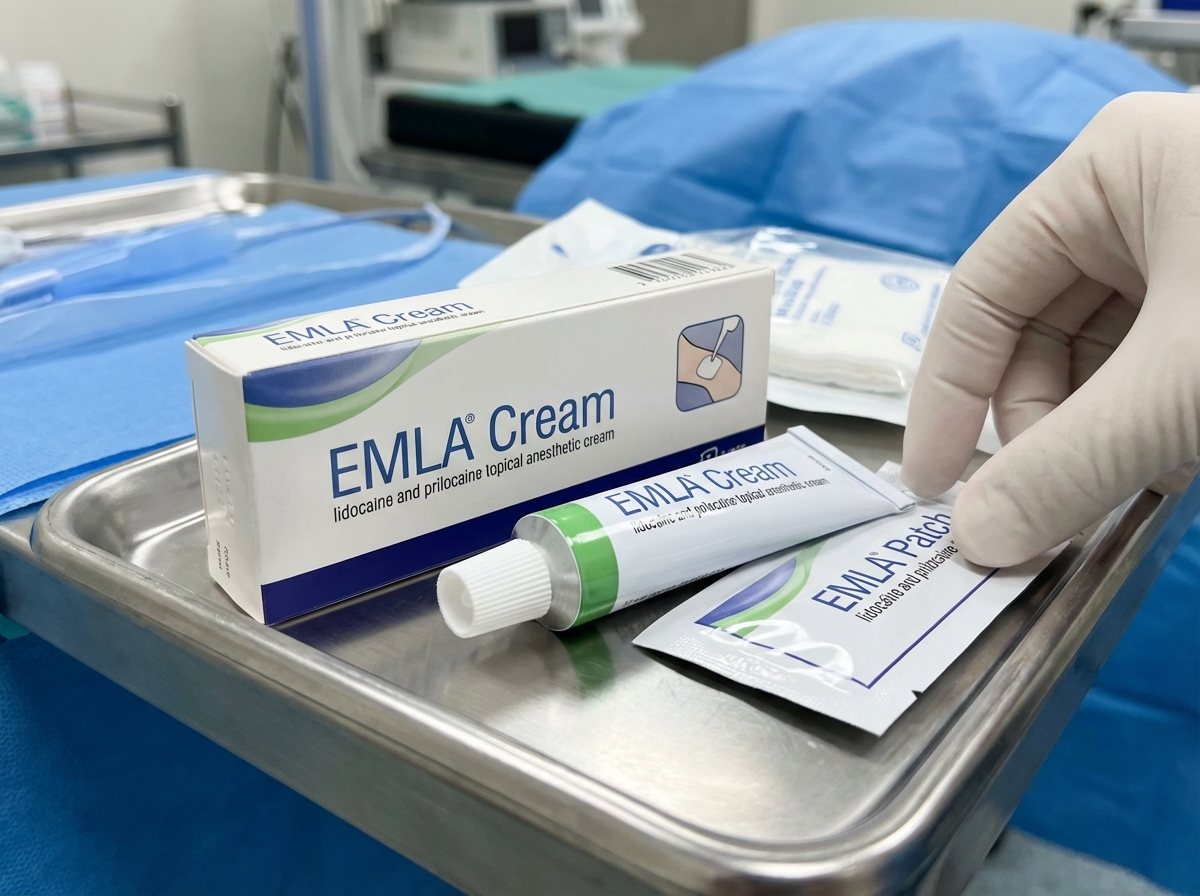
Which of the following statements regarding the patch shown in the figure is correct?
A 32-year-old male patient presents to the emergency department after being found down on a sidewalk. He is able to be aroused but seems confused and confabulates extensively during history taking. Physical exam of the eye reveals nystagmus and the patient is unable to complete finger-to-nose or heel-to-shin testing. Chart review shows that the patient is well known for a long history of alcohol abuse. Which of the following substances should be administered prior to giving IV glucose to this patient?
A 65-year-old woman with COPD comes to the emergency department with 2-day history of worsening shortness of breath and cough. She often has a mild productive cough, but she noticed that her sputum is more yellow than usual. She has not had any recent fevers, chills, sore throat, or a runny nose. Her only medication is a salmeterol inhaler that she uses twice daily. Her temperature is 36.7°C (98°F), pulse is 104/min, blood pressure is 134/73 mm Hg, respiratory rate is 22/min, and oxygen saturation is 85%. She appears uncomfortable and shows labored breathing. Lung auscultation reveals coarse bibasilar inspiratory crackles. A plain film of the chest shows mild hyperinflation and flattening of the diaphragm but no consolidation. She is started on supplemental oxygen via nasal cannula. Which of the following is the most appropriate initial pharmacotherapy?
A 16-year-old college student presents to the emergency department with a 3-day history of fever, muscle rigidity, and confusion. He was started on a new medication for schizophrenia 2 months ago. There is no history of sore throat, burning micturition, or loose motions. At the hospital, his temperature is 38.6°C (101.5°F); the blood pressure is 108/62 mm Hg; the pulse is 120/min, and the respiratory rate is 16/min. His urine is cola-colored. On physical examination, he is sweating profusely. Treatment is started with antipyretics and intravenous hydration. Which of the following is most likely responsible for this patient's condition?
Want unlimited practice?
Get full access to all questions, explanations, and performance tracking.
Scan to download app