
Sympathomimetics — MCQs

A 17-year-old high school student is brought to the emergency department because of irritability and rapid breathing. He appears agitated and is diaphoretic. His temperature is 38.3°C (101°F), pulse is 129/min, respirations are 28/min, and blood pressure is 158/95 mmHg. His pupils are dilated. An ECG shows sinus tachycardia. Which of the following substances is used to make the drug this patient has most likely taken?
A 24-year-old graduate student is brought to the emergency department by her boyfriend because of chest pain that started 90 minutes ago. Her boyfriend says she has been taking medication to help her study for an important exam and has not slept in several days. On examination, she is diaphoretic, agitated, and attempts to remove her IV lines and ECG leads. Her temperature is 37.6°C (99.7°F), pulse is 128/min, and blood pressure is 163/97 mmHg. Her pupils are dilated. The most appropriate next step in management is the administration of which of the following?
A 43-year-old man is brought to the emergency department 45 minutes after his wife found him on the floor sweating profusely. On arrival, he is lethargic and unable to provide a history. He vomited multiple times on the way to the hospital. His temperature is 37.3°C (99.1°F), pulse is 55/min, respirations are 22/min, and blood pressure is 98/65 mm Hg. Pulse oximetry on room air shows an oxygen saturation of 80%. Examination shows profuse diaphoresis and excessive salivation. He withdraws his extremities sluggishly to pain. The pupils are constricted and reactive. Scattered expiratory wheezing and rhonchi are heard throughout both lung fields. Cardiac examination shows no abnormalities. There are fine fasciculations in the lower extremities bilaterally. Muscle strength is reduced and deep tendon reflexes are 1+ bilaterally. His clothes are soaked with urine and feces. Which of the following is the mechanism of action of the most appropriate initial pharmacotherapy?
A 55-year-old woman comes to the physician because of involuntary hand movements that improve with alcohol consumption. Physical examination shows bilateral hand tremors that worsen when the patient is asked to extend her arms out in front of her. The physician prescribes a medication that is associated with an increased risk of bronchospasms. This drug has which of the following immediate effects on the cardiovascular system? Stroke volume | Heart rate | Peripheral vascular resistance
A 44-year-old male is brought to the emergency department by fire and rescue after he was the unrestrained driver in a motor vehicle accident. His wife notes that the patient’s only past medical history is recent development of severe episodes of headache accompanied by sweating and palpitations. She says that these episodes were diagnosed as atypical panic attacks by the patient’s primary care provider, and the patient was started on sertraline and alprazolam. In the trauma bay, the patient’s temperature is 97.6°F (36.4°C), blood pressure is 81/56 mmHg, pulse is 127/min, and respirations are 14/min. He has a Glascow Coma Score (GCS) of 10. He is extremely tender to palpation in the abdomen with rebound and guarding. His skin is cool and clammy, and he has thready peripheral pulses. The patient's Focused Assessment with Sonography for Trauma (FAST) exam reveals bleeding in the perisplenic space, and he is taken for emergency laparotomy. He is found to have a ruptured spleen, and his spleen is removed. During manipulation of the bowel, the patient’s temperature is 97.8°F (36.6°C), blood pressure is 246/124 mmHg, and pulse is 104/min. The patient is administered intravenous labetalol, but his blood pressure continues to worsen. The patient dies during the surgery. Which of the following medications would most likely have prevented this outcome?
A 75-year-old male arrives by ambulance to the emergency room severely confused. His vitals are T 40 C, HR 120 bpm, BP 80/55 mmHg, RR 25. His wife explains that he injured himself about a week ago while cooking, and several days later his finger became infected, oozing with pus. He ignored her warning to see a doctor and even refused after he developed fever, chills, and severe fatigue yesterday. After being seen by the emergency physician, he was given antibiotics and IV fluids. Following initial resuscitation with IV fluids, he remains hypotensive. The ED physicians place a central venous catheter and begin infusing norepinephrine. Which of the following receptors are activated by norepinephrine?
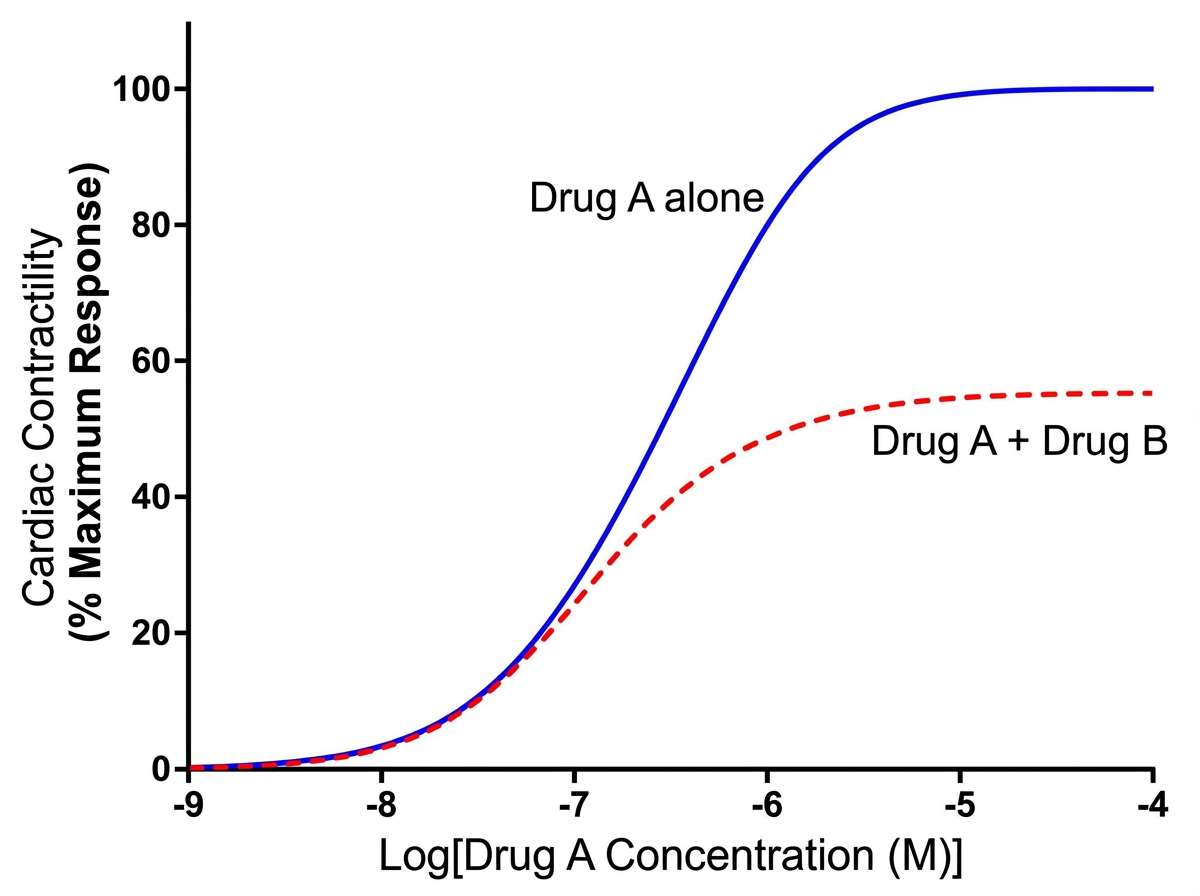
An investigator is studying the effects of different drugs on the contraction of cardiomyocytes. The myocytes are able to achieve maximal contractility with the administration of drug A. The subsequent administration of drug B produces the response depicted in the graph shown. Which of the following drugs is most likely to produce a response similar to that of drug B?
A researcher is studying receptors that respond to epinephrine in the body and discovers a particular subset that is expressed in presynaptic adrenergic nerve terminals. She discovers that upon activation, these receptors will lead to decreased sympathetic nervous system activity. She then studies the intracellular second messenger changes that occur when this receptor is activated. She records these changes and begins searching for analogous receptor pathways. Which of the following receptors would cause the most similar set of intracellular second messenger changes?
A 22-year-old woman is brought to the emergency department by her roommate for unusual behavior. They were at a party where alcohol and recreational drugs were consumed, but her roommate is unsure of what she may have taken or had to drink. She is otherwise healthy and does not take any medications. The patient appears anxious. Her temperature is 37.5°C (99.5°F), pulse is 110/min, respiratory rate is 16/min, and blood pressure is 145/82 mmHg. Examination shows dry mucous membranes and bilateral conjunctival injection. Breath sounds are normal. The abdomen is soft and nontender. Further evaluation will most likely reveal which of the following?
Two 19-year-old men are referred by their professor and mentor to a psychiatrist for substance abuse management. The two friends have both used different stimulants for 3 years—Drug A and Drug B, respectively. Both use these substances cyclically. Use of Drug A usually lasts for about 12 hours. The cycle for Drug B lasts several days. A month ago, both men visited the emergency room (ER) due to acute intoxication. Clinical features in the emergency department included hypotension, bradycardia, sweating, chills, mydriasis, nausea, and psychomotor agitation. After a urine drug screen, the psychiatrist identifies both the drugs and informs the professor that although both Drug A and Drug B are stimulants, their mechanisms of action are different. Drug A is an alkaloid that is naturally present in the leaves of the coca plant, while it is possible to make Drug B from over-the-counter nasal decongestant products. Which of the following options best describes the mechanism of action of both drugs?
Want unlimited practice?
Get full access to all questions, explanations, and performance tracking.
Scan to download app