
Pulmonary hypertension therapies — MCQs

A 70-year-old male presents to his primary care provider complaining of decreased sexual function. He reports that over the past several years, he has noted a gradual decline in his ability to sustain an erection. He used to wake up with erections but no longer does. His past medical history is notable for diabetes, hyperlipidemia, and a prior myocardial infarction. He takes metformin, glyburide, aspirin, and atorvastatin. He drinks 2-3 drinks per week and has a 25 pack-year smoking history. He has been happily married for 40 years. He retired from his job as a construction worker 5 years ago and has been enjoying retirement with his wife. His physician recommends starting a medication that is also used in the treatment of pulmonary hypertension. Which of the following is a downstream effect of this medication?
A 30-year-old woman presents complaining of shortness of breath, chest pain, and fatigue. The patient complains of dyspnea upon exertion, generalized fatigue, lethargy, and chest pain associated with strenuous activities. Her history is notable for an atrial septal defect at birth. Her temperature is 99.5°F (37.5°C), blood pressure is 147/98 mmHg, pulse is 90/min, respirations are 17/min, and oxygen saturation is 98% on room air. On exam, she has a wide, fixed splitting of S2. Which of the following medications most directly treats the underlying pathophysiology causing this patient's presentation?
A 57-year-old male presents with a primary complaint of erectile dysfunction. After proper evaluation, the patient is started on daily administration of sildenafil. This medication directly causes accumulation of which of the following intracellular mediators?
A 72-year-old man with type 2 diabetes mellitus, hypertension, and systolic heart failure comes to the physician because of a 5-day history of progressively worsening shortness of breath at rest. Physical examination shows jugular venous distention, diffuse crackles over the lower lung fields, and bilateral lower extremity edema. As a part of treatment, he is given a derivative of a hormone that acts by altering guanylate cyclase activity. This drug has been found to reduce pulmonary capillary wedge pressure and causes systemic hypotension as an adverse effect. The drug is most likely a derivative of which of the following hormones?
A 33-year-old woman comes to the physician because of a 6-month history of worsening shortness of breath and fatigue. Her paternal uncle had similar symptoms and died of respiratory failure at 45 years of age. The lungs are clear to auscultation. Pulmonary function testing shows an FVC of 84%, an FEV1/FVC ratio of 92%, and a normal diffusion capacity. An ECG shows a QRS axis greater than +90 degrees. Genetic analysis shows an inactivating mutation in the bone morphogenetic protein receptor type II (BMPR2) gene. Which of the following is the most likely cause of this patient's symptoms?
A 69-year-old woman comes to the clinic for an annual well exam. She reports no significant changes to her health except for an arm fracture 3 weeks ago while she was lifting some heavy bags. Her diabetes is well controlled with metformin. She reports some vaginal dryness that she manages with adequate lubrication. She denies any weight changes, fevers, chills, palpitations, nausea/vomiting, incontinence, or bowel changes. A dual-energy X-ray absorptiometry (DEXA) scan was done and demonstrated a T-score of -2.7. She was subsequently prescribed a selective estrogen receptor modulator, in addition to vitamin and weight-bearing exercises, for the management of her symptoms. What is the mechanism of action of the prescribed medication?
A 45-year-old woman with history of systemic sclerosis presents with new onset dyspnea, which is worsened with moderate exertion. She also complains of chest pain. An ECG was obtained, and showed right-axis deviation. Chest x-ray showed right ventricle hypertrophy. Given the patient's history and presentation, right heart catheterization was performed, which confirmed the suspected diagnosis of pulmonary artery hypertension. It is decided to start the patient on bosentan. Which of the following describes the method of action of bosentan?
A 58-year-old man presents for a follow-up appointment. He recently was found to have a history of stage 2 chronic kidney disease secondary to benign prostatic hyperplasia leading to urinary tract obstruction. He has no other medical conditions. His father died at age 86 from a stroke, and his mother lives in an assisted living facility. He smokes a pack of cigarettes a day and occasionally drinks alcohol. His vital signs include: blood pressure 130/75 mm Hg, pulse 75/min, respiratory rate 17/min, and temperature 36.5°C (97.7°F). His physical examination is unremarkable. A 24-hour urine specimen reveals the following findings: Specific gravity 1,050 pH 5.6 Nitrites (-) Glucose (-) Proteins 250 mg/24hrs Which of the following should be prescribed to this patient to decrease his cardiovascular risk?
A 72-year-old man presents to his primary care provider to discuss the frequency with which he wakes up at night to urinate. He avoids drinking liquids at night, but the symptoms have progressively worsened. The medical history is significant for hypertension and hyperlipidemia. He takes lisinopril, atorvastatin, and a multivitamin every day. Today, the vital signs include: blood pressure 120/80 mm Hg, heart rate 90/min, respiratory rate 17/min, and temperature 37.0°C (98.6°F). On physical examination, he appears tired. The heart has a regular rate and rhythm and the lungs are clear to auscultation bilaterally. A bedside bladder ultrasound reveals a full bladder. A digital rectal exam reveals an enlarged and symmetric prostate free of nodules, that is consistent with benign prostatic enlargement. He also has a history of symptomatic hypotension with several episodes of syncope in the past. The patient declines a prostate biopsy that would provide a definitive diagnosis and requests less invasive treatment. Which of the following is recommended to treat this patient’s enlarged prostate?
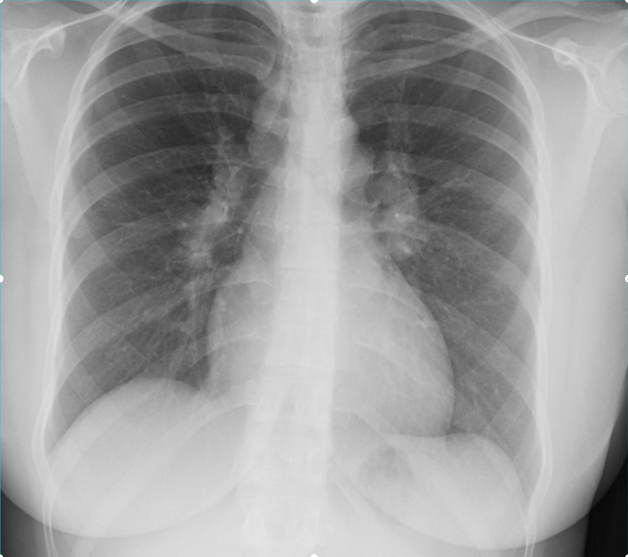
A 26-year-old man comes to the physician because of a 1-week history of left-sided chest pain. The pain is worse when he takes deep breaths. Over the past 6 weeks, he had been training daily for an upcoming hockey tournament. He does not smoke cigarettes or drink alcohol but has used cocaine once. His temperature is 37.1°C (98.7°F), pulse is 75/min, and blood pressure is 128/85 mm Hg. Physical examination shows tenderness to palpation of the left chest. An x-ray of the chest is shown. Which of the following is the most appropriate initial pharmacotherapy?
Want unlimited practice?
Get full access to all questions, explanations, and performance tracking.
Scan to download app