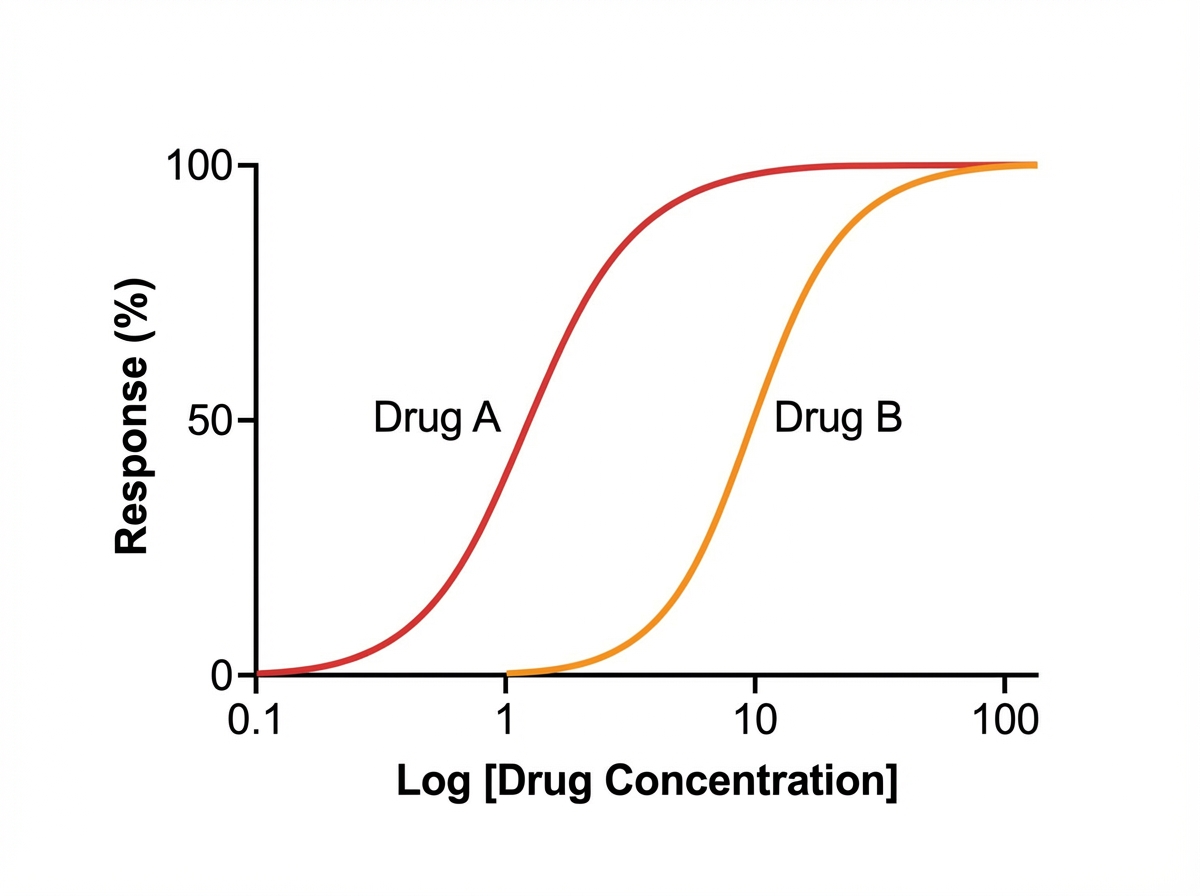
A student is reviewing the various effects that can be plotted on a dose-response curve. He has observed that certain drugs can work as an agonist and an antagonist at a particular site. He has plotted a particular graph (as shown below) and is checking for other responses that can be measured on the same graph. He learned that drug B is less potent than drug A. Drug B also reduces the potency of drug A when combined in the same solution; however, if additional drug A is added to the solution, the maximal efficacy (Emax) of drug A increases. He wishes to plot another curve for drug C. He learns that drug C works on the same molecules as drugs A and B, but drug C reduces the maximal efficacy (Emax) of drug A significantly when combined with drug A. Which of the following best describes drug C?
Q962
An obese, 66-year-old woman comes to the physician for a routine health maintenance examination. She feels well but is unhappy about being overweight. She reports that she feels out of breath when walking for more than one block and while climbing stairs. She has tried to lose weight for several years without success. She goes for a walk 3 times a week but she has difficulty following a low-calorie diet. During the past 12 months, she has had two urinary tract infections that were treated with fosfomycin. She has type 2 diabetes mellitus and osteoarthritis. Her only current medication is metformin. She has never smoked. She is 160 cm (5 ft 3 in) tall and weighs 100 kg (220 lb); BMI is 39.1 kg/m2. Vital signs are within normal limits. Physical examination shows cracking in both knees on passive movement. The remainder of the examination shows no abnormalities. Serum studies show an HbA1c of 9.5%, and a fasting serum glucose concentration of 158 mg/dL. An ECG shows no abnormalities. Which of the following is the most appropriate pharmacotherapy?
Q963
A 65-year-old male with a history of CHF presents to the emergency room with shortness of breath, lower leg edema, and fatigue. He is diagnosed with acute decompensated congestive heart failure, was admitted to the CCU, and treated with a medication that targets beta-1 adrenergic receptors preferentially over beta-2 adrenergic receptors. The prescribing physician explained that this medication would only be used temporarily as its efficacy decreases within 2-3 days due to receptor downregulation. Which of the following was prescribed?
Q964
A 42-year-old male presents to the emergency department due to severe headaches and palpitations. He has had previous episodes of sweating and headache, but this episode was particularly disabling. Upon presentation, he appears pale and diaphoretic. His temperature is 99.3°F (37.4°C), blood pressure is 162/118 mmHg, pulse is 87/min, and respirations are 20/min. Based on clinical suspicion, an abdominal CT scan is obtained, which shows a retroperitoneal mass. This patient's increased heart rate is most likely due to a change in activity of which of the following channels?
Q965
A 28-year-old woman comes to the emergency department because of increasing abdominal pain for 2 days. The pain is diffuse and constant, and she describes it as 7 out of 10 in intensity. She has also had numbness in her lower extremities for 12 hours. She has type 1 diabetes mellitus, migraine with aura, and essential tremor. She appears uncomfortable. She is oriented to place and person only. Her temperature is 37°C (98.6°F), pulse is 123/min, and blood pressure is 140/70 mm Hg. Examination shows a distended abdomen with no tenderness to palpation. Bowel sounds are decreased. Muscle strength and sensation is decreased in the lower extremities. There is a tremor of the right upper extremity. Urinalysis shows elevated levels of aminolevulinic acid and porphobilinogen. Which of the following is the most likely cause of this patient's symptoms?
Q966
A 10-year-old girl is brought to the emergency department by her mother 30 minutes after having had a seizure. When her mother woke her up that morning, the girl's entire body stiffened and she started shaking vigorously for several minutes. Her mother also reports that over the past few months, her daughter has had multiple episodes of being unresponsive for less than a minute, during which her eyelids were fluttering. The girl did not recall these episodes afterwards. Upon arrival, she appears drowsy. Neurologic examination shows no abnormalities. Which of the following is the most appropriate pharmacotherapy to prevent recurrence of this patient's symptoms?
Q967
A man returns home late at night to find his 15-year-old son and 40-year-old wife unconscious in the family room. He immediately summons emergency services. In the field, pulse oximetry shows oxygen saturation at 100% for both patients. 100%, yet they both appear cyanotic. Both patients are provided with 2L of oxygen by way of nasal cannula on the way to the hospital. An arterial blood gas is performed on the teenager and reveals pH of 7.35, PaCO2 of 31.8 mm Hg, PaO2 of 150 mm Hg, HCO3- of 20 mEq/L, SaO2 of 80%, and a COHb of 18%. What is the most likely cause of his condition?
Q968
A middle-aged homeless man is found lying unresponsive on the streets by the police and is rushed to the emergency department. His vital signs include: blood pressure 110/80 mm Hg, pulse rate 100/min, and respirations 10/min and shallow. On physical examination, his extremities are cold and clammy. Pupils are constricted and non-reactive. His blood glucose is 55 mg/dL. IV access is established immediately with the administration of dextrose and naloxone. In half an hour, the patient is fully conscious, alert and responsive. He denies any medical illnesses, hospitalizations, or surgeries in the past. Physical examination reveals injection track marks along both arms. He admits to the use of cocaine and heroin. He smokes cigarettes and consumes alcohol. His vital signs are now stable. A urine sample is sent for toxicology screening. Which of the following was the most likely cause of this patient’s respiratory depression?
Q969
A 29-year-old woman comes to the physician because of intermittent episodes of sharp chest pain and palpitations. She appears nervous. Her pulse is 115/min and irregularly irregular, and blood pressure is 139/86 mmHg. Examination shows a fine tremor on both hands and digital swelling; the extremities are warm. There is retraction of the right upper eyelid. Which of the following is the most appropriate next step in the management of this patient?
Q970
A P1G0 diabetic woman is at risk of delivering at 30 weeks gestation. Her obstetrician counsels her that there is a risk the baby could have significant pulmonary distress after it is born. However, she states she will administer a drug to the mother to help prevent this from occurring. By what action will this drug prevent respiratory distress in the premature infant?
Autonomic/CV Drugs US Medical PG Practice Questions and MCQs
Question 961: A student is reviewing the various effects that can be plotted on a dose-response curve. He has observed that certain drugs can work as an agonist and an antagonist at a particular site. He has plotted a particular graph (as shown below) and is checking for other responses that can be measured on the same graph. He learned that drug B is less potent than drug A. Drug B also reduces the potency of drug A when combined in the same solution; however, if additional drug A is added to the solution, the maximal efficacy (Emax) of drug A increases. He wishes to plot another curve for drug C. He learns that drug C works on the same molecules as drugs A and B, but drug C reduces the maximal efficacy (Emax) of drug A significantly when combined with drug A. Which of the following best describes drug C?
A. Reversible antagonist
B. Competitive antagonist
C. Full agonist
D. Inverse agonist
E. Non-competitive antagonist (Correct Answer)
Explanation: ***Non-competitive antagonist***
- A non-competitive antagonist **reduces the maximal efficacy (Emax)** of an agonist, even at high agonist concentrations. This is because it binds to a site other than the active site or binds irreversibly to the active site, preventing the agonist from producing its full effect.
- Unlike competitive antagonists, its effects cannot be overcome by simply increasing the concentration of the agonist.
*Reversible antagonist*
- This is a broad category; while some non-competitive antagonists can be reversible, the key characteristic for drug C is its impact on **maximal efficacy (Emax)**, which points more specifically to non-competitive antagonism.
- A reversible antagonist's effect can be overcome by increasing the agonist concentration, which is not the defining feature described for drug C.
*Competitive antagonist*
- A competitive antagonist **reduces the potency** (shifts the dose-response curve to the right, meaning a higher concentration of agonist is needed for the same effect) but **does not reduce the maximal efficacy (Emax)** of an agonist.
- Its effects can be fully overcome by adding more agonist, allowing the agonist to reach its original Emax.
*Full agonist*
- A full agonist **binds to a receptor and produces the maximal possible effect (Emax)**.
- This drug C is described as reducing the Emax of drug A, which is the opposite effect of an agonist.
*Inverse agonist*
- An inverse agonist **binds to a receptor and produces an effect opposite to that of a full agonist**, by stabilizing the receptor in an inactive conformation.
- While it modulates receptor activity, its primary action is not described as reducing the Emax of another agonist in the manner of an antagonist.
Question 962: An obese, 66-year-old woman comes to the physician for a routine health maintenance examination. She feels well but is unhappy about being overweight. She reports that she feels out of breath when walking for more than one block and while climbing stairs. She has tried to lose weight for several years without success. She goes for a walk 3 times a week but she has difficulty following a low-calorie diet. During the past 12 months, she has had two urinary tract infections that were treated with fosfomycin. She has type 2 diabetes mellitus and osteoarthritis. Her only current medication is metformin. She has never smoked. She is 160 cm (5 ft 3 in) tall and weighs 100 kg (220 lb); BMI is 39.1 kg/m2. Vital signs are within normal limits. Physical examination shows cracking in both knees on passive movement. The remainder of the examination shows no abnormalities. Serum studies show an HbA1c of 9.5%, and a fasting serum glucose concentration of 158 mg/dL. An ECG shows no abnormalities. Which of the following is the most appropriate pharmacotherapy?
A. Exenatide (Correct Answer)
B. Pioglitazone
C. Acarbose
D. Topiramate
E. Phentermine
Explanation: ***Exenatide***
- This patient has uncontrolled type 2 diabetes (HbA1c 9.5%) despite metformin, and significant obesity (BMI 39.1 kg/m²). **GLP-1 receptor agonists** like exenatide are effective in lowering HbA1c and promoting **weight loss**, making it an excellent choice.
- GLP-1 agonists also offer **cardioprotective benefits** and do not increase the risk of hypoglycemia when used as monotherapy or with metformin, which is important given her age and comorbidities.
*Pioglitazone*
- **Pioglitazone** is a thiazolidinedione that improves insulin sensitivity but is associated with **weight gain** and fluid retention, which would be detrimental to this obese patient with shortness of breath and osteoarthritis.
- It also carries a risk of **heart failure exacerbation**, which is a concern in an older, obese patient with exertional dyspnea, even if her ECG is currently normal.
*Acarbose*
- **Acarbose** is an alpha-glucosidase inhibitor that delays carbohydrate absorption, primarily impacting postprandial glucose. Its efficacy in significantly lowering HbA1c (usually 0.5-0.8%) is generally **less robust** compared to other agents.
- It often causes significant **gastrointestinal side effects** like flatulence, bloating, and diarrhea, leading to poor patient adherence and making it a less favored option for significant hyperglycemia.
*Topiramate*
- **Topiramate** is an anticonvulsant that can cause weight loss, but its primary indication is **epilepsy** and **migraine prophylaxis**, not diabetes management.
- While it might assist with weight, it does not directly manage blood glucose effectively and has potential **cognitive side effects** (e.g., "dopamax") which are generally undesirable for routine use in diabetes.
*Phentermine*
- **Phentermine** is a sympathomimetic amine used for **short-term weight loss** (typically 12 weeks) due to its potential for abuse and side effects like increased blood pressure and heart rate.
- It does not directly address **blood glucose control** and is not suitable for long-term management of both obesity and diabetes in an older patient with existing cardiovascular risk factors.
Question 963: A 65-year-old male with a history of CHF presents to the emergency room with shortness of breath, lower leg edema, and fatigue. He is diagnosed with acute decompensated congestive heart failure, was admitted to the CCU, and treated with a medication that targets beta-1 adrenergic receptors preferentially over beta-2 adrenergic receptors. The prescribing physician explained that this medication would only be used temporarily as its efficacy decreases within 2-3 days due to receptor downregulation. Which of the following was prescribed?
A. Epinephrine
B. Norepinephrine
C. Milrinone
D. Isoproterenol
E. Dobutamine (Correct Answer)
Explanation: ***Dobutamine***
- **Dobutamine** is a beta-1 adrenergic agonist preferentially acting on beta-1 receptors in the heart, increasing contractility and heart rate during acute decompensated heart failure.
- Its efficacy reduces over time due to **receptor downregulation**, making it effective for only short-term use, typically less than 72 hours.
*Epinephrine*
- **Epinephrine** is a non-selective adrenergic agonist acting on both alpha and beta receptors, causing vasoconstriction and bronchodilation in addition to cardiac stimulation.
- It is typically used in emergency situations like **cardiac arrest** and **anaphylaxis**, not primarily for acute CHF exacerbation in this manner.
*Norepinephrine*
- **Norepinephrine** primarily acts on alpha-1 adrenergic receptors, causing significant vasoconstriction, and has some beta-1 agonistic effects.
- It is mainly used as a **vasopressor** in septic shock or severe hypotension to increase systemic vascular resistance, rather than directly improving cardiac output in decompensated CHF.
*Milrinone*
- **Milrinone** is a phosphodiesterase-3 inhibitor, increasing intracellular cAMP levels and leading to positive inotropy and vasodilation.
- While used in acute heart failure, its mechanism is distinct from adrenergic agonists, and its efficacy is not limited by a rapid receptor downregulation mechanism as described.
*Isoproterenol*
- **Isoproterenol** is a non-selective beta-adrenergic agonist, stimulating both beta-1 and beta-2 receptors, leading to increased heart rate and contractility, as well as bronchodilation and vasodilation.
- Due to its strong chronotropic effects and potential for severe arrhythmias and hypotension, it is rarely used in CHF and is primarily reserved for conditions like **bradycardia** or **torsades de pointes**.
Question 964: A 42-year-old male presents to the emergency department due to severe headaches and palpitations. He has had previous episodes of sweating and headache, but this episode was particularly disabling. Upon presentation, he appears pale and diaphoretic. His temperature is 99.3°F (37.4°C), blood pressure is 162/118 mmHg, pulse is 87/min, and respirations are 20/min. Based on clinical suspicion, an abdominal CT scan is obtained, which shows a retroperitoneal mass. This patient's increased heart rate is most likely due to a change in activity of which of the following channels?
A. L-type calcium channels
B. Voltage-gated sodium channels
C. Voltage-gated potassium channels
D. T-type calcium channels
E. Hyperpolarization-activated, nucleotide-gated channels (Correct Answer)
Explanation: ***Hyperpolarization-activated, nucleotide-gated channels (HCN channels)***
- The patient's symptoms (severe headaches, palpitations, sweating, hypertension) indicate **pheochromocytoma**, which secretes excessive **catecholamines** (epinephrine and norepinephrine).
- Catecholamines bind to **β1-adrenergic receptors** in the sinoatrial (SA) node, activating adenylyl cyclase and increasing **cAMP** production.
- **cAMP directly binds to and activates HCN channels**, increasing the **funny current (If)**, which enhances the slope of phase 4 depolarization in pacemaker cells.
- This is the **primary mechanism** by which catecholamines increase heart rate (positive chronotropic effect).
*L-type calcium channels*
- While β-adrenergic stimulation does enhance L-type calcium channel activity, this primarily increases **myocardial contractility** (positive inotropy) rather than heart rate.
- L-type channels are important for phase 0 depolarization in SA/AV nodal cells, but their modulation is not the primary mechanism for catecholamine-induced tachycardia.
*Voltage-gated sodium channels*
- Essential for the rapid **depolarization phase** (phase 0) in ventricular and atrial myocytes.
- Responsible for rapid conduction but not the primary target of catecholamine-induced chronotropic effects.
- SA nodal cells lack fast sodium channels and rely on calcium channels for phase 0.
*Voltage-gated potassium channels*
- These channels mediate **repolarization** (phase 3) and help establish the resting membrane potential.
- Decreased (not increased) potassium channel activity would increase heart rate, but this is not the mechanism of catecholamine action.
*T-type calcium channels*
- Contribute to the early phase of pacemaker depolarization in SA nodal cells.
- Play a role in automaticity but are **not the primary target** of β-adrenergic stimulation for increasing heart rate.
- HCN channels are the direct effector of cAMP-mediated chronotropy.
Question 965: A 28-year-old woman comes to the emergency department because of increasing abdominal pain for 2 days. The pain is diffuse and constant, and she describes it as 7 out of 10 in intensity. She has also had numbness in her lower extremities for 12 hours. She has type 1 diabetes mellitus, migraine with aura, and essential tremor. She appears uncomfortable. She is oriented to place and person only. Her temperature is 37°C (98.6°F), pulse is 123/min, and blood pressure is 140/70 mm Hg. Examination shows a distended abdomen with no tenderness to palpation. Bowel sounds are decreased. Muscle strength and sensation is decreased in the lower extremities. There is a tremor of the right upper extremity. Urinalysis shows elevated levels of aminolevulinic acid and porphobilinogen. Which of the following is the most likely cause of this patient's symptoms?
A. Flunarizine
B. Amitriptyline
C. Metoclopramide
D. Sumatriptan
E. Primidone (Correct Answer)
Explanation: ***Primidone***
* This patient presents with symptoms characteristic of an **acute intermittent porphyria (AIP) attack**, including diffuse abdominal pain, neurological dysfunction (numbness, tremor, disorientation), and elevated urinary **aminolevulinic acid (ALA)** and **porphobilinogen (PBG)**.
* **Primidone** is a barbiturate-derived anticonvulsant that is known to induce **cytochrome P450 enzymes**, which can exacerbate AIP by increasing the synthesis of ALA synthase and subsequently porphyrin precursors.
*Flunarizine*
* **Flunarizine** is a calcium channel blocker primarily used for migraine prevention; it is not typically associated with inducing porphyria attacks.
* While some medications like **calcium channel blockers** can have neurological side effects, they generally do not cause the profound and multisystem symptoms seen in this patient, nor do they elevate porphyrin precursors.
*Amitriptyline*
* **Amitriptyline** is a tricyclic antidepressant sometimes used for migraine prophylaxis; however, it is generally considered safe in porphyria.
* Though **tricyclic antidepressants** can have anticholinergic side effects such as constipation, they do not directly trigger porphyric crises or significantly elevate ALA and PBG levels.
*Metoclopramide*
* **Metoclopramide** is a prokinetic agent and antiemetic, often used for nausea and gastroparesis, and it is considered safe in porphyria.
* It primarily acts as a **dopamine receptor antagonist** and does not induce the enzyme pathways responsible for porphyria exacerbations.
*Sumatriptan*
* **Sumatriptan** is a serotonin receptor agonist used for acute migraine treatment; it is not known to be a porphyrogenic agent.
* **Triptans** work by constricting blood vessels and are generally considered safe in patients with porphyria, without affecting porphyrin metabolism.
Question 966: A 10-year-old girl is brought to the emergency department by her mother 30 minutes after having had a seizure. When her mother woke her up that morning, the girl's entire body stiffened and she started shaking vigorously for several minutes. Her mother also reports that over the past few months, her daughter has had multiple episodes of being unresponsive for less than a minute, during which her eyelids were fluttering. The girl did not recall these episodes afterwards. Upon arrival, she appears drowsy. Neurologic examination shows no abnormalities. Which of the following is the most appropriate pharmacotherapy to prevent recurrence of this patient's symptoms?
A. Valproate (Correct Answer)
B. Topiramate
C. Lorazepam
D. Ethosuximide
E. Phenytoin
Explanation: ***Valproate***
- The patient's presentation with **tonic-clonic seizures** and brief unresponsiveness with **eyelid fluttering** (absence seizures) indicates a generalized epilepsy syndrome, likely **juvenile myoclonic epilepsy**.
- **Valproate** is a broad-spectrum antiepileptic drug effective against both generalized tonic-clonic and absence seizures, making it the most appropriate choice for this combination.
*Topiramate*
- While **topiramate** is a broad-spectrum antiepileptic, it is not considered first-line for combined absence and generalized tonic-clonic seizures due to its side effect profile, which includes **cognitive impairment** and **kidney stones**.
- It can also **exacerbate absence seizures** in some patients.
*Lorazepam*
- **Lorazepam** is a benzodiazepine primarily used for the acute management of **status epilepticus** and acute seizure termination due to its rapid onset of action.
- It is not suitable for long-term seizure prevention or maintenance therapy due to its sedative effects and potential for **tolerance and dependence**.
*Ethosuximide*
- **Ethosuximide** is highly effective specifically for **absence seizures** and is considered first-line for childhood absence epilepsy.
- However, it has little to no efficacy against **generalized tonic-clonic seizures**, which this patient also experiences, making it an insufficient monotherapy.
*Phenytoin*
- **Phenytoin** is effective for **focal (partial) seizures** and **generalized tonic-clonic seizures** but is generally less effective for certain generalized epilepsies, such as juvenile myoclonic epilepsy.
- It is not effective for **absence seizures** and can sometimes worsen them.
Question 967: A man returns home late at night to find his 15-year-old son and 40-year-old wife unconscious in the family room. He immediately summons emergency services. In the field, pulse oximetry shows oxygen saturation at 100% for both patients. 100%, yet they both appear cyanotic. Both patients are provided with 2L of oxygen by way of nasal cannula on the way to the hospital. An arterial blood gas is performed on the teenager and reveals pH of 7.35, PaCO2 of 31.8 mm Hg, PaO2 of 150 mm Hg, HCO3- of 20 mEq/L, SaO2 of 80%, and a COHb of 18%. What is the most likely cause of his condition?
A. Ischemic hypoxia
B. Methemoglobinemia
C. Diffusion-limited hypoxia
D. Carbon monoxide poisoning (Correct Answer)
E. Anemic hypoxia
Explanation: ***Carbon monoxide poisoning***
- The combination of **cyanosis**, **normal pulse oximetry readings (due to inaccurate readings for CO)**, and a **high COHb level (18%)** is highly indicative of carbon monoxide poisoning.
- Exposure to carbon monoxide forms **carboxyhemoglobin (COHb)**, which has a higher affinity for hemoglobin than oxygen, leading to **tissue hypoxia** despite normal PaO2.
*Ischemic hypoxia*
- This type of hypoxia occurs when there is **reduced blood flow** to a tissue, often due to conditions like **heart failure, shock**, or **arterial occlusion**.
- There is no clinical or lab evidence in the scenario to suggest reduced blood flow as the primary cause of the patient's symptoms.
*Methemoglobinemia*
- While methemoglobinemia can also cause **cyanosis** and an **oxygen saturation gap** (discrepancy between SaO2 and pulse oximetry), it is characterized by a high level of **methemoglobin (MetHb)**.
- The patient's COHb level is elevated at 18%, but there's no information suggesting elevated MetHb, distinguishing it from carbon monoxide poisoning.
*Diffusion-limited hypoxia*
- This occurs when the **diffusion of oxygen from the alveoli to the blood is impaired**, as seen in conditions like **pulmonary fibrosis** or **severe emphysema**.
- The patient's PaO2 of 150 mmHg is very high, indicating excellent oxygen loading in the lungs, which rules out a diffusion limitation.
*Anemic hypoxia*
- Anemic hypoxia results from a **decreased oxygen-carrying capacity of the blood** due to a **low hemoglobin concentration**.
- The scenario does not provide information about the patient's hemoglobin level, and the primary issue is the inability of hemoglobin to release oxygen due to CO binding, not a lack of hemoglobin itself.
Question 968: A middle-aged homeless man is found lying unresponsive on the streets by the police and is rushed to the emergency department. His vital signs include: blood pressure 110/80 mm Hg, pulse rate 100/min, and respirations 10/min and shallow. On physical examination, his extremities are cold and clammy. Pupils are constricted and non-reactive. His blood glucose is 55 mg/dL. IV access is established immediately with the administration of dextrose and naloxone. In half an hour, the patient is fully conscious, alert and responsive. He denies any medical illnesses, hospitalizations, or surgeries in the past. Physical examination reveals injection track marks along both arms. He admits to the use of cocaine and heroin. He smokes cigarettes and consumes alcohol. His vital signs are now stable. A urine sample is sent for toxicology screening. Which of the following was the most likely cause of this patient’s respiratory depression?
A. Opioid intoxication (Correct Answer)
B. Alcohol intoxication
C. Cocaine abuse
D. Hallucinogen toxicity
E. Hypoglycemia
Explanation: ***Opioid intoxication***
- The patient's presentation with **respiratory depression** (respirations 10/min), **constricted pupils**, and rapid improvement after **naloxone administration** strongly indicates opioid overdose.
- The presence of **injection track marks** and admitted **heroin use** further supports opioid intoxication as the primary cause.
*Alcohol intoxication*
- While alcohol can cause respiratory depression and altered mental status, it typically presents with **dilated pupils** or normal pupils, not pinpoint pupils.
- The rapid reversal with **naloxone** would not occur in pure alcohol intoxication.
*Cocaine abuse*
- Cocaine is a **stimulant** and typically causes **tachycardia**, **hypertension**, **mydriasis (dilated pupils)**, and potentially agitation or seizures, rather than respiratory depression and constricted pupils.
- It would not respond to naloxone.
*Hallucinogen toxicity*
- Hallucinogens (e.g., LSD, PCP) primarily affect perception, mood, and thought, causing **psychosis**, **hallucinations**, and **agitation**, not severe respiratory depression or constricted pupils.
- Their effects are not reversed by naloxone.
*Hypoglycemia*
- Although the patient had a blood glucose of 55 mg/dL (mild hypoglycemia), the primary cause of respiratory depression was reversed by **naloxone**, not solely by dextrose.
- While hypoglycemia can cause altered mental status, it does not typically cause **pinpoint pupils** or such profound respiratory depression that is immediately reversed by an opioid antagonist.
Question 969: A 29-year-old woman comes to the physician because of intermittent episodes of sharp chest pain and palpitations. She appears nervous. Her pulse is 115/min and irregularly irregular, and blood pressure is 139/86 mmHg. Examination shows a fine tremor on both hands and digital swelling; the extremities are warm. There is retraction of the right upper eyelid. Which of the following is the most appropriate next step in the management of this patient?
A. Amiodarone
B. Propylthiouracil
C. Warfarin
D. Methimazole
E. Propranolol (Correct Answer)
Explanation: ***Propranolol***
- This patient presents with symptoms suggestive of **hyperthyroidism** (tachycardia, palpitations, tremor, warm extremities, eyelid retraction, and nervousness). **Propranolol** is a non-selective beta-blocker that would help manage the sympathetic symptoms of hyperthyroidism, such as tachycardia and tremor.
- While other treatments target the thyroid hormone production, propranolol provides **rapid symptomatic relief** and is often used as initial therapy alongside antithyroid medications or radioiodine.
*Amiodarone*
- **Amiodarone** is an antiarrhythmic medication and a known cause of both hyperthyroidism and hypothyroidism due to its high iodine content and direct thyroid effects.
- It would not be appropriate for treating existing hyperthyroidism and could potentially worsen the condition if it's the underlying cause or if the hyperthyroidism is related to iodine excess.
*Propylthiouracil*
- **Propylthiouracil (PTU)** is an antithyroid medication that inhibits thyroid hormone synthesis and the peripheral conversion of T4 to T3.
- While PTU is a definitive treatment for hyperthyroidism, it has a slower onset of action compared to beta-blockers for symptomatic relief and carries a risk of severe **hepatotoxicity**, making methimazole often preferred unless in specific situations like pregnancy or thyroid storm.
*Warfarin*
- **Warfarin** is an anticoagulant used to prevent blood clots. While patients with atrial fibrillation (which can be caused by hyperthyroidism and presents as an irregularly irregular pulse) may require anticoagulation, it is not the most immediate step for managing the acute symptoms of hyperthyroidism.
- The patient's pulse is 115/min and irregularly irregular, suggesting possible atrial fibrillation, but addressing the hyperadrenergic state with a beta-blocker is the primary immediate intervention.
*Methimazole*
- **Methimazole** is an antithyroid medication that inhibits thyroid hormone synthesis. It is a common first-line treatment for hyperthyroidism.
- Similar to PTU, methimazole has a slower onset of action for symptomatic relief and does not immediately address the acute adrenergic symptoms as effectively as a beta-blocker.
Question 970: A P1G0 diabetic woman is at risk of delivering at 30 weeks gestation. Her obstetrician counsels her that there is a risk the baby could have significant pulmonary distress after it is born. However, she states she will administer a drug to the mother to help prevent this from occurring. By what action will this drug prevent respiratory distress in the premature infant?
A. Increasing the secretory product of type II alveolar cells (Correct Answer)
B. Promoting increased surface tension of alveoli
C. Suppressing the neonatal immune system
D. Preventing infection of immature lungs
E. Reducing the secretory product of type II alveolar cells
Explanation: ***Increasing the secretory product of type II alveolar cells***
- The drug administered is likely a **corticosteroid**, which **accelerates fetal lung maturation** by stimulating the production and release of **surfactant** from **type II alveolar cells**.
- **Surfactant** is crucial for reducing surface tension within the alveoli, preventing their collapse and ensuring proper lung function in premature infants.
*Promoting increased surface tension of alveoli*
- This option is incorrect because premature infants suffer from **respiratory distress syndrome (RDS)** due to **insufficient surfactant**, which leads to **high surface tension** and alveolar collapse.
- The goal of treatment is to **reduce surface tension**, not increase it.
*Suppressing the neonatal immune system*
- While corticosteroids do have **immunosuppressive effects**, this is not the primary mechanism by which they prevent **respiratory distress syndrome (RDS)** in premature infants.
- The main goal in this context is lung maturation, not immune modulation.
*Preventing infection of immature lungs*
- Although premature infants are susceptible to infections, the primary purpose of administering corticosteroids in this scenario is to promote **lung maturation** and prevent **respiratory distress syndrome (RDS)** due to **surfactant deficiency**, not to directly prevent infection.
- Antibiotics would be used for infection prevention or treatment.
*Reducing the secretory product of type II alveolar cells*
- This statement is incorrect because the problem in premature infants is a **deficiency of surfactant**, the secretory product of **type II alveolar cells**.
- The treatment aims to **increase** this secretory product to facilitate lung function.