A hospitalized 70-year-old woman, who recently underwent orthopedic surgery, develops severe thrombocytopenia of 40,000/mm3 during her 7th day of hospitalization. She has no other symptoms and has no relevant medical history. All of the appropriate post-surgery prophylactic measures had been taken. Her labs from the 7th day of hospitalization are shown here:
The complete blood count results are as follows:
Hemoglobin 13 g/dL
Hematocrit 38%
Leukocyte count 8,000/mm3
Neutrophils 54%
Bands 3%
Eosinophils 1%
Basophils 0%
Lymphocytes 33%
Monocytes 7%
Platelet count 40,000/mm3
The coagulation tests are as follows:
Partial thromboplastin time (activated) 85 seconds
Prothrombin time 63 seconds
Reticulocyte count 1.2%
Thrombin time < 2 seconds deviation from control
The lab results from previous days were within normal limits. What is the most likely cause of the thrombocytopenia?
Q952
A 53-year-old man with obesity and heart disease presents to your outpatient clinic with complaints of orthopnea, significant dyspnea on minimal exertion, nausea, vomiting, and diarrhea. He says that his old doctor gave him "some pills" that he takes in varying amounts every morning. Physical exam is significant for a severely displaced point of maximal impulse, bilateral rales in the lower lung fields, an S3 gallop, and hepatomegaly. You decide to perform an EKG (shown in figure A). Suddenly, his rhythm changes to ventricular tachycardia followed by ventricular fibrillation, and he syncopizes and expires despite resuscitative efforts. High levels of which medication are most likely responsible?
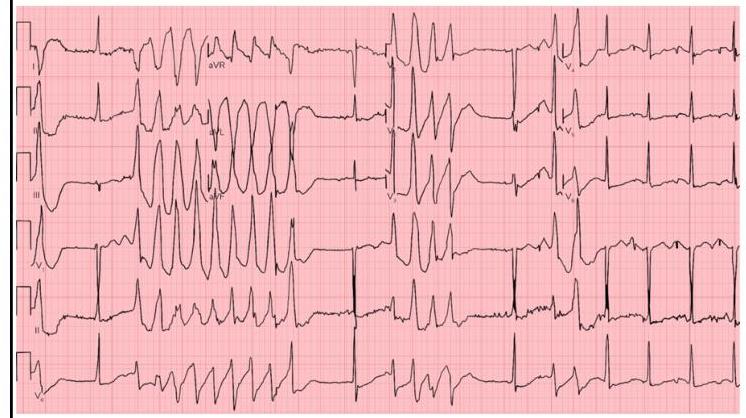
Q953
Four days after admission to the hospital for anorexia nervosa, a 20-year-old woman has new-onset palpitations and paresthesias in all four limbs. Prior to admission, she was found unconscious by her parents on the floor of a residential treatment center. The patient was started on a trial of nutritional rehabilitation upon arrival to the hospital. Her temperature is 36°C (96.8°F), pulse is 47/min, and blood pressure is 90/60 mmHg. She is 160 cm tall and weighs 35 kg; BMI is 14 kg/m2. The patient appears emaciated. Examination shows lower leg edema. A 2/6 holosystolic murmur is heard over the 5th intercostal space at the midclavicular line. An ECG shows intermittent supraventricular tachycardia and QTc prolongation. Serum studies show:
Day 2 Day 4
Potassium (mEq/L) 3.5 2.7
Calcium (mg/dL) 8.5 7.8
Magnesium (mEq/L) 1.2 0.5
Phosphorus (mg/dL) 3.6 1.5
Which of the following is the most likely underlying cause of this patient's condition?
Q954
A 23-year-old patient with a past medical history of anxiety and appropriately treated schizophrenia presents to the emergency department for a first time seizure. The patient was at home eating dinner when he began moving abnormally and did not respond to his mother, prompting her to bring him in. His symptoms persisted in the emergency department and were successfully treated with diazepam. The patient is discharged and scheduled for a follow up appointment with neurology the next day for treatment. The patient returns to his neurologist 1 month later for a checkup. Physical exam is notable for carpopedal spasm when his blood pressure is being taken. Cranial nerves II-XII are grossly intact and his gait is stable. Which of the following is the most likely explanation of this patient's current presentation?
Q955
A 72-year-old man presents to his primary care provider to discuss the frequency with which he wakes up at night to urinate. He avoids drinking liquids at night, but the symptoms have progressively worsened. The medical history is significant for hypertension and hyperlipidemia. He takes lisinopril, atorvastatin, and a multivitamin every day. Today, the vital signs include: blood pressure 120/80 mm Hg, heart rate 90/min, respiratory rate 17/min, and temperature 37.0°C (98.6°F). On physical examination, he appears tired. The heart has a regular rate and rhythm and the lungs are clear to auscultation bilaterally. A bedside bladder ultrasound reveals a full bladder. A digital rectal exam reveals an enlarged and symmetric prostate free of nodules, that is consistent with benign prostatic enlargement. He also has a history of symptomatic hypotension with several episodes of syncope in the past. The patient declines a prostate biopsy that would provide a definitive diagnosis and requests less invasive treatment. Which of the following is recommended to treat this patient’s enlarged prostate?
Q956
A 53-year-old woman comes to the physician for a follow-up examination. One month ago, she was diagnosed with carcinoma of the left breast. She underwent a lumpectomy for a 2.1-cm mass and sentinel lymph node biopsy 2 weeks ago. The biopsy of the breast mass showed margin-free invasive ductal carcinoma; immunohistochemistry showed the carcinoma is estrogen-receptor and progesterone-receptor negative, and HER2-receptor positive. The lymph node biopsy was negative for metastases. Examination shows a healing surgical incision over the left breast. There is no palpable axillary lymphadenopathy. Her physician decides to initiate treatment with appropriate pharmacotherapy. Which of the following is the most appropriate next step in management?
Q957
Several patients at a local US hospital present with chronic secretory diarrhea. Although there are multiple potential causes of diarrhea present in these patients, which of the following is most likely the common cause of their chronic secretory diarrhea?
Q958
A 71-year-old man presents to the clinic with complaints of right wrist pain for 2 days. On examination, redness and swelling were noted on the dorsal aspect of his right wrist. He had pain with extreme range of motion of the wrist. His history includes 2 hip replacements, 2 previous episodes of gout in both first metatarsophalangeal joints, and hypertension. Two days later, the swelling had increased in the dorsal aspect of his right wrist and hand. Wrist flexion was limited to 80% with severe pain. The pain was present on palpation of the scaphoid bone. Due to the suspicion of fracture, the patient was referred to his general practitioner for radiographs. These findings were consistent with gouty arthritis. What is the most likely cytokine involved in this process?
Q959
A 23-year-old man comes to the physician because of recurrent episodes of chest pain, shortness of breath, palpitations, and a sensation of choking. The symptoms usually resolve with deep breathing exercises after about 5 minutes. He now avoids going to his graduate school classes because he is worried about having another episode. Physical examination is unremarkable. Treatment with lorazepam is initiated. The concurrent intake of which of the following drugs should be avoided in this patient?
Q960
A researcher is studying how arachidonic acid metabolites mediate the inflammatory response in rats. She has developed multiple enzyme inhibitors that specifically target individual proteins in the arachidonic acid pathway. She injects these inhibitors in rats who have been exposed to common bacterial pathogens and analyzes their downstream effects. In one of her experiments, she injects a leukotriene B4 inhibitor into a rat and observes an abnormal cell response. Which of the following interleukins would most closely restore the function of one of the missing products?
Autonomic/CV Drugs US Medical PG Practice Questions and MCQs
Question 951: A hospitalized 70-year-old woman, who recently underwent orthopedic surgery, develops severe thrombocytopenia of 40,000/mm3 during her 7th day of hospitalization. She has no other symptoms and has no relevant medical history. All of the appropriate post-surgery prophylactic measures had been taken. Her labs from the 7th day of hospitalization are shown here:
The complete blood count results are as follows:
Hemoglobin 13 g/dL
Hematocrit 38%
Leukocyte count 8,000/mm3
Neutrophils 54%
Bands 3%
Eosinophils 1%
Basophils 0%
Lymphocytes 33%
Monocytes 7%
Platelet count 40,000/mm3
The coagulation tests are as follows:
Partial thromboplastin time (activated) 85 seconds
Prothrombin time 63 seconds
Reticulocyte count 1.2%
Thrombin time < 2 seconds deviation from control
The lab results from previous days were within normal limits. What is the most likely cause of the thrombocytopenia?
A. Thrombotic microangiopathy
B. Myelodysplasia
C. DIC
D. Heparin-induced thrombocytopenia (Correct Answer)
E. Immune thrombocytopenia
Explanation: **Heparin-induced thrombocytopenia**
- The development of **severe thrombocytopenia** (platelet count 40,000/mm3) between **days 5 and 10 of heparin therapy** (day 7 in this case, post-surgery implying heparin prophylaxis) is highly characteristic of **HIT**.
- **Prolonged PTT and PT** are seen due to **heparin's effect** on coagulation, even in the setting of HIT, and **thrombotic events** (though not explicitly stated as occurring, the risk is high) are a hallmark.
*Thrombotic microangiopathy*
- This condition typically presents with **microangiopathic hemolytic anemia** (fragmented red blood cells/schistocytes on blood smear) and **renal dysfunction**, none of which are mentioned here.
- Although it causes thrombocytopenia, the absence of **hemolysis** and **renal involvement** makes it less likely.
*Myelodysplasia*
- This is a bone marrow disorder causing **cytopenias** (low blood cell counts) in one or more cell lines, but it is a **chronic condition** that would not typically manifest acutely on the 7th day of hospitalization like this.
- It doesn't explain the **sudden drop in platelets** in the context of recent surgery and likely heparin exposure.
*DIC*
- **Disseminated intravascular coagulation** usually involves significant **consumption of clotting factors** and platelets, leading to both **bleeding and thrombosis**.
- While it causes thrombocytopenia and prolonged PT/PTT, the **absence of severe bleeding** or overwhelming sepsis/trauma, and the **isolated nature of the thrombocytopenia** (no significant drop in other cell lines or evidence of severe organ dysfunction), make it less likely than HIT in this context. The **normal thrombin time** is also atypical for DIC.
*Immune thrombocytopenia*
- **Immune thrombocytopenia (ITP)** is a diagnosis of exclusion and typically presents with **bleeding manifestations** and can be **acute or chronic**.
- While it causes isolated thrombocytopenia, the **timing of onset 7 days post-surgery and probable heparin exposure** makes HIT a much more specific and common diagnosis in this clinical scenario.
Question 952: A 53-year-old man with obesity and heart disease presents to your outpatient clinic with complaints of orthopnea, significant dyspnea on minimal exertion, nausea, vomiting, and diarrhea. He says that his old doctor gave him "some pills" that he takes in varying amounts every morning. Physical exam is significant for a severely displaced point of maximal impulse, bilateral rales in the lower lung fields, an S3 gallop, and hepatomegaly. You decide to perform an EKG (shown in figure A). Suddenly, his rhythm changes to ventricular tachycardia followed by ventricular fibrillation, and he syncopizes and expires despite resuscitative efforts. High levels of which medication are most likely responsible?
A. Propranolol
B. Amiodarone
C. Lidocaine
D. Verapamil
E. Digoxin (Correct Answer)
Explanation: ***Digoxin***
- The patient's presentation with **heart failure** symptoms (dyspnea, orthopnea, rales, S3 gallop, hepatomegaly) and erratic self-dosing of "some pills" strongly suggests **digoxin toxicity**.
- **Gastrointestinal symptoms** (nausea, vomiting, diarrhea) are common initial signs of digoxin toxicity, and the progression to **ventricular tachycardia** and **ventricular fibrillation** is consistent with severe digitalis-induced arrhythmia.
*Propranolol*
- This is a **beta-blocker** primarily used for hypertension, angina, and arrhythmias.
- While overdose can cause bradycardia, hypotension, and heart block, it typically does not lead to **ventricular tachycardia or fibrillation** as seen in this case.
*Amiodarone*
- This is a **Class III antiarrhythmic** medication with a long half-life, used for various tachyarrhythmias.
- Though it can cause many side effects, including proarrhythmia, it is less likely to present with the classic **GI symptoms** and rapid progression to fatal ventricular arrhythmias seen here, especially in the context of erratic self-dosing and underlying heart failure.
*Lidocaine*
- This is a **Class IB antiarrhythmic** primarily used for ventricular arrhythmias, especially post-myocardial infarction.
- Toxicity typically manifests as **neurological symptoms** (drowsiness, confusion, seizures) and sometimes hypotension or bradycardia, not the wide range of GI and lethal cardiac arrhythmias described.
*Verapamil*
- This is a **calcium channel blocker** used for hypertension, angina, and supraventricular tachycardias.
- Overdose primarily causes **bradycardia, hypotension, and atrioventricular block**, but it is generally not associated with the pronounced GI symptoms or directly triggering ventricular tachycardia/fibrillation like digoxin toxicity.
Question 953: Four days after admission to the hospital for anorexia nervosa, a 20-year-old woman has new-onset palpitations and paresthesias in all four limbs. Prior to admission, she was found unconscious by her parents on the floor of a residential treatment center. The patient was started on a trial of nutritional rehabilitation upon arrival to the hospital. Her temperature is 36°C (96.8°F), pulse is 47/min, and blood pressure is 90/60 mmHg. She is 160 cm tall and weighs 35 kg; BMI is 14 kg/m2. The patient appears emaciated. Examination shows lower leg edema. A 2/6 holosystolic murmur is heard over the 5th intercostal space at the midclavicular line. An ECG shows intermittent supraventricular tachycardia and QTc prolongation. Serum studies show:
Day 2 Day 4
Potassium (mEq/L) 3.5 2.7
Calcium (mg/dL) 8.5 7.8
Magnesium (mEq/L) 1.2 0.5
Phosphorus (mg/dL) 3.6 1.5
Which of the following is the most likely underlying cause of this patient's condition?
A. Uncompensated metabolic alkalosis
B. Thiamine deficiency
C. Euthyroid sick syndrome
D. Rapid gastric emptying
E. Increased insulin release (Correct Answer)
Explanation: ***Increased insulin release***
- **Refeeding syndrome** is triggered by a sudden increase in carbohydrate intake after a period of starvation, leading to an abrupt rise in **insulin secretion**.
- Insulin shifts **potassium, phosphate, and magnesium** into cells, causing rapid and severe **hypokalemia, hypophosphatemia, and hypomagnesemia**, which manifest as cardiac arrhythmias, neurological symptoms (paresthesias), and muscle weakness.
*Uncompensated metabolic alkalosis*
- While metabolic alkalosis can occur in anorexia nervosa due to **vomiting**, it typically causes hypokalemia, not the widespread electrolyte derangements seen here.
- It does not directly explain the acute drop in **phosphate and magnesium** or the onset of refeeding syndrome symptoms.
*Thiamine deficiency*
- **Thiamine deficiency** can occur in malnourished patients and lead to Wernicke encephalopathy or Korsakoff syndrome, but it typically presents with ocular abnormalities, ataxia, and confusion, not primarily with the acute cardiac and electrolyte disturbances observed.
- While important for metabolism, it is not the **primary driver** of the acute electrolyte shifts characteristic of refeeding syndrome.
*Euthyroid sick syndrome*
- Characterized by **abnormal thyroid function tests** in a severely ill patient without primary thyroid disease, reflecting altered peripheral thyroid hormone metabolism.
- It does not directly cause the acute and severe **electrolyte abnormalities** (hypokalemia, hypophosphatemia, hypomagnesemia) or the specific clinical presentation of refeeding syndrome.
*Rapid gastric emptying*
- While rapid gastric emptying can be a feature in some eating disorders, it directly leads to symptoms like **dumping syndrome** (abdominal pain, diarrhea).
- It does not explain the profound **intracellular shift of electrolytes** and the resulting cardiac and neurological symptoms seen in this case.
Question 954: A 23-year-old patient with a past medical history of anxiety and appropriately treated schizophrenia presents to the emergency department for a first time seizure. The patient was at home eating dinner when he began moving abnormally and did not respond to his mother, prompting her to bring him in. His symptoms persisted in the emergency department and were successfully treated with diazepam. The patient is discharged and scheduled for a follow up appointment with neurology the next day for treatment. The patient returns to his neurologist 1 month later for a checkup. Physical exam is notable for carpopedal spasm when his blood pressure is being taken. Cranial nerves II-XII are grossly intact and his gait is stable. Which of the following is the most likely explanation of this patient's current presentation?
A. Sub-therapeutic dose
B. Acute renal failure
C. Elevated blood levels of a medication
D. P450 induction (Correct Answer)
E. Increased water consumption
Explanation: ***P450 induction***
- The described carpopedal spasm when checking blood pressure (**Trousseau's sign**) is indicative of **hypocalcemia**.
- Many antiepileptic drugs (AEDs) can induce **CYP450 enzymes**, leading to increased metabolism of vitamin D and subsequent **hypocalcemia**.
*Sub-therapeutic dose*
- A sub-therapeutic dose of a seizure medication would likely result in **poor seizure control**, not the specific physical exam findings of hypocalcemia.
- The patient's initial seizure was treated, suggesting the medication had an effect, and the current symptoms are distinct from seizure activity.
*Acute renal failure*
- **Acute renal failure** can cause hypocalcemia due to impaired vitamin D activation and phosphate retention, but there is no information in the vignette to suggest kidney dysfunction.
- The physical exam findings are primarily suggestive of hypocalcemia, and renal failure would typically present with other systemic symptoms.
*Elevated blood levels of a medication*
- Elevated blood levels of antiepileptic medications usually cause **toxic effects** such as ataxia, nystagmus, or somnolence, not carpopedal spasms secondary to hypocalcemia.
- While some medications can indirectly affect calcium, the primary presentation of toxicity is different.
*Increased water consumption*
- Increased water consumption can lead to **hyponatremia**, but it does not directly cause hypocalcemia or the characteristic carpopedal spasms.
- The symptoms described are not consistent with water intoxication.
Question 955: A 72-year-old man presents to his primary care provider to discuss the frequency with which he wakes up at night to urinate. He avoids drinking liquids at night, but the symptoms have progressively worsened. The medical history is significant for hypertension and hyperlipidemia. He takes lisinopril, atorvastatin, and a multivitamin every day. Today, the vital signs include: blood pressure 120/80 mm Hg, heart rate 90/min, respiratory rate 17/min, and temperature 37.0°C (98.6°F). On physical examination, he appears tired. The heart has a regular rate and rhythm and the lungs are clear to auscultation bilaterally. A bedside bladder ultrasound reveals a full bladder. A digital rectal exam reveals an enlarged and symmetric prostate free of nodules, that is consistent with benign prostatic enlargement. He also has a history of symptomatic hypotension with several episodes of syncope in the past. The patient declines a prostate biopsy that would provide a definitive diagnosis and requests less invasive treatment. Which of the following is recommended to treat this patient’s enlarged prostate?
A. Tadalafil
B. Finasteride (Correct Answer)
C. Tamsulosin
D. Prazosin
E. Leuprolide
Explanation: ***Finasteride***
- This patient's symptoms of **nocturia** and an **enlarged, symmetric prostate** on DRE are classic for **benign prostatic hyperplasia (BPH)**. Finasteride is a **5-alpha reductase inhibitor** that reduces prostate volume by blocking the conversion of testosterone to dihydrotestosterone.
- Given the patient's history of **symptomatic hypotension** and preference for less invasive treatment, finasteride is a suitable choice as it has a lower risk of exacerbating hypotension compared to alpha-blockers.
*Tadalafil*
- While tadalafil is approved for BPH with erectile dysfunction, its primary mechanism involves **vasodilation**, which could worsen the patient's existing **symptomatic hypotension**.
- It does not directly reduce prostate size, which is a key component of long-term BPH management, especially in a patient with a significantly enlarged prostate.
*Tamsulosin*
- Tamsulosin is an **alpha-1 adrenergic blocker** that relaxes smooth muscle in the prostate and bladder neck, improving urine flow. However, it can cause **hypotension** and **syncope**, which would be contraindicated in this patient with a history of symptomatic hypotension.
- While effective for BPH symptoms, the risk of worsening his cardiovascular stability makes it a less favorable option given his medical history.
*Prazosin*
- Prazosin is another **alpha-1 adrenergic blocker** that can be used for BPH. However, it has a significant risk of **first-dose hypotension** and orthostatic hypotension, which would be highly problematic for this patient with a history of symptomatic hypotension and syncope.
- Due to its potent hypotensive effects, prazosin is generally not preferred for BPH, especially in older patients or those with cardiovascular instability.
*Leuprolide*
- Leuprolide is a **GnRH agonist** primarily used in the treatment of **prostate cancer** to reduce testosterone levels. It would effectively reduce prostate size but is an aggressive treatment with significant side effects (e.g., hot flashes, decreased libido, bone density loss) not typically used for benign prostatic hyperplasia.
- It is not indicated for the management of BPH and would be considered overtreatment for this patient's condition, especially given his desire for less aggressive management.
Question 956: A 53-year-old woman comes to the physician for a follow-up examination. One month ago, she was diagnosed with carcinoma of the left breast. She underwent a lumpectomy for a 2.1-cm mass and sentinel lymph node biopsy 2 weeks ago. The biopsy of the breast mass showed margin-free invasive ductal carcinoma; immunohistochemistry showed the carcinoma is estrogen-receptor and progesterone-receptor negative, and HER2-receptor positive. The lymph node biopsy was negative for metastases. Examination shows a healing surgical incision over the left breast. There is no palpable axillary lymphadenopathy. Her physician decides to initiate treatment with appropriate pharmacotherapy. Which of the following is the most appropriate next step in management?
A. Dual energy x-ray absorptiometry scan
B. Endometrial biopsy
C. X-ray of the chest
D. Fundoscopy
E. Echocardiography (Correct Answer)
Explanation: ***Echocardiography***
- This patient has **HER2-positive breast cancer**, for which **trastuzumab** a cardiotoxic drug, is often prescribed.
- An **echocardiogram** is necessary to assess baseline cardiac function and monitor for **cardiotoxicity** before and during trastuzumab treatment.
*Dual energy x-ray absorptiometry scan*
- A **DEXA scan** is used to assess **bone density**, typically for patients at risk of or with **osteoporosis**.
- While relevant for some breast cancer treatments that induce early menopause, it is not the immediate priority for a patient about to start **HER2-targeted therapy**.
*Endometrial biopsy*
- **Endometrial biopsy** is indicated for patients using **tamoxifen**, an anti-estrogen drug, to monitor for potential **endometrial hyperplasia** or **carcinoma**.
- This patient's cancer is **estrogen receptor negative**, so tamoxifen is not appropriate, making an endometrial biopsy unindicated.
*X-ray of the chest*
- A **chest X-ray** might be considered in the context of staging for metastatic disease or for evaluation of respiratory symptoms.
- Given the negative lymph node biopsy and early-stage presentation, it is not the most urgent or critical next step compared to assessing for **drug-related cardiotoxicity**.
*Fundoscopy*
- **Fundoscopy** is an examination of the **retina** and optic nerve, primarily used to assess for conditions like **diabetic retinopathy**, **hypertensive retinopathy**, or papilledema.
- It is not a standard assessment required before initiating treatment for newly diagnosed breast cancer or specifically for **HER2-positive breast cancer**.
Question 957: Several patients at a local US hospital present with chronic secretory diarrhea. Although there are multiple potential causes of diarrhea present in these patients, which of the following is most likely the common cause of their chronic secretory diarrhea?
A. Crohn’s disease with ileitis
B. Carcinoid tumor
C. Lactose intolerance
D. Medications (Correct Answer)
E. Lymphocytic colitis
Explanation: ***Medications***
**Medication-induced diarrhea** is the most common cause of chronic secretory diarrhea in hospitalized patients. Many drugs can cause secretory diarrhea through various mechanisms, including:
- **Antibiotics** (disrupting gut microbiome)
- **Metformin** (altering intestinal glucose metabolism)
- **SSRIs** (increasing serotonin effects on gut)
- **Colchicine, chemotherapy agents, proton pump inhibitors**
The question implies a "common" cause affecting "several patients" in a hospital setting, making medications the most plausible general cause rather than rare tumors or specific inflammatory conditions.
*Crohn's disease with ileitis*
While Crohn's disease causes chronic diarrhea, it primarily causes **inflammatory diarrhea** (often with malabsorption features), not secretory diarrhea. Although common among inflammatory bowel diseases, it's less likely to be the *most common* cause of secretory diarrhea across multiple patients in a general hospital setting compared to medication effects.
*Carcinoid tumor*
Carcinoid tumors can cause secretory diarrhea through release of **serotonin and vasoactive substances** (carcinoid syndrome). However, these are **rare neuroendocrine tumors**, making them unlikely to be the most common cause among several patients presenting with chronic secretory diarrhea.
*Lactose intolerance*
Lactose intolerance causes **osmotic diarrhea**, NOT secretory diarrhea. It results from malabsorption of lactose, which draws water into the colon. **Key distinction**: Osmotic diarrhea resolves with fasting, whereas secretory diarrhea persists during fasting.
*Lymphocytic colitis*
Lymphocytic colitis (a microscopic colitis) causes chronic watery diarrhea that can be secretory due to inflammation-induced altered ion transport. However, it is **less common** than medication-induced diarrhea and doesn't fit the description of the most common cause affecting several patients in a hospital setting.
Question 958: A 71-year-old man presents to the clinic with complaints of right wrist pain for 2 days. On examination, redness and swelling were noted on the dorsal aspect of his right wrist. He had pain with extreme range of motion of the wrist. His history includes 2 hip replacements, 2 previous episodes of gout in both first metatarsophalangeal joints, and hypertension. Two days later, the swelling had increased in the dorsal aspect of his right wrist and hand. Wrist flexion was limited to 80% with severe pain. The pain was present on palpation of the scaphoid bone. Due to the suspicion of fracture, the patient was referred to his general practitioner for radiographs. These findings were consistent with gouty arthritis. What is the most likely cytokine involved in this process?
A. INFγ
B. IL-4
C. IL-10
D. IL-5
E. IL-1 (Correct Answer)
Explanation: ***IL-1***
- Interleukin-1 (IL-1) is a crucial **pro-inflammatory cytokine** highly implicated in the pathogenesis of gout. **Monosodium urate (MSU) crystals** activate the **NLRP3 inflammasome**, leading to the production of active IL-1β, which drives the inflammatory response seen in acute gout.
- The symptoms of acute gout, including severe pain, redness, and swelling, are largely mediated by IL-1, as evidenced by the effectiveness of **IL-1 inhibitors** in treating acute gout attacks.
*INFγ*
- **Interferon-gamma (IFN-γ)** is primarily associated with **Th1-mediated immune responses** and cellular immunity, often involved in antiviral and anti-tumor responses.
- While it has immunomodulatory effects, it is not the primary cytokine driving the acute inflammatory response in gout.
*IL-4*
- **Interleukin-4 (IL-4)** is a key cytokine in **Th2-mediated immune responses**, promoting **B cell activation** and **IgE production**, and is primarily involved in allergic reactions and anti-parasitic immunity.
- IL-4 generally has **anti-inflammatory effects** regarding acute crystal-induced inflammation and would not be the main driver of the symptoms described.
*IL-10*
- **Interleukin-10 (IL-10)** is a potent **anti-inflammatory cytokine** that plays a critical role in limiting the immune response and preventing tissue damage.
- IL-10 would actively suppress the inflammation seen in gout, rather than contribute to it.
*IL-5*
- **Interleukin-5 (IL-5)** is primarily involved in the growth and differentiation of **eosinophils** and is important in **allergic reactions** and defense against parasites.
- It does not play a significant role in the acute inflammatory cascade triggered by MSU crystals in gout.
Question 959: A 23-year-old man comes to the physician because of recurrent episodes of chest pain, shortness of breath, palpitations, and a sensation of choking. The symptoms usually resolve with deep breathing exercises after about 5 minutes. He now avoids going to his graduate school classes because he is worried about having another episode. Physical examination is unremarkable. Treatment with lorazepam is initiated. The concurrent intake of which of the following drugs should be avoided in this patient?
A. Phenelzine
B. Ondansetron
C. Fluoxetine
D. Diphenhydramine (Correct Answer)
E. Naloxone
Explanation: ***Diphenhydramine***
- Diphenhydramine is an **antihistamine** with significant **sedative properties**, which can exacerbate the central nervous system (CNS) depression caused by lorazepam.
- Combining these two medications can lead to excessive drowsiness, confusion, respiratory depression, and increased risk of falls.
*Phenelzine*
- Phenelzine is a **monoamine oxidase inhibitor (MAOI)** and its primary interaction concern is with tyramine-rich foods or other serotonergic drugs, potentially leading to **hypertensive crisis** or **serotonin syndrome**.
- There is no direct significant interaction with lorazepam that would necessitate avoidance, as **benzodiazepines are generally safe** to use with MAOIs.
*Ondansetron*
- Ondansetron is a **5-HT3 receptor antagonist** used as an antiemetic, and its main side effects are headache, constipation, and QT prolongation.
- It does not significantly interact with lorazepam to cause adverse effects or necessitate avoidance.
*Fluoxetine*
- Fluoxetine is a **selective serotonin reuptake inhibitor (SSRI)** often used to treat anxiety disorders, and it can be safely co-administered with benzodiazepines like lorazepam.
- While there is a theoretical risk of **serotonin syndrome** if combined with other serotonergic agents, this is not a common or significant interaction with lorazepam, which does not directly affect serotonin levels.
*Naloxone*
- Naloxone is an **opioid antagonist** used to reverse opioid overdose, and it has no direct interaction with benzodiazepines like lorazepam.
- Lorazepam does not act on opioid receptors, so naloxone would not reverse its effects or cause adverse interactions.
Question 960: A researcher is studying how arachidonic acid metabolites mediate the inflammatory response in rats. She has developed multiple enzyme inhibitors that specifically target individual proteins in the arachidonic acid pathway. She injects these inhibitors in rats who have been exposed to common bacterial pathogens and analyzes their downstream effects. In one of her experiments, she injects a leukotriene B4 inhibitor into a rat and observes an abnormal cell response. Which of the following interleukins would most closely restore the function of one of the missing products?
A. Interleukin 2
B. Interleukin 4
C. Interleukin 1
D. Interleukin 5
E. Interleukin 8 (Correct Answer)
Explanation: ***Interleukin 8***
- **Leukotriene B4 (LTB4)** is a potent **chemoattractant** and activator of neutrophils.
- **Interleukin 8 (IL-8)**, also known as **CXCL8**, is a primary **chemoattractant** for neutrophils, functionally mimicking the role of LTB4 in recruiting these inflammatory cells to the site of infection.
*Interleukin 2*
- **IL-2** is primarily involved in the **growth, proliferation, and differentiation of T cells**, as well as the activation of B cells and natural killer cells.
- It does not have a significant role in **neutrophil chemotaxis**, which is the main function of LTB4.
*Interleukin 4*
- **IL-4** is crucial for **B cell activation** and class switching to IgE, and it's a key cytokine in the **Th2 immune response**.
- Its functions are related to **allergic reactions** and **parasitic infections**, not neutrophil recruitment.
*Interleukin 1*
- **IL-1** is a pro-inflammatory cytokine that mediates a wide range of immune responses, including **fever** and the activation of other immune cells.
- While it contributes to inflammation, it does not directly act as a **chemoattractant for neutrophils** in the same manner as LTB4 or IL-8.
*Interleukin 5*
- **IL-5** is primarily involved in the **growth and differentiation of eosinophils** and B cell IgA production.
- It plays a significant role in **allergic reactions** and defense against parasites, not neutrophil chemotaxis.