A 26-year-old healthy woman presents with lightheadedness, palpitations, and sweating, which started suddenly after she was frightened by her neighbor’s dog. The patient’s blood pressure is 135/80 mm Hg, the heart rate is 150/min, the respiratory rate is 15/min, and the temperature is 36.6℃ (97.9℉). Her ECG is shown in the exhibit. What is the preferred agent for pharmacologic management of this condition?
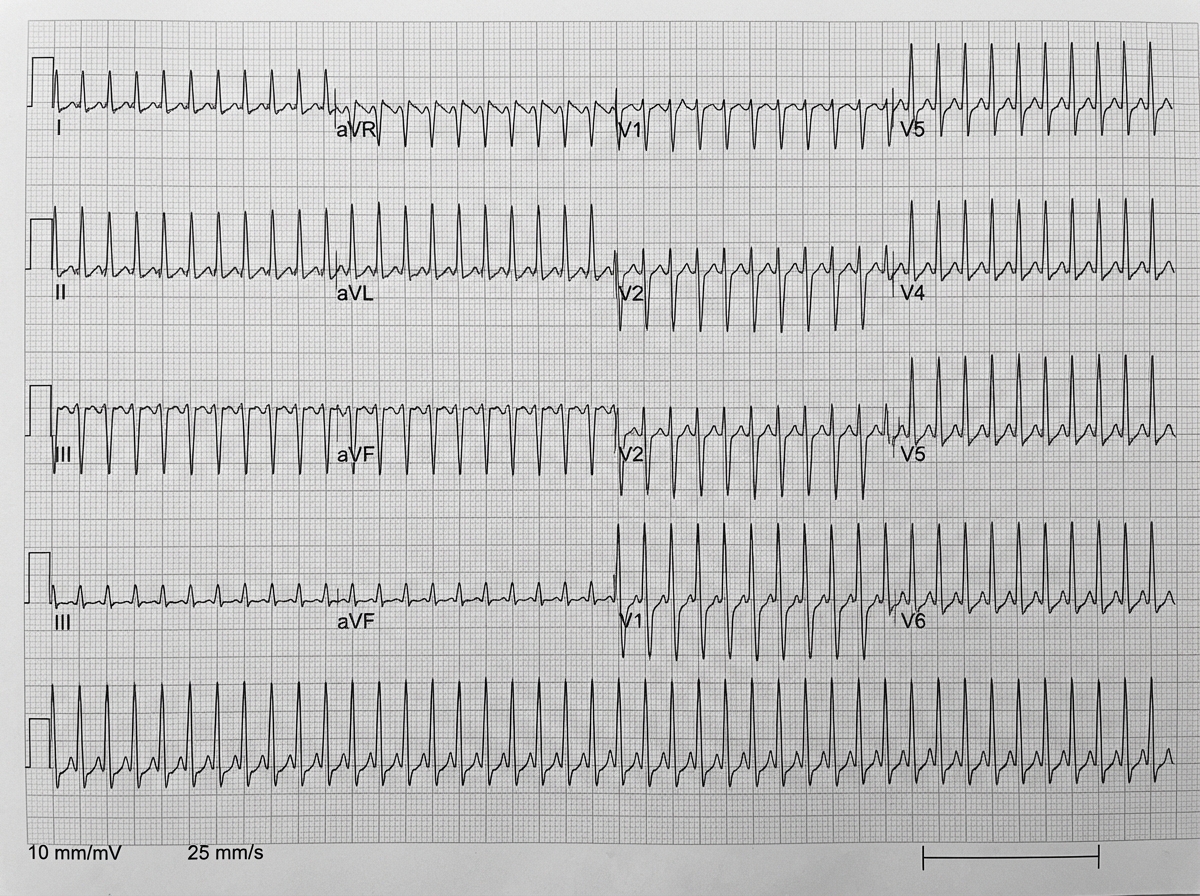
Q892
A 26-year-old woman comes to the emergency room because she had difficulty breathing during an exercise session. She also has a cough and end-expiratory wheezing. Besides these symptoms, she has a normal physical appearance. She has experienced similar breathing problems during exercise in the past, but never during rest. She is afebrile. What is the best treatment in this case?
Q893
Two days after hospitalization for urgent chemotherapy to treat Burkitt’s lymphoma, a 7-year-old boy develops dyspnea and reduced urine output. He also feels a tingling sensation in his fingers and toes. Blood pressure is 100/65 mm Hg, respirations are 28/min, pulse is 100/min, and temperature is 36.2°C (97.2°F). The lungs are clear to auscultation. He has excreted 20 mL of urine in the last 6 hours. Laboratory studies show:
Hemoglobin 15 g/dL
Leukocyte count 6,000/mm3 with a normal differential serum
K+ 6.5 mEq/L
Ca+ 7.6 mg/dL
Phosphorus 5.4 mg/dL
HCO3− 15 mEq/L
Uric acid 12 mg/dL
Urea nitrogen 44 mg/dL
Creatinine 2.4 mg/dL
Arterial blood gas analysis on room air:
pH 7.30
PCO2 30 mm Hg
O2 saturation 95%
Which of the following is most likely to have prevented this patient’s condition?
Q894
A 21-year-old G1P0 woman presents to the labor and delivery ward at 39 weeks gestation for elective induction of labor. She requests a labor epidural. An epidural catheter is secured at the L4-L5 space. She exhibits no hemodynamic reaction to lidocaine 1.5% with epinephrine 1:200,000. A continuous infusion of bupivacaine 0.0625% is started. After 5 minutes, the nurse informs the anesthesiologist that the patient is hypotensive to 80/50 mmHg with a heart rate increase from 90 bpm to 120 bpm. The patient is asymptomatic and fetal heart rate has not changed significantly from baseline. She says that her legs feel heavy but is still able to move them. What is the most likely cause of the hemodynamic change?
Q895
A 25-year-old man presents to the emergency department with a severe pulsatile headache for an hour. He says that he is having palpitations as well. He adds that he has had several episodes of headache in the past which resolved without seeking medical attention. He is a non-smoker and does not drink alcohol. He denies use of any illicit drugs. He looks scared and anxious. His temperature is 37°C (98.6°F), respirations are 25/min, pulse is 107/min, and blood pressure is 221/161 mm Hg. An urgent urinalysis reveals elevated plasma metanephrines. What is the next best step in the management of this patient?
Q896
An investigator is comparing the risk of adverse effects among various antiarrhythmic medications. One of the drugs being studied primarily acts by blocking the outward flow of K+ during myocyte repolarization. Further investigation shows that the use of this drug is associated with a lower rate of ventricular tachycardia, ventricular fibrillation, and torsades de pointes when compared to similar drugs. Which of the following drugs is most likely being studied?
Q897
A 38-year-old man presents to his primary care provider for abdominal pain. He reports that he has had a dull, burning pain for several months that has progressively gotten worse. He also notes a weight loss of about five pounds over that time frame. The patient endorses nausea and feels that the pain is worse after meals, but he denies any vomiting or diarrhea. He has a past medical history of hypertension, and he reports that he has been under an unusual amount of stress since losing his job as a construction worker. His home medications include enalapril and daily ibuprofen, which he takes for lower back pain he developed at his job. The patient drinks 1-2 beers with dinner and has a 25-pack-year smoking history. His family history is significant for colorectal cancer in his father and leukemia in his grandmother. On physical exam, the patient is moderately tender to palpation in the epigastrium. A fecal occult test is positive for blood in the stool.
Which of the following in the patient’s history is most likely causing this condition?
Q898
A 26-year-old man being treated for major depressive disorder returns to his psychiatrist complaining that he has grown weary of the sexual side effects. Which other medication used to treat major depressive disorder may be appropriate as a stand-alone or add-on therapy?
Q899
A 44-year-old man presents for a checkup. The patient says he has to urinate quite frequently but denies any dysuria or pain on urination. Past medical history is significant for diabetes mellitus type 2 and hypertension, both managed medically, as well as a chronic mild cough for the past several years. Current medications are metformin, aspirin, rosuvastatin, captopril, and furosemide. His vital signs are an irregular pulse of 74/min, a respiratory rate of 14/min, a blood pressure of 130/80 mm Hg, and a temperature of 36.7°C (98.0°F). His BMI is 32 kg/m2. On physical examination, there are visible jugular pulsations present in the neck bilaterally. Laboratory findings are significant for the following:
Glycated Hemoglobin (Hb A1c) 7.5%
Fasting Blood Glucose 120 mg/dL
Serum Electrolytes
Sodium 138 mEq/L
Potassium 3.9 mEq/L
Chloride 101 mEq/L
Serum Creatinine 1.3 mg/dL
Blood Urea Nitrogen 18 mg/dL
Which of the following is the next best step in the management of this patient?
Q900
A 25-year-old male is brought into the emergency department by emergency medical services. The patient has a history of bipolar disease complicated by polysubstance use. He was found down in his apartment at the bottom of a staircase lying on his left arm. He was last seen several hours earlier by his roommate. He is disoriented and unable to answer any questions, but is breathing on his own. His vitals are HR 55, T 96.5, RR 18, BP 110/75. You decide to obtain an EKG as shown in Figure 1. What is the next best step in the treatment of this patient?
Autonomic/CV Drugs US Medical PG Practice Questions and MCQs
Question 891: A 26-year-old healthy woman presents with lightheadedness, palpitations, and sweating, which started suddenly after she was frightened by her neighbor’s dog. The patient’s blood pressure is 135/80 mm Hg, the heart rate is 150/min, the respiratory rate is 15/min, and the temperature is 36.6℃ (97.9℉). Her ECG is shown in the exhibit. What is the preferred agent for pharmacologic management of this condition?
A. Metoprolol
B. Amiodarone
C. Propafenone
D. Adenosine (Correct Answer)
E. Verapamil
Explanation: ***Adenosine***
- The ECG shows a **narrow complex tachycardia** with a regular rhythm and no visible P waves, consistent with **paroxysmal supraventricular tachycardia (PSVT)**, likely AVNRT.
- **Adenosine** is the preferred agent for acute termination of stable PSVT due to its ability to transiently block the **AV node**.
*Metoprolol*
- **Beta-blockers** like metoprolol can be used for rate control or prevention of PSVT, but they are not the first-line agent for acute termination due to a slower onset of action compared to adenosine.
- While metoprolol can reduce heart rate, its efficacy in acutely converting PSVT to sinus rhythm is less predictable than adenosine's.
*Amiodarone*
- **Amiodarone** is primarily used for the treatment of **ventricular arrhythmias** and certain types of refractory supraventricular tachycardias, but it is not the first-line treatment for stable PSVT.
- Its use for PSVT is generally reserved for cases unresponsive to adenosine or other first-line agents, or in patients with structural heart disease, due to its significant side effect profile and slower onset.
*Propafenone*
- **Propafenone** is a Class Ic antiarrhythmic drug used for the maintenance of sinus rhythm in patients with atrial fibrillation or flutter, and for some supraventricular tachycardias.
- It is not typically the first-line agent for acute termination of stable PSVT due to its proarrhythmic potential and slower onset of action compared to adenosine.
*Verapamil*
- **Verapamil**, a non-dihydropyridine calcium channel blocker, is an alternative to adenosine for acute termination of PSVT, especially in patients where adenosine is contraindicated or ineffective.
- However, adenosine is generally preferred as the first-line agent for hemodynamically stable PSVT due to its very rapid onset and short duration of action.
Question 892: A 26-year-old woman comes to the emergency room because she had difficulty breathing during an exercise session. She also has a cough and end-expiratory wheezing. Besides these symptoms, she has a normal physical appearance. She has experienced similar breathing problems during exercise in the past, but never during rest. She is afebrile. What is the best treatment in this case?
A. Systemic corticosteroids
B. No therapy, only avoidance of exercise
C. Short acting β2-agonists (Correct Answer)
D. Aminophylline
E. Long acting β2-agonists
Explanation: ***Short acting β2-agonists***
- The patient presents with classic symptoms of **exercise-induced bronchoconstriction (EIB)**, including dyspnea, cough, and wheezing during exercise.
- **Short-acting β2-agonists (SABAs)** like albuterol are the first-line treatment for EIB, providing rapid bronchodilation and symptom relief when used before exercise.
*Systemic corticosteroids*
- **Systemic corticosteroids** are potent anti-inflammatory agents used for severe or persistent asthma exacerbations, but they are not indicated for acute management of mild to moderate EIB.
- Long-term use of systemic corticosteroids carries significant side effects, making them unsuitable for routine pre-exercise use.
*No therapy, only avoidance of exercise*
- While avoiding exercise would prevent symptoms, it is not a practical or desirable solution for a generally healthy 26-year-old woman.
- Effective pharmacologic options exist to allow patients with EIB to continue exercising safely.
*Aminophylline*
- **Aminophylline** is a methylxanthine that acts as a bronchodilator but has a narrow therapeutic index and significant side effects, making it a less preferred option than SABAs for EIB.
- Its use is typically reserved for severe, refractory asthma and not for acute, exercise-induced symptoms.
*Long acting β2-agonists*
- **Long-acting β2-agonists (LABAs)** are used for daily control of persistent asthma, often in combination with inhaled corticosteroids.
- While they can provide sustained bronchodilation, they are not ideal for acute, on-demand relief for EIB due to their slower onset of action compared to SABAs.
Question 893: Two days after hospitalization for urgent chemotherapy to treat Burkitt’s lymphoma, a 7-year-old boy develops dyspnea and reduced urine output. He also feels a tingling sensation in his fingers and toes. Blood pressure is 100/65 mm Hg, respirations are 28/min, pulse is 100/min, and temperature is 36.2°C (97.2°F). The lungs are clear to auscultation. He has excreted 20 mL of urine in the last 6 hours. Laboratory studies show:
Hemoglobin 15 g/dL
Leukocyte count 6,000/mm3 with a normal differential serum
K+ 6.5 mEq/L
Ca+ 7.6 mg/dL
Phosphorus 5.4 mg/dL
HCO3− 15 mEq/L
Uric acid 12 mg/dL
Urea nitrogen 44 mg/dL
Creatinine 2.4 mg/dL
Arterial blood gas analysis on room air:
pH 7.30
PCO2 30 mm Hg
O2 saturation 95%
Which of the following is most likely to have prevented this patient’s condition?
A. Ciprofloxacin
B. Sodium bicarbonate
C. No prevention would have been effective
D. Pneumococcal polysaccharide vaccine
E. Allopurinol (Correct Answer)
Explanation: ***Allopurinol***
* This patient's presentation with **hyperkalemia**, **hyperphosphatemia**, **hypocalcemia**, **hyperuricemia**, and **acute kidney injury** (elevated BUN and creatinine, reduced urine output) shortly after chemotherapy for Burkitt's lymphoma is classic for **tumor lysis syndrome (TLS)**.
* **Allopurinol** prevents the formation of uric acid by inhibiting **xanthine oxidase**, thereby reducing the risk of **uric acid nephropathy** and mitigating TLS.
* *Ciprofloxacin*
* Ciprofloxacin is an **antibiotic** used to treat bacterial infections.
* It plays no direct role in preventing tumor lysis syndrome.
* *Sodium bicarbonate*
* While **sodium bicarbonate** can be used to **alkalinize the urine** to increase uric acid solubility, it is not a primary preventative measure for TLS.
* Its use can also exacerbate **hypocalcemia** by increasing ionized calcium binding to bicarbonate.
* *No prevention would have been effective*
* This statement is incorrect as tumor lysis syndrome is a well-known complication of chemotherapy for highly proliferative tumors, and preventative measures like **allopurinol** and **aggressive hydration** are cornerstone treatments.
* Prophylactic measures significantly reduce the incidence and severity of TLS.
* *Pneumococcal polysaccharide vaccine*
* The **pneumococcal polysaccharide vaccine** protects against infections caused by *Streptococcus pneumoniae*.
* It has no relevance to the prevention of tumor lysis syndrome.
Question 894: A 21-year-old G1P0 woman presents to the labor and delivery ward at 39 weeks gestation for elective induction of labor. She requests a labor epidural. An epidural catheter is secured at the L4-L5 space. She exhibits no hemodynamic reaction to lidocaine 1.5% with epinephrine 1:200,000. A continuous infusion of bupivacaine 0.0625% is started. After 5 minutes, the nurse informs the anesthesiologist that the patient is hypotensive to 80/50 mmHg with a heart rate increase from 90 bpm to 120 bpm. The patient is asymptomatic and fetal heart rate has not changed significantly from baseline. She says that her legs feel heavy but is still able to move them. What is the most likely cause of the hemodynamic change?
A. Local anesthetic systemic toxicity
B. Intrathecal infiltration of local anesthetic
C. Sympathetic blockade (Correct Answer)
D. Bainbridge reflex
E. Spinal anesthesia
Explanation: ***Sympathetic blockade***
- **Epidural anesthesia** blocks the **sympathetic nerves**, leading to **vasodilation** and decreased venous return, which results in hypotension and a compensatory tachycardia.
- The patient's symptoms of **hypotension** (80/50 mmHg) and **tachycardia** (120 bpm) following epidural initiation are classic signs of sympathetic blockade.
*Local anesthetic systemic toxicity*
- This condition presents with central nervous system symptoms such as **perioral numbness**, **tinnitus**, **seizures**, or **cardiovascular collapse** (severe arrhythmias, asystole), none of which are described.
- The patient is **asymptomatic** apart from the hemodynamic changes, and her ability to move her legs makes systemic toxicity less likely.
*Intrathecal infiltration of local anesthetic*
- This would cause a rapid onset of a **dense motor and sensory block** with profound hypotension and bradycardia, often within seconds to a few minutes.
- The patient's ability to move her legs and the gradual onset over 5 minutes with only "heavy" legs makes a full intrathecal spread unlikely.
*Bainbridge reflex*
- The Bainbridge reflex occurs with an **increase in central venous pressure**, leading to an increase in heart rate.
- In this case, the patient is experiencing **hypotension**, indicating decreased venous return rather than increased, making this reflex an unlikely cause.
*Spinal anesthesia*
- While spinal anesthesia also causes **sympathetic blockade** and hypotension, it typically results in a **rapid onset** (within minutes) of a **dense motor and sensory block** with inability to move the legs.
- The patient's ability to still move her legs and the more gradual presentation are not typical of a full spinal block.
Question 895: A 25-year-old man presents to the emergency department with a severe pulsatile headache for an hour. He says that he is having palpitations as well. He adds that he has had several episodes of headache in the past which resolved without seeking medical attention. He is a non-smoker and does not drink alcohol. He denies use of any illicit drugs. He looks scared and anxious. His temperature is 37°C (98.6°F), respirations are 25/min, pulse is 107/min, and blood pressure is 221/161 mm Hg. An urgent urinalysis reveals elevated plasma metanephrines. What is the next best step in the management of this patient?
A. Hydralazine
B. Amlodipine
C. Phenoxybenzamine followed by propranolol (Correct Answer)
D. Propranolol followed by phenoxybenzamine
E. Emergent surgery
Explanation: ***Phenoxybenzamine followed by propranolol***
- This patient presents with symptoms highly suggestive of a **pheochromocytoma crisis**, including **severe headache**, **palpitations**, **hypertension**, **tachycardia**, and **anxiety**, along with elevated **plasma metanephrines**. The initial management for a pheochromocytoma crisis is **alpha-blockade** (e.g., with phenoxybenzamine) to control the severe hypertension, followed by **beta-blockade** (e.g., with propranolol) to manage tachycardia and prevent unopposed alpha-agonist effects.
- Giving a beta-blocker before an alpha-blocker can lead to **unopposed alpha-adrenergic stimulation**, which can cause a life-threatening increase in blood pressure due to vasoconstriction.
*Hydralazine*
- While **hydralazine** is a potent direct vasodilator used for hypertensive emergencies, it is generally **not the first-line treatment for pheochromocytoma** crisis.
- It can cause reflex **tachycardia**, which might be detrimental in a patient with excessive catecholamine release.
*Amlodipine*
- **Amlodipine** is a **calcium channel blocker** that can lower blood pressure.
- However, it is **not the preferred initial agent for the acute hypertensive crisis** associated with pheochromocytoma, which requires specific alpha-blockade.
*Propranolol followed by phenoxybenzamine*
- Administering a **beta-blocker** (propranolol) before an **alpha-blocker** (phenoxybenzamine) in a patient with pheochromocytoma is **contraindicated** and potentially dangerous.
- This sequence could lead to **unopposed alpha-adrenergic stimulation**, resulting in profound **vasoconstriction** and an extreme, life-threatening increase in blood pressure.
*Emergent surgery*
- While surgical removal of the tumor (adrenalectomy) is the **definitive treatment** for pheochromocytoma, it is **not the immediate next step** in a hypertensive crisis.
- The patient needs **pharmacological stabilization** of blood pressure and heart rate first to reduce surgical risks.
Question 896: An investigator is comparing the risk of adverse effects among various antiarrhythmic medications. One of the drugs being studied primarily acts by blocking the outward flow of K+ during myocyte repolarization. Further investigation shows that the use of this drug is associated with a lower rate of ventricular tachycardia, ventricular fibrillation, and torsades de pointes when compared to similar drugs. Which of the following drugs is most likely being studied?
A. Verapamil
B. Procainamide
C. Esmolol
D. Amiodarone (Correct Answer)
E. Sotalol
Explanation: ***Amiodarone***
- Amiodarone is a **Class III antiarrhythmic drug** that primarily blocks **potassium channels**, thereby prolonging repolarization and the effective refractory period in cardiac myocytes.
- While it has properties of all four Vaughn-Williams classes, its dominant action as a potassium channel blocker makes it highly effective in preventing and treating various arrhythmias, including **ventricular tachycardia (VT)** and **ventricular fibrillation (VF)**, and it has a relatively lower risk of **torsades de pointes (TdP)** compared to other Class III drugs due to its broader ion channel effects.
*Verapamil*
- Verapamil is a **Class IV antiarrhythmic drug (non-dihydropyridine calcium channel blocker)** that primarily blocks **L-type calcium channels**, slowing conduction through the AV node.
- It is mainly used for **supraventricular tachycardias** and rate control in atrial fibrillation, not typically for ventricular arrhythmias like VT/VF.
*Procainamide*
- Procainamide is a **Class IA antiarrhythmic drug** that blocks **sodium channels** and also prolongs repolarization by blocking some potassium channels, but its primary effect is on sodium channels.
- Class IA drugs are known to **increase the QT interval** and carry a significant risk of **torsades de pointes**, making them less favorable for preventing VT/VF with adverse effect concerns.
*Esmolol*
- Esmolol is a **Class II antiarrhythmic drug (beta-blocker)** that primarily acts by **blocking beta-adrenergic receptors**, thereby reducing heart rate, contractility, and AV nodal conduction.
- While useful in some arrhythmias, its main mechanism is not potassium channel blockade, and it is not typically preferred for the direct prevention of VT/VF in situations with concerns about TdP.
*Sotalol*
- Sotalol is a **Class III antiarrhythmic drug** that primarily acts as a **potassium channel blocker**, prolonging the action potential duration and effective refractory period, and also has **beta-blocking properties**.
- While it blocks potassium channels, sotalol carries a **higher risk of torsades de pointes** compared to amiodarone, especially at higher doses and in patients with underlying heart conditions.
Question 897: A 38-year-old man presents to his primary care provider for abdominal pain. He reports that he has had a dull, burning pain for several months that has progressively gotten worse. He also notes a weight loss of about five pounds over that time frame. The patient endorses nausea and feels that the pain is worse after meals, but he denies any vomiting or diarrhea. He has a past medical history of hypertension, and he reports that he has been under an unusual amount of stress since losing his job as a construction worker. His home medications include enalapril and daily ibuprofen, which he takes for lower back pain he developed at his job. The patient drinks 1-2 beers with dinner and has a 25-pack-year smoking history. His family history is significant for colorectal cancer in his father and leukemia in his grandmother. On physical exam, the patient is moderately tender to palpation in the epigastrium. A fecal occult test is positive for blood in the stool.
Which of the following in the patient’s history is most likely causing this condition?
A. Family history of cancer
B. Physiologic stress
C. Medication use (Correct Answer)
D. Smoking history
E. Alcohol use
Explanation: ***Medication use***
- The patient's daily use of **ibuprofen**, an **NSAID**, is a significant risk factor for **peptic ulcer disease**, which can cause abdominal pain, weight loss, and GI bleeding.
- NSAIDs **inhibit prostaglandin synthesis**, disrupting the protective **gastric mucosal barrier**.
*Family history of cancer*
- While a family history of colorectal cancer can increase an individual's risk, the patient's symptoms (epigastric pain, pain worse after meals, positive fecal occult) are more characteristic of an **upper GI source**, not typically colorectal cancer.
- The type of cancers in his family (colorectal, leukemia) are not directly linked to the patient's current presentation of **epigastric pain** and likely **gastric ulceration**.
*Physiologic stress*
- While stress can exacerbate gastrointestinal symptoms and is a risk factor for various GI issues, the combination of specific symptoms (burning pain, post-prandial worsening, and GI bleeding) points more strongly to an **organic cause** like an ulcer, particularly given the other risk factors.
- Stress alone is less likely to be the primary cause of a **positive fecal occult test** and the described persistent, worsening pain over several months without other clear organic pathology.
*Smoking history*
- **Smoking** is a known risk factor for **peptic ulcer disease** and an independent risk factor for many GI cancers.
- However, the direct, immediate causal link to the patient's acute presentation of symptoms and positive fecal occult test is less direct than NSAID use.
*Alcohol use*
- Moderate alcohol intake (1-2 beers daily) is generally not considered a direct or primary cause of peptic ulcer disease in the same way that NSAID use is.
- While excessive alcohol can irritate the gastric mucosa, this patient's reported intake is **not typically sufficient** to be the most likely sole cause of the described symptoms and bleeding.
Question 898: A 26-year-old man being treated for major depressive disorder returns to his psychiatrist complaining that he has grown weary of the sexual side effects. Which other medication used to treat major depressive disorder may be appropriate as a stand-alone or add-on therapy?
A. Venlafaxine
B. Cyproheptadine
C. Aripiprazole
D. Bupropion (Correct Answer)
E. Paroxetine
Explanation: ***Bupropion***
- **Bupropion** is an antidepressant that works via **norepinephrine-dopamine reuptake inhibition**, and unlike most common antidepressants, it is **not associated with sexual dysfunction**.
- It can be used as a **stand-alone treatment** or as an **add-on therapy** to counteract sexual side effects from other antidepressants like SSRIs.
- This makes it the ideal choice for this patient.
*Venlafaxine*
- **Venlafaxine** is a **serotonin-norepinephrine reuptake inhibitor (SNRI)**, and like SSRIs, it can cause or worsen **sexual dysfunction**.
- It is unlikely to resolve the patient's complaint of sexual side effects.
*Cyproheptadine*
- **Cyproheptadine** is an **antihistamine** with **serotonin antagonist** properties that is sometimes used **off-label to treat SSRI-induced sexual dysfunction**.
- However, it is **not an antidepressant** itself and therefore would not be appropriate as a **stand-alone therapy** for major depressive disorder.
- The question specifically asks for "medication used to treat major depressive disorder," which excludes cyproheptadine despite its utility for sexual side effects.
*Aripiprazole*
- **Aripiprazole** is an **atypical antipsychotic** that is approved as an **adjunctive treatment** for major depressive disorder.
- While it can be an add-on, it is **not typically used to mitigate sexual side effects** and can sometimes have its own sexual side effects.
*Paroxetine*
- **Paroxetine** is an **SSRI** that is notoriously associated with a **high incidence of sexual side effects**, including decreased libido, delayed orgasm, and anorgasmia.
- Using paroxetine would likely **exacerbate** rather than alleviate the patient's complaint.
Question 899: A 44-year-old man presents for a checkup. The patient says he has to urinate quite frequently but denies any dysuria or pain on urination. Past medical history is significant for diabetes mellitus type 2 and hypertension, both managed medically, as well as a chronic mild cough for the past several years. Current medications are metformin, aspirin, rosuvastatin, captopril, and furosemide. His vital signs are an irregular pulse of 74/min, a respiratory rate of 14/min, a blood pressure of 130/80 mm Hg, and a temperature of 36.7°C (98.0°F). His BMI is 32 kg/m2. On physical examination, there are visible jugular pulsations present in the neck bilaterally. Laboratory findings are significant for the following:
Glycated Hemoglobin (Hb A1c) 7.5%
Fasting Blood Glucose 120 mg/dL
Serum Electrolytes
Sodium 138 mEq/L
Potassium 3.9 mEq/L
Chloride 101 mEq/L
Serum Creatinine 1.3 mg/dL
Blood Urea Nitrogen 18 mg/dL
Which of the following is the next best step in the management of this patient?
A. Replace captopril with valsartan.
B. Stop furosemide.
C. Stop metformin.
D. Start rosiglitazone.
E. Start exenatide. (Correct Answer)
Explanation: ***Correct: Start exenatide.***
* The patient has **diabetes mellitus type 2** with an **HbA1c of 7.5%**, indicating suboptimal glycemic control despite being on metformin. Exenatide, a **GLP-1 receptor agonist**, helps improve glycemic control by increasing insulin secretion, decreasing glucagon secretion, and slowing gastric emptying.
* Given his BMI of **32 kg/m²**, exenatide is particularly beneficial as it also promotes **weight loss**, addressing an important comorbidity.
*Incorrect: Replace captopril with valsartan.*
* The patient is currently on captopril, an **ACE inhibitor**, for hypertension. Replacing it with valsartan, an **ARB**, is generally considered if the patient develops an ACE inhibitor-induced cough or angioedema.
* While the patient has a chronic cough, it's been present for several years, making a **long-standing smoker's cough or COPD more likely** than an ACE-inhibitor-induced cough, which usually resolves within a few weeks of stopping the drug. His blood pressure and renal function are stable on captopril.
*Incorrect: Stop furosemide.*
* The presence of **visible jugular pulsations** in the neck suggests **elevated central venous pressure**, which could indicate **fluid overload** or heart failure. Stopping a diuretic like furosemide in this context would likely worsen fluid retention.
* Furosemide is currently helping to manage the patient's fluid status, and discontinuing it could lead to **decompensation**, especially given the potential cardiac involvement hinted at by the jugular pulsations and irregular pulse.
*Incorrect: Stop metformin.*
* The patient's **HbA1c of 7.5%** indicates that his diabetes is **not well-controlled** on metformin alone, but this does not warrant stopping metformin, which is a first-line agent.
* Metformin should only be stopped in cases of severe renal impairment (eGFR <30 mL/min/1.73m²), which is not indicated by his **creatinine of 1.3 mg/dL**, or other contraindications such as metabolic acidosis.
*Incorrect: Start rosiglitazone.*
* Rosiglitazone is a **thiazolidinedione (TZD)** that can improve insulin sensitivity and lower blood glucose. However, it is associated with side effects such as **weight gain** and **fluid retention**, which would be undesirable in this patient given his obesity and potential signs of fluid overload (jugular pulsations).
* Additionally, TZDs have been linked to an increased risk of **congestive heart failure**, a concern given his irregular pulse and jugular pulsations suggesting potential cardiac issues.
Question 900: A 25-year-old male is brought into the emergency department by emergency medical services. The patient has a history of bipolar disease complicated by polysubstance use. He was found down in his apartment at the bottom of a staircase lying on his left arm. He was last seen several hours earlier by his roommate. He is disoriented and unable to answer any questions, but is breathing on his own. His vitals are HR 55, T 96.5, RR 18, BP 110/75. You decide to obtain an EKG as shown in Figure 1. What is the next best step in the treatment of this patient?
A. Calcium gluconate (Correct Answer)
B. Albuterol
C. Intubation
D. Insulin
E. Epinephrine
Explanation: ***Calcium gluconate***
- The patient exhibits signs of **rhabdomyolysis** due to prolonged immobility and potential crush injury to the arm, leading to **hyperkalemia** suggested by the EKG changes (likely **peaked T waves**). **Calcium gluconate** stabilizes the cardiac membrane, preventing dangerous arrhythmias.
- While other measures are needed to reduce potassium levels, **calcium gluconate** provides immediate cardiac protection against the effects of hyperkalemia.
*Albuterol*
- **Albuterol** can temporarily shift potassium into cells, but it does not stabilize the cardiac membrane and is often used as an adjunct, not as a primary immediate treatment for severe hyperkalemia with EKG changes.
- Its effects are transient, and it does not directly counteract the cardiotoxic effects of high potassium.
*Intubation*
- The patient is **breathing on his own** and his respiratory rate is normal, indicating no immediate need for intubation for ventilatory support.
- While intubation may be needed for airway protection if his mental status deteriorates further, addressing the life-threatening hyperkalemia is the priority.
*Insulin*
- **Insulin** with glucose helps shift potassium into cells, thereby lowering serum potassium levels. However, it does not provide immediate cardiac membrane stabilization, which is crucial when EKG changes are present.
- Insulin's effect on potassium takes longer to manifest compared to the immediate action of calcium gluconate on the myocardium.
*Epinephrine*
- **Epinephrine** is a vasoconstrictor and cardiac stimulant typically used in cardiac arrest or severe bradycardia.
- It is not indicated for the treatment of **hyperkalemia-induced EKG changes** and would not prevent arrhythmia due to membrane instability.