A 32-year-old woman brought to the emergency department because of a 1-week history of palpitations and shortness of breath. She has congestive heart failure. Current medications include furosemide, lisinopril, and atenolol. Her pulse is 124/min and irregularly irregular, and blood pressure is 110/70 mm Hg. Examination shows coarse crackles over the lower lung fields bilaterally. Treatment with digoxin is started. Five days later, an ECG shows prolongation of the PR interval. Which of the following is the most likely explanation for the observed effect of this drug?
Q682
A 2-year-old boy is brought to the physician for evaluation of delayed onset of speech. Over the past year, he has also had recurrent dizziness and three episodes of syncope. Examination of the ears shows clear auditory canals and intact tympanic membranes with normal light reflexes. Visual reinforcement audiometry shows bilateral sensorineural deafness. Genetic analysis reveals a mutation in the KCNQ1 gene causing a defect in slow voltage-gated potassium channels. An electrocardiogram of this patient is most likely to show which of the following?
Q683
A 71-year-old woman comes to the physician because of dizziness and intermittent episodes of heart palpitations for 5 days. During this time, she has also had one episode of syncope. An ECG shows absence of P waves and irregular RR intervals. Treatment with an antiarrhythmic drug is initiated. The effect of the drug on the cardiac action potential is shown. Which of the following cardiac ion channels is most likely targeted by this drug?
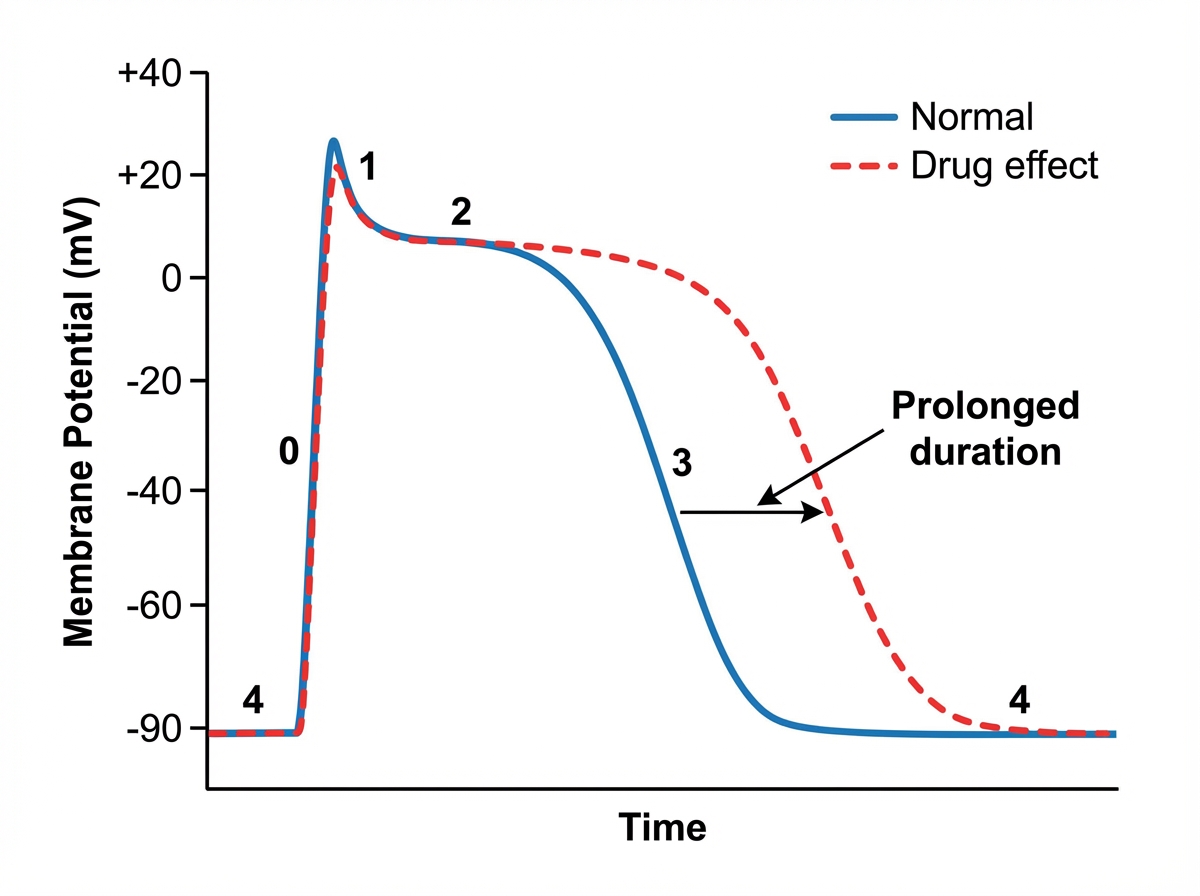
Q684
A 45-year-old Caucasian male presents complaining of inability to open his mouth. Patient history reveals that he recently injured his foot from an exposed floor nail in his house. This patient's symptoms are likely the result of:
Q685
An 18-year-old college student presents to the ED straight from chemistry lab where he ingested an unknown compound. He complains of a headache, and is flushed, tachypneic and tachycardic. Suspecting cyanide poisoning, you administer amyl nitrite which causes which of the following?
Q686
A pharmaceutical company has created an experimental medication, Drug Z, for patients with relapsing-remitting multiple sclerosis. Drug Z has been deemed to be safe in rats and is nearly ready for human trials. Before initiating a Phase I clinical trial, the company would like to study the medication’s pharmacokinetic properties in humans. The drug was found to have a half-life of 2.5 hours and is eliminated by first-order kinetics. The volume of distribution of the drug is determined to be 0.5 L/kg. The drug is administered intravenously and sublingually and plasma drug concentration vs. time plots are obtained. Intravenous administration of 10 mg of Drug Z yields an area under the curve (AUC) of 15 mg hr/L. Sublingual administration of 25 mg of Drug Z yields an area under the curve of 20 mg hr/L. What is the absolute bioavailability of this medication?
Q687
A goalkeeper of a famous soccer team gives an interview with a health agency regarding his childhood. He describes how when he was a child, he would constantly clear his throat in class and the teachers would write a note to his mother with advice to go see an ENT doctor. He complained of being restless, fidgety, and sometimes hyperactive in class, disrupting the environment and causing him many social problems. He would blurt out the answer at times and keep repeating it without any control, leading to some embarrassing timeouts. But he was always nice to his teachers, so he calls it a “benign frustration” rather than aggressively causing distress. He also talked about how his symptoms were dramatically improved with medication. Which of the following is an FDA approved drug for this patient’s most likely condition?
Q688
A 32-year-old man presents to the emergency department with vomiting, diarrhea, and abdominal pain 2 hours after eating seafood in a restaurant. He also mentions that immediately after ingestion of the food, he experienced tingling and numbness over the lips and face. On physical examination, his vital signs are stable. On neurological examination, he has reduced strength in the lower extremities, but deep tendon reflexes are present and normal. Laboratory evaluation of the seafood from the restaurant confirms the presence of a toxin which is known to block voltage-gated fast sodium channels. Which of the following toxins is the most likely cause of the patient’s symptoms?
Q689
A 44-year-old man presents to the clinic with recurrent epigastric pain following meals for a month. He adds that the pain radiates up his neck and throat. Over the counter antacids have not helped. On further questioning, he endorses foul breath upon waking in the morning and worsening of pain when lying down. He denies any recent weight loss. His temperature is 37°C (98.6°F), respirations are 15/min, pulse is 70/min, and blood pressure is 100/84 mm Hg. A physical examination is performed which is within normal limits except for mild tenderness on deep palpation of the epigastrium. An ECG performed in the clinic shows no abnormalities. What is the next best step in the management of this patient?
Q690
A 57-year-old man comes to the emergency department because of shortness of breath and palpitations for 3 hours. He has had similar episodes intermittently for 4 months. His pulse is 140/min and blood pressure is 90/60 mm Hg. An ECG shows irregular narrow-complex tachycardia with no discernable P waves. Emergent electrical cardioversion is performed and the patient reverts to normal sinus rhythm. Pharmacotherapy with sotalol is begun. Which of the following is the most likely physiologic effect of this drug?
Autonomic/CV Drugs US Medical PG Practice Questions and MCQs
Question 681: A 32-year-old woman brought to the emergency department because of a 1-week history of palpitations and shortness of breath. She has congestive heart failure. Current medications include furosemide, lisinopril, and atenolol. Her pulse is 124/min and irregularly irregular, and blood pressure is 110/70 mm Hg. Examination shows coarse crackles over the lower lung fields bilaterally. Treatment with digoxin is started. Five days later, an ECG shows prolongation of the PR interval. Which of the following is the most likely explanation for the observed effect of this drug?
A. Activation of Na+/Ca2+ exchanger
B. Increase in vagal tone (Correct Answer)
C. Inhibition of myocardial Na+/K+ ATPase
D. Decrease in intracellular cAMP
E. Inhibition of AV node L-type Ca2+ channels
Explanation: ***Increase in vagal tone***
- Digoxin enhances **vagal tone**, which slows conduction through the **AV node** and prolongs the **PR interval**.
- This effect is mediated by increased **acetylcholine** release and sensitivity at the AV node.
*Activation of Na+/Ca2+ exchanger*
- Digoxin indirectly increases the activity of the **Na+/Ca2+ exchanger** by raising intracellular calcium, but this primarily affects **myocardial contractility**, not AV nodal conduction.
- While increased intracellular calcium is a part of digoxin's mechanism, direct activation of the exchanger is not the primary reason for **PR interval prolongation**.
*Inhibition of myocardial Na+/K+ ATPase*
- Digoxin primarily acts by **inhibiting the Na+/K+ ATPase**, leading to increased intracellular sodium and subsequently increased calcium.
- This action is responsible for its **positive inotropic effect** on contractility, but not the direct cause of increased PR interval.
*Decrease in intracellular cAMP*
- A decrease in intracellular **cAMP** is typically associated with drugs like **beta-blockers**, which directly reduce sympathetic stimulation.
- Digoxin's effect on AV nodal conduction is primarily through increased **vagal tone**, not reduced cAMP.
*Inhibition of AV node L-type Ca2+ channels*
- Inhibition of **L-type Ca2+ channels** in the AV node is characteristic of **calcium channel blockers** (e.g., verapamil, diltiazem), which would also prolong the PR interval.
- Digoxin does not directly block these channels; its effect is mediated by **vagal stimulation**.
Question 682: A 2-year-old boy is brought to the physician for evaluation of delayed onset of speech. Over the past year, he has also had recurrent dizziness and three episodes of syncope. Examination of the ears shows clear auditory canals and intact tympanic membranes with normal light reflexes. Visual reinforcement audiometry shows bilateral sensorineural deafness. Genetic analysis reveals a mutation in the KCNQ1 gene causing a defect in slow voltage-gated potassium channels. An electrocardiogram of this patient is most likely to show which of the following?
A. Prolongation of the QT interval (Correct Answer)
B. Epsilon wave following the QRS complex
C. Slurred upstroke of the QRS complex
D. Absence of P waves
E. Pseudo-right bundle branch block
Explanation: **Prolongation of the QT interval**
- The constellation of **congenital sensorineural deafness**, **recurrent syncope**, and **dizziness** points to **Jervell and Lange-Nielsen syndrome (JLNS)**, a form of **long QT syndrome (LQTS)**.
- JLNS is caused by mutations, often in the **KCNQ1 gene**, which encodes a subunit of the **slow delayed rectifier potassium channel (Iks)**, leading to a **prolonged QT interval** on EKG.
*Epsilon wave following the QRS complex*
- An **epsilon wave** is characteristic of **arrhythmogenic right ventricular cardiomyopathy (ARVC)** and represents delayed ventricular depolarization.
- ARVC is not associated with congenital deafness or mutations in the KCNQ1 gene.
*Slurred upstroke of the QRS complex*
- A **slurred upstroke of the QRS complex** (delta wave) is typical of **Wolff-Parkinson-White syndrome (WPW)**, indicating pre-excitation via an accessory pathway.
- While WPW can cause syncope, it is not linked to congenital deafness or KCNQ1 mutations.
*Absence of P waves*
- The **absence of P waves** is seen in conditions like **atrial fibrillation** or **sinus arrest with a junctional escape rhythm**.
- These conditions do not typically present with congenital sensorineural deafness in a 2-year-old child and are not caused by KCNQ1 gene mutations.
*Pseudo-right bundle branch block*
- A **pseudo-right bundle branch block pattern** (Brugada pattern) is seen in **Brugada syndrome**, a channelopathy associated with sudden cardiac death.
- Brugada syndrome is not associated with congenital deafness and involves different genetic mutations (e.g., SCN5A).
Question 683: A 71-year-old woman comes to the physician because of dizziness and intermittent episodes of heart palpitations for 5 days. During this time, she has also had one episode of syncope. An ECG shows absence of P waves and irregular RR intervals. Treatment with an antiarrhythmic drug is initiated. The effect of the drug on the cardiac action potential is shown. Which of the following cardiac ion channels is most likely targeted by this drug?
A. Voltage-gated potassium channels (Correct Answer)
B. Voltage-gated chloride channels
C. Voltage-gated sodium channels
D. Voltage-gated nonselective cation channels
E. Voltage-gated calcium channels
Explanation: ***Voltage-gated potassium channels***
- The ECG findings of **absent P waves** and **irregularly irregular RR intervals** are characteristic of **atrial fibrillation**.
- Medications that block **potassium channels** (Class III antiarrhythmics) prolong repolarization and the refractory period, which helps to terminate or prevent atrial fibrillation by increasing the effective refractory period in the atria.
*Voltage-gated chloride channels*
- These channels are primarily involved in **skeletal muscle excitability** and are not significant targets for antiarrhythmic therapy in the heart.
- While chloride channels exist in the heart, their modulation is not a primary mechanism for treating atrial fibrillation.
*Voltage-gated sodium channels*
- Blocking **sodium channels** (Class I antiarrhythmics) slows conduction velocity and prolongs the QRS duration, which is useful in treating ventricular arrhythmias and some supraventricular tachycardias, but is not the primary target for the antiarrhythmic drug in the provided action potential graph, which shows prolonged repolarization.
- While Class Ic drugs are used for atrial fibrillation, the depicted action potential change more closely aligns with Class III effects.
*Voltage-gated nonselective cation channels*
- **Nonselective cation channels** can be involved in various cellular processes but are not a primary, specific target for antiarrhythmic drugs used to treat atrial fibrillation in the way that potassium, sodium, or calcium channels are.
- These channels are less relevant in the direct mechanism of action for terminating or preventing atrial fibrillation compared to channels whose blockade directly impacts action potential duration.
*Voltage-gated calcium channels*
- Blocking **calcium channels** (Class IV antiarrhythmics) slows the heart rate and AV nodal conduction, beneficial for rate control in atrial fibrillation but not for rhythm conversion by significantly altering the action potential as depicted (prolonging repolarization).
- While helpful for ventricular rate control, they do not primarily prolong the action potential duration in atrial or ventricular myocytes as shown in the action potential graph (which indicates a lengthened phase 3).
Question 684: A 45-year-old Caucasian male presents complaining of inability to open his mouth. Patient history reveals that he recently injured his foot from an exposed floor nail in his house. This patient's symptoms are likely the result of:
A. Increased production of gas in his soft tissues
B. Impaired motor neuron release of ACh
C. Bacterial infiltration of the central nervous system
D. Cross-reactivity of bacterial antigens
E. Impaired motor neuron release of GABA (Correct Answer)
Explanation: ***Impaired motor neuron release of GABA***
- The patient's inability to open his mouth (**trismus** or lockjaw) following a contaminated wound (exposed nail) is highly suggestive of **tetanus**.
- Tetanus toxin (tetanospasmin) produced by *Clostridioides tetani* inhibits the release of **inhibitory neurotransmitters** like **GABA** (gamma-aminobutyric acid) and glycine from presynaptic terminals in the spinal cord, leading to uncontrolled muscle spasms.
*Increased production of gas in his soft tissues*
- This symptom is characteristic of **gas gangrene**, caused by *Clostridium perfringens*, which leads to tissue necrosis and gas formation, but not typically lockjaw.
- While *Clostridium* species are involved, the clinical picture of gas gangrene differs significantly from the described symptoms.
*Impaired motor neuron release of ACh*
- Impaired release of **acetylcholine (ACh)** at the neuromuscular junction leads to **flaccid paralysis**, as seen in **botulism**, not the spastic paralysis and muscle rigidity of tetanus.
- Botulism typically causes generalized muscle weakness and cranial nerve palsies, not trismus where muscles are rigidly contracted.
*Bacterial infiltration of the central nervous system*
- While some bacteria can directly invade the CNS (e.g., in bacterial meningitis), tetanus toxin acts by **retrograde transport** to the CNS, where it inhibits neurotransmitter release; it does not involve direct bacterial infiltration of the CNS.
- Bacterial meningitis would present with fever, headache, and nuchal rigidity, not specifically trismus as the primary symptom.
*Cross-reactivity of bacterial antigens*
- Cross-reactivity of bacterial antigens is the mechanism for conditions like **post-streptococcal glomerulonephritis** or **rheumatic fever**, where the immune system mistakenly attacks host tissues.
- This mechanism does not explain the acute muscle spasm and rigidity seen in tetanus, which is a direct effect of a neurotoxin.
Question 685: An 18-year-old college student presents to the ED straight from chemistry lab where he ingested an unknown compound. He complains of a headache, and is flushed, tachypneic and tachycardic. Suspecting cyanide poisoning, you administer amyl nitrite which causes which of the following?
A. Formation of thiocyanate
B. Increase in intracellular NADH/NAD+ ratio
C. A decrease in serum methemoglobin levels
D. Chelation of the residue
E. Oxidation of ferrous iron in hemoglobin to ferric iron (Correct Answer)
Explanation: ***Oxidation of ferrous iron in hemoglobin to ferric iron***
- Amyl nitrite induces **methemoglobinemia**, converting the **ferrous iron (Fe2+)** in hemoglobin to **ferric iron (Fe3+)**, forming methemoglobin.
- Methemoglobin competes with **cytochrome c oxidase** for cyanide, forming **cyanmethemoglobin**, thereby reducing cyanide's toxic effect on cellular respiration.
*Formation of thiocyanate*
- The formation of **thiocyanate** is the result of cyanide detoxification by the enzyme **rhodanase**, which is a slower process and not directly caused by amyl nitrite.
- This process requires a **sulfur donor**, typically provided by **sodium thiosulfate**, and is not the immediate mechanism of action of nitrites.
*Increase in intracellular NADH/NAD+ ratio*
- An **increase in the intracellular NADH/NAD+ ratio** indicates metabolic dysfunction, which is a consequence of cyanide poisoning inhibiting oxidative phosphorylation.
- Amyl nitrite therapy aims to mitigate these effects rather than directly causing this ratio change.
*A decrease in serum methemoglobin levels*
- Amyl nitrite works by **increasing serum methemoglobin levels**, as its therapeutic effect relies on creating methemoglobin to bind cyanide.
- A decrease in methemoglobin would counteract the desired effect, as methemoglobin is crucial for cyanide sequestration.
*Chelation of the residue*
- **Chelation** typically refers to the binding of a metal ion, often facilitated by agents like **EDTA** or **deferoxamine**, to detoxify heavy metal poisoning.
- While cyanide binds metals in enzymes, amyl nitrite's action is specifically to convert hemoglobin to **methemoglobin** to bind free cyanide, not through a general chelation of the cyanide molecule itself.
Question 686: A pharmaceutical company has created an experimental medication, Drug Z, for patients with relapsing-remitting multiple sclerosis. Drug Z has been deemed to be safe in rats and is nearly ready for human trials. Before initiating a Phase I clinical trial, the company would like to study the medication’s pharmacokinetic properties in humans. The drug was found to have a half-life of 2.5 hours and is eliminated by first-order kinetics. The volume of distribution of the drug is determined to be 0.5 L/kg. The drug is administered intravenously and sublingually and plasma drug concentration vs. time plots are obtained. Intravenous administration of 10 mg of Drug Z yields an area under the curve (AUC) of 15 mg hr/L. Sublingual administration of 25 mg of Drug Z yields an area under the curve of 20 mg hr/L. What is the absolute bioavailability of this medication?
A. 48%
B. 59%
C. 67%
D. 71%
E. 53% (Correct Answer)
Explanation: ***53%***
- Absolute bioavailability (F) is calculated as the ratio of the AUC of the extravascular dose to the AUC of the intravenous dose, adjusted for the respective doses: **F = (AUC_sublingual / Dose_sublingual) / (AUC_intravenous / Dose_intravenous)**.
- Substituting the given values: F = (20 mg·hr/L / 25 mg) / (15 mg·hr/L / 10 mg) = (0.8 hr/L) / (1.5 hr/L) = 0.5333, or approximately **53%**.
*48%*
- This value would be obtained if the calculation were incorrect, possibly by reversing the doses or AUC values, leading to an underestimation of bioavailability.
- It does not align with the correct application of the formula for absolute bioavailability.
*59%*
- This result might arise from a calculation error, such as transposing values or an arithmetic mistake in the division or multiplication steps.
- It is not consistent with the correct formula for absolute bioavailability given the provided data.
*67%*
- This would be the result if there was a significant overestimation in the bioavailability calculation, possibly due to incorrectly assigning AUCs or doses.
- A value of 67% would imply a much higher absorption rate than the given data actually supports.
*71%*
- This outcome would suggest a calculation error that significantly inflates the bioavailability, potentially from an incorrect manipulation of the AUC or dose ratios.
- It is not derivable from the provided information using the correct formula for absolute bioavailability.
Question 687: A goalkeeper of a famous soccer team gives an interview with a health agency regarding his childhood. He describes how when he was a child, he would constantly clear his throat in class and the teachers would write a note to his mother with advice to go see an ENT doctor. He complained of being restless, fidgety, and sometimes hyperactive in class, disrupting the environment and causing him many social problems. He would blurt out the answer at times and keep repeating it without any control, leading to some embarrassing timeouts. But he was always nice to his teachers, so he calls it a “benign frustration” rather than aggressively causing distress. He also talked about how his symptoms were dramatically improved with medication. Which of the following is an FDA approved drug for this patient’s most likely condition?
A. Lithium
B. Clonazepam
C. Haloperidol (Correct Answer)
D. Clonidine
E. Guanfacine
Explanation: ***Haloperidol***
- The patient's presentation of constant throat clearing (**motor tics**), blurting out answers and repeating words (**vocal tics**), along with restlessness and hyperactivity, is highly suggestive of **Tourette syndrome**.
- **Haloperidol** is one of the **FDA-approved medications** specifically for Tourette syndrome, along with pimozide and aripiprazole.
- It is a **typical antipsychotic** that effectively treats severe tics through **dopamine D2 receptor blockade**, particularly in the nigrostriatal pathway.
- It remains a gold standard treatment despite potential extrapyramidal side effects.
*Lithium*
- **Lithium** is a **mood stabilizer** used primarily for **bipolar disorder** through its effects on intracellular signaling pathways.
- It has no role in treating Tourette syndrome or tic disorders and is not FDA-approved for this indication.
*Clonazepam*
- **Clonazepam** is a **benzodiazepine** with **GABAergic effects** used for **anxiety disorders**, **panic disorder**, and certain seizure disorders.
- While it may help with comorbid anxiety, it is not a primary treatment for tics and is **not FDA-approved** for Tourette syndrome.
*Clonidine*
- **Clonidine** is an **alpha-2 adrenergic agonist** that can reduce tics, particularly in children with mild to moderate symptoms or comorbid ADHD.
- However, it is **off-label** for Tourette syndrome and not FDA-approved for this indication, though commonly used as a second-line agent.
*Guanfacine*
- **Guanfacine** is also an **alpha-2 adrenergic agonist** similar to clonidine, used primarily for ADHD.
- It may help with tics in an **off-label capacity**, especially when ADHD is comorbid, but it is **not FDA-approved** specifically for Tourette syndrome.
Question 688: A 32-year-old man presents to the emergency department with vomiting, diarrhea, and abdominal pain 2 hours after eating seafood in a restaurant. He also mentions that immediately after ingestion of the food, he experienced tingling and numbness over the lips and face. On physical examination, his vital signs are stable. On neurological examination, he has reduced strength in the lower extremities, but deep tendon reflexes are present and normal. Laboratory evaluation of the seafood from the restaurant confirms the presence of a toxin which is known to block voltage-gated fast sodium channels. Which of the following toxins is the most likely cause of the patient’s symptoms?
A. Tetrodotoxin (Correct Answer)
B. Domoic acid
C. Scombrotoxin
D. Okadaic acid
E. Saxitoxin
Explanation: ***Tetrodotoxin***
- The symptoms of **tingling, numbness (paresthesias) of the lips and face**, followed by **gastrointestinal symptoms** and **progressive weakness**, are classic for **tetrodotoxin poisoning**.
- **Tetrodotoxin** blocks voltage-gated fast **sodium channels**, preventing neuronal depolarization and leading to paralysis without affecting deep tendon reflexes until severe stages.
*Domoic acid*
- **Domoic acid** poisoning (Amnesic Shellfish Poisoning) typically presents with **gastrointestinal symptoms** and **neurological symptoms** like confusion, memory loss, and seizures, not paresthesias and weakness as prominently.
- It acts as an **excitotoxin** by overstimulating **glutamate receptors**, leading to neuronal damage.
*Scombrotoxin*
- **Scombrotoxin** (histamine poisoning) causes symptoms resembling an **allergic reaction**, including flushing, headache, palpitations, and gastrointestinal distress, usually without neurological deficits.
- It results from the bacterial breakdown of histidine into **histamine** in improperly stored fish like tuna and mackerel.
*Okadaic acid*
- **Okadaic acid** (Diarrhetic Shellfish Poisoning) primarily causes **gastrointestinal symptoms** such as nausea, vomiting, diarrhea, and abdominal pain.
- It acts as a **toxin** that inhibits **protein phosphatases**, leading to increased phosphorylation and altered cellular signaling.
*Saxitoxin*
- **Saxitoxin** (Paralytic Shellfish Poisoning) also blocks **voltage-gated sodium channels** like tetrodotoxin but is produced by different organisms (dinoflagellates).
- While it causes similar neurological symptoms, the key distinguishing feature in this case is the **specific clinical presentation and timing** that is most consistent with tetrodotoxin from pufferfish or certain shellfish.
- Saxitoxin poisoning can progress to respiratory paralysis more rapidly in severe cases.
Question 689: A 44-year-old man presents to the clinic with recurrent epigastric pain following meals for a month. He adds that the pain radiates up his neck and throat. Over the counter antacids have not helped. On further questioning, he endorses foul breath upon waking in the morning and worsening of pain when lying down. He denies any recent weight loss. His temperature is 37°C (98.6°F), respirations are 15/min, pulse is 70/min, and blood pressure is 100/84 mm Hg. A physical examination is performed which is within normal limits except for mild tenderness on deep palpation of the epigastrium. An ECG performed in the clinic shows no abnormalities. What is the next best step in the management of this patient?
A. Liquid antacid
B. Lansoprazole (Correct Answer)
C. Endoscopy
D. Barium swallow
E. Ranitidine
Explanation: ***Correct Option: Lansoprazole***
- The patient's symptoms, including **postprandial epigastric pain that radiates up the neck and throat**, **foul breath**, and **worsening pain when lying down**, are highly suggestive of **gastroesophageal reflux disease (GERD)**.
- **Proton pump inhibitors (PPIs)** such as lansoprazole are the most effective medications for symptom relief and healing in GERD due to their potent and sustained acid suppression.
- PPIs are first-line therapy for patients with **moderate-to-severe GERD symptoms** or those who have failed antacid therapy.
*Incorrect Option: Liquid antacid*
- While antacids can provide **temporary relief** for heartburn, they do not address the underlying pathology of GERD and are generally **insufficient for chronic or severe symptoms**.
- The patient has already tried **over-the-counter antacids without relief**, indicating that a stronger medication is needed.
*Incorrect Option: Endoscopy*
- **Endoscopy** is typically reserved for patients with **alarm symptoms** (e.g., dysphagia, odynophagia, weight loss, GI bleeding, anemia) or those who **fail to respond to an empiric trial of PPIs**.
- This patient does not have alarm symptoms, and a trial of PPIs is the appropriate initial step.
*Incorrect Option: Barium swallow*
- A **barium swallow** (esophagogram) can be useful for evaluating **structural abnormalities** of the esophagus, such as strictures, rings, or motility disorders.
- However, it has **limited sensitivity for diagnosing GERD** itself and is not typically the first-line diagnostic or therapeutic step in uncomplicated GERD.
*Incorrect Option: Ranitidine*
- **Ranitidine** is an **H2 receptor antagonist** that reduces stomach acid production, but it is generally **less potent and less effective than PPIs** for controlling GERD symptoms and healing erosions.
- It might be considered for milder cases or as an add-on therapy, but a PPI like lansoprazole is preferred for initial empiric treatment given the persistent symptoms.
Question 690: A 57-year-old man comes to the emergency department because of shortness of breath and palpitations for 3 hours. He has had similar episodes intermittently for 4 months. His pulse is 140/min and blood pressure is 90/60 mm Hg. An ECG shows irregular narrow-complex tachycardia with no discernable P waves. Emergent electrical cardioversion is performed and the patient reverts to normal sinus rhythm. Pharmacotherapy with sotalol is begun. Which of the following is the most likely physiologic effect of this drug?
A. Increased ventricular repolarization rate
B. Increased myocyte inotropy
C. Increased K+ efflux from myocytes
D. Decreased Purkinje fiber conduction
E. Decreased AV nodal conduction (Correct Answer)
Explanation: ***Decreased AV nodal conduction***
- **Sotalol** is a **beta-blocker** (Class II antiarrhythmic) and a **potassium channel blocker** (Class III antiarrhythmic). Its beta-blocking effect **slows AV nodal conduction**, increasing the refractory period and thereby reducing ventricular response in atrial fibrillation or flutter.
- This action helps to **control the ventricular rate** and prevent rapid conduction from the atria to the ventricles, which is crucial in managing tachyarrhythmias.
*Increased ventricular repolarization rate*
- Sotalol is a **Class III antiarrhythmic** drug, which primarily works by **blocking potassium channels** and **prolonging the action potential duration** (and thus repolarization time) in ventricular myocytes.
- Therefore, it **decreases** (rather than increases) the ventricular repolarization rate.
*Increased myocyte inotropy*
- As a **beta-blocker**, sotalol typically acts to **decrease myocardial contractility** (negative inotropy) by blocking beta-adrenergic receptors.
- This effect is generally not desired in patients with heart failure but contributes to its antiarrhythmic properties by reducing myocardial oxygen demand.
*Increased K+ efflux from myocytes*
- Sotalol is a **potassium channel blocker**, meaning it **inhibits K+ efflux** from myocytes during phase 3 of the action potential.
- This inhibition leads to a **prolongation of repolarization** and the refractory period, which is a key mechanism of its Class III antiarrhythmic effect.
*Decreased Purkinje fiber conduction*
- While sotalol can have some effect on Purkinje fibers due to its Class III activity (prolonging action potential), its direct and most significant effect as a beta-blocker on conduction is primarily on the **AV node**.
- Other antiarrhythmics like **Class IC drugs** (e.g., flecainide, propafenone) are known for marked conduction velocity reduction in Purkinje fibers and ventricular myocardium.