Serum studies show a troponin T concentration of 6.73 ng/mL (N < 0.01), and fingerstick blood glucose concentration of 145 mg/dL. The cardiac catheterization team is activated. Treatment with unfractionated heparin, aspirin, ticagrelor, and sublingual nitroglycerin is begun, and the patient's pain subsides. His temperature is 37.3°C (99.1°F), pulse is 65/min, respirations are 23/min, and blood pressure is 91/60 mm Hg. Pulse oximetry on room air shows an oxygen saturation of 96%. Which of the following is the most appropriate additional pharmacotherapy?
Q262
A 28-year-old female presents to her primary care provider for headache. The patient reports that every few weeks she has an episode of right-sided, throbbing headache. The episodes began several years ago and are accompanied by nausea and bright spots in her vision. The headache usually subsides if she lies still in a dark, quiet room for several hours. The patient denies any weakness, numbness, or tingling during these episodes. Her past medical history is significant for acne, hypothyroidism, obesity, and endometriosis. Her home medications include levothyroxine, oral contraceptive pills, and topical tretinoin. She has two glasses of wine with dinner several nights a week and has never smoked. She works as a receptionist at a marketing company. On physical exam, the patient has no focal neurologic deficits. A CT of the head is performed and shows no acute abnormalities. Which of the following is the most appropriate treatment for this patient during these episodes?
Q263
A 55-year-old man with a history of congestive heart failure, hypertension, and hyperlipidemia presents to his primary care clinic. He admits he did not adhere to a low salt diet on a recent vacation. He now has progressive leg swelling and needs two pillows to sleep because he gets short of breath when lying flat. Current medications include aspirin, metoprolol, lisinopril, atorvastatin, and furosemide. His physician decides to increase the dosage and frequency of the patient’s furosemide. Which of the following electrolyte abnormalities is associated with loop diuretics?
Q264
A 45-year-old woman comes to the emergency department with recurrent episodes of shaking, sweating, and palpitations. The patient is confused and complains of hunger. One week ago, she had similar symptoms that improved after eating. She has hypertension and a history of biliary pancreatitis. She underwent cholecystectomy 1 year ago. She works as a nurse aide in a nursing care facility. She does not smoke or drink alcohol. She does not exercise. Her temperature is 36.7°C (98°F), pulse is 104/min, respirations are 20/min, and blood pressure is 135/88 mm Hg. Examination shows tremors and diaphoresis. Laboratory studies show:
Blood glucose 50 mg/dL
Thyroid-stimulating hormone 1 mU/L
C-peptide 0.50 ng/mL (N=0.8–3.1)
Abdominal ultrasound reveals a 1-cm anechoic lesion in the head of the pancreas. Which of the following is the most likely cause of this patient's symptoms?
Q265
A 76-year-old woman comes to the physician because of a sudden loss of vision in her right eye for 10 minutes that morning, which subsided spontaneously. Over the past 2 months, she has had multiple episodes of left-sided headaches and pain in her jaw while chewing. Examination shows conjunctival pallor. Range of motion of the shoulders and hips is slightly limited by pain. Her erythrocyte sedimentation rate is 69 mm/h. Treatment with the appropriate medication for this patient's condition is initiated. Which of the following sets of laboratory findings is most likely as a consequence of treatment?
| Lymphocytes | Neutrophils | Eosinophils | Fibroblasts |
Q266
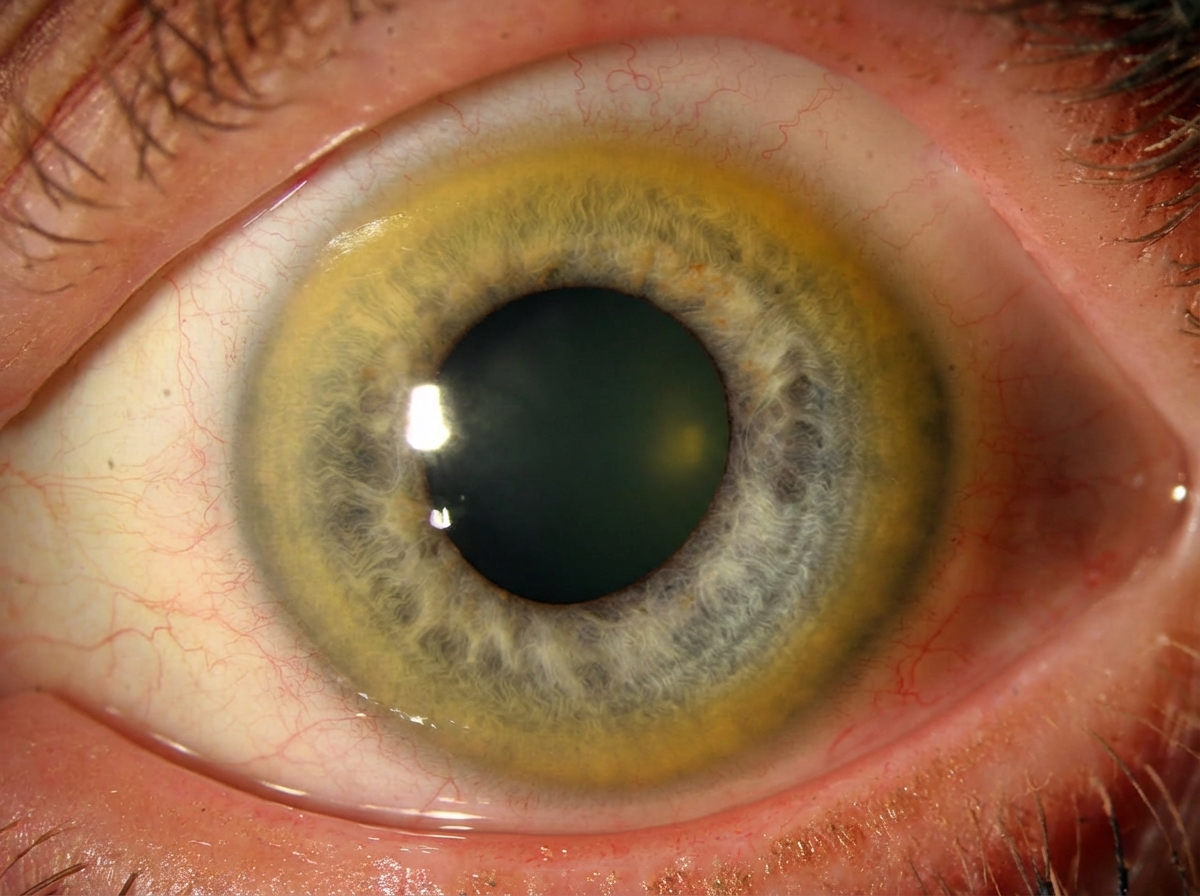
A 23-year-old man comes to the physician because of a tremor in his right hand for the past 3 months. The tremor has increased in intensity and he is unable to perform his daily activities. When he wakes up in the morning, his pillow is soaked in saliva. During this period, he has been unable to concentrate in his college classes. He has had several falls over the past month. He has no past history of serious illness. He appears healthy. His vital signs are within normal limits. Examination shows a broad-based gait. There is a low frequency tremor that affects the patient's right hand to a greater extent than his left. When the patient holds his arms fully abducted with his elbows flexed, he has a bilateral low frequency arm tremor that increases in amplitude the longer he holds his arms up. Muscle strength is normal in all extremities. Sensation is intact. Deep tendon reflexes are 4+ bilaterally. Dysmetria is present. A photograph of the patient's eye is shown. Mental status examination shows a restricted affect. The rate and rhythm of his speech is normal. Which of the following is the most appropriate pharmacotherapy?
Q267
A previously healthy 61-year-old man comes to the physician because of bilateral knee pain for the past year. The pain is worse with movement and is relieved with rest. Physical examination shows crepitus, pain, and decreased range of motion with complete flexion and extension of both knees. There is no warmth, redness, or swelling. X-rays of both knees show irregular joint space narrowing, osteophytes, and subchondral cysts. Which of the following is the most appropriate pharmacotherapy?
Q268
A 72-year-old man with congestive heart failure is brought to the emergency department because of chest pain, shortness of breath, dizziness, and palpitations for 30 minutes. An ECG shows a wide complex tachycardia with a P-wave rate of 105/min, an R-wave rate of 130/min, and no apparent relation between the two. Intravenous pharmacotherapy is initiated with a drug that prolongs the QRS and QT intervals. The patient was most likely treated with which of the following drugs?
Q269
You are a resident on an anesthesiology service and are considering using nitrous oxide to assist in placing a laryngeal mask airway (LMA) in your patient, who is about to undergo a minor surgical procedure. You remember that nitrous oxide has a very high minimal alveolar concentration (MAC) compared to other anesthetics. This means that nitrous oxide has:
Q270
A 47-year-old patient returns to his primary care physician after starting aspirin two weeks ago for primary prevention of coronary artery disease. He complains that he wakes up short of breath in the middle of the night and has had coughing "attacks" three times. After discontinuing aspirin, what medication is most appropriate for prevention of similar symptoms in this patient?
Autonomic/CV Drugs US Medical PG Practice Questions and MCQs
Question 261: Serum studies show a troponin T concentration of 6.73 ng/mL (N < 0.01), and fingerstick blood glucose concentration of 145 mg/dL. The cardiac catheterization team is activated. Treatment with unfractionated heparin, aspirin, ticagrelor, and sublingual nitroglycerin is begun, and the patient's pain subsides. His temperature is 37.3°C (99.1°F), pulse is 65/min, respirations are 23/min, and blood pressure is 91/60 mm Hg. Pulse oximetry on room air shows an oxygen saturation of 96%. Which of the following is the most appropriate additional pharmacotherapy?
A. Intravenous morphine
B. Intravenous furosemide
C. Intravenous insulin
D. Oral atorvastatin (Correct Answer)
E. Intravenous nitroglycerin
Explanation: ***Oral atorvastatin***
- All patients with **acute coronary syndrome (ACS)** should receive high-intensity statin therapy, such as **atorvastatin 80 mg daily**, as early as possible.
- Statins stabilize plaques, reduce inflammation, and improve endothelial function, which are crucial in the acute setting of a myocardial infarction.
*Intravenous morphine*
- Morphine can be used for persistent chest pain refractory to nitroglycerin, but its routine use is now questioned due to potential adverse effects like hypotension and delayed antiplatelet absorption.
- The patient's pain has already subsided with initial treatment, and his blood pressure is already low (91/60 mm Hg), making morphine less appropriate.
*Intravenous furosemide*
- Furosemide is a loop diuretic primarily used for treating **fluid overload** and **pulmonary edema**, which are not indicated by the patient's current presentation (oxygen saturation 96%, no mention of crackles or dyspnea).
- Its use in a patient with **borderline hypotension** could worsen hemodynamic stability.
*Intravenous insulin*
- While the patient has elevated fingerstick glucose (145 mg/dL), this level does not immediately require intravenous insulin unless there is evidence of **diabetic ketoacidosis** or **hyperosmolar hyperglycemic state**, or persistent severe hyperglycemia.
- More moderate hyperglycemia can often be managed with subcutaneous insulin or diet in the acute phase, and focuses remain on cardiac stabilization.
*Intravenous nitroglycerin*
- Intravenous nitroglycerin is indicated for ongoing ischemic chest pain or uncontrolled hypertension in ACS, but the patient's pain has subsided and he is **hypotensive** (91/60 mm Hg).
- Administering more nitroglycerin would likely worsen his hypotension and could compromise coronary perfusion.
Question 262: A 28-year-old female presents to her primary care provider for headache. The patient reports that every few weeks she has an episode of right-sided, throbbing headache. The episodes began several years ago and are accompanied by nausea and bright spots in her vision. The headache usually subsides if she lies still in a dark, quiet room for several hours. The patient denies any weakness, numbness, or tingling during these episodes. Her past medical history is significant for acne, hypothyroidism, obesity, and endometriosis. Her home medications include levothyroxine, oral contraceptive pills, and topical tretinoin. She has two glasses of wine with dinner several nights a week and has never smoked. She works as a receptionist at a marketing company. On physical exam, the patient has no focal neurologic deficits. A CT of the head is performed and shows no acute abnormalities. Which of the following is the most appropriate treatment for this patient during these episodes?
A. Acetazolamide
B. Topiramate
C. Verapamil
D. High-flow oxygen
E. Sumatriptan (Correct Answer)
Explanation: ***Sumatriptan***
- The patient's presentation with **throbbing, unilateral headaches** accompanied by **nausea** and **visual aura** (bright spots), relieved by rest in a quiet room, is classic for **migraine with aura**.
- **Triptans** like sumatriptan are first-line abortive treatments for moderate to severe migraines, effectively targeting serotonin receptors to reduce headache pain and associated symptoms.
*Acetazolamide*
- This medication is a **carbonic anhydrase inhibitor** primarily used for conditions like **glaucoma**, **altitude sickness**, and **idiopathic intracranial hypertension**, not acute migraine attacks.
- It works by reducing cerebrospinal fluid production and is not indicated for the immediate relief of migraine symptoms.
*Topiramate*
- **Topiramate** is an **anti-epileptic drug** that is used for **migraine prophylaxis** (prevention), not for acute treatment of a migraine episode.
- While it can reduce the frequency of migraines over time, it will not alleviate an ongoing headache.
*Verapamil*
- **Verapamil** is a **calcium channel blocker** and is primarily used for **cluster headache prophylaxis** or for conditions like hypertension and angina.
- It is not an effective acute treatment for migraine, and its use is typically reserved for preventative measures in specific headache types.
*High-flow oxygen*
- **High-flow oxygen** is a highly effective acute treatment for **cluster headaches**, which present with very distinct symptoms like excruciating unilateral pain, often with autonomic features (e.g., lacrimation, rhinorrhea).
- This patient's symptoms are consistent with migraine, not cluster headache, making oxygen an inappropriate treatment.
Question 263: A 55-year-old man with a history of congestive heart failure, hypertension, and hyperlipidemia presents to his primary care clinic. He admits he did not adhere to a low salt diet on a recent vacation. He now has progressive leg swelling and needs two pillows to sleep because he gets short of breath when lying flat. Current medications include aspirin, metoprolol, lisinopril, atorvastatin, and furosemide. His physician decides to increase the dosage and frequency of the patient’s furosemide. Which of the following electrolyte abnormalities is associated with loop diuretics?
A. Hyperchloremia
B. Hypocalcemia
C. Hypermagnesemia
D. Hypouricemia
E. Hypokalemia (Correct Answer)
Explanation: ***Hypokalemia***
- **Loop diuretics** are most commonly associated with **hypokalemia**, which is one of their most clinically significant electrolyte disturbances.
- Loop diuretics inhibit the **Na-K-2Cl cotransporter** in the thick ascending limb, increasing sodium delivery to the collecting duct.
- This stimulates **aldosterone-mediated potassium secretion** via principal cells, leading to increased urinary potassium loss.
- **Clinical significance**: Hypokalemia can cause muscle weakness, cardiac arrhythmias, and potentiates digoxin toxicity—particularly important in heart failure patients.
*Hyperchloremia*
- Loop diuretics cause **hypochloremia**, not hyperchloremia.
- Chloride reabsorption is blocked in the thick ascending limb, leading to increased chloride excretion.
*Hypocalcemia*
- Loop diuretics increase **urinary calcium excretion** (hypercalciuria) by reducing the positive luminal charge needed for paracellular calcium reabsorption.
- However, this typically does **not cause clinically significant hypocalcemia** in most patients.
- In contrast, thiazide diuretics decrease calcium excretion.
*Hypermagnesemia*
- Loop diuretics cause **hypomagnesemia**, not hypermagnesemia.
- They disrupt the positive lumen potential necessary for magnesium reabsorption in the thick ascending limb.
*Hypouricemia*
- Loop diuretics cause **hyperuricemia**, not hypouricemia.
- They compete with uric acid for secretion in the proximal tubule, promoting uric acid reabsorption and decreasing its excretion.
Question 264: A 45-year-old woman comes to the emergency department with recurrent episodes of shaking, sweating, and palpitations. The patient is confused and complains of hunger. One week ago, she had similar symptoms that improved after eating. She has hypertension and a history of biliary pancreatitis. She underwent cholecystectomy 1 year ago. She works as a nurse aide in a nursing care facility. She does not smoke or drink alcohol. She does not exercise. Her temperature is 36.7°C (98°F), pulse is 104/min, respirations are 20/min, and blood pressure is 135/88 mm Hg. Examination shows tremors and diaphoresis. Laboratory studies show:
Blood glucose 50 mg/dL
Thyroid-stimulating hormone 1 mU/L
C-peptide 0.50 ng/mL (N=0.8–3.1)
Abdominal ultrasound reveals a 1-cm anechoic lesion in the head of the pancreas. Which of the following is the most likely cause of this patient's symptoms?
A. Pancreatic neoplasm
B. Pancreatic pseudocyst
C. Graves' disease
D. Surreptitious insulin use (Correct Answer)
E. Type 1 diabetes mellitus
Explanation: ***Surreptitious insulin use***
- The patient's symptoms of **hypoglycemia** (shaking, sweating, palpitations, confusion, hunger) combined with a **low C-peptide level** (0.50 ng/mL) and a normal TSH strongly suggest **exogenous insulin administration**.
- As a nurse aide, she has access to insulin, and the normal pancreatic ultrasound (1 cm anechoic lesion is non-specific and unlikely to cause these symptoms) rules out an **insulinoma**, which would present with high C-peptide.
*Pancreatic neoplasm*
- While a pancreatic neoplasm can cause various symptoms, an **insulinoma** (a type of pancreatic neuroendocrine tumor) would present with **hypoglycemia** but typically with **elevated C-peptide levels**, as it produces endogenous insulin.
- The ultrasound finding of a 1-cm anechoic lesion is **non-specific** and not definitively indicative of an insulinoma or any other functional neoplasm causing these specific symptoms.
*Pancreatic pseudocyst*
- Pancreatic pseudocysts are collections of fluid that can occur after **pancreatitis** or trauma, and while this patient has a history of biliary pancreatitis, pseudocysts generally cause symptoms like **abdominal pain, distension, and early satiety**, not hypoglycemia.
- They also do not explain the **low C-peptide** and recurrent episodes of neuroglycopenic symptoms.
*Graves' disease*
- Graves' disease is an **autoimmune hyperthyroid condition** that causes symptoms like palpitations, sweating, and tremors, but it is characterized by **low TSH** with elevated free T3/T4 due to negative feedback, not hypoglycemia or low C-peptide.
- The patient's **normal TSH** (1 mU/L) rules out Graves' disease as the cause of her current symptoms.
*Type 1 diabetes mellitus*
- Type 1 diabetes is characterized by **insulin deficiency** due to autoimmune destruction of pancreatic beta cells, leading to **hyperglycemia**, not hypoglycemia.
- While patients with type 1 diabetes may experience hypoglycemia if they administer too much insulin, the underlying disease itself causes high blood glucose, and the C-peptide would be very low or undetectable in a new diagnosis, but not as the cause of recurrent spontaneous hypoglycemia.
Question 265: A 76-year-old woman comes to the physician because of a sudden loss of vision in her right eye for 10 minutes that morning, which subsided spontaneously. Over the past 2 months, she has had multiple episodes of left-sided headaches and pain in her jaw while chewing. Examination shows conjunctival pallor. Range of motion of the shoulders and hips is slightly limited by pain. Her erythrocyte sedimentation rate is 69 mm/h. Treatment with the appropriate medication for this patient's condition is initiated. Which of the following sets of laboratory findings is most likely as a consequence of treatment?
| Lymphocytes | Neutrophils | Eosinophils | Fibroblasts |
A. ↓ ↑ ↓ ↓ (Correct Answer)
B. ↓ ↓ ↓ ↓
C. ↑ ↑ ↓ ↑
D. ↓ ↓ ↑ ↓
E. ↑ ↓ ↓ ↓
Explanation: ***↓ ↑ ↓ ↓***
- The patient's symptoms (sudden visual loss, headaches, jaw claudication, polymyalgia rheumatica-like symptoms, and elevated **ESR**) are highly suggestive of **giant cell arteritis (GCA)**.
- The treatment for GCA is high-dose **corticosteroids**, which cause characteristic hematologic changes: **lymphopenia** (↓), **neutrophilia** (↑), **eosinopenia** (↓), and **decreased fibroblast proliferation** (↓).
- Corticosteroids induce **lymphocyte apoptosis** and redistribution, cause **neutrophil demargination** from vessel walls and inhibit neutrophil apoptosis (leading to increased circulating neutrophils), sequester **eosinophils** in lymphoid tissue, and suppress **fibroblast activity**.
*↓ ↓ ↓ ↓*
- While lymphocytes, eosinophils, and fibroblasts decrease with corticosteroid use, **neutrophils** typically **increase**, not decrease, due to demargination from vascular walls and inhibited apoptosis.
- This option incorrectly shows neutropenia when neutrophilia is expected.
*↑ ↑ ↓ ↑*
- Corticosteroids cause **lymphopenia** (↓), not lymphocytosis (↑).
- **Fibroblasts** also decrease (↓), not increase (↑), as corticosteroids inhibit fibroblast proliferation and collagen synthesis.
- This option incorrectly shows increases in both lymphocytes and fibroblasts.
*↓ ↓ ↑ ↓*
- Corticosteroids cause **eosinopenia** (↓), not eosinophilia (↑).
- Eosinophils are sequestered in lymphoid tissues and undergo apoptosis with corticosteroid treatment.
- This option also incorrectly shows neutropenia instead of the expected neutrophilia.
*↑ ↓ ↓ ↓*
- Corticosteroids cause **lymphopenia** (↓), not lymphocytosis (↑).
- Lymphocytes undergo apoptosis and redistribute from circulation with corticosteroid therapy.
- This option also incorrectly shows neutropenia instead of neutrophilia.
Question 266: A 23-year-old man comes to the physician because of a tremor in his right hand for the past 3 months. The tremor has increased in intensity and he is unable to perform his daily activities. When he wakes up in the morning, his pillow is soaked in saliva. During this period, he has been unable to concentrate in his college classes. He has had several falls over the past month. He has no past history of serious illness. He appears healthy. His vital signs are within normal limits. Examination shows a broad-based gait. There is a low frequency tremor that affects the patient's right hand to a greater extent than his left. When the patient holds his arms fully abducted with his elbows flexed, he has a bilateral low frequency arm tremor that increases in amplitude the longer he holds his arms up. Muscle strength is normal in all extremities. Sensation is intact. Deep tendon reflexes are 4+ bilaterally. Dysmetria is present. A photograph of the patient's eye is shown. Mental status examination shows a restricted affect. The rate and rhythm of his speech is normal. Which of the following is the most appropriate pharmacotherapy?
A. Propranolol
B. Penicillamine (Correct Answer)
C. Prednisone
D. Levodopa
E. Deferoxamine
Explanation: ***Penicillamine***
- This patient presents with symptoms suggestive of **Wilson's disease**, including a **tremor**, drooling (sialorrhea), falls, **broad-based gait**, **dysmetria**, and psychiatric changes (restricted affect, inability to concentrate). The mention of an eye photograph likely points to **Kayser-Fleischer rings**.
- **Penicillamine** is a **copper chelator** and is considered a first-line treatment for Wilson's disease, as it promotes the excretion of excess copper from the body.
*Propranolol*
- **Propranolol** is a **beta-blocker** commonly used to treat essential tremor.
- While the patient has a tremor, his constellation of symptoms (neurological, psychiatric, and liver involvement implied by copper accumulation) is more consistent with Wilson's disease, making beta-blockers insufficient as a primary treatment.
*Prednisone*
- **Prednisone** is a corticosteroid used to reduce inflammation and suppress the immune system.
- It is not indicated for the treatment of Wilson's disease, which is a genetic disorder of copper metabolism, not an inflammatory or autoimmune condition.
*Levodopa*
- **Levodopa** is a precursor to dopamine and is the primary medication used to treat Parkinson's disease, particularly for its bradykinesia and rigidity.
- While there is a tremor, the overall clinical picture, including the age of onset, psychiatric symptoms, and gait abnormalities like dysmetria, is not typical for Parkinson's disease.
*Deferoxamine*
- **Deferoxamine** is an **iron-chelating agent** used to treat iron overload conditions like hemochromatosis.
- Wilson's disease involves copper overload, not iron overload, so deferoxamine would not be an appropriate treatment.
Question 267: A previously healthy 61-year-old man comes to the physician because of bilateral knee pain for the past year. The pain is worse with movement and is relieved with rest. Physical examination shows crepitus, pain, and decreased range of motion with complete flexion and extension of both knees. There is no warmth, redness, or swelling. X-rays of both knees show irregular joint space narrowing, osteophytes, and subchondral cysts. Which of the following is the most appropriate pharmacotherapy?
A. Allopurinol
B. Naproxen (Correct Answer)
C. Celecoxib
D. Infliximab
E. Prednisone
Explanation: ***Naproxen***
- The patient's presentation with **bilateral knee pain worse with movement**, relief with rest, crepitus, and characteristic X-ray findings (joint space narrowing, osteophytes, subchondral cysts) is classic for **osteoarthritis (OA)** [3].
- **NSAIDs** like naproxen are **first-line pharmacotherapy** for managing pain and inflammation in osteoarthritis that is not adequately controlled by acetaminophen or topical agents [1].
- As a **non-selective NSAID**, naproxen is an appropriate initial choice for a patient without specified risk factors for GI complications or cardiovascular disease [2].
*Allopurinol*
- **Allopurinol** is a xanthine oxidase inhibitor used to reduce **urate production in hyperuricemia** and prevent gout attacks.
- The patient's symptoms are not consistent with gout, as there is **no acute inflammatory arthritis, redness, warmth, or swelling**.
*Celecoxib*
- **Celecoxib** is a **COX-2 selective NSAID** that can be used for osteoarthritis pain.
- It is generally preferred in patients with **documented GI risk factors** (history of peptic ulcer, concurrent anticoagulation, or advanced age with other risk factors).
- While this 61-year-old patient has age as a consideration, in the absence of other specified GI risk factors, either non-selective or COX-2 selective NSAIDs are reasonable; **naproxen is acceptable as initial therapy** and is more cost-effective.
*Infliximab*
- **Infliximab** is a **biologic disease-modifying antirheumatic drug (DMARD)**, specifically a TNF-alpha inhibitor, used to treat inflammatory arthritides like rheumatoid arthritis, psoriatic arthritis, and ankylosing spondylitis.
- It is **not indicated for osteoarthritis**, which is a degenerative joint disease rather than an autoimmune inflammatory process.
*Prednisone*
- **Prednisone** is a corticosteroid used to **reduce inflammation** in various conditions, including inflammatory arthritides and acute pain flares.
- While it can provide symptomatic relief, it is **not a first-line or long-term pharmacotherapy for osteoarthritis** due to significant **side effects** with chronic use (weight gain, hyperglycemia, osteoporosis, immunosuppression) [1].
Question 268: A 72-year-old man with congestive heart failure is brought to the emergency department because of chest pain, shortness of breath, dizziness, and palpitations for 30 minutes. An ECG shows a wide complex tachycardia with a P-wave rate of 105/min, an R-wave rate of 130/min, and no apparent relation between the two. Intravenous pharmacotherapy is initiated with a drug that prolongs the QRS and QT intervals. The patient was most likely treated with which of the following drugs?
A. Carvedilol
B. Verapamil
C. Flecainide
D. Quinidine (Correct Answer)
E. Sotalol
Explanation: **Quinidine**
- Quinidine is a **Class IA antiarrhythmic** that blocks fast sodium channels, prolonging both the **QRS complex** (due to slowed conduction) and the **QT interval** (due to prolonged repolarization).
- The ECG findings of **wide-complex tachycardia** and **AV dissociation** (P-wave rate different from R-wave rate without apparent relation) are consistent with ventricular tachycardia, which Class IA drugs can treat.
*Carvedilol*
- Carvedilol is a **beta-blocker** (Class II antiarrhythmic) that primarily slows heart rate and AV nodal conduction, generally **shortening the QT interval** or having no effect, and would not widen the QRS complex.
- Beta-blockers are typically contraindicated in **decompensated heart failure** and **wide-complex tachycardia** due to their negative inotropic effects and risk of worsening decompensation.
*Verapamil*
- Verapamil is a **non-dihydropyridine calcium channel blocker** (Class IV antiarrhythmic) that mainly slows AV nodal conduction. It would not cause QRS widening and can shorten the QT interval.
- Verapamil is generally contraindicated in **wide-complex tachycardias** of unknown origin as it can precipitate cardiovascular collapse if the arrhythmia is ventricular.
*Flecainide*
- Flecainide is a **Class IC antiarrhythmic** that primarily blocks fast sodium channels, causing significant **QRS widening** but has **minimal effect on the QT interval**, which is contrary to the case description.
- Class IC agents are also generally avoided in patients with **structural heart disease** like congestive heart failure due to increased mortality risk.
*Sotalol*
- Sotalol is a **Class III antiarrhythmic** (beta-blocker with potassium channel blockade) that primarily prolongs the **QT interval** by blocking potassium channels. While it prolongs the QT, it does **not significantly widen the QRS complex**.
- Its beta-blocking effects could exacerbate **decompensated heart failure** in this patient, similar to carvedilol.
Question 269: You are a resident on an anesthesiology service and are considering using nitrous oxide to assist in placing a laryngeal mask airway (LMA) in your patient, who is about to undergo a minor surgical procedure. You remember that nitrous oxide has a very high minimal alveolar concentration (MAC) compared to other anesthetics. This means that nitrous oxide has:
A. no effect on lipid solubility or potency
B. decreased lipid solubility and decreased potency (Correct Answer)
C. decreased lipid solubility and increased potency
D. increased lipid solubility and increased potency
E. increased lipid solubility and decreased potency
Explanation: ***Decreased lipid solubility and decreased potency***
- A **very high MAC** indicates that a large concentration of the anesthetic agent is required to produce immobility in 50% of patients, signifying **low potency**.
- According to the **Meyer-Overton rule**, anesthetic potency is directly correlated with lipid solubility; therefore, low potency implies **decreased lipid solubility**.
*No effect on lipid solubility or potency*
- This statement is incorrect as MAC is a direct measure of potency, and potency is linked to lipid solubility by the **Meyer-Overton rule**.
- A high MAC unequivocally indicates **low potency**, and indirectly, low lipid solubility.
*Decreased lipid solubility and increased potency*
- This is incorrect because **increased potency** would be associated with a **low MAC**.
- Potency and lipid solubility are positively correlated, so decreased lipid solubility would lead to **decreased potency**.
*Increased lipid solubility and increased potency*
- This is incorrect; while **increased lipid solubility** is associated with **increased potency**, increased potency would manifest as a **low MAC**, not a high one.
- The given information states a **very high MAC**, which signifies low potency.
*Increased lipid solubility and decreased potency*
- This statement contradicts the **Meyer-Overton rule**, which establishes a direct relationship between lipid solubility and anesthetic potency.
- Therefore, **increased lipid solubility** should correspond to **increased potency**, not decreased potency.
Question 270: A 47-year-old patient returns to his primary care physician after starting aspirin two weeks ago for primary prevention of coronary artery disease. He complains that he wakes up short of breath in the middle of the night and has had coughing "attacks" three times. After discontinuing aspirin, what medication is most appropriate for prevention of similar symptoms in this patient?
A. Prednisone
B. Montelukast (Correct Answer)
C. Albuterol
D. Fluticasone
E. Tiotropium
Explanation: ***Montelukast***
- The patient is experiencing symptoms consistent with **aspirin-exacerbated respiratory disease (AERD)**, characterized by asthma symptoms, nasal polyps, and aspirin sensitivity.
- **Montelukast**, a **leukotriene receptor antagonist**, is effective in preventing these symptoms by blocking the inflammatory effects of leukotrienes, which are overproduced in AERD.
*Prednisone*
- While **oral corticosteroids** like prednisone can treat acute exacerbations of AERD, they are not suitable for long-term primary prevention due to significant side effects.
- Long-term use of prednisone is associated with issues like **osteoporosis**, **diabetes**, and **hypertension**.
*Albuterol*
- **Albuterol** is a **short-acting beta-agonist (SABA)** used for rescue relief of acute asthma symptoms and bronchospasm, not for long-term prevention.
- It does not address the underlying inflammatory pathway triggered by aspirin in AERD.
*Fluticasone*
- **Fluticasone** is an **inhaled corticosteroid (ICS)** primarily used for long-term control of asthma by reducing airway inflammation.
- While it can help with some asthma symptoms, it does not specifically prevent the aspirin-induced bronchospasm seen in AERD as effectively as leukotriene modifiers.
*Tiotropium*
- **Tiotropium** is a **long-acting muscarinic antagonist (LAMA)** primarily used in the maintenance treatment of **COPD** and sometimes for severe asthma.
- It works by bronchodilation but does not target the specific leukotriene pathway involved in AERD.