A 59-year-old woman is scheduled to undergo a right hip total arthroplasty for severe hip osteoarthritis that has failed conservative management. She has never had surgery before. She has a history of major depressive disorder and takes sertraline daily and ibuprofen occasionally for pain. Her mother died of breast cancer and her father died from a myocardial infarction. She has a brother who had an adverse reaction following anesthesia, but she does not know details of the event. In the operating room, the anesthesiologist administers isoflurane and succinylcholine. Two minutes later, the patient develops hypercarbia and hypertonicity of her bilateral upper and lower extremities. Her temperature is 103.7°F (39.8°C), blood pressure is 155/95 mmHg, pulse is 115/min, and respirations are 20/min.
A medication with which of the following mechanisms of action is most strongly indicated for this patient?
Q202
A 70-year-old man comes to the physician for the evaluation of pain, cramps, and tingling in his lower extremities over the past 6 months. The patient reports that the symptoms worsen with walking more than two blocks and are completely relieved by rest. Over the past 3 months, his symptoms have not improved despite his participating in supervised exercise therapy. He has type 2 diabetes mellitus. He had smoked one pack of cigarettes daily for the past 50 years, but quit 3 months ago. He does not drink alcohol. His current medications include metformin, atorvastatin, and aspirin. Examination shows loss of hair and decreased skin temperature in the lower legs. Femoral pulses are palpable; pedal pulses are absent. Which of the following is the most appropriate treatment for this patient?
Q203
A 4-year-old boy is brought to the emergency department with intense crying and pain in both hands after playing with ice cubes. His mother denies any preceding trauma. The temperature is 37.0°C (98.6°F), the blood pressure is 90/55 mm Hg, and the pulse is 100/min. The physical examination shows swollen dorsa of the hands and scleral icterus. The laboratory tests show hemoglobin of 10.1 g/dL and unconjugated hyperbilirubinemia. The cellulose acetate electrophoresis shows 60% HbS and absence of HbA. Which of the following can reduce the recurrence of the patient’s current condition?
Q204
A 21-year-old woman was brought to the emergency department after her roommate found her unconscious at their apartment. On arrival, her GCS was 3/15, with bilateral mydriasis, fever of 39.4℃ (103.0℉), and ventricular tachycardia which was converted to sinus rhythm. She had one episode of a generalized tonic-clonic seizure on the way to the hospital which was managed with intravenous diazepam. Her hypertension was managed with nitroglycerin. After nasogastric tube insertion, gastric lavage and activated charcoal were given. Biochemistry result showed elevated creatine phosphokinase (CPK) of 268 U/L and low serum bicarbonate of 16.7 mmol/L. Her blood and urine samples will most likely show intoxication with which of the following drugs?
Q205
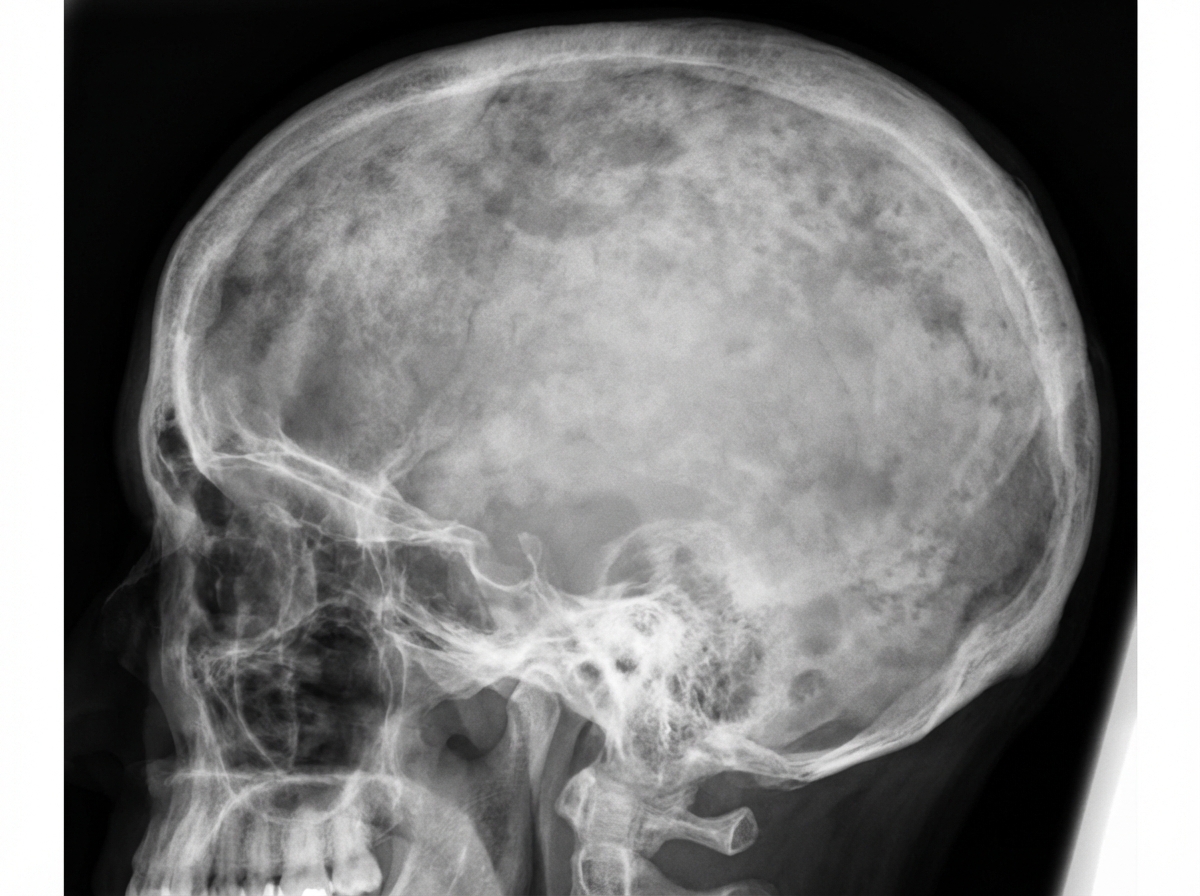
A 58-year-old man comes to the physician because of a 6-month history of headaches and back pain. Examination shows mild sensorineural hearing loss. Serum concentration of alkaline phosphatase is increased. An x-ray of the skull is shown. The most appropriate pharmacotherapy for this patient is a drug that has which of the following mechanisms of action?
Q206
A 66-year-old man presents to the emergency department for shortness of breath for the last 2 hours. Despite his diagnosis of heart failure 2 years ago, he has refused to make any diet changes. He takes aspirin and carvedilol but is poorly compliant. His vital signs are pulse of 135/min, respirations 30/min, and a blood pressure of 150/80 mm Hg. The patient is visibly distressed and unable to lie down. He is taking shallow breaths and auscultation reveals bilateral crackles in the chest. Jugular venous distension is seen. Pitting edema is present in the lower limbs. A chest X-ray shows prominent interstitial markings bilaterally with alveolar infiltrates. Which of the following is the mechanism of action of the drug that can relieve his ongoing symptoms?
Q207
A 61-year-old man with longstanding diabetes and coronary artery disease presents to the ER with chest pain and dyspnea. The echocardiogram reveals moderate-to-severe mitral regurgitation and an ejection fraction of 27%. A chest X-ray shows bibasilar infiltrates. A new drug is added to his medication regimen, and the physician mentions urinary frequency, increased breast tissue development, and erectile dysfunction as possible side effects. What is the mechanism of action of this drug?
Q208
A 32-year-old woman comes to the emergency department because of a 3-hour history of severe nausea, vomiting, tremor, and anxiety. She recently started a new medication but does not remember its name. She has a history of major depressive disorder treated with fluoxetine. Her temperature is 38.9 C (102.1 F), pulse is 132/min, respirations are 22/min, and blood pressure is 152/94 mm Hg. She is confused. Physical examination shows diaphoresis and an ataxic gait. Patellar reflexes are 4+ bilaterally. This patient's condition is most likely due to which of the following medications?
Q209
An 8-year-old girl is brought to the physician by her mother because of a 6-month history of an episodic dry cough, shortness of breath, and chest tightness. She has seasonal allergic rhinitis. Physical examination shows high-pitched expiratory wheezes throughout both lung fields. Pulmonary function testing shows an FEV1 of 70% (N ≥ 80%). Which of the following drugs would be most effective at reducing bronchial inflammation in this patient?
Q210
A 55-year-old man comes to the physician because of a 4-month history of episodic, pressure-like chest pain. The chest pain occurs when he is walking up stairs and improves with rest. He has hypertension and type 2 diabetes mellitus. His father died from a myocardial infarction at the age of 50 years. Current medications include hydrochlorothiazide and metformin. His pulse is 85/min, respirations are 12/min, and blood pressure is 140/90 mm Hg. Cardiac examination shows normal heart sounds without any murmurs, rubs, or gallops. An ECG shows high amplitude of the S wave in lead V3. An exercise stress test is performed but stopped after 4 minutes because the patient experiences chest pain. An ECG obtained during the stress test shows sinus tachycardia and ST-segment depressions in leads V1–V4. Which of the following is the most appropriate long-term pharmacotherapy to reduce the frequency of symptoms in this patient?
Autonomic/CV Drugs US Medical PG Practice Questions and MCQs
Question 201: A 59-year-old woman is scheduled to undergo a right hip total arthroplasty for severe hip osteoarthritis that has failed conservative management. She has never had surgery before. She has a history of major depressive disorder and takes sertraline daily and ibuprofen occasionally for pain. Her mother died of breast cancer and her father died from a myocardial infarction. She has a brother who had an adverse reaction following anesthesia, but she does not know details of the event. In the operating room, the anesthesiologist administers isoflurane and succinylcholine. Two minutes later, the patient develops hypercarbia and hypertonicity of her bilateral upper and lower extremities. Her temperature is 103.7°F (39.8°C), blood pressure is 155/95 mmHg, pulse is 115/min, and respirations are 20/min.
A medication with which of the following mechanisms of action is most strongly indicated for this patient?
A. Muscarinic antagonist
B. Antihistamine
C. Ryanodine receptor antagonist (Correct Answer)
D. Cholinesterase inhibitor
E. Dopamine receptor agonist
Explanation: ***Ryanodine receptor antagonist***
- The patient's presentation with **hyperthermia**, **hypercarbia**, and **muscle rigidity** after exposure to isoflurane and succinylcholine is highly indicative of **malignant hyperthermia (MH)**.
- **Dantrolene**, a **ryanodine receptor antagonist**, is the primary treatment for MH as it blocks the release of calcium from the sarcoplasmic reticulum, thereby reducing muscle contraction and heat production.
*Muscarinic antagonist*
- **Muscarinic antagonists** like atropine block the action of acetylcholine at muscarinic receptors and are used to treat **bradycardia** or reduce secretions.
- They would not address the underlying pathophysiology of malignant hyperthermia, which involves uncontrolled calcium release from the sarcoplasmic reticulum.
*Antihistamine*
- **Antihistamines** block histamine receptors and are used to treat **allergic reactions** or reduce nausea and vomiting.
- They have no role in the management of malignant hyperthermia, which is not an allergic response.
*Cholinesterase inhibitor*
- **Cholinesterase inhibitors** increase acetylcholine levels at the neuromuscular junction and are used to reverse **neuromuscular blockade** or treat **myasthenia gravis**.
- Administering a cholinesterase inhibitor would likely intensify muscle contraction and rigidity, worsening the patient's condition in malignant hyperthermia.
*Dopamine receptor agonist*
- **Dopamine receptor agonists** are primarily used to treat **Parkinson's disease** or as **vasopressors** in critical care.
- They have no direct therapeutic effect on the severe muscle rigidity and hypermetabolic state characteristic of malignant hyperthermia.
Question 202: A 70-year-old man comes to the physician for the evaluation of pain, cramps, and tingling in his lower extremities over the past 6 months. The patient reports that the symptoms worsen with walking more than two blocks and are completely relieved by rest. Over the past 3 months, his symptoms have not improved despite his participating in supervised exercise therapy. He has type 2 diabetes mellitus. He had smoked one pack of cigarettes daily for the past 50 years, but quit 3 months ago. He does not drink alcohol. His current medications include metformin, atorvastatin, and aspirin. Examination shows loss of hair and decreased skin temperature in the lower legs. Femoral pulses are palpable; pedal pulses are absent. Which of the following is the most appropriate treatment for this patient?
A. Compression stockings
B. Endarterectomy
C. Bypass surgery
D. Percutaneous transluminal angioplasty
E. Administration of cilostazol (Correct Answer)
Explanation: ***Administration of cilostazol***
- The patient presents with classic symptoms of **peripheral artery disease (PAD)**, including **intermittent claudication** (pain with exertion, relieved by rest), **loss of hair**, **decreased skin temperature**, and **absent pedal pulses**.
- **Cilostazol** is a phosphodiesterase inhibitor that improves walking distance and reduces symptoms of claudication by causing **vasodilation** and inhibiting **platelet aggregation**.
*Compression stockings*
- Compression stockings are primarily used for conditions like **venous insufficiency** or **lymphedema**, which involve problems with venous return or lymphatic drainage.
- They are **contraindicated** in patients with significant PAD because they can further occlude already compromised arterial flow and worsen tissue ischemia.
*Endarterectomy*
- **Endarterectomy** is a surgical procedure to remove plaque from the inner lining of an artery. It is indicated for **localized, severe arterial stenosis** and is more invasive than other revascularization options.
- While it can be considered for PAD, less invasive options are usually tried first, especially in a patient who has not yet received optimal medical therapy.
*Bypass surgery*
- **Bypass surgery** involves rerouting blood flow around a blocked artery using a graft (vein or synthetic material). It is a more invasive revascularization procedure for PAD with significant, extensive arterial occlusions.
- It is typically reserved for **severe symptoms** refractory to medical management and less invasive procedures, or for critical limb ischemia.
*Percutaneous transluminal angioplasty*
- **Percutaneous transluminal angioplasty (PTA)** is a minimally invasive procedure that uses a balloon to widen a narrowed artery, often with stent placement.
- It is an effective revascularization option for PAD but is generally considered after lifestyle modifications and pharmacotherapy (like cilostazol) have failed to improve symptoms sufficiently.
Question 203: A 4-year-old boy is brought to the emergency department with intense crying and pain in both hands after playing with ice cubes. His mother denies any preceding trauma. The temperature is 37.0°C (98.6°F), the blood pressure is 90/55 mm Hg, and the pulse is 100/min. The physical examination shows swollen dorsa of the hands and scleral icterus. The laboratory tests show hemoglobin of 10.1 g/dL and unconjugated hyperbilirubinemia. The cellulose acetate electrophoresis shows 60% HbS and absence of HbA. Which of the following can reduce the recurrence of the patient’s current condition?
A. Vaccinations
B. Avoidance of sulfa drugs
C. Folic acid
D. Hydroxyurea (Correct Answer)
E. Allopurinol
Explanation: ***Hydroxyurea***
- This patient presents with **dactylitis** (pain and swelling in hands) due to **vaso-occlusive crisis** from **sickle cell anemia**, confirmed by **HbS 60%, absence of HbA** and **unconjugated hyperbilirubinemia**.
- **Hydroxyurea** is the **primary disease-modifying therapy** that increases **fetal hemoglobin (HbF)** levels, which prevents HbS polymerization and reduces sickling.
- It significantly reduces the frequency of **vaso-occlusive crises** (including dactylitis), acute chest syndrome, and need for transfusions in both children and adults with sickle cell disease.
*Vaccinations*
- While vaccinations like **pneumococcal** and **meningococcal vaccines** are crucial for sickle cell patients due to functional asplenia, they prevent infections, not directly reduce the recurrence of vaso-occlusive crises.
- Infections can trigger crises, so vaccines are important supportive care but not the primary intervention for crisis recurrence.
*Avoidance of sulfa drugs*
- Sulfa drugs can cause **hemolysis** in patients with **glucose-6-phosphate dehydrogenase (G6PD) deficiency**, which is a separate condition.
- They are not directly implicated in preventing vaso-occlusive crises in sickle cell disease unless the patient also has G6PD deficiency, which is not indicated here.
*Folic acid*
- **Folic acid** is a daily supplement for sickle cell patients to support increased **erythropoiesis** due to chronic hemolysis.
- It helps prevent **megaloblastic anemia** but does not reduce the frequency or severity of sickling episodes or vaso-occlusive crises.
*Allopurinol*
- **Allopurinol** is used to prevent **uric acid nephropathy** and **gout** by reducing uric acid production, often given during chemotherapy or in conditions with high cell turnover.
- It is not a treatment for sickle cell disease itself or for preventing vaso-occlusive crises.
Question 204: A 21-year-old woman was brought to the emergency department after her roommate found her unconscious at their apartment. On arrival, her GCS was 3/15, with bilateral mydriasis, fever of 39.4℃ (103.0℉), and ventricular tachycardia which was converted to sinus rhythm. She had one episode of a generalized tonic-clonic seizure on the way to the hospital which was managed with intravenous diazepam. Her hypertension was managed with nitroglycerin. After nasogastric tube insertion, gastric lavage and activated charcoal were given. Biochemistry result showed elevated creatine phosphokinase (CPK) of 268 U/L and low serum bicarbonate of 16.7 mmol/L. Her blood and urine samples will most likely show intoxication with which of the following drugs?
A. Opioid
B. PCP
C. Marijuana
D. MPTP
E. Cocaine (Correct Answer)
Explanation: ***Cocaine***
- Cocaine intoxication presents with a classic "sympathomimetic toxidrome" including **mydriasis**, **tachycardia** (including ventricular tachycardia), **hypertension**, **hyperthermia**, and **seizures**.
- **Elevated CPK** (due to rhabdomyolysis from seizures and hyperthermia) and **low serum bicarbonate** (due to lactic acidosis from hypoperfusion and increased metabolic demand) are characteristic findings.
*Opioid*
- Opioid overdose typically causes **miosis** (pinpoint pupils), **respiratory depression**, and **CNS depression**, which are directly opposite to the presented symptoms.
- While opioids can cause CNS depression and unresponsiveness, the rest of the clinical picture, especially mydriasis, hyperthermia, and tachycardia, is inconsistent.
*PCP*
- Phencyclidine (PCP) intoxication can cause severe agitation, psychosis, nystagmus, hypertension, and tachycardia, but **bilateral mydriasis** is less typical, and it doesn't commonly lead to ventricular arrhythmias or the profound metabolic derangements seen.
- While PCP can induce seizures and hyperthermia, the overall clinical constellation strongly points away from it.
*Marijuana*
- Marijuana (cannabis) intoxication typically causes conjunctival injection, tachycardia, and altered perception but not severe CNS depression, ventricular arrhythmias, hyperthermia, or seizures in this acute and severe manner.
- The patient's critical condition with GCS 3, seizures, and severe cardiotoxicity is inconsistent with a primary marijuana overdose.
*MPTP*
- MPTP (1-methyl-4-phenyl-1,2,3,6-tetrahydropyridine) is a neurotoxin that selectively destroys dopaminergic neurons in the substantia nigra, leading to **irreversible parkinsonism**.
- It does not cause acute, severe sympathomimetic toxidrome, ventricular arrhythmias, or hyperthermia as presented in the case.
Question 205: A 58-year-old man comes to the physician because of a 6-month history of headaches and back pain. Examination shows mild sensorineural hearing loss. Serum concentration of alkaline phosphatase is increased. An x-ray of the skull is shown. The most appropriate pharmacotherapy for this patient is a drug that has which of the following mechanisms of action?
A. Inhibition of proteasomes
B. Inhibition of tubulin polymerization
C. Apoptosis of osteoclasts (Correct Answer)
D. Formation of DNA strand breaks
E. Inhibition of nuclear factor-κB
Explanation: ***Apoptosis of osteoclasts***
- The patient's symptoms (headaches, back pain, sensorineural hearing loss, elevated alkaline phosphatase) and the skull X-ray showing diffuse sclerosis (\"cotton wool\" appearance) are classic for **Paget's disease of bone**.
- **Bisphosphonates** (which induce osteoclast apoptosis) are the first-line treatment for Paget's disease by reducing abnormal bone turnover.
*Inhibition of proteasomes*
- This mechanism of action is characteristic of drugs like **bortezomib**, which are primarily used in the treatment of **multiple myeloma**.
- Multiple myeloma causes osteolytic lesions and hypercalcemia, but the X-ray findings and overall clinical picture are not consistent with this diagnosis.
*Inhibition of tubulin polymerization*
- Drugs that inhibit tubulin polymerization, such as **colchicine** (for gout) or **vincristine/vinblastine** (for various cancers), prevent cell division and migration.
- This mechanism is not relevant to the pathophysiology or treatment of Paget's disease.
*Formation of DNA strand breaks*
- This is the mechanism of action for certain **chemotherapeutic agents** (e.g., alkylating agents, platinum compounds) that damage DNA to kill rapidly dividing cancer cells.
- Paget's disease is a disorder of bone remodeling, not a primary malignancy requiring such aggressive therapy.
*Inhibition of nuclear factor-κB*
- **NF-κB** is a protein complex that controls transcription of DNA and is involved in immune responses and inflammation.
- While NF-κB inhibitors are being investigated for various inflammatory conditions and cancers, they are not the primary pharmacotherapy for Paget's disease of bone.
Question 206: A 66-year-old man presents to the emergency department for shortness of breath for the last 2 hours. Despite his diagnosis of heart failure 2 years ago, he has refused to make any diet changes. He takes aspirin and carvedilol but is poorly compliant. His vital signs are pulse of 135/min, respirations 30/min, and a blood pressure of 150/80 mm Hg. The patient is visibly distressed and unable to lie down. He is taking shallow breaths and auscultation reveals bilateral crackles in the chest. Jugular venous distension is seen. Pitting edema is present in the lower limbs. A chest X-ray shows prominent interstitial markings bilaterally with alveolar infiltrates. Which of the following is the mechanism of action of the drug that can relieve his ongoing symptoms?
A. By holding water within the tubule, leading to osmotic diuresis
B. Blocking the NaCl channels in the distal tubule of the nephron
C. Blocking the angiotensin II receptors, leading to vasodilation
D. Acting on the β-adrenergic receptors to increase cardiac contractility
E. Blocking the Na+-K+-2Cl- cotransporter in the thick ascending limb of the loop of Henle (Correct Answer)
Explanation: ***Blocking the Na+-K+-2Cl- cotransporter in the thick ascending limb of the loop of Henle***
- This describes the mechanism of action of **loop diuretics** (e.g., furosemide), which are the most effective class of diuretics for rapid relief of **pulmonary edema** and **volume overload** in acute decompensated heart failure.
- Blocking this cotransporter prevents the reabsorption of a large amount of sodium, potassium, and chloride, leading to significant diuresis and reduction of **preload**, thereby improving shortness of breath.
*By holding water within the tubule, leading to osmotic diuresis*
- This mechanism describes **osmotic diuretics** like mannitol, which are primarily used for reducing intracranial pressure or intraocular pressure and are not the drug of choice for acute pulmonary edema due to heart failure.
- While they cause diuresis, their effect is less potent and rapid compared to loop diuretics for congestion in heart failure, and they can sometimes **expand intravascular volume** initially, potentially worsening pulmonary edema in some patients.
*Blocking the NaCl channels in the distal tubule of the nephron*
- This describes the mechanism of action of **thiazide diuretics**, which act on the **distal convoluted tubule**.
- Thiazides are less potent than loop diuretics and are generally used for chronic management of hypertension or mild to moderate heart failure, not for the acute, severe volume overload seen in this patient.
*Blocking the angiotensin II receptors, leading to vasodilation*
- This describes the mechanism of **angiotensin receptor blockers (ARBs)**, which reduce blood pressure and afterload through vasodilation and are used in chronic heart failure management.
- While ARBs have a role in heart failure, they do not provide the immediate relief of acute pulmonary edema and severe volume overload needed for this patient's acute symptoms.
*Acting on the β-adrenergic receptors to increase cardiac contractility*
- This describes the mechanism of **beta-agonists** (e.g., dobutamine) or **cardiac glycosides** (e.g., digoxin), which aim to improve cardiac output.
- While these drugs can be used in some heart failure settings, they are not the primary treatment for the **acute pulmonary congestion** and **volume overload** presented, and beta-agonists can increase myocardial oxygen demand, potentially worsening ischemia.
Question 207: A 61-year-old man with longstanding diabetes and coronary artery disease presents to the ER with chest pain and dyspnea. The echocardiogram reveals moderate-to-severe mitral regurgitation and an ejection fraction of 27%. A chest X-ray shows bibasilar infiltrates. A new drug is added to his medication regimen, and the physician mentions urinary frequency, increased breast tissue development, and erectile dysfunction as possible side effects. What is the mechanism of action of this drug?
A. Inhibits Na-Cl symporter on the distal convoluted tubule
B. Inhibits epithelial Na-channels on the cortical collecting duct
C. Inhibits mineralocorticoid receptor on the cortical collecting duct (Correct Answer)
D. Inhibits Na-K-2Cl symporter on the ascending loop of Henle
E. Inhibits beta-adrenergic receptors to decrease SA node automaticity
Explanation: ***Inhibits mineralocorticoid receptor on the cortical collecting duct***
- The patient's presentation of **heart failure** (chest pain, dyspnea, low ejection fraction, bibasilar infiltrates, mitral regurgitation) along with the side effects of **urinary frequency**, **gynecomastia**, and **erectile dysfunction** are characteristic of **spironolactone** or **eplerenone**.
- These drugs are **aldosterone antagonists** that work by inhibiting the **mineralocorticoid receptor** in the cortical collecting duct, leading to diuresis and beneficial effects in heart failure.
*Inhibits Na-Cl symporter on the distal convoluted tubule*
- This describes the mechanism of action of **thiazide diuretics**, such as hydrochlorothiazide.
- While thiazides cause urinary frequency, they are not typically associated with gynecomastia or erectile dysfunction.
*Inhibits epithelial Na-channels on the cortical collecting duct*
- This mechanism describes **potassium-sparing diuretics** like amiloride and triamterene (not aldosterone antagonists).
- These drugs primarily prevent sodium reabsorption and potassium secretion, but they do not cause gynecomastia or erectile dysfunction as directly as spironolactone.
*Inhibits Na-K-2Cl symporter on the ascending loop of Henle*
- This is the mechanism of action for **loop diuretics**, such as furosemide or bumetanide.
- Loop diuretics are potent diuretics and cause urinary frequency but are not known to cause gynecomastia or erectile dysfunction.
*Inhibits beta-adrenergic receptors to decrease SA node automaticity*
- This mechanism describes **beta-blockers**, such as metoprolol or carvedilol, which are often used in heart failure management.
- While beta-blockers can cause erectile dysfunction, they do not cause urinary frequency or gynecomastia.
Question 208: A 32-year-old woman comes to the emergency department because of a 3-hour history of severe nausea, vomiting, tremor, and anxiety. She recently started a new medication but does not remember its name. She has a history of major depressive disorder treated with fluoxetine. Her temperature is 38.9 C (102.1 F), pulse is 132/min, respirations are 22/min, and blood pressure is 152/94 mm Hg. She is confused. Physical examination shows diaphoresis and an ataxic gait. Patellar reflexes are 4+ bilaterally. This patient's condition is most likely due to which of the following medications?
A. Haloperidol
B. Succinylcholine
C. Sumatriptan (Correct Answer)
D. Amiodarone
E. Scopolamine
Explanation: ***Sumatriptan***
- The patient's symptoms (fever, tachycardia, hypertension, confusion, diaphoresis, hyperreflexia, tremor, nausea, vomiting) are characteristic of **serotonin syndrome**.
- **Sumatriptan** is a 5-HT1B/1D receptor agonist and, when co-administered with an SSRI like **fluoxetine**, can precipitate serotonin syndrome due to excessive serotonergic activity.
*Haloperidol*
- This is a **D2 dopamine receptor antagonist** primarily used as an antipsychotic.
- While it can cause extrapyramidal symptoms, it does not typically induce the constellation of symptoms seen here, especially **hyperthermia** and **hyperreflexia** associated with serotonin syndrome.
*Succinylcholine*
- A **depolarizing neuromuscular blocker** used primarily for rapid-sequence intubation.
- Its effects are systemic muscle paralysis, not central nervous system hyperstimulation or serotonin syndrome signs.
*Amiodarone*
- An **antiarrhythmic drug** that can cause various adverse effects, including thyroid dysfunction, pulmonary fibrosis, and liver toxicity.
- It does not directly affect serotonin levels or induce a **hyperadrenergic state** with hyperreflexia as seen in serotonin syndrome.
*Scopolamine*
- An **anticholinergic agent** used for motion sickness.
- Overdose would present with anticholinergic toxidrome symptoms, such as dry mouth, blurred vision, urinary retention, and altered mental status, but typically **hyporeflexia** and **dry skin**, opposite to what is observed here.
Question 209: An 8-year-old girl is brought to the physician by her mother because of a 6-month history of an episodic dry cough, shortness of breath, and chest tightness. She has seasonal allergic rhinitis. Physical examination shows high-pitched expiratory wheezes throughout both lung fields. Pulmonary function testing shows an FEV1 of 70% (N ≥ 80%). Which of the following drugs would be most effective at reducing bronchial inflammation in this patient?
A. Tiotropium
B. Budesonide (Correct Answer)
C. Salmeterol
D. Montelukast
E. Adenosine
Explanation: ***Budesonide***
- **Budesonide** is an **inhaled corticosteroid** (ICS) that is the most effective long-term control medication for persistent asthma by directly reducing **airway inflammation**.
- Given the patient's symptoms (episodic cough, shortness of breath, chest tightness, wheezing, and reduced FEV1) and history of allergic rhinitis, **asthma** is likely, and an ICS is the cornerstone of treatment for managing chronic inflammation.
*Tiotropium*
- **Tiotropium** is a **long-acting anticholinergic** used primarily for **COPD** and, in some cases, severe asthma that is not well-controlled by ICS/LABA combinations.
- While it helps with bronchodilation, it does not directly target the underlying **airway inflammation** as effectively as corticosteroids.
*Salmeterol*
- **Salmeterol** is a **long-acting beta-2 agonist (LABA)** that causes bronchodilation but does not address the underlying **bronchial inflammation**.
- LABAs should never be used as monotherapy for asthma and must always be combined with an **inhaled corticosteroid** to prevent serious adverse events and improve asthma control.
*Montelukast*
- **Montelukast** is a **leukotriene receptor antagonist** that can help reduce inflammation and bronchoconstriction, particularly in **allergy-induced asthma** and **exercise-induced bronchoconstriction**.
- While it has anti-inflammatory effects, it is generally less potent than **inhaled corticosteroids** in reducing overall bronchial inflammation in persistent asthma.
*Adenosine*
- **Adenosine** is a nucleoside used for the treatment of **supraventricular tachycardia** due to its ability to temporarily block the AV node.
- It has no role in the management of **asthma** or the reduction of bronchial inflammation.
Question 210: A 55-year-old man comes to the physician because of a 4-month history of episodic, pressure-like chest pain. The chest pain occurs when he is walking up stairs and improves with rest. He has hypertension and type 2 diabetes mellitus. His father died from a myocardial infarction at the age of 50 years. Current medications include hydrochlorothiazide and metformin. His pulse is 85/min, respirations are 12/min, and blood pressure is 140/90 mm Hg. Cardiac examination shows normal heart sounds without any murmurs, rubs, or gallops. An ECG shows high amplitude of the S wave in lead V3. An exercise stress test is performed but stopped after 4 minutes because the patient experiences chest pain. An ECG obtained during the stress test shows sinus tachycardia and ST-segment depressions in leads V1–V4. Which of the following is the most appropriate long-term pharmacotherapy to reduce the frequency of symptoms in this patient?
A. Metoprolol (Correct Answer)
B. Clopidogrel
C. Aspirin
D. Nitroglycerin
E. Isosorbide mononitrate
Explanation: ***Metoprolol***
- **Beta-blockers** like metoprolol are first-line agents for **symptom relief** in stable angina by reducing myocardial oxygen demand.
- They decrease **heart rate**, **blood pressure**, and **myocardial contractility**, thereby reducing the frequency and severity of anginal episodes.
*Clopidogrel*
- **Clopidogrel** is an antiplatelet agent used primarily to prevent **thrombotic events** in patients with established cardiovascular disease or acute coronary syndromes.
- It does not directly reduce the frequency of anginal symptoms, but rather prevents progression to **myocardial infarction** or **stroke**.
*Aspirin*
- **Aspirin** is an antiplatelet medication used for **secondary prevention** of cardiovascular events by inhibiting platelet aggregation.
- While crucial for reducing cardiovascular risk, it does not directly alleviate the **frequency of anginal symptoms** themselves.
*Nitroglycerin*
- **Nitroglycerin** is a short-acting nitrate used to provide **immediate relief** of anginal pain during an acute episode.
- It is not a long-term pharmacotherapy for reducing the *frequency* of symptoms.
*Isosorbide mononitrate*
- **Isosorbide mononitrate** is a long-acting nitrate used to *prevent* angina, but it is typically a **second-line agent** after beta-blockers due to potential for **tolerance** and side effects.
- While it can reduce symptom frequency, beta-blockers are generally preferred as initial long-term therapy for symptom control.