
Other antiarrhythmic agents — MCQs

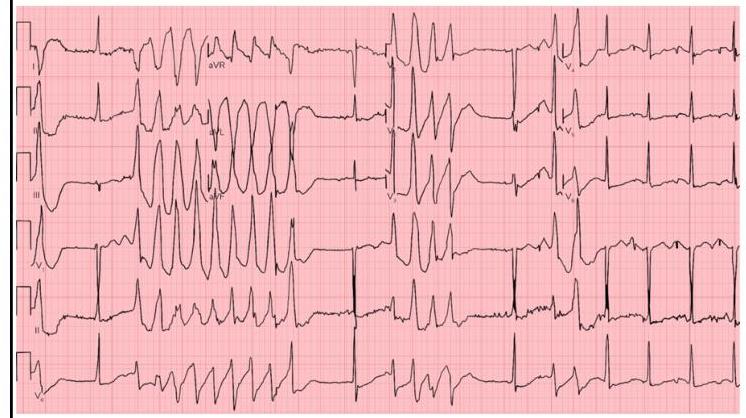
A 53-year-old man with obesity and heart disease presents to your outpatient clinic with complaints of orthopnea, significant dyspnea on minimal exertion, nausea, vomiting, and diarrhea. He says that his old doctor gave him "some pills" that he takes in varying amounts every morning. Physical exam is significant for a severely displaced point of maximal impulse, bilateral rales in the lower lung fields, an S3 gallop, and hepatomegaly. You decide to perform an EKG (shown in figure A). Suddenly, his rhythm changes to ventricular tachycardia followed by ventricular fibrillation, and he syncopizes and expires despite resuscitative efforts. High levels of which medication are most likely responsible?
An investigator is comparing the risk of adverse effects among various antiarrhythmic medications. One of the drugs being studied primarily acts by blocking the outward flow of K+ during myocyte repolarization. Further investigation shows that the use of this drug is associated with a lower rate of ventricular tachycardia, ventricular fibrillation, and torsades de pointes when compared to similar drugs. Which of the following drugs is most likely being studied?
A 63-year-old man with a history of hypertension and atrial fibrillation is brought into the emergency room and found to have a ventricular tachyarrhythmia. Ibutilide is discontinued and the patient is switched to another drug that also prolongs the QT interval but is associated with a decreased risk of torsades de pointes. Which drug was most likely administered in this patient?
A 77-year-old woman with congestive heart failure is admitted to the hospital for evaluation prior to cardiac transplantation. During her stay at the hospital, the physician prescribes a drug to improve cardiac contractility. The drug works by selectively inhibiting an isoenzyme that is responsible for the degradation of cyclic adenosine monophosphate. Which of the following is the most likely adverse effect of this drug?
A group of investigators have conducted a randomized clinical trial to evaluate the efficacy of adding a novel adenosine A1 receptor agonist to the standard anti-epileptic treatment in reducing the frequency of focal seizures. It was found that patients taking the combination regimen (n = 200) had a lower seizure frequency compared to patients taking the standard treatment alone (n = 200; p < 0.01). However, several participants taking the novel drug reported severe drowsiness. The investigators administered a survey to both the combination treatment group and standard treatment group to evaluate whether the drowsiness interfered with daily functioning using a yes or no questionnaire. Results are shown: Interference with daily functioning Yes (number of patients) No (number of patients) Combination treatment group 115 85 Standard treatment group 78 122 Which of the following statistical methods would be most appropriate for assessing the statistical significance of these results?
A 62-year-old man is brought to the emergency department because of a 4-hour history of abdominal pain, nausea, vomiting, and confusion. His wife reports that he had blurry vision on the way to the hospital. Two weeks ago, he lost his job and since then has been extremely worried about their financial situation and future. He has congestive heart failure and atrial fibrillation well controlled with combination medical therapy. His temperature is 36.5°C (97.7°F), pulse is 57/min and irregular, respirations are 14/min, and blood pressure is 118/63 mm Hg. The patient is oriented only to person. Serum studies show: Na+ 138 mEq/L Cl− 100 mEq/L K+ 5.3 mEq/L HCO3− 25 mEq/L Blood urea nitrogen 14 mg/dL Creatinine 0.9 mg/dL An ECG shows premature ventricular beats. The drug most likely responsible for this patient's symptoms has which of the following mechanisms of action?
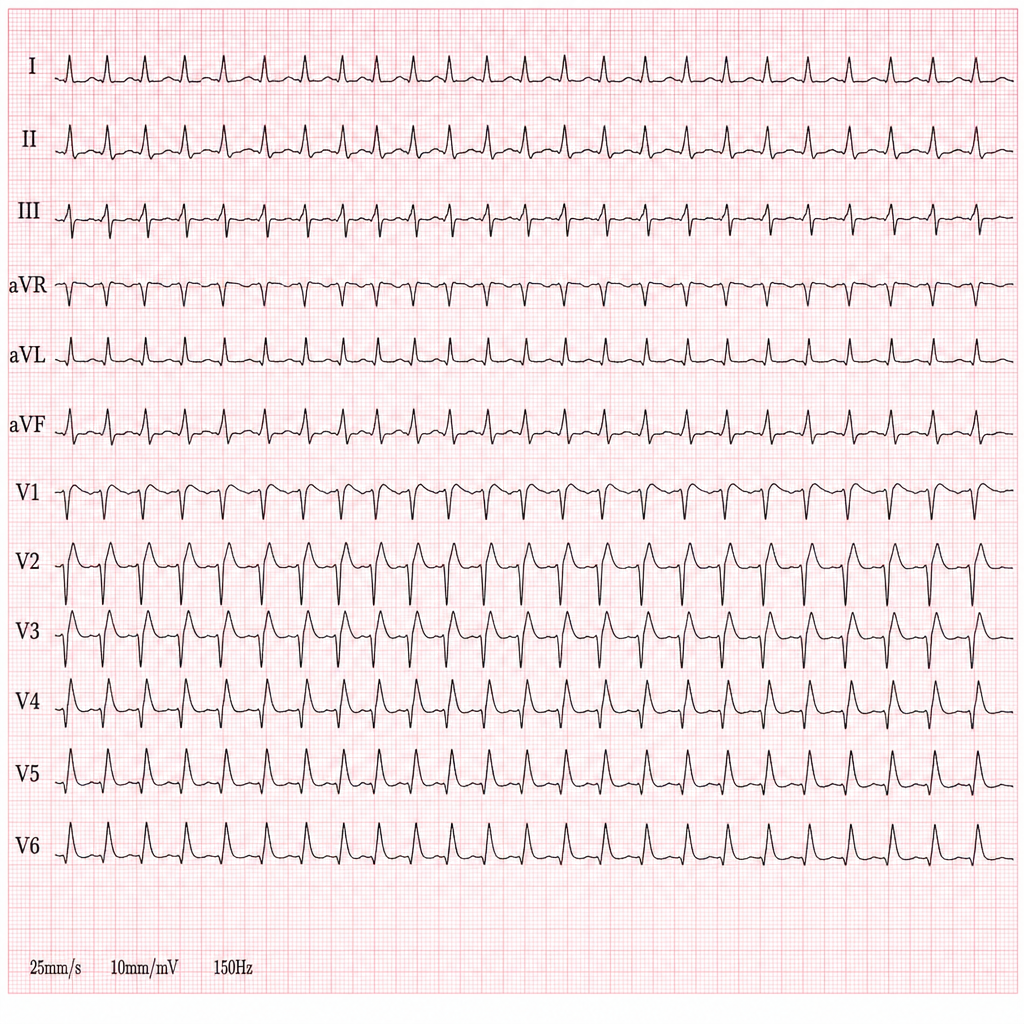
A 44-year-old woman presents with palpitations and lightheadedness. She says that symptoms onset 3 days ago and have not improved. She denies any similar episodes in this past. Her blood pressure is 140/90 mm Hg, heart rate is 150/min, respiratory rate is 16/min, and temperature is 36.6℃ (97.9℉). An ECG is performed and the results are shown in the picture. For cardioversion, it is decided to use an antiarrhythmic agent which has a use-dependent effect. Which of the following medications was most probably used?
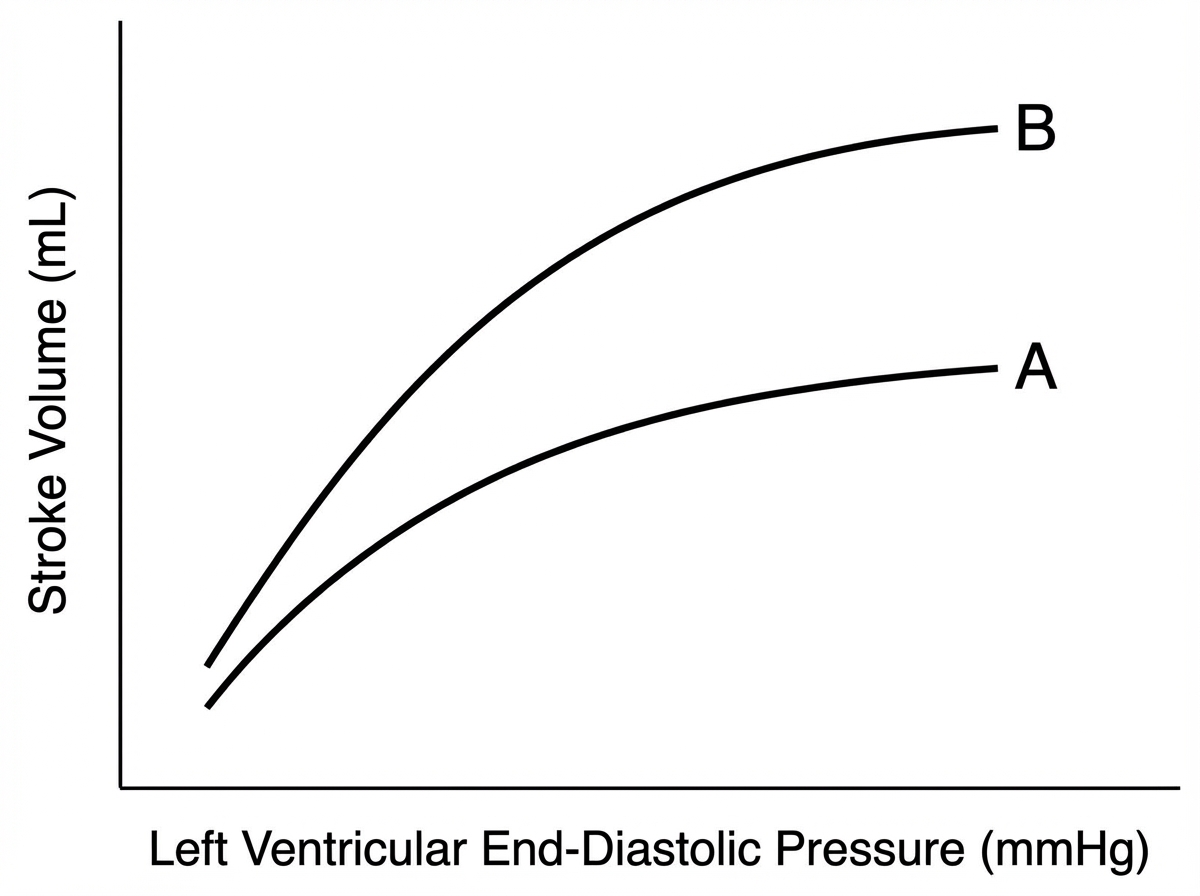
A 78-year-old male comes to the physician’s office for a routine check-up. He complains of increased lower extremity swelling, inability to climb the one flight of stairs in his home, and waking up in the middle of the night 2-3 times gasping for breath. He has had to increase the number of pillows on which he sleeps at night. These symptoms started 9 months ago and have been progressing. The doctor starts him on a medication regimen, one of which changes his Starling curve from A to B as shown in the Figure. Which of the following medications is most consistent with this mechanism of action?
A 51-year-old woman with a history of paroxysmal atrial fibrillation comes to the physician for a follow-up visit. She feels well and wants to discuss pausing her only current medication, flecainide. Her pulse is 75/min and regular, blood pressure is 125/75 mm Hg. Physical examination shows no abnormalities. An ECG shows a PR interval of 180 ms, QRS time of 120 ms, and corrected QT interval of 440 ms. Which of the following ECG changes is most likely to be seen on cardiac stress testing in this patient?
An 8-year-old boy is brought to the emergency department by his parents because of vomiting, abdominal pain, and blurry vision for the past hour. The parents report that the boy developed these symptoms after he accidentally ingested 2 tablets of his grandfather’s heart failure medication. On physical examination, the child is drowsy, and his pulse is 120/min and irregular. Digoxin toxicity is suspected. A blood sample is immediately sent for analysis and shows a serum digoxin level of 4 ng/mL (therapeutic range: 0.8–2 ng/mL). Which of the following electrolyte abnormalities is most likely to be present in the boy?
Want unlimited practice?
Get full access to all questions, explanations, and performance tracking.
Scan to download app