
Cardiac glycosides — MCQs

An experimental infusable drug, X729, is currently being studied to determine its pharmacokinetics. The drug was found to have a half life of 1.5 hours and is eliminated by first order kinetics. What is the minimum number of hours required to reach a steady state concentration of >90%?
A 58-year-old male with a history of congestive heart failure and hypertension comes to you with the chief complaint of new-onset cough as well as increased serum potassium in the setting of a new medication. Which of the following medications is most likely responsible for these findings?
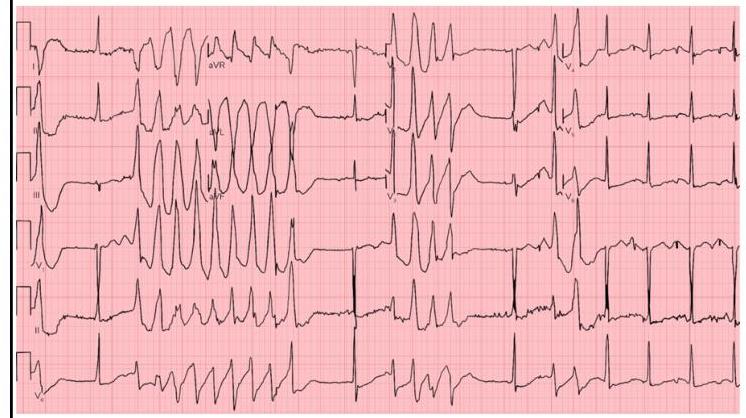
A 53-year-old man with obesity and heart disease presents to your outpatient clinic with complaints of orthopnea, significant dyspnea on minimal exertion, nausea, vomiting, and diarrhea. He says that his old doctor gave him "some pills" that he takes in varying amounts every morning. Physical exam is significant for a severely displaced point of maximal impulse, bilateral rales in the lower lung fields, an S3 gallop, and hepatomegaly. You decide to perform an EKG (shown in figure A). Suddenly, his rhythm changes to ventricular tachycardia followed by ventricular fibrillation, and he syncopizes and expires despite resuscitative efforts. High levels of which medication are most likely responsible?
An 8-year-old boy is brought to the emergency department by his parents because of vomiting, abdominal pain, and blurry vision for the past hour. The parents report that the boy developed these symptoms after he accidentally ingested 2 tablets of his grandfather’s heart failure medication. On physical examination, the child is drowsy, and his pulse is 120/min and irregular. Digoxin toxicity is suspected. A blood sample is immediately sent for analysis and shows a serum digoxin level of 4 ng/mL (therapeutic range: 0.8–2 ng/mL). Which of the following electrolyte abnormalities is most likely to be present in the boy?
A scientist is studying the excretion of a novel toxin X by the kidney in order to understand the dynamics of this new substance. He discovers that this new toxin X has a clearance that is half that of inulin in a particular patient. This patient's filtration fraction is 20% and his para-aminohippuric acid (PAH) dynamics are as follows: Urine volume: 100 mL/min Urine PAH concentration: 30 mg/mL Plasma PAH concentration: 5 mg/mL Given these findings, what is the clearance of the novel toxin X?
A 63-year-old man with a history of hypertension and atrial fibrillation is brought into the emergency room and found to have a ventricular tachyarrhythmia. Ibutilide is discontinued and the patient is switched to another drug that also prolongs the QT interval but is associated with a decreased risk of torsades de pointes. Which drug was most likely administered in this patient?
A 25-year-old woman is brought to the emergency department 12 hours after ingesting 30 tablets of an unknown drug in a suicide attempt. The tablets belonged to her father, who has a chronic heart condition. She has had nausea and vomiting. She also reports blurring and yellowing of her vision. Her temperature is 36.7°C (98°F), pulse is 51/min, and blood pressure is 108/71 mm Hg. Abdominal examination shows diffuse tenderness with no guarding or rebound. Bowel sounds are normal. An ECG shows prolonged PR-intervals and flattened T-waves. Further evaluation is most likely to show which of the following electrolyte abnormalities?
A 62-year-old man is brought to the emergency department because of a 4-hour history of abdominal pain, nausea, vomiting, and confusion. His wife reports that he had blurry vision on the way to the hospital. Two weeks ago, he lost his job and since then has been extremely worried about their financial situation and future. He has congestive heart failure and atrial fibrillation well controlled with combination medical therapy. His temperature is 36.5°C (97.7°F), pulse is 57/min and irregular, respirations are 14/min, and blood pressure is 118/63 mm Hg. The patient is oriented only to person. Serum studies show: Na+ 138 mEq/L Cl− 100 mEq/L K+ 5.3 mEq/L HCO3− 25 mEq/L Blood urea nitrogen 14 mg/dL Creatinine 0.9 mg/dL An ECG shows premature ventricular beats. The drug most likely responsible for this patient's symptoms has which of the following mechanisms of action?
A 58-year-old woman with New York Heart Association Class III heart failure, atrial fibrillation, and bipolar disorder presents to the urgent care center with nausea, vomiting, abdominal pain, double vision, and describes seeing green/yellow outlines around objects. Her current medications include ramipril, bisoprolol, spironolactone, digoxin, amiodarone, and lithium. Of the following, which medication is most likely responsible for her symptoms?
An investigator is studying the effects of drugs on the cardiac action potential. Cardiomyocytes are infused with a pharmacological agent and incubated for 5 minutes, after which the action potential is registered on a graph in real time for 2 minutes. Following infusion of the pharmacological agent, the action potential demonstrates a decreased slope of phase 0 depolarization and reduced peak amplitude compared to baseline. These results are most likely caused by an agent that inhibits which of the following?
Want unlimited practice?
Get full access to all questions, explanations, and performance tracking.
Scan to download app