A 65-year-old man presents to a clinic after 2 days of pain just below the right nipple. The pain radiates to the scapula. The rash was preceded by a burning and tingling pain in the affected region. His medical history is relevant for hypertension and hypercholesterolemia. He does not recall his vaccination status or childhood illnesses. A physical examination reveals stable vital signs and a vesicular rash distributed along the T4 dermatome. Which of the following is most appropriate for treating his condition and preventing further complications?
Q22
A 27-year-old woman presents with painful swallowing for the past 2 days. She received a kidney transplant 3 months ago for lupus-induced end-stage renal disease. She takes tacrolimus, mycophenolate mofetil, prednisone, and calcium supplements. The blood pressure is 120/80 mm Hg, the pulse is 72/min, the respirations are 14/min, and the temperature is 38.0°C (100.4°F). Esophagoscopy shows serpiginous ulcers in the distal esophagus with normal surrounding mucosa. Biopsy shows large cytoplasmic inclusion bodies. Which of the following is the most appropriate pharmacotherapy at this time?
Q23
A 31-year-old man with untreated HIV infection is admitted to the hospital because of a 3-day history of blurred vision and flashing lights in his left eye. Indirect ophthalmoscopy shows retinal hemorrhages of the left eye. Treatment with a drug that directly inhibits viral DNA polymerases by binding to pyrophosphate-binding sites is initiated. Two days later, the patient has a generalized tonic-clonic seizure. This patient's seizure was most likely caused by which of the following?
Q24
A 29-year-old female presents to her gynecologist complaining of a painful rash around her genitals. She has multiple sexual partners and uses condoms intermittently. Her last STD screen one year ago was negative. On examination, she has bilateral erosive vesicles on her labia majora and painful inguinal lymphadenopathy. She is started on an oral medication that requires a specific thymidine kinase for activation. Which of the following adverse effects is associated with this drug?
Q25
A 27-year-old man presents to the family medicine clinic for a routine check-up. The patient recently accepted a new job at a childcare center and the employer is requesting his vaccination history. After checking the records from the patient’s childhood, the physician realizes that the patient never had the varicella vaccine. The patient is unsure if he had chickenpox as a child, and there is no record of him having had the disease in the medical record. There is no significant medical history, and the patient takes no current medications. The patient’s heart rate is 82/min, respiratory rate is 14/min, temperature is 37.5°C (99.5°F), and blood pressure is 120/72 mm Hg. The patient appears alert and oriented. Auscultation of the heart reveals no murmurs, rubs, or gallops. The lungs are clear to auscultation bilaterally. With regard to the varicella vaccine, which of the following is recommended for the patient at this time?
Q26
A 9-month-old boy is brought to a pediatrician by his parents for routine immunization. The parents say they have recently immigrated to the United States from a developing country, where the infant was receiving immunizations as per the national immunization schedule for that country. The pediatrician prepares a plan for the infant’s immunizations as per standard US guidelines. Looking at the plan, the parents ask why the infant needs to be vaccinated with injectable polio vaccine, as he had already received an oral polio vaccine back in their home country. The pediatrician explains to them that, as per the recommended immunization schedule for children and adolescents in the United States, it is important to complete the schedule of immunizations using the injectable polio vaccine (IPV). He also mentions that IPV is considered safer than OPV, and IPV has some distinct advantages over OPV. Which of the following statements best explains the advantage of IPV over OPV to which the pediatrician is referring?
Q27
A thymidine kinase-deficient varicella-zoster virus strain has been isolated at a retirement home. Many of the elderly had been infected with this strain and are experiencing shingles. Which of the following would be the best antiviral agent to treat this population?
Q28
A 40-year-old man presents with problems with his vision. He says he has been experiencing blurred vision and floaters in his left eye for the past few days. He denies any ocular pain, fever, or headaches. Past medical history is significant for HIV infection a few years ago, for which he is noncompliant with his antiretroviral medications and his most recent CD4 count was 100 cells/mm3. His temperature is 36.5°C (97.7°F), the blood pressure is 110/89 mm Hg, the pulse rate is 70/min, and the respiratory rate is 14/min. Ocular exam reveals a decreased vision in the left eye, and a funduscopic examination is shown in the image. The patient is admitted and immediately started on intravenous ganciclovir. A few days after admission he is still complaining of blurry vision and floaters, so he is switched to a different medication. Inhibition of which of the following processes best describes the mechanism of action of the newly added medication?
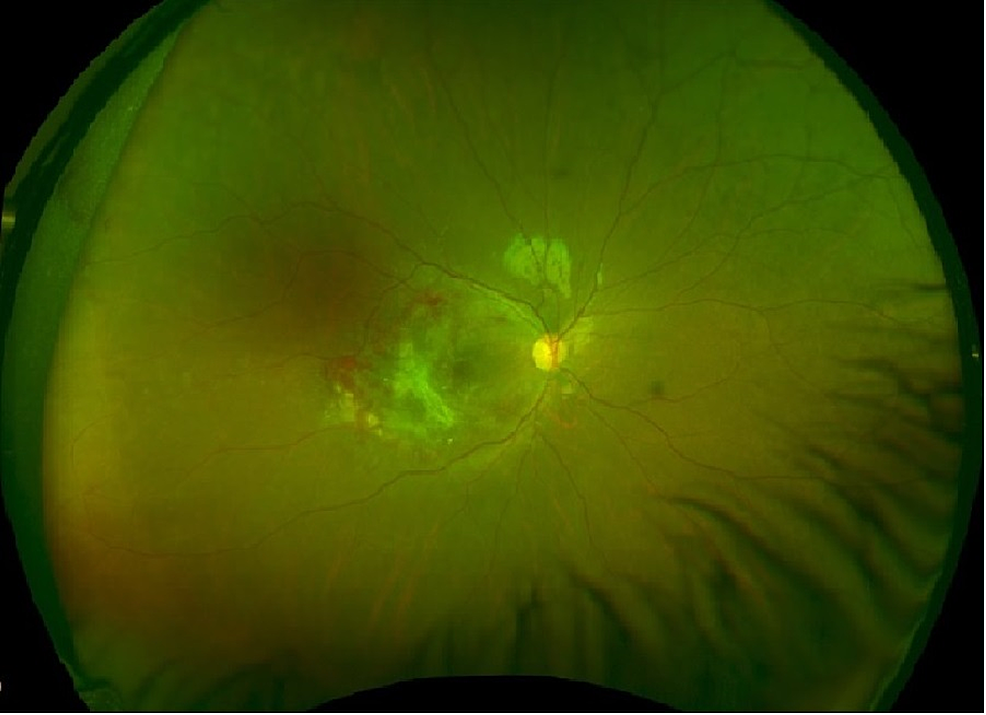
Q29
A 65-year-old male is evaluated in clinic approximately six months after resolution of a herpes zoster outbreak on his left flank. He states that despite the lesions having resolved, he is still experiencing constant burning and hypersensitivity to touch in the distribution of the old rash. You explain to him that this complication can occur in 20-30% of patients after having herpes zoster. You also explain that vaccination with the shingles vaccine in individuals 60-70 years of age can reduce the incidence of this complication. What is the complication?
Q30
A 45-year-old man presents for follow-up to monitor his chronic hepatitis C treatment. The patient was infected with hepatitis C genotype 1, one year ago. He has been managed on a combination of pegylated interferon-alpha and ribavirin, but a sustained viral response has not been achieved. Past medical history is significant for non-alcoholic fatty liver disease for the last 5 years. Which of the following, if added to the patient’s current treatment regimen, would most likely benefit this patient?
Antivirals US Medical PG Practice Questions and MCQs
Question 21: A 65-year-old man presents to a clinic after 2 days of pain just below the right nipple. The pain radiates to the scapula. The rash was preceded by a burning and tingling pain in the affected region. His medical history is relevant for hypertension and hypercholesterolemia. He does not recall his vaccination status or childhood illnesses. A physical examination reveals stable vital signs and a vesicular rash distributed along the T4 dermatome. Which of the following is most appropriate for treating his condition and preventing further complications?
A. Prednisone
B. Valganciclovir
C. Gabapentin
D. Amitriptyline
E. Famciclovir (Correct Answer)
Explanation: ***Famciclovir***
- This patient presents with classic **herpes zoster** (shingles): **prodrome of burning/tingling pain** followed by a **vesicular rash in a dermatomal distribution (T4)**.
- **Antiviral therapy** with famciclovir, valacyclovir, or acyclovir is the **primary treatment** for acute herpes zoster.
- Most effective when initiated **within 72 hours of rash onset** to reduce duration of pain, accelerate rash healing, and **decrease risk of postherpetic neuralgia (PHN)**.
- Famciclovir is a **prodrug of penciclovir** with excellent oral bioavailability.
*Prednisone*
- Corticosteroids are **not the primary treatment** for acute herpes zoster and do not prevent viral replication.
- Evidence for corticosteroids reducing **postherpetic neuralgia** is limited and controversial.
- May be used as **adjunctive therapy** in select cases for severe inflammation, but antivirals remain first-line.
*Valganciclovir*
- Valganciclovir is specific for **cytomegalovirus (CMV)** infections, not **varicella-zoster virus (VZV)**.
- While structurally related to other antivirals, it has **poor activity against VZV** compared to famciclovir, valacyclovir, or acyclovir.
- Used primarily in immunocompromised patients with CMV retinitis or organ transplant recipients.
*Gabapentin*
- Gabapentin is an **antiepileptic/neuropathic pain agent** used to treat **postherpetic neuralgia (PHN)** after it develops.
- Does **not treat the acute viral infection** or prevent PHN when started during acute phase.
- Started if chronic neuropathic pain persists **>90 days** after rash onset.
*Amitriptyline*
- Amitriptyline is a **tricyclic antidepressant (TCA)** effective for managing chronic **neuropathic pain** including PHN.
- Like gabapentin, it treats the **chronic pain complication**, not the acute viral infection.
- Does not prevent PHN development when used during acute shingles phase.
Question 22: A 27-year-old woman presents with painful swallowing for the past 2 days. She received a kidney transplant 3 months ago for lupus-induced end-stage renal disease. She takes tacrolimus, mycophenolate mofetil, prednisone, and calcium supplements. The blood pressure is 120/80 mm Hg, the pulse is 72/min, the respirations are 14/min, and the temperature is 38.0°C (100.4°F). Esophagoscopy shows serpiginous ulcers in the distal esophagus with normal surrounding mucosa. Biopsy shows large cytoplasmic inclusion bodies. Which of the following is the most appropriate pharmacotherapy at this time?
A. Ganciclovir (Correct Answer)
B. Budesonide
C. No pharmacotherapy at this time
D. Fluconazole
E. Pantoprazole
Explanation: ***Ganciclovir***
- The patient's presentation with **painful swallowing**, **serpiginous ulcers in the distal esophagus**, and **large cytoplasmic inclusion bodies** on biopsy, especially in an immunocompromised patient (kidney transplant recipient), is highly suggestive of **cytomegalovirus (CMV) esophagitis**.
- **Ganciclovir** is the first-line antiviral treatment for CMV infections, including esophagitis, particularly in transplant patients.
*Budesonide*
- **Budesonide** is a corticosteroid often used for inflammatory conditions like Crohn's disease or eosinophilic esophagitis.
- It is not indicated for viral infections and could potentially worsen the patient's immunocompromised state.
*No pharmacotherapy at this time*
- The patient has a clear symptomatic infection with characteristic findings (ulcers, inclusion bodies) in an immunocompromised state (post-transplant).
- Delaying treatment could lead to serious complications and dissemination of the CMV infection.
*Fluconazole*
- **Fluconazole** is an antifungal medication primarily used to treat *Candida* esophagitis, which typically presents with **linear, white plaques** and not serpiginous ulcers with cytoplasmic inclusion bodies.
- The biopsy findings rule out candidal infection, for which fluconazole would be appropriate.
*Pantoprazole*
- **Pantoprazole** is a proton pump inhibitor (PPI) used to reduce stomach acid, commonly prescribed for esophagitis due to reflux disease.
- While acid suppression can be part of supportive care, it does not address the underlying **viral etiology** of this patient's symptoms (CMV esophagitis).
Question 23: A 31-year-old man with untreated HIV infection is admitted to the hospital because of a 3-day history of blurred vision and flashing lights in his left eye. Indirect ophthalmoscopy shows retinal hemorrhages of the left eye. Treatment with a drug that directly inhibits viral DNA polymerases by binding to pyrophosphate-binding sites is initiated. Two days later, the patient has a generalized tonic-clonic seizure. This patient's seizure was most likely caused by which of the following?
A. Hypoglycemia
B. Demyelination
C. Encephalitis
D. Hypocalcemia (Correct Answer)
E. Lactic acidosis
Explanation: ***Hypocalcemia***
- The drug described is **foscarnet**, which inhibits viral DNA polymerase by binding to **pyrophosphate-binding sites** and is used to treat CMV retinitis, common in HIV patients.
- A known side effect of foscarnet is **electrolyte abnormalities**, including **hypocalcemia** and **hypomagnesemia**, which can precipitate seizures.
*Hypoglycemia*
- While hypoglycemia can cause seizures, it is not a direct known side effect of foscarnet or typically associated with the treatment of CMV retinitis.
- The clinical presentation does not suggest **low blood sugar** as the primary cause for the seizure.
*Demyelination*
- Demyelination can be seen in HIV infection (e.g., **PML**), but it's a slower process and less likely to cause an acute, sudden seizure following initiation of an antiviral drug for CMV retinitis.
- There is no direct link between foscarnet administration and acute demyelination leading to seizures.
*Encephalitis*
- Encephalitis can cause seizures, but the primary clinical picture describes **CMV retinitis** and a subsequent seizure after starting a specific antiviral medication.
- While HIV patients are susceptible to various CNS infections, the acute onset seizure directly linked to the initiation of foscarnet therapy points to a drug-related adverse effect rather than a new infection.
*Lactic acidosis*
- Lactic acidosis can occur in HIV patients, particularly with certain antiretroviral therapies (**NRTIs**), but it is not a direct or common side effect of foscarnet.
- While severe lactic acidosis can cause neurological symptoms, it primarily manifests with other systemic signs (e.g., nausea, vomiting, tachypnea) not described here.
Question 24: A 29-year-old female presents to her gynecologist complaining of a painful rash around her genitals. She has multiple sexual partners and uses condoms intermittently. Her last STD screen one year ago was negative. On examination, she has bilateral erosive vesicles on her labia majora and painful inguinal lymphadenopathy. She is started on an oral medication that requires a specific thymidine kinase for activation. Which of the following adverse effects is associated with this drug?
A. Photosensitivity
B. Deafness
C. Renal failure (Correct Answer)
D. Gingival hyperplasia
E. Pulmonary fibrosis
Explanation: ***Renal failure***
- The patient's symptoms (painful genital rash, erosive vesicles, inguinal lymphadenopathy) are highly suggestive of **herpes simplex virus (HSV) infection**, likely genital herpes.
- The drug described is an antiviral agent like **acyclovir, valacyclovir, or famciclovir**, which require **viral thymidine kinase** for activation and are known to cause **renal impairment** (nephrotoxicity) as an adverse effect, especially with high doses or in dehydrated patients due to crystal nephropathy.
*Photosensitivity*
- **Photosensitivity** is a common side effect of some antibiotics (e.g., tetracyclines, sulfonamides), diuretics (e.g., thiazides), and antifungals, but it is **not a prominent adverse effect of acyclovir or its derivatives**.
- While theoretical, it is not a clinically significant or frequently observed adverse effect associated with the class of antiviral drugs used for HSV.
*Deafness*
- **Ototoxicity**, leading to deafness or hearing loss, is a well-known adverse effect of certain classes of drugs, such as **aminoglycoside antibiotics** (e.g., gentamicin) and **loop diuretics** (e.g., furosemide).
- It is **not an adverse effect** associated with antiviral medications like acyclovir.
*Gingival hyperplasia*
- **Gingival hyperplasia** (overgrowth of gum tissue) is a recognized side effect of specific medications including **phenytoin** (an anticonvulsant), **cyclosporine** (an immunosuppressant), and **calcium channel blockers** (e.g., nifedipine, amlodipine).
- This adverse effect is **not associated with antiviral drugs** used to treat herpes simplex.
*Pulmonary fibrosis*
- **Pulmonary fibrosis** is a serious adverse effect linked to various drugs like **amiodarone** (an antiarrhythmic), **bleomycin** (a chemotherapeutic agent), **methotrexate** (an immunosuppressant/chemotherapeutic), and **nitrofurantoin** (an antibiotic).
- **Antiviral medications for HSV** do not typically cause pulmonary fibrosis.
Question 25: A 27-year-old man presents to the family medicine clinic for a routine check-up. The patient recently accepted a new job at a childcare center and the employer is requesting his vaccination history. After checking the records from the patient’s childhood, the physician realizes that the patient never had the varicella vaccine. The patient is unsure if he had chickenpox as a child, and there is no record of him having had the disease in the medical record. There is no significant medical history, and the patient takes no current medications. The patient’s heart rate is 82/min, respiratory rate is 14/min, temperature is 37.5°C (99.5°F), and blood pressure is 120/72 mm Hg. The patient appears alert and oriented. Auscultation of the heart reveals no murmurs, rubs, or gallops. The lungs are clear to auscultation bilaterally. With regard to the varicella vaccine, which of the following is recommended for the patient at this time?
A. Two doses of vaccine (Correct Answer)
B. One dose of the vaccine
C. Wait until patient turns 50
D. Serology then administer the vaccine (2 doses)
E. Serology then administer the vaccine (1 dose)
Explanation: ***Two doses of vaccine***
- According to **CDC/ACIP guidelines**, adults without evidence of immunity to varicella should receive **two doses of varicella vaccine** (4-8 weeks apart) without prior serologic testing.
- The patient has no documentation of vaccination or prior disease, and works in a **high-risk setting (childcare center)** with frequent exposure to children.
- **Routine serologic testing is NOT recommended** before vaccination as it delays protection, is cost-ineffective, and the vaccine is safe even if the person is already immune.
- Two doses provide **97% protection** against varicella and significant protection against breakthrough disease.
*Serology then administer the vaccine (2 doses)*
- While the two-dose schedule is correct, obtaining serology first is **not recommended by CDC** for routine adult varicella vaccination.
- Serologic testing delays protection and is cost-ineffective; the vaccine is safe to give even if immunity already exists.
- Serology may be considered in special circumstances (e.g., for healthcare workers when cost-benefit analysis favors testing), but not routinely.
*One dose of the vaccine*
- A single dose provides only **80-85% protection** and is insufficient for adults.
- **Two doses are required** for optimal immunity in adults without evidence of immunity.
*Wait until patient turns 50*
- This confuses the **varicella (chickenpox) vaccine** with the **herpes zoster (shingles) vaccine** (Shingrix), which is recommended at age 50.
- The patient needs immediate protection due to high-risk occupational exposure and current susceptibility.
*Serology then administer the vaccine (1 dose)*
- This option is incorrect for two reasons: serology is not routinely recommended, and one dose is insufficient for adult vaccination.
- Adults require a **two-dose series** for adequate protection against varicella.
Question 26: A 9-month-old boy is brought to a pediatrician by his parents for routine immunization. The parents say they have recently immigrated to the United States from a developing country, where the infant was receiving immunizations as per the national immunization schedule for that country. The pediatrician prepares a plan for the infant’s immunizations as per standard US guidelines. Looking at the plan, the parents ask why the infant needs to be vaccinated with injectable polio vaccine, as he had already received an oral polio vaccine back in their home country. The pediatrician explains to them that, as per the recommended immunization schedule for children and adolescents in the United States, it is important to complete the schedule of immunizations using the injectable polio vaccine (IPV). He also mentions that IPV is considered safer than OPV, and IPV has some distinct advantages over OPV. Which of the following statements best explains the advantage of IPV over OPV to which the pediatrician is referring?
A. IPV is known to produce higher titers of mucosal IgG antibodies than OPV
B. IPV is known to produce virus-specific CD4+ T cells that produce interleukins and interferons to control polio viruses
C. IPV is known to produce higher titers of mucosal IgA antibodies than OPV
D. IPV is known to produce higher titers of serum IgG antibodies than OPV (Correct Answer)
E. IPV is known to produce virus-specific CD8+ T cells that directly kill polio-infected cells
Explanation: ***IPV is known to produce higher titers of serum IgG antibodies than OPV***
- The **injectable polio vaccine (IPV)** is an **inactivated vaccine** that primarily induces a systemic immune response, leading to high levels of **serum IgG antibodies**. These antibodies are crucial for preventing **viremia** and subsequently protecting against paralytic poliomyelitis.
- While OPV (oral polio vaccine) induces both mucosal and humoral immunity, IPV's strength lies in its ability to generate robust systemic immunity without the risk of vaccine-associated paralytic polio (VAPP), a rare but serious complication of OPV.
*IPV is known to produce higher titers of mucosal IgG antibodies than OPV*
- IPV primarily stimulates **systemic immunity** rather than strong mucosal immunity, meaning it does not typically produce higher titers of mucosal IgG antibodies than OPV.
- Mucosal immunity, especially IgA, is better stimulated by vaccines administered orally, like **OPV**, as it directly interacts with the gut-associated lymphoid tissue.
*IPV is known to produce virus-specific CD4+ T cells that produce interleukins and interferons to control polio viruses*
- Both IPV and OPV can induce **CD4+ T cell responses**, but this statement does not highlight a distinct advantage of IPV over OPV.
- While CD4+ T cells are important for immune coordination and antibody production, the primary advantage of IPV is its **safety profile** and systemic antibody levels, not necessarily a superior CD4+ T cell response.
*IPV is known to produce higher titers of mucosal IgA antibodies than OPV*
- **OPV**, being an oral vaccine, is highly effective at inducing a strong **mucosal IgA response** in the gut, which is important for preventing viral shedding and transmission.
- **IPV**, administered parenterally, produces minimal to no mucosal IgA response, making this statement incorrect.
*IPV is known to produce virus-specific CD8+ T cells that directly kill polio-infected cells*
- **Cytotoxic CD8+ T cells** are primarily involved in clearing cells infected with intracellular pathogens.
- While both vaccines may induce some cellular immunity, their primary mechanism for protecting against polio is through **neutralizing antibodies**, and the induction of CD8+ T cells is not the principal advantage of IPV over OPV.
Question 27: A thymidine kinase-deficient varicella-zoster virus strain has been isolated at a retirement home. Many of the elderly had been infected with this strain and are experiencing shingles. Which of the following would be the best antiviral agent to treat this population?
A. Famciclovir
B. Ganciclovir
C. Cidofovir (Correct Answer)
D. Amantadine
E. Acyclovir
Explanation: ***Cidofovir***
- This is the best choice because **cidofovir** does not require **thymidine kinase** for its activation; it is phosphorylated by cellular kinases.
- Since the varicella-zoster virus (VZV) strain is **thymidine kinase-deficient**, drugs dependent on this enzyme (like acyclovir, famciclovir, ganciclovir) would be ineffective.
*Famciclovir*
- This is a prodrug that is converted to **penciclovir**, which requires **viral thymidine kinase** for its initial phosphorylation.
- Due to the VZV strain's **thymidine kinase deficiency**, famciclovir would not be effectively activated and thus not offer therapeutic benefit.
*Ganciclovir*
- Similar to acyclovir, ganciclovir requires **phosphorylation by viral thymidine kinase** (or phosphotransferase in CMV) for its antiviral activity.
- The **thymidine kinase-deficient VZV** would render ganciclovir ineffective against this specific resistant strain.
*Amantadine*
- **Amantadine** is an antiviral agent specifically used for **influenza A virus** and has no activity against VZV.
- Its mechanism of action involves inhibiting the M2 proton channel of influenza A, which is not relevant for herpesviruses.
*Acyclovir*
- **Acyclovir** is a nucleoside analog that requires **viral thymidine kinase** for its initial phosphorylation and subsequent activation.
- A **thymidine kinase-deficient VZV** strain would be resistant to acyclovir, making it an ineffective treatment.
Question 28: A 40-year-old man presents with problems with his vision. He says he has been experiencing blurred vision and floaters in his left eye for the past few days. He denies any ocular pain, fever, or headaches. Past medical history is significant for HIV infection a few years ago, for which he is noncompliant with his antiretroviral medications and his most recent CD4 count was 100 cells/mm3. His temperature is 36.5°C (97.7°F), the blood pressure is 110/89 mm Hg, the pulse rate is 70/min, and the respiratory rate is 14/min. Ocular exam reveals a decreased vision in the left eye, and a funduscopic examination is shown in the image. The patient is admitted and immediately started on intravenous ganciclovir. A few days after admission he is still complaining of blurry vision and floaters, so he is switched to a different medication. Inhibition of which of the following processes best describes the mechanism of action of the newly added medication?
A. Protein synthesis
B. Nucleic acid synthesis (Correct Answer)
C. Progeny virus release
D. Viral penetration into host cells
E. Viral uncoating
Explanation: ***Nucleic acid synthesis***
- This patient likely has **cytomegalovirus (CMV) retinitis**, characterized by **blurred vision**, **floaters**, and **necrotizing retinitis** in an HIV-positive individual with a **low CD4 count (100 cells/mm3)**.
- The initial drug, **ganciclovir**, targets nucleic acid synthesis by inhibiting viral DNA polymerase. If ganciclovir fails, a common second-line agent like **foscarnet** or **cidofovir** is used, and both also inhibit viral **nucleic acid (DNA) synthesis** through different mechanisms (foscarnet directly inhibits DNA polymerase, cidofovir is a nucleotide analog).
*Protein synthesis*
- This mechanism is targeted by certain antibacterial and antifungal drugs, but not typically by antiviral medications used for CMV.
- Antiviral drugs generally target specific viral processes, distinct from host protein synthesis, to limit toxicity.
*Progeny virus release*
- This mechanism is primarily targeted by **neuraminidase inhibitors** (e.g., oseltamivir, zanamivir) used to treat influenza, which prevent the release of new viral particles from infected cells.
- It is not a common mechanism for CMV antivirals.
*Viral penetration into host cells*
- Medications that inhibit viral penetration or entry, such as **fusion inhibitors** (e.g., enfuvirtide for HIV) or **CCR5 antagonists** (e.g., maraviroc for HIV), prevent the virus from entering the host cell.
- These mechanisms are not relevant to the treatment of CMV retinitis.
*Viral uncoating*
- **Amantadine** and **rimantadine** are examples of antiviral drugs that inhibit **viral uncoating** by interfering with the M2 ion channel in influenza A.
- This mechanism is specific to influenza viruses and is not involved in the action of CMV antiviral medications.
Question 29: A 65-year-old male is evaluated in clinic approximately six months after resolution of a herpes zoster outbreak on his left flank. He states that despite the lesions having resolved, he is still experiencing constant burning and hypersensitivity to touch in the distribution of the old rash. You explain to him that this complication can occur in 20-30% of patients after having herpes zoster. You also explain that vaccination with the shingles vaccine in individuals 60-70 years of age can reduce the incidence of this complication. What is the complication?
A. Ramsay-Hunt syndrome
B. Post-herpetic neuralgia (Correct Answer)
C. Recurrent zoster
D. Secondary bacterial infection
E. Acute herpetic neuralgia
Explanation: ***Post-herpetic neuralgia***
- This condition is characterized by **persistent pain** (burning, throbbing, or shooting) and **allodynia** (hypersensitivity to light touch) in the dermatomal distribution of a resolved herpes zoster rash.
- It occurs due to **nerve damage** caused by the varicella-zoster virus and is more common in older adults, with symptoms persisting for months to years, consistent with the patient's presentation and the statistic of 20-30% incidence.
*Ramsay-Hunt syndrome*
- This syndrome is a complication of **herpes zoster oticus**, affecting the facial nerve (cranial nerve VII).
- It presents with **facial paralysis**, rash in the ear or mouth, and sometimes hearing loss or vertigo, which is not described in this patient's symptoms.
*Recurrent zoster*
- While possible, **recurrent zoster** would involve the reappearance of the vesicular rash and associated acute pain, not persistent burning and hypersensitivity after the original rash has resolved.
- The patient describes a "resolved" outbreak, indicating the skin lesions are gone, and only the nerve pain remains.
*Secondary bacterial infection*
- A **secondary bacterial infection** would manifest as redness, warmth, swelling, pus, and increased acute pain at the site of the skin lesions.
- The patient's symptoms of chronic burning and hypersensitivity in the absence of active lesions are not consistent with a bacterial infection.
*Acute herpetic neuralgia*
- **Acute herpetic neuralgia** refers to the pain experienced *during* the active herpes zoster outbreak and up to 30 days after the rash onset.
- In this case, the pain persists six months *after resolution* of the rash, indicating a chronic condition rather than acute pain.
Question 30: A 45-year-old man presents for follow-up to monitor his chronic hepatitis C treatment. The patient was infected with hepatitis C genotype 1, one year ago. He has been managed on a combination of pegylated interferon-alpha and ribavirin, but a sustained viral response has not been achieved. Past medical history is significant for non-alcoholic fatty liver disease for the last 5 years. Which of the following, if added to the patient’s current treatment regimen, would most likely benefit this patient?
A. Emtricitabine
B. Entecavir
C. Simeprevir (Correct Answer)
D. Tenofovir
E. Telbivudine
Explanation: ***Simeprevir***
- Simeprevir is a **first-generation direct-acting antiviral (DAA)**, specifically a **protease inhibitor (NS3/4A inhibitor)**, highly effective against **HCV genotype 1**.
- Adding simeprevir to a regimen of **pegylated interferon-alpha and ribavirin** significantly increases the likelihood of achieving a **sustained virologic response** for patients who previously failed interferon-based therapy.
- **Note:** While this triple therapy approach was standard practice historically, current guidelines (as of 2024-2025) favor **interferon-free DAA combination regimens** (such as sofosbuvir/ledipasvir or glecaprevir/pibrentasvir) as first-line treatment for HCV genotype 1. However, among the options provided, simeprevir remains the only appropriate HCV-specific antiviral agent.
*Emtricitabine*
- This is a **nucleoside reverse transcriptase inhibitor (NRTI)** primarily used in the treatment of **HIV infection** and sometimes for hepatitis B.
- It has **no significant role** in the treatment of **hepatitis C viral infection**.
*Entecavir*
- Entecavir is an **antiviral agent** specifically used for the treatment of **chronic hepatitis B virus (HBV)** infection.
- It has **no established efficacy** against the **hepatitis C virus (HCV)**.
*Tenofovir*
- Tenofovir is a **nucleotide reverse transcriptase inhibitor** primarily used for treating **HIV infection** and **chronic hepatitis B virus (HBV)** infection.
- It is **not effective** against **hepatitis C virus (HCV)**.
*Telbivudine*
- Telbivudine is an **oral antiviral agent** indicated specifically for the treatment of **chronic hepatitis B virus (HBV)** infection.
- It does **not have antiviral activity** against the **hepatitis C virus (HCV)**.