
Broad-spectrum antivirals — MCQs

A 57-year-old man comes to the emergency department because he has been having problems seeing over the last week. He says that he has been seeing specks in his vision and his vision also becomes blurry when he tries to focus on objects. He says that he cannot recall anything that may have precipitated this; however, he has been homeless for several months. His CD4+ cell count is 27 cells/mL so he is started on a new medication. Notably, this drug has the following properties when mixed with various proteins: Drug alone - drug remains unphosphorylated Drug and HSV proteins - drug remains unphosphorylated Drug and CMV proteins - drug remains unphosphorylated Drug and human proteins - drug is phosphorylated Which of the following drugs is most consistent with this set of findings?
A 60-year-old man comes to the physician’s office with jaundice. Liver ultrasound reveals a shrunken liver and biopsy reveals cirrhosis. Hepatitis serologies are below: Anti-HAV: negative HBsAg: negative HBsAb: positive HBeAg: negative Anti-HBe: negative Anti-HBc: negative Anti-HCV: positive The hepatitis C viral load is 1,000,000 copies/mL. The patient is started on an antiviral regimen including sofosbuvir. What is the mechanism of action of this drug?
A 53-year-old woman comes to the physician in February because of a 1-day history of fever, chills, headache, and dry cough. She also reports malaise and generalized muscle aches. She works as a teacher at a local high school, where there was recently an outbreak of influenza. She has a history of intermittent asthma, for which she takes albuterol as needed. She declined the influenza vaccine offered in the fall because her sister told her that a friend developed a flulike illness after receiving the vaccine. She is worried about possibly becoming ill and cannot afford to miss work. Her temperature is 37.9°C (100.3°F), heart rate is 58/min, and her respirations are 12/min. Physical examination is unremarkable. Her hemoglobin concentration is 14.5 g/dL, leukocyte count is 9,400/mm3, and platelet count is 280,000/mm3. In addition to analgesia, which of the following is the most appropriate next step in management?
A 66-year-old woman with chronic obstructive pulmonary disease is brought to the emergency department because of fever, body aches, malaise, and a dry cough. She has smoked one pack of cigarettes daily for 30 years but quit smoking 1 year ago. She lives with her daughter and her granddaughter, who attends daycare. Her temperature is 38.1°C (101°F). Physical examination shows bilateral conjunctivitis, rhinorrhea, and erythematous tonsils without exudates. Further testing confirms infection with an enveloped orthomyxovirus. Administration of a drug with which of the following mechanisms of action is most appropriate?
A 49-year-old woman presents to her primary care doctor in late December with malaise. She reports worsening fatigue, myalgias, headache, and malaise that started 1 day ago. She works as a lunch lady at an elementary school. Her past medical history is notable for a distal radius fracture after a fall 2 years ago, but she is otherwise healthy and takes no medications. She does not smoke or drink alcohol. She is married and has 3 adult children who are healthy. Her temperature is 102.9°F (39.4°C), blood pressure is 101/61 mmHg, pulse is 112/min, and respirations are 21/min. On exam, she appears lethargic and uncomfortable but is able to answer questions appropriately. Breath sounds are normal bilaterally. She is started on intravenous fluids and a pharmacologic agent for treatment. Which of the following is the most likely mechanism of action of the drug being used to treat this patient?
An HIV-positive patient with a CD4+ count of 45 is receiving recommended first-line treatment for a case of cytomegalovirus retinitis. Coadministration with which of the following agents would be most likely to precipitate a deficiency of neutrophils in this patient?
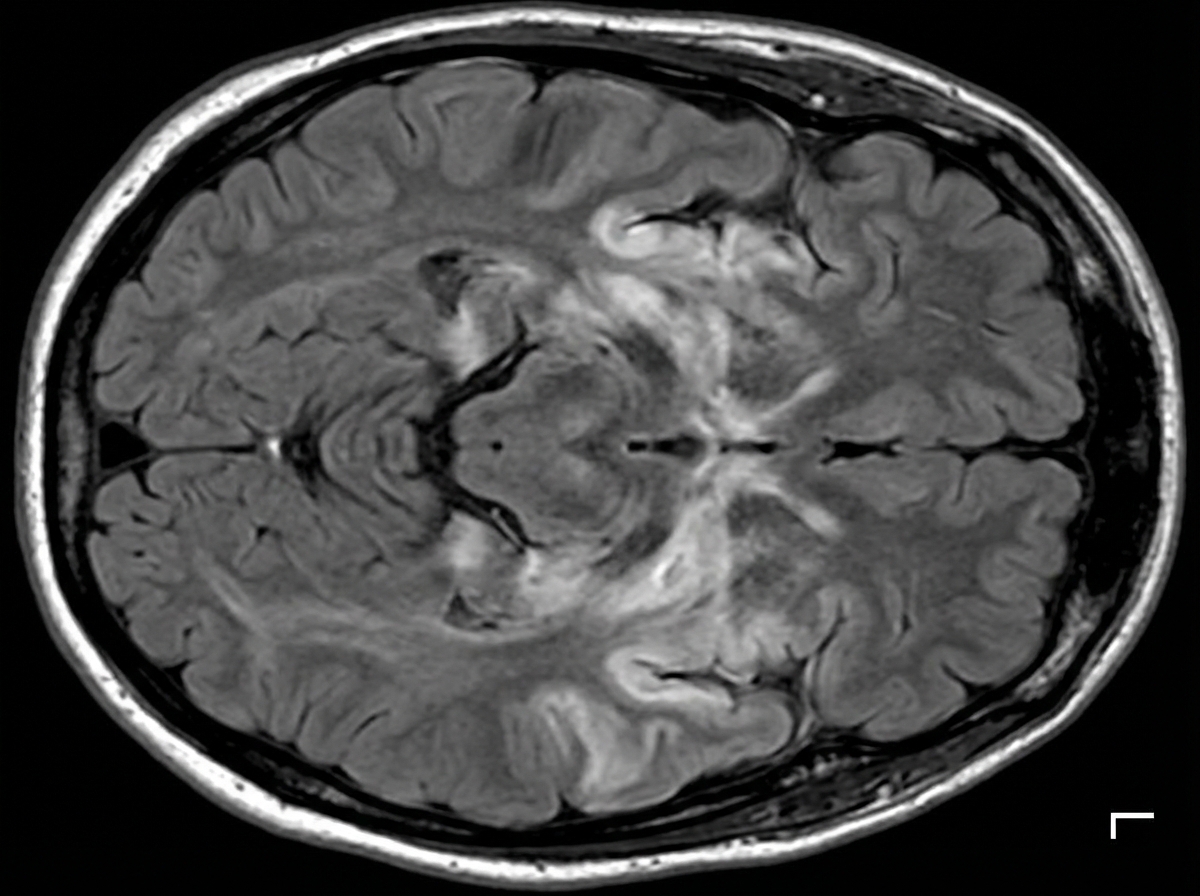
A 27-year-old man is brought to the emergency department by his friends in a confused state. He was doing fine 5 days ago when he started to complain of fever and flu-like symptoms. His fever was low-grade and associated with a headache. For the past 2 days, he has become increasingly irritable, confused, and was getting angry at trivial things. Past medical history is unremarkable. He is a college student and is physically active. He smokes cigarettes occasionally. He drinks alcohol socially. He is sexually active with his girlfriend and they use condoms inconsistently. Physical examination reveals: blood pressure 120/80 mm Hg, heart rate 108/min, respiratory rate 10/min, and temperature 37.4°C (99.4°F). He is confused and disoriented. Pupils are 3 mm in diameter and respond to light sluggishly. He is moving all his limbs spontaneously. His neck is supple. MRI of the brain is shown in the picture. Cerebrospinal fluid (CSF) reveals an opening pressure of 16 cm of H20, a total leukocyte count of 112/mm3 with 85% lymphocytes, the protein of 42 mg/dL, and glucose of 58 mg/dL. What is the best treatment for this condition?
A 6-month-old infant boy is brought to the clinic for a check-up by a couple who recently adopted him from foster care. The biological mother was from a rehabilitation facility and was found incompetent to care for the child, hence he was handed over to foster care. No other information is available regarding his prenatal or birth history. On examination, his weight is found to be below the 3rd percentile. Physical appearance is remarkable for midfacial hypoplasia with a flattened nasal bridge, smooth philtrum, and thin lips. Auscultation reveals a grade 3/6 holosystolic murmur at the left lower sternal border. Developmental delay is noted as well. Which of the following teratogens is most likely to be associated with the infant's presentation?
A 26-year-old G1P0 woman is brought to the emergency room by her spouse for persistently erratic behavior. Her spouse reports that she has been sleeping > 1 hour a night, and it sometimes seems like she’s talking to herself. She has maxed out their credit cards on baby clothes. The patient’s spouse reports this has been going on for over a month. Since first seeing a physician, she has been prescribed multiple first and second generation antipsychotics, but the patient’s spouse reports that her behavior has failed to improve. Upon examination, the patient is speaking rapidly and occasionally gets up to pace the room. She reports she is doing “amazing,” and that she is “so excited for the baby to get here because I’m going to be the best mom.” She denies illicit drug use, audiovisual hallucinations, or suicidal ideation. The attending psychiatrist prescribes a class of medication the patient has not yet tried to treat the patient’s psychiatric condition. In terms of this new medication, which of the following is the patient’s newborn most likely at increased risk for?
An 8-year-old boy is brought to the emergency department by his parents because of sudden onset of abdominal pain beginning an hour ago. The parents report that their son has also had an episode of dark urine earlier that morning. Three days ago, he was diagnosed with a urinary tract infection and was treated with trimethoprim-sulfamethoxazole. He emigrated from Liberia to the US with his family 3 years ago. There is no personal history of serious illness. His immunizations are up-to-date. Vital signs are within normal limits. Examination shows diffuse abdominal tenderness and scleral icterus. The spleen is palpated 1–2 cm below the left costal margin. Laboratory studies show: Hemoglobin 10 g/dL Mean corpuscular volume 90 μm3 Reticulocyte count 3% Serum Bilirubin Total 3 mg/dL Direct 0.5 mg/dL Haptoglobin 20 mg/dL (N=41–165 mg/dL) Lactate dehydrogenase 160 U/L Urine Blood 3+ Protein 1+ RBC 2–3/hpf WBC 2–3/hpf Which of the following is the most likely underlying cause of this patient's symptoms?
Want unlimited practice?
Get full access to all questions, explanations, and performance tracking.
Scan to download app