An experimental drug, ES 62, is being studied. It prohibits the growth of vancomycin-resistant Staphylococcus aureus. It is highly lipid-soluble. The experimental design is dependent on a certain plasma concentration of the drug. The target plasma concentration is 100 mmol/dL. Which of the following factors is most important for calculating the appropriate loading dose?
Q152
A 33-year-old man with recently diagnosed testicular cancer visits his oncologist to discuss the treatment plan. His left testicle was removed after a thorough workup of a lump. A pelvic CT showed no enlarged lymph nodes and a simple orchiectomy and pelvic lymph node dissection was completed. The final diagnosis was stage IB non-seminoma testicular cancer (pT2N0M0). A combination of different chemotherapeutic medications is recommended including bleomycin, etoposide, and cisplatin. Each of the antineoplastic drugs has a different mechanism of action targeting cancer cells. What is the primary mechanism of action of bleomycin in cancer treatment?
Q153
A 32-year-old man presents to an outpatient clinic for tuberculosis prophylaxis before leaving for a trip to Asia, where tuberculosis is endemic. The Mantoux test is positive, but the chest X-ray and AFB sputum culture are negative. He was started on isoniazid. What is the most likely mechanism of resistance to isoniazid?
Q154
A 55-year-old man with a history of hypertension and benign prostate hyperplasia presents for follow-up 4 days into the treatment of a urinary tract infection with trimethoprim-sulfamethoxazole. His symptoms have resolved, and he reports no problems with urination, with the exception of a weak urine stream and hesitancy, which he has had for the past 2 years. At the time of this visit, the patient is afebrile; the blood pressure is 130/88 mm Hg and the heart rate is 80/min. There is no flank tenderness. A urinalysis reveals no leukocytes and is negative for esterase. The urinalysis reveals 2 red blood cells (RBCs)/ high power field (HPF), and there are no casts on urinary sediment analysis. The physician, however, notices the following abnormality:
Prior treatment
BUN 12 mg/dL
Creatinine 1.2 mg/dL
Today’s visit
BUN 13 mg/dL
Creatinine 2.1 mg/dL
Q155
A 59-year-old man presents to the health clinic for evaluation of severe itching for the past week. The itching is worse at night while lying in bed. The patient has a past medical history of hyperlipidemia, atrial fibrillation, and colon cancer. The patient takes rivaroxaban, simvastatin, and aspirin. The patient has a surgical history of colon resection, appendectomy, and tonsillectomy. He drinks a 6-pack of beer almost every night of the week. He smokes 2 packs of cigarettes daily and has been living at a homeless shelter for the past 6 months. Examination of the skin shows small crusted sores and superficial, wavy gray lines along the wrists and interdigital spaces of both hands as seen in the image. Small vesicles are also present along with excoriations. Which of the following is the most appropriate treatment option for this patient?
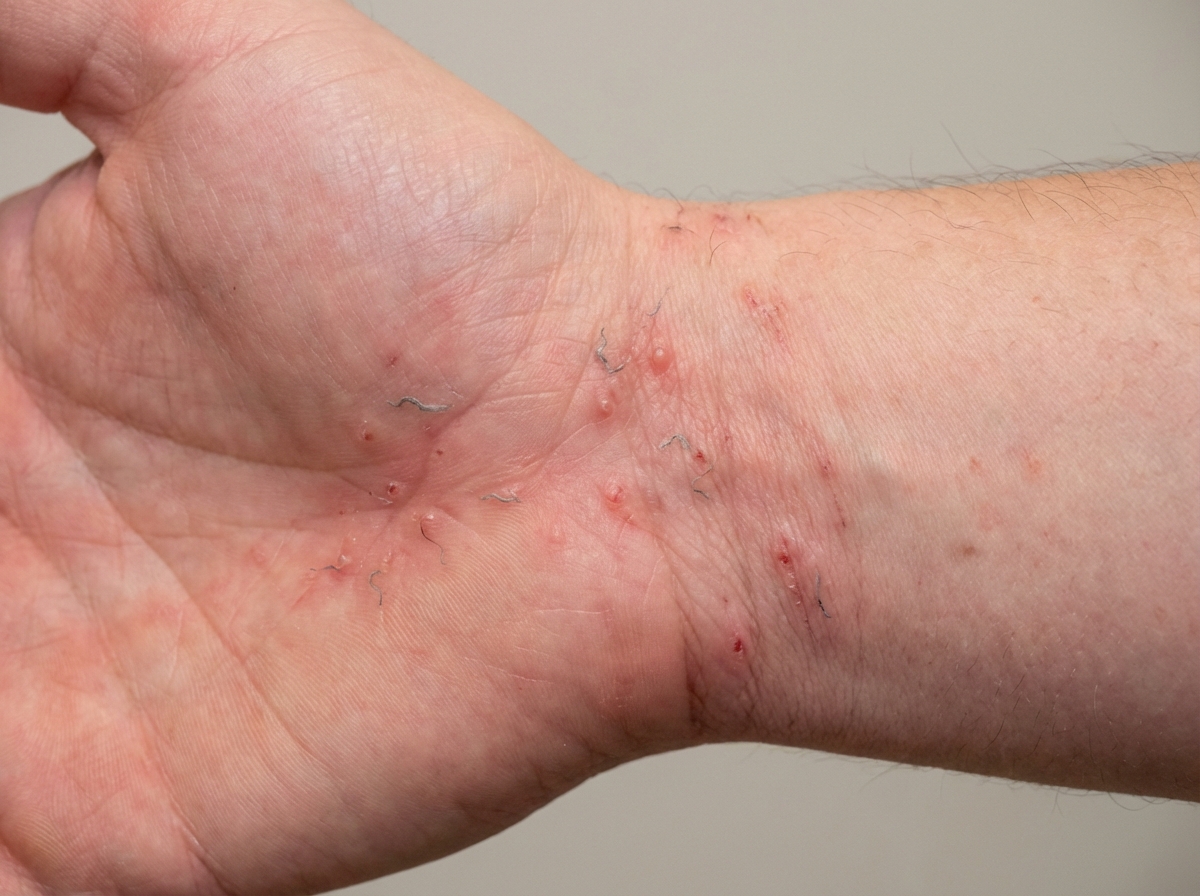
Q156
A 56-year-old woman undergoes open reduction and internal fixation of the distal tibia 1 day after a fall. She has had rheumatoid arthritis for 12 years and diabetes mellitus for 2 years. Her medications over the past year have included metformin, prednisone, calcium supplements, and methotrexate. Prior to surgery, insulin was added to her medications, and the dose of prednisone was increased. She has had appropriate nutrition over the years with regular follow-ups with her healthcare professional. Which of the following is the most appropriate supplement to prevent wound failure in this patient?
Q157
A 25-year-old woman presented to an urgent care center with a complaint of a cough for more than 3 weeks that was accompanied by night sweats, weight loss, and malaise. On physical examination, the patient had slightly pale palpebral conjunctivae, bilateral posterior cervical lymphadenopathy, but with no adventitious breath sounds in the lung fields bilaterally. The remainder of the physical examination was routine. The patient was started on a drug regimen that was to be taken for 6 months. On follow-up after 2 months, the ALT and AST levels were elevated. Which of the following anti-tubercular drugs could have contributed to this laboratory result?
Q158
A 24-year-old man presents to his primary care provider with complaints of 2 days of profuse diarrhea. He states that his stool started to turn watery and lighter in color beginning yesterday, and he has not noticed any fevers. His diarrhea episodes have become more frequent and white-colored over the past day. He has also noticed dry mouth symptoms and darker urine today. He is otherwise healthy but recently returned from a trip with friends to South Asia. None of his friends have reported any symptoms. On exam, his temperature is 98.6°F (37.0°C), blood pressure is 110/68 mmHg, pulse is 80/min, respirations are 14/min. The patient has normal skin turgor, but he has noticeably dry oral mucosa and chapped lips. The patient has dull abdominal aching but no tenderness to palpation. The stool is found to contain large quantities of comma-shaped organisms. Fecal occult blood testing is negative and no steatorrhea is found. The provider recommends immediate oral rehydration therapy. Which of the following is the likely mechanism of this patient’s diarrhea?
Q159
A 19-year-old woman presents to the emergency department with chronic diarrhea, fatigue, and weakness. She also had mild lower extremity edema. On examination, she was noted to be pale. Blood testing revealed peripheral eosinophilia (60%) and a Hb concentration of 8 g/dL. The stool examination revealed Fasciolopsis buski eggs. Which of the following drugs would most likely be effective?
Q160
A 31-year-old man comes to the physician because of several months of recurrent abdominal pain and diarrhea. Six months ago, he traveled to Lake Superior for a fishing trip with his friends, during which they often ate their day's catch for dinner. Physical examination shows pallor. Laboratory studies show macrocytic anemia with eosinophilia. A peripheral blood smear shows megaloblasts and hypersegmented neutrophils. A cestode infection is suspected and a drug is prescribed that kills cestodes by inducing uncontrollable muscle spasm in the parasite. The drug prescribed for this patient most likely acts by which of the following mechanisms of action?
Antimicrobials US Medical PG Practice Questions and MCQs
Question 151: An experimental drug, ES 62, is being studied. It prohibits the growth of vancomycin-resistant Staphylococcus aureus. It is highly lipid-soluble. The experimental design is dependent on a certain plasma concentration of the drug. The target plasma concentration is 100 mmol/dL. Which of the following factors is most important for calculating the appropriate loading dose?
A. Volume of distribution (Correct Answer)
B. Half-life of the drug
C. Therapeutic index
D. Clearance of the drug
E. Rate of administration
Explanation: **Volume of distribution**
- The **loading dose** is primarily determined by the desired **plasma concentration** and the **volume of distribution (Vd)**, as it reflects how extensively a drug is distributed in the body.
- The formula for loading dose is: Loading Dose = (Target Plasma Concentration × Vd).
*Half-life of the drug*
- The **half-life** is crucial for determining the **dosing interval** and the time it takes to reach **steady-state concentrations**, not the initial loading dose.
- It reflects the rate at which the drug is eliminated from the body.
*Therapeutic index*
- The **therapeutic index** is a measure of a drug's relative safety, indicating the ratio between the **toxic dose** and the **effective dose**.
- While important for drug safety, it does not directly determine the magnitude of the loading dose itself.
*Clearance of the drug*
- **Clearance** is the rate at which the drug is removed from the body and is a primary determinant of the **maintenance dose** required to sustain a desired plasma concentration.
- It does not directly calculate the initial loading dose needed to achieve an immediate target concentration.
*Rate of administration*
- The **rate of administration** (e.g., infusion rate) primarily influences how quickly the drug reaches its target concentration, but not the total quantity of drug needed for the initial loading dose.
- It affects the kinetics of how the loading dose achieves the target concentration, rather than defining the dose amount.
Question 152: A 33-year-old man with recently diagnosed testicular cancer visits his oncologist to discuss the treatment plan. His left testicle was removed after a thorough workup of a lump. A pelvic CT showed no enlarged lymph nodes and a simple orchiectomy and pelvic lymph node dissection was completed. The final diagnosis was stage IB non-seminoma testicular cancer (pT2N0M0). A combination of different chemotherapeutic medications is recommended including bleomycin, etoposide, and cisplatin. Each of the antineoplastic drugs has a different mechanism of action targeting cancer cells. What is the primary mechanism of action of bleomycin in cancer treatment?
A. Direct DNA strand cleavage (Correct Answer)
B. Ribonucleotide reductase inhibition
C. RNA polymerase inhibition
D. Topoisomerase II inhibition
E. DNA polymerase inhibition
Explanation: ***Direct DNA strand cleavage***
- Bleomycin is a **cytotoxic antibiotic** that induces DNA damage by generating **free radicals**, leading to **single and double-strand DNA breaks**.
- This mechanism primarily occurs in the **G2 and M phases** of the cell cycle, inhibiting DNA synthesis and cell division.
*Ribonucleotide reductase inhibition*
- This is the primary mechanism of action for drugs like **hydroxyurea**, which prevents the conversion of **ribonucleotides to deoxyribonucleotides**, thereby impairing DNA synthesis.
- Bleomycin does not act by inhibiting this enzyme.
*RNA polymerase inhibition*
- This mechanism is associated with drugs such as **dactinomycin (actinomycin D)**, which intercalates into DNA and blocks RNA synthesis.
- Bleomycin's action is more direct in causing DNA damage rather than inhibiting RNA transcription.
*Topoisomerase II inhibition*
- Drugs like **etoposide** and **doxorubicin** are topoisomerase II inhibitors, which prevent DNA unwinding and re-ligation, leading to DNA breaks and cell death.
- While etoposide is used in the same regimen, this is not the mechanism of action for bleomycin.
*DNA polymerase inhibition*
- This is the mechanism of action for certain **antimetabolites** and **nucleoside analogs**, such as **cytarabine** or **gemcitabine**, which interfere with DNA replication by blocking DNA polymerase.
- Bleomycin's action is distinct, involving direct oxidative cleavage of DNA.
Question 153: A 32-year-old man presents to an outpatient clinic for tuberculosis prophylaxis before leaving for a trip to Asia, where tuberculosis is endemic. The Mantoux test is positive, but the chest X-ray and AFB sputum culture are negative. He was started on isoniazid. What is the most likely mechanism of resistance to isoniazid?
A. Methylation of the RNA binding site
B. Plasmid-mediated resistance
C. Reduction of drug binding to RNA polymerase
D. Increased efflux from the cell
E. Mutations in katG (Correct Answer)
Explanation: ***Mutations in katG***
- The **katG gene** encodes **catalase-peroxidase**, an enzyme essential for activating isoniazid into its active form within *Mycobacterium tuberculosis*.
- Mutations in *katG* prevent the activation of isoniazid, thereby conferring **resistance**.
*Methylation of the RNA binding site*
- This mechanism is primarily associated with **aminoglycoside resistance**, where methylation of ribosomal RNA prevents antibiotic binding.
- It is not a known mechanism for resistance to **isoniazid**.
*Plasmid-mediated resistance*
- While common in many bacteria for antibiotic resistance, **plasmid-mediated resistance** is rare for **first-line anti-tuberculosis drugs** like isoniazid in *Mycobacterium tuberculosis*.
- Most *M. tuberculosis* resistance mechanisms involve **chromosomal mutations**.
*Reduction of drug binding to RNA polymerase*
- This mechanism is typically associated with resistance to **rifamycins** (e.g., rifampin), which target the **bacterial RNA polymerase**.
- Isoniazid's mechanism of action involves **mycolic acid synthesis inhibition**, not RNA polymerase binding.
*Increased efflux from the cell*
- While efflux pumps contribute to antibiotic resistance in many bacteria, they are less commonly the primary mechanism for high-level **isoniazid resistance** in *M. tuberculosis*.
- Resistance is predominantly linked to target modification or enzyme deficits, like those involving **katG**.
Question 154: A 55-year-old man with a history of hypertension and benign prostate hyperplasia presents for follow-up 4 days into the treatment of a urinary tract infection with trimethoprim-sulfamethoxazole. His symptoms have resolved, and he reports no problems with urination, with the exception of a weak urine stream and hesitancy, which he has had for the past 2 years. At the time of this visit, the patient is afebrile; the blood pressure is 130/88 mm Hg and the heart rate is 80/min. There is no flank tenderness. A urinalysis reveals no leukocytes and is negative for esterase. The urinalysis reveals 2 red blood cells (RBCs)/ high power field (HPF), and there are no casts on urinary sediment analysis. The physician, however, notices the following abnormality:
Prior treatment
BUN 12 mg/dL
Creatinine 1.2 mg/dL
Today’s visit
BUN 13 mg/dL
Creatinine 2.1 mg/dL
A. Admit the patient for further management of acute interstitial nephritis
B. Admit the patient for further management of acute tubular necrosis
C. Schedule a cystoscopy for urethral obstruction
D. Schedule an intravenous pyelography for urinary obstruction
E. Reassure the patient, stop trimethoprim-sulfamethoxazole and repeat the measurement in 1–2 weeks (Correct Answer)
Explanation: ***Reassure the patient, stop trimethoprim-sulfamethoxazole and repeat the measurement in 1–2 weeks***
- The patient's **creatinine elevation** from 1.2 to 2.1 mg/dL after starting **trimethoprim-sulfamethoxazole** is likely due to the drug's known effect of inhibiting **creatinine secretion** in the renal tubules, leading to a rise in serum creatinine without actual kidney injury, and this effect is often reversible upon discontinuation.
- Given that the patient's symptoms of UTI have resolved, and there are no signs of active kidney injury (afebrile, no flank tenderness, normal urinalysis for leukocytes/casts, mild RBCs), the most appropriate step is to stop the medication and monitor kidney function.
*Admit the patient for further management of acute interstitial nephritis*
- **Acute interstitial nephritis** typically presents with systemic symptoms like **fever**, **rash**, and **eosinophilia**, none of which are present in this case.
- The urinalysis would typically show **white blood cells** and possibly **eosinophils**, which are absent here.
*Admit the patient for further management of acute tubular necrosis*
- **Acute tubular necrosis** (ATN) usually causes a more significant and rapid rise in creatinine, often accompanied by **oliguria** or **anuria**, and a urinalysis showing muddy brown casts, which are not seen here.
- The patient's symptoms have improved, suggesting no severe acute kidney injury requiring admission for ATN.
*Schedule a cystoscopy for urethral obstruction*
- While the patient has a history of benign prostatic hyperplasia (BPH) and symptoms of weak stream and hesitancy, these are chronic issues and do not explain the acute rise in creatinine.
- A **cystoscopy** is an invasive procedure and is not indicated as an immediate response to this reversible creatinine elevation.
*Schedule an intravenous pyelography for urinary obstruction*
- An **intravenous pyelography** (IVP) is used to visualize the urinary tract and might detect a urinary obstruction, but the history of BPH and chronic symptoms don't point towards a new, acute obstructive process causing the creatinine increase.
- Furthermore, an IVP involves contrast dye, which could be nephrotoxic, especially in a patient with elevated creatinine, making it an inappropriate initial step.
Question 155: A 59-year-old man presents to the health clinic for evaluation of severe itching for the past week. The itching is worse at night while lying in bed. The patient has a past medical history of hyperlipidemia, atrial fibrillation, and colon cancer. The patient takes rivaroxaban, simvastatin, and aspirin. The patient has a surgical history of colon resection, appendectomy, and tonsillectomy. He drinks a 6-pack of beer almost every night of the week. He smokes 2 packs of cigarettes daily and has been living at a homeless shelter for the past 6 months. Examination of the skin shows small crusted sores and superficial, wavy gray lines along the wrists and interdigital spaces of both hands as seen in the image. Small vesicles are also present along with excoriations. Which of the following is the most appropriate treatment option for this patient?
A. Ivermectin
B. Dicloxacillin
C. Penicillin G
D. Acyclovir
E. Permethrin (Correct Answer)
Explanation: ***Permethrin***
- The patient's symptoms of **severe itching**, especially **worse at night**, and the presence of **crusted sores, wavy gray lines (burrows)** on the wrists and interdigital spaces are highly characteristic of **scabies**.
- **Permethrin cream** (5%) is a first-line topical treatment for scabies due to its high efficacy against *Sarcoptes scabiei* mites.
*Ivermectin*
- While **oral ivermectin** is effective for scabies, particularly **crusted scabies** or when topical treatment fails, it is typically considered a second-line agent.
- Given the classic presentation, a topical approach like permethrin is usually tried first, especially if the patient is not severely immunocompromised or has extensive crusted lesions.
*Dicloxacillin*
- **Dicloxacillin** is an **antibiotic** used to treat **bacterial infections**, commonly staphylococcal and streptococcal skin infections.
- While the patient has excoriations and crusted sores, suggesting potential secondary bacterial infection, the primary infestation diagnosis is scabies, which requires an **acaricide**, not an antibiotic.
*Penicillin G*
- **Penicillin G** is an **antibiotic** primarily used for treating severe bacterial infections, particularly those caused by susceptible streptococci, meningococci, and specific spirochetes.
- It is **ineffective against parasitic infestations** like scabies, which is caused by mites.
*Acyclovir*
- **Acyclovir** is an **antiviral medication** used to treat herpes simplex virus (HSV) infections (e.g., cold sores, genital herpes) and varicella-zoster virus (VZV) infections (e.g., shingles, chickenpox).
- The patient's clinical presentation is inconsistent with a viral infection; therefore, **acyclovir would not be an appropriate treatment** for scabies.
Question 156: A 56-year-old woman undergoes open reduction and internal fixation of the distal tibia 1 day after a fall. She has had rheumatoid arthritis for 12 years and diabetes mellitus for 2 years. Her medications over the past year have included metformin, prednisone, calcium supplements, and methotrexate. Prior to surgery, insulin was added to her medications, and the dose of prednisone was increased. She has had appropriate nutrition over the years with regular follow-ups with her healthcare professional. Which of the following is the most appropriate supplement to prevent wound failure in this patient?
A. Glutamine
B. Zinc
C. Vitamin A
D. Arginine
E. Vitamin C (Correct Answer)
Explanation: ***Vitamin C***
- This patient is at high risk for **wound healing complications** due to her comorbidities (diabetes, rheumatoid arthritis) and medications (prednisone, methotrexate). **Vitamin C** (ascorbic acid) is essential for **collagen synthesis** and cross-linking, which is crucial for wound strength and tissue repair.
- While other options play a role in wound healing, Vitamin C is particularly important in patients with **impaired healing** due to chronic inflammation, corticosteroid use, and metabolic disorders, as it counteracts their negative effects on collagen formation.
*Glutamine*
- **Glutamine** is an important fuel for rapidly dividing cells, including immune cells and fibroblasts, and can be beneficial in catabolic states.
- However, its role in directly counteracting the specific challenges of this patient's wound healing (corticosteroid use, diabetes, rheumatoid arthritis) is **less direct** compared to Vitamin C's role in collagen synthesis.
*Zinc*
- **Zinc** is a cofactor for numerous enzymes involved in cell proliferation, immune function, and collagen synthesis.
- While important, zinc deficiency is not explicitly indicated, and its role as a primary intervention to prevent wound failure in a patient with **prednisone-induced healing impairment** is secondary to vitamin C.
*Vitamin A*
- **Vitamin A** can help reverse the negative effects of **corticosteroids** on wound healing by promoting epithelialization and collagen synthesis.
- While relevant due to prednisone use, its overall importance in **collagen formation** and direct wound strength is not as profound or broad as Vitamin C.
*Arginine*
- **Arginine** is a precursor for nitric oxide, which improves blood flow to wounds, and is involved in collagen formation and immune function.
- Although beneficial for wound healing, particularly in critically ill patients, it is **not the most appropriate single supplement** for addressing the specific collagen synthesis impairment seen in this patient's context of corticosteroid use and chronic disease.
Question 157: A 25-year-old woman presented to an urgent care center with a complaint of a cough for more than 3 weeks that was accompanied by night sweats, weight loss, and malaise. On physical examination, the patient had slightly pale palpebral conjunctivae, bilateral posterior cervical lymphadenopathy, but with no adventitious breath sounds in the lung fields bilaterally. The remainder of the physical examination was routine. The patient was started on a drug regimen that was to be taken for 6 months. On follow-up after 2 months, the ALT and AST levels were elevated. Which of the following anti-tubercular drugs could have contributed to this laboratory result?
A. Streptomycin
B. Rifampicin
C. Ethambutol
D. Isoniazid (Correct Answer)
E. Pyrazinamide
Explanation: ***Isoniazid***
- **Isoniazid** is the **most commonly implicated** anti-tubercular drug in hepatotoxicity, particularly in the first 2 months of therapy, which matches this patient's timeline.
- While **Pyrazinamide** and **Rifampicin** can also cause hepatotoxicity, **Isoniazid** causes hepatotoxicity in **10-20% of patients** with elevated transaminases and is the **most frequent single agent** responsible for drug-induced liver injury in TB treatment.
- The hepatotoxicity manifests as elevated **ALT and AST levels** and can range from mild, asymptomatic enzyme elevations to severe, fatal hepatitis.
- Risk factors include **fast acetylator status**, alcohol use, and concurrent use of other hepatotoxic drugs.
*Rifampicin*
- **Rifampicin** can cause **hepatotoxicity**, but when it occurs alone (without Isoniazid), it typically presents as a **cholestatic pattern** with elevated alkaline phosphatase and bilirubin rather than predominantly elevated transaminases.
- Its primary adverse effects include **red-orange discoloration** of bodily fluids and significant drug interactions due to potent **cytochrome P450 enzyme induction**.
- Hepatotoxicity from Rifampicin is **less common** than from Isoniazid when used as monotherapy.
*Pyrazinamide*
- **Pyrazinamide** can cause **hepatotoxicity** and is associated with elevated liver enzymes, making it a possible contributor.
- However, **hepatotoxicity from Pyrazinamide** is **dose-dependent** and typically seen more with higher doses (>30 mg/kg/day) or in patients with pre-existing liver disease.
- It is also associated with **hyperuricemia** and can precipitate gouty arthritis, which is not indicated in this clinical scenario.
- In standard first-line therapy, **Isoniazid remains statistically more likely** to cause isolated transaminase elevation.
*Streptomycin*
- **Streptomycin** is an aminoglycoside antibiotic primarily known for its **ototoxicity** (vestibular and cochlear damage) and **nephrotoxicity**, rather than hepatotoxicity.
- Liver enzyme elevation is **not a characteristic adverse effect** of streptomycin and is rarely reported.
*Ethambutol*
- **Ethambutol** is primarily associated with **optic neuritis**, leading to decreased visual acuity and red-green color blindness, which requires monitoring with regular visual acuity and color vision testing.
- While mild liver enzyme elevations can rarely occur, significant **hepatotoxicity is uncommon** and not a characteristic primary adverse effect of ethambutol.
Question 158: A 24-year-old man presents to his primary care provider with complaints of 2 days of profuse diarrhea. He states that his stool started to turn watery and lighter in color beginning yesterday, and he has not noticed any fevers. His diarrhea episodes have become more frequent and white-colored over the past day. He has also noticed dry mouth symptoms and darker urine today. He is otherwise healthy but recently returned from a trip with friends to South Asia. None of his friends have reported any symptoms. On exam, his temperature is 98.6°F (37.0°C), blood pressure is 110/68 mmHg, pulse is 80/min, respirations are 14/min. The patient has normal skin turgor, but he has noticeably dry oral mucosa and chapped lips. The patient has dull abdominal aching but no tenderness to palpation. The stool is found to contain large quantities of comma-shaped organisms. Fecal occult blood testing is negative and no steatorrhea is found. The provider recommends immediate oral rehydration therapy. Which of the following is the likely mechanism of this patient’s diarrhea?
A. Decreased cyclic AMP
B. Inhibition of protein synthesis
C. Increased cyclic AMP (Correct Answer)
D. Shortening of intestinal villi
E. Increased cyclic GMP
Explanation: ***Increased cyclic AMP***
- The clinical picture of **watery, white-colored "rice-water" diarrhea** without fever, rapid onset following travel to South Asia, and the presence of **comma-shaped organisms** strongly points to **Vibrio cholerae** infection.
- The **cholera toxin** produced by *V. cholerae* permanently **activates adenylate cyclase**, leading to persistently **increased intracellular cyclic AMP (cAMP)** levels within intestinal epithelial cells, causing massive secretion of chloride and water into the lumen.
*Decreased cyclic AMP*
- This mechanism would typically lead to **decreased fluid secretion** into the intestinal lumen, likely resulting in constipation or less severe diarrhea, which is contrary to the patient's presentation of profuse watery diarrhea.
- **Decreased cyclic AMP** is not a known mechanism for the severe secretory diarrhea caused by pathogens like *Vibrio cholerae*.
*Inhibition of protein synthesis*
- Toxins that inhibit protein synthesis, such as **Shiga toxin** from *Shigella dysenteriae* or Shiga-like toxin from **enterohemorrhagic E. coli (EHEC)**, cause **cytotoxicity** and mucosal damage, often leading to **bloody diarrhea (dysentery)**.
- The patient's diarrhea is watery and lacks blood, making this mechanism less likely.
*Shortening of intestinal villi*
- **Villous atrophy** or shortening of intestinal villi **reduces the absorptive surface area** and can lead to malabsorptive diarrhea.
- While this can cause watery diarrhea, it typically doesn't result in the extreme volume and "rice-water" appearance characteristic of cholera, nor is it the primary mechanism of action for *Vibrio cholerae* toxins.
*Increased cyclic GMP*
- Some bacterial toxins, such as **heat-stable enterotoxins (STa)** produced by **enterotoxigenic E. coli (ETEC)**, increase **intracellular cyclic GMP (cGMP)**, leading to chloride and water secretion.
- While ETEC can cause watery diarrhea, *Vibrio cholerae* specifically acts via **cAMP**, and the classic "rice-water" stools are more indicative of cholera.
Question 159: A 19-year-old woman presents to the emergency department with chronic diarrhea, fatigue, and weakness. She also had mild lower extremity edema. On examination, she was noted to be pale. Blood testing revealed peripheral eosinophilia (60%) and a Hb concentration of 8 g/dL. The stool examination revealed Fasciolopsis buski eggs. Which of the following drugs would most likely be effective?
A. Albendazole
B. Oxamniquine
C. Niclosamide
D. Praziquantel (Correct Answer)
E. Bithionol
Explanation: ***Praziquantel***
- **Praziquantel** is the **drug of choice** for treating trematode infections, including those caused by **Fasciolopsis buski**.
- Its mechanism of action involves increasing the permeability of the parasite's cell membrane to calcium, leading to paralysis and death of the fluke.
- It is highly effective, well-tolerated, and the standard first-line treatment.
*Albendazole*
- **Albendazole** is primarily used for various **nematode (roundworm)** infections, such as ascariasis, hookworm, and trichuriasis.
- While it has some activity against certain cestodes, it is not the first-line treatment for **Fasciolopsis buski**, a **trematode (fluke)**.
*Oxamniquine*
- **Oxamniquine** is an anthelmintic specifically used for the treatment of **schistosomiasis**, particularly against *Schistosoma mansoni*.
- It works by damaging the adult worms' teguments, but it is not effective against **Fasciolopsis buski**.
*Niclosamide*
- **Niclosamide** is an effective treatment for **cestode (tapeworm)** infections, such as *Taenia saginata* and *Hymenolepis nana*.
- Its mechanism involves inhibiting parasitic mitochondrial oxidative phosphorylation, but it is not active against **fluke** infections like **Fasciolopsis buski**.
*Bithionol*
- **Bithionol** is used primarily for treating **Fasciola hepatica** (the common liver fluke) and **Paragonimus westermani** (lung fluke) infections.
- While it has trematocidal activity, it is **not the drug of choice** for **Fasciolopsis buski**—**praziquantel** is preferred due to its superior efficacy, broader spectrum against intestinal flukes, better safety profile, and widespread availability.
Question 160: A 31-year-old man comes to the physician because of several months of recurrent abdominal pain and diarrhea. Six months ago, he traveled to Lake Superior for a fishing trip with his friends, during which they often ate their day's catch for dinner. Physical examination shows pallor. Laboratory studies show macrocytic anemia with eosinophilia. A peripheral blood smear shows megaloblasts and hypersegmented neutrophils. A cestode infection is suspected and a drug is prescribed that kills cestodes by inducing uncontrollable muscle spasm in the parasite. The drug prescribed for this patient most likely acts by which of the following mechanisms of action?
A. Increased calcium influx into the sarcoplasm (Correct Answer)
B. Increased potassium efflux from the sarcoplasm
C. Increased sodium efflux from the sarcoplasm
D. Phosphorylation of adenosine diphosphate
E. Blockade of myosin binding sites
Explanation: ***Increased calcium influx into the sarcoplasm***
- The clinical picture (macrocytic anemia, eosinophilia, travel history, eating raw fish) points to **Diphyllobothriasis**, caused by the **fish tapeworm** *Diphyllobothrium latum*.
- The drug described, causing **uncontrollable muscle spasm**, is likely **Praziquantel**, which works by increasing **calcium influx** into the worms, leading to paralysis and dislodgement.
*Increased potassium efflux from the sarcoplasm*
- This mechanism is not characteristic of anti-cestode medications that induce muscle spasms.
- While ion channels are therapeutic targets, **potassium efflux** wouldn't directly lead to spastic paralysis in this context.
*Increased sodium efflux from the sarcoplasm*
- This mechanism is not typically associated with the anti-cestode drug Praziquantel or other drugs causing spastic paralysis in parasites.
- Changes in **sodium concentrations** can affect muscle function, but not in the described manner for cestodes.
*Phosphorylation of adenosine diphosphate*
- This refers to the formation of ATP and is a fundamental process in cellular energy metabolism, not a direct drug mechanism for inducing muscle spasms in parasites.
- Anti-parasitic drugs usually target specific metabolic pathways or ion channels rather than general energy production in this manner.
*Blockade of myosin binding sites*
- This mechanism would typically lead to muscle relaxation or flaccid paralysis (e.g., botulinum toxin in humans), not the spastic, uncontrollable spasms described.
- Drugs that block **myosin binding** prevent muscle contraction, which is the opposite of the described effect.