
Antimicrobial allergies and cross-reactivity — MCQs

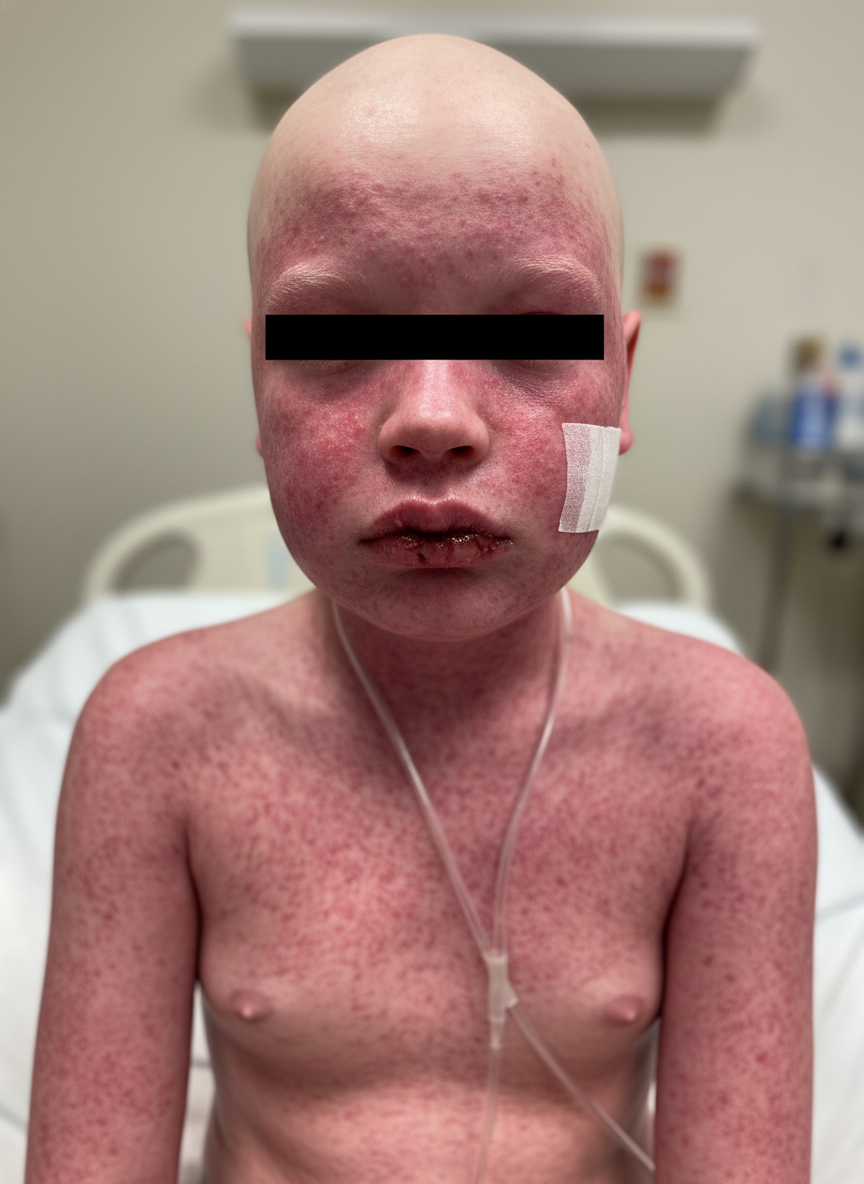
A 10-year-old boy presents with a painful rash for 1 day. He says that the reddish, purple rash started on his forearm but has now spread to his abdomen. He says there is a burning pain in the area where the rash is located. He also says he has had a stuffy nose for several days. Past medical history is significant for asthma and epilepsy, medically managed. Current medications are a daily chewable multivitamin, albuterol, budesonide, and lamotrigine. On physical examination, there is a red-purple maculopapular rash present on upper extremities and torso. There are some blisters present over the rash, as shown in the image, which is also present in the oral mucosa. Which of the following is the most likely cause of this patient’s symptoms?
An 8-year-old girl is brought to the emergency department because of a 2-day history of low-grade fever, itchy rash, and generalized joint pain. The rash initially started in the antecubital and popliteal fossae and then spread to her trunk and distal extremities. One week ago, she was diagnosed with acute sinusitis and was started on amoxicillin. She has no history of adverse drug reactions and immunizations are up-to-date. Her temperature is 37.5°C (99.5°F), pulse is 90/min, and blood pressure is 110/70 mm Hg. Physical examination shows periorbital edema and multiple erythematous, annular plaques of variable sizes over her entire body. One of the lesions in the right popliteal fossa has an area of central clearing and the patient's mother reports that it has been present for over 24 hours. Urinalysis is normal. Which of the following is the most likely diagnosis?
An investigator is studying the chemical structure of antibiotics and its effect on bacterial growth. He has synthesized a simple beta-lactam antibiotic and has added a bulky side chain to the molecule that inhibits the access of bacterial enzymes to the beta-lactam ring. The synthesized drug will most likely be appropriate for the treatment of which of the following conditions?
A 42-year-old homeless man presents to the emergency department complaining of pain in his right knee and fever. The patient is having difficulty walking and looks visibly uncomfortable. On examination, he is disheveled but his behavior is not erratic. The patient’s right knee is erythematous, edematous, and warm, with evidence of a 3 cm wound that is weeping purulent fluid. The patient has a decreased range of motion secondary to pain and swelling. The wound is cultured and empiric antibiotic therapy is initiated. Four minutes into the patient’s antibiotic therapy, he develops a red, pruritic rash on his face and neck. What is the most likely antibiotic this patient is being treated with?
A 77-year-old woman is brought to the emergency department from her nursing home because she was found down overnight. On presentation she was found to be delirious and was unable to answer questions. Chart review shows that she is allergic to cephalosporins. Her temperature is 102.2°F (39°C), blood pressure is 105/52 mmHg, pulse is 94/min, and respirations are 23/min. Physical exam reveals a productive cough. A metabolic panel is obtained with the following results: Serum: Na+: 135 mEq/L Cl-: 95 mEq/L K+: 4 mEq/L HCO3-: 19 mEq/L BUN: 40 mg/dL Creatinine: 2.5 mg/dL Glucose: 150 mg/dL Based on these findings two different drugs are started empirically. Gram stain on a blood sample is performed showing the presence of gram-positive organisms on all samples. One of the drugs is subsequently stopped. The drug that was most likely stopped has which of the following characteristics?
A 13-year-old boy re-presents to his pediatrician with a new onset rash that began a few days after his initial visit. He initially presented with complaints of sore throat but was found to have a negative strep test. His mother demanded that he be placed on antibiotics, but this was refused by his pediatrician. The boy's father, a neurologist, therefore, started him on penicillin. Shortly after starting the drug, the boy developed a fever and a rash. The patient is admitted and his symptoms worsen. His skin begins to slough off, and the rash covers over 30% of his body. His oropharynx and corneal membranes are also affected. You examine him at the bedside and note a positive Nikolsky's sign. What is the most likely diagnosis?
You are treating a neonate with meningitis using ampicillin and a second antibiotic, X, that is known to cause ototoxicity. What is the mechanism of antibiotic X?
A 28-year-old man presents with painless anal ulcer. Dark-field microscopy shows spirochetes. He is allergic to penicillin with history of anaphylaxis. Which of the following is the most appropriate treatment?
A 49-year-old man presents to the clinic for evaluation of puncture wounds on the dorsal aspect of his right second and third metacarpals. He states that he was in a fight 3 nights ago and he struck another individual in the mouth. The patient’s medical history is significant for peripheral vascular disease and hypertension. He takes aspirin, sulfasalazine, and lisinopril. He is allergic to penicillin. He drinks socially on weekends and smokes one and one-half packs of cigarettes daily. Vitals of the patient are as follows: blood pressure is 142/88 mm Hg; heart rate is 88/min; respiratory rate is 14/min; temperature is 38.9°C (102.1°F). On physical examination, the patient appears alert and oriented. His BMI is 33 kg/ m². His eyes are without scleral icterus. His right orbital region reveals ecchymosis along the superior and inferior borders. His heart is regular in rhythm and rate without murmurs. Capillary refill is 4 seconds in fingers and toes. His right dorsal second and third metacarpal region reveals two 3 mm lacerations with edema. Which of the following is the most appropriate management strategy for this patient?
A 12-year-old girl is brought to the physician by her mother because of high fever and left ankle and knee joint swelling. She had a sore throat 3 weeks ago. There is no family history of serious illness. Her immunizations are up-to-date. She had an episode of breathlessness and generalized rash when she received dicloxacillin for a skin infection 2 years ago. She appears ill. Her temperature is 38.8°C (102.3°F), pulse is 87/min, and blood pressure is 98/62 mm Hg. Examination shows left ankle and knee joint swelling and tenderness; range of motion is limited. Breath sounds over both lungs are normal. A grade 3/6 holosytolic murmur is heard best at the apex. Abdominal examination is normal. Which of the following is the most appropriate pharmacotherapy?
Want unlimited practice?
Get full access to all questions, explanations, and performance tracking.
Scan to download app