A 60-year-old woman sought evaluation at an urgent care clinic after developing breathlessness 30 minutes earlier. She also developed swelling of the tongue and lips. She has heart failure and was recently diagnosed with hypertension. She was started on a medication, the first dose of which she took this afternoon before her symptoms started. Her blood pressure is 167/88 mm Hg, the respiratory rate is 17/min, and the pulse is 78/min. The physical examination reveals a skin rash on the back and abdomen. There is a mild swelling of the lips and tongue. Chest auscultation does not reveal any abnormal breath sounds. Which of the following medications most likely led to her current symptoms?
Q152
A 45-year-old man was shown to have a blood pressure of 142/90 mm Hg at a health fair. Despite modifying his lifestyle, his blood pressure remained elevated on 2 separate subsequent occasions. He was prescribed an anti-hypertensive medication. After 3 weeks, the swelling of the lips shown in the accompanying photograph was observed. What is the most likely cause of this finding?
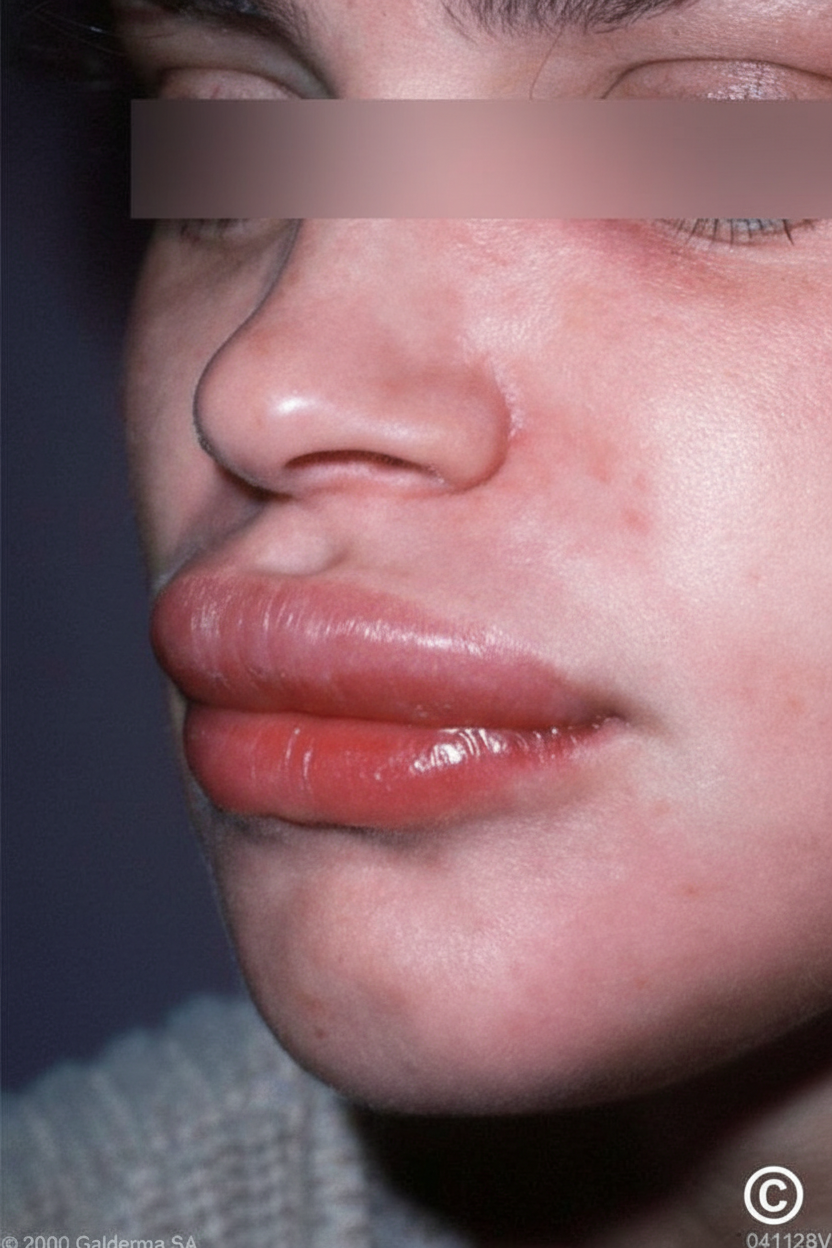
Q153
A 62-year-old man comes to the physician for a follow-up examination. One month ago, therapy with lisinopril was initiated for treatment of hypertension. His blood pressure is 136/86 mm Hg. Urinalysis shows a creatinine clearance of 92 mL/min. The patient's serum creatinine concentration is most likely closest to which of the following values?
Q154
A 45-year-old woman comes to the physician because of a 2-week history of fatigue and excessive thirst. During this period, she has not been able to sleep through the night because of the frequent urge to urinate. She also urinates more than usual during the day. She drinks 4–5 liters of water and 1–2 beers daily. She has autosomal dominant polycystic kidney disease, hypertension treated with lisinopril, and bipolar disorder. Therapy with valproic acid was begun after a manic episode 3 months ago. Vital signs are within normal limits. Irregular flank masses are palpated bilaterally. The remainder of the examination shows no abnormalities. Laboratory studies show:
Serum
Na+ 152 mEq/L
K+ 4.1 mEq/L
Cl− 100 mEq/L
HCO3− 25 mEq/L
Creatinine 1.8 mg/dL
Osmolality 312 mOsmol/kg
Glucose 98 mg/dL
Urine osmolality 190 mOsmol/kg
The urine osmolality does not change after 3 hours despite no fluid intake or after administration of desmopressin. Which of the following is the most appropriate next step in management?
Q155
A 60-year-old man comes to the physician because of flank pain, rash, and blood-tinged urine for 1 day. Two months ago, he was started on hydrochlorothiazide for hypertension. He takes acetaminophen for back pain. Examination shows a generalized, diffuse maculopapular rash. Serum studies show a creatinine concentration of 3.0 mg/dL. Renal ultrasonography shows no abnormalities. Which of the following findings is most likely to be observed in this patient?
Q156
A 52-year-old man presents to the emergency department with chest pain radiating to his left jaw and arm. He states that he had experienced similar symptoms when playing basketball. The medical history is significant for diabetes mellitus, hypertension, and GERD, for which he takes metformin, hydrochlorothiazide, and pantoprazole, respectively. The blood pressure is 150/90 mm Hg, the pulse is 100/min, and the respirations are 15/min. The ECG reveals ST elevation in leads V3-V6. He is hospitalized for an acute MI and started on treatment including lisinopril. The next day he complains of dizziness and blurred vision. Repeat vital signs were as follows: blood pressure 90/60 mm Hg, pulse 72/min, and respirations 12/min. The laboratory results were as follows:
Serum chemistry
Sodium 143 mEq/L
Potassium 4.1 mEq/L
Chloride 98 mEq/L
Bicarbonate 22 mEq/L
Blood urea nitrogen 26 mg/dL
Creatinine 2.3 mg/dL
Glucose 120 mg/dL
Which of the following drugs is responsible for this patient's lab abnormalities?
Antihypertensives US Medical PG Practice Questions and MCQs
Question 151: A 60-year-old woman sought evaluation at an urgent care clinic after developing breathlessness 30 minutes earlier. She also developed swelling of the tongue and lips. She has heart failure and was recently diagnosed with hypertension. She was started on a medication, the first dose of which she took this afternoon before her symptoms started. Her blood pressure is 167/88 mm Hg, the respiratory rate is 17/min, and the pulse is 78/min. The physical examination reveals a skin rash on the back and abdomen. There is a mild swelling of the lips and tongue. Chest auscultation does not reveal any abnormal breath sounds. Which of the following medications most likely led to her current symptoms?
A. Hydrochlorothiazide (HCTZ)
B. Captopril (Correct Answer)
C. Amlodipine
D. Clonidine
E. Propranolol
Explanation: ***Captopril***
- The symptoms of **angioedema**, including tongue and lip swelling, and breathlessness, are classic adverse effects of **ACE inhibitors** like captopril.
- Angioedema can occur even after the **first dose** and is more common in patients treated for hypertension and heart failure.
*Hydrochlorothiazide (HCTZ)*
- While HCTZ can cause allergic reactions, severe angioedema with acute breathlessness and tongue/lip swelling as the primary presentation is **rare** with this drug.
- Common side effects include electrolyte imbalances, **orthostatic hypotension**, and photosensitivity, none of which are described as the main acute issue here.
*Amlodipine*
- Amlodipine, a **calcium channel blocker**, does not typically cause angioedema or acute breathlessness and lip/tongue swelling.
- Its common side effects include **peripheral edema**, headache, and flushing.
*Clonidine*
- Clonidine is an **alpha-2 adrenergic agonist** used for hypertension. It primarily causes central nervous system depression, such as **sedation** and **dry mouth**.
- It does not cause angioedema, tongue/lip swelling, or acute breathlessness.
*Propranolol*
- Propranolol is a **non-selective beta-blocker** and can cause **bronchospasm** in susceptible individuals, leading to breathlessness.
- However, it does not typically cause angioedema with lip and tongue swelling.
Question 152: A 45-year-old man was shown to have a blood pressure of 142/90 mm Hg at a health fair. Despite modifying his lifestyle, his blood pressure remained elevated on 2 separate subsequent occasions. He was prescribed an anti-hypertensive medication. After 3 weeks, the swelling of the lips shown in the accompanying photograph was observed. What is the most likely cause of this finding?
A. Hydrochlorothiazide
B. Lisinopril (Correct Answer)
C. Amlodipine
D. Verapamil
E. Furosemide
Explanation: ***Lisinopril***
- The patient developed **angioedema**, a known side effect of **ACE inhibitors** like lisinopril, which presents as swelling of the lips, face, and sometimes airways.
- ACE inhibitors block the degradation of **bradykinin**, leading to its accumulation and subsequent vasodilation and increased vascular permeability.
*Hydrochlorothiazide*
- This is a **thiazide diuretic** commonly used for hypertension.
- While it can cause various side effects (e.g., electrolyte imbalances, photosensitivity), **angioedema** is not a characteristic or common adverse effect.
*Amlodipine*
- Amlodipine is a **calcium channel blocker**.
- Common side effects include peripheral edema (swelling of ankles/feet), headache, and flushing, but not typically **angioedema of the lips**.
*Verapamil*
- Verapamil is a **non-dihydropyridine calcium channel blocker**.
- Side effects include constipation, bradycardia, and AV block; **angioedema is not a known adverse reaction**.
*Furosemide*
- Furosemide is a **loop diuretic**.
- Its main side effects include electrolyte disturbances, dehydration, and ototoxicity; there is **no association with angioedema**.
Question 153: A 62-year-old man comes to the physician for a follow-up examination. One month ago, therapy with lisinopril was initiated for treatment of hypertension. His blood pressure is 136/86 mm Hg. Urinalysis shows a creatinine clearance of 92 mL/min. The patient's serum creatinine concentration is most likely closest to which of the following values?
A. 1.7 mg/dL
B. 1.1 mg/dL (Correct Answer)
C. 2.0 mg/dL
D. 1.4 mg/dL
E. 2.3 mg/dL
Explanation: ***1.1 mg/dL***
- For a 62-year-old man with a **creatinine clearance of 92 mL/min**, the serum creatinine can be estimated using the **Cockcroft-Gault relationship**.
- With CrCl of 92 mL/min (near-normal for age), the baseline serum creatinine would be approximately **0.9-1.0 mg/dL** for a typical male patient.
- **Lisinopril (ACE inhibitor)** commonly causes a **mild increase in serum creatinine (10-20%)** due to reduced efferent arteriolar tone, which is acceptable if <30% increase and creatinine clearance remains adequate.
- Therefore, **1.1 mg/dL** represents the expected value: baseline creatinine consistent with CrCl of 92 mL/min plus the typical mild ACE inhibitor-induced elevation.
*1.4 mg/dL*
- A serum creatinine of **1.4 mg/dL** would be inconsistent with a creatinine clearance of **92 mL/min** in this patient.
- Using the Cockcroft-Gault formula for a 62-year-old male, a creatinine of 1.4 mg/dL would correspond to a **CrCl of approximately 65-70 mL/min**, not 92 mL/min.
- This would represent a more significant decrease in GFR than is present in this patient.
*1.7 mg/dL*
- A serum creatinine of **1.7 mg/dL** is far too high for a creatinine clearance of **92 mL/min**.
- This level would correspond to a **CrCl of approximately 50-55 mL/min** in a 62-year-old male, indicating **moderate renal impairment**.
- Such an elevation with ACE inhibitors would warrant investigation for **bilateral renal artery stenosis** or other significant renal pathology.
*2.0 mg/dL*
- A serum creatinine of **2.0 mg/dL** would indicate **significant renal dysfunction** with an estimated CrCl of approximately **40-45 mL/min**, not the 92 mL/min observed.
- This degree of elevation is incompatible with the measured creatinine clearance.
- Would suggest **acute kidney injury** or **severe bilateral renal artery stenosis** and require immediate ACE inhibitor discontinuation.
*2.3 mg/dL*
- A serum creatinine of **2.3 mg/dL** indicates **severe renal impairment** with an estimated CrCl well below 40 mL/min.
- This is completely incompatible with the measured **creatinine clearance of 92 mL/min**.
- Would represent **acute kidney injury** requiring urgent evaluation and medication adjustment.
Question 154: A 45-year-old woman comes to the physician because of a 2-week history of fatigue and excessive thirst. During this period, she has not been able to sleep through the night because of the frequent urge to urinate. She also urinates more than usual during the day. She drinks 4–5 liters of water and 1–2 beers daily. She has autosomal dominant polycystic kidney disease, hypertension treated with lisinopril, and bipolar disorder. Therapy with valproic acid was begun after a manic episode 3 months ago. Vital signs are within normal limits. Irregular flank masses are palpated bilaterally. The remainder of the examination shows no abnormalities. Laboratory studies show:
Serum
Na+ 152 mEq/L
K+ 4.1 mEq/L
Cl− 100 mEq/L
HCO3− 25 mEq/L
Creatinine 1.8 mg/dL
Osmolality 312 mOsmol/kg
Glucose 98 mg/dL
Urine osmolality 190 mOsmol/kg
The urine osmolality does not change after 3 hours despite no fluid intake or after administration of desmopressin. Which of the following is the most appropriate next step in management?
A. Further water restriction
B. Begin infusion of 3% saline
C. Desmopressin therapy
D. Hydrochlorothiazide therapy (Correct Answer)
E. Amiloride therapy
Explanation: ***Hydrochlorothiazide therapy***
- The patient's presentation of polyuria, polydipsia, hypernatremia, and inappropriately low urine osmolality, unresponsive to **desmopressin**, indicates **nephrogenic diabetes insipidus (NDI)**.
- **Thiazide diuretics**, such as hydrochlorothiazide, induce mild volume depletion, which stimulates proximal tubular water and solute reabsorption, effectively reducing water delivery to the collecting duct and ameliorating symptoms of NDI.
- This is the first-line treatment for NDI regardless of underlying etiology.
*Further water restriction*
- While the patient exhibits polydipsia, further water restriction would exacerbate her **hypernatremia** and dehydration without addressing the underlying inability to concentrate urine.
- This would lead to increased thirst and potentially more severe electrolyte imbalances.
*Begin infusion of 3% saline*
- The patient already has **hypernatremia (Na+ 152 mEq/L)**; infusing **hypertonic saline** would dangerously worsen this condition and increase serum osmolality.
- This intervention is used for severe hyponatremia, not hypernatremia.
*Desmopressin therapy*
- The diagnostic test showed that the urine osmolality did not change after **desmopressin administration**, indicating a lack of renal response to ADH.
- This confirms **nephrogenic diabetes insipidus**, making exogenous ADH (desmopressin) ineffective as a treatment.
*Amiloride therapy*
- **Amiloride**, a potassium-sparing diuretic, is specifically used to treat **lithium-induced NDI** by blocking ENaC channels and reducing lithium uptake in principal cells.
- This patient is on **valproic acid** (not lithium) for bipolar disorder, making amiloride inappropriate.
- Her NDI is likely multifactorial, related to her ADPKD with chronic kidney disease (creatinine 1.8 mg/dL) and possibly valproic acid, but **thiazide diuretics remain first-line regardless of etiology**.
Question 155: A 60-year-old man comes to the physician because of flank pain, rash, and blood-tinged urine for 1 day. Two months ago, he was started on hydrochlorothiazide for hypertension. He takes acetaminophen for back pain. Examination shows a generalized, diffuse maculopapular rash. Serum studies show a creatinine concentration of 3.0 mg/dL. Renal ultrasonography shows no abnormalities. Which of the following findings is most likely to be observed in this patient?
A. Dermal IgA deposition on skin biopsy
B. Urinary eosinophils (Correct Answer)
C. Mesangial IgA deposits on renal biopsy
D. Crescent-shape extracapillary cell proliferation
E. Urinary crystals on Brightfield microscopy
Explanation: ***Urinary eosinophils***
- The patient's presentation with **flank pain**, **rash**, **blood-tinged urine**, and **acute kidney injury** after starting hydrochlorothiazide is highly suggestive of **acute interstitial nephritis (AIN)**.
- **Urinary eosinophils** are a classic, though not always present, finding in **drug-induced AIN**, indicating an allergic inflammatory response in the kidney.
*Dermal IgA deposition on skin biopsy*
- **Dermal IgA deposition** is characteristic of **IgA vasculitis (Henoch-Schönlein purpura)**, which typically involves palpable purpura, arthralgias, abdominal pain, and nephritis, but does not usually present as a maculopapular rash directly caused by a drug.
- While IgA vasculitis can cause a rash and renal involvement, the temporal relationship with a new medication and the diffuse maculopapular nature of the rash point away from this diagnosis.
*Mesangial IgA deposits on renal biopsy*
- **Mesangial IgA deposits** are the hallmark of **IgA nephropathy**, which typically presents with recurrent episodes of gross hematuria (often synpharyngitic) or persistent microscopic hematuria and proteinuria, not primarily with an acute, drug-induced rash and flank pain.
- While IgA nephropathy can cause renal dysfunction and hematuria, the acute onset and systemic allergic features are not characteristic.
*Crescent-shape extracapillary cell proliferation*
- **Crescent-shape extracapillary cell proliferation** is characteristic of **rapidly progressive glomerulonephritis (RPGN)**, which causes a rapid decline in renal function often associated with severe hematuria and proteinuria.
- While the patient has acute kidney injury and hematuria, the rash and flank pain in the context of new medication are more indicative of AIN than primary glomerulonephritis leading to crescents.
*Urinary crystals on Brightfield microscopy*
- **Urinary crystals** can be seen in conditions like **kidney stones** or **acute uric acid nephropathy**, which might cause flank pain and hematuria. However, the presence of a rash and the temporal association with hydrochlorothiazide do not align with these conditions.
- Furthermore, renal ultrasonography showed no abnormalities, making kidney stones less likely to be the primary cause of symptoms.
Question 156: A 52-year-old man presents to the emergency department with chest pain radiating to his left jaw and arm. He states that he had experienced similar symptoms when playing basketball. The medical history is significant for diabetes mellitus, hypertension, and GERD, for which he takes metformin, hydrochlorothiazide, and pantoprazole, respectively. The blood pressure is 150/90 mm Hg, the pulse is 100/min, and the respirations are 15/min. The ECG reveals ST elevation in leads V3-V6. He is hospitalized for an acute MI and started on treatment including lisinopril. The next day he complains of dizziness and blurred vision. Repeat vital signs were as follows: blood pressure 90/60 mm Hg, pulse 72/min, and respirations 12/min. The laboratory results were as follows:
Serum chemistry
Sodium 143 mEq/L
Potassium 4.1 mEq/L
Chloride 98 mEq/L
Bicarbonate 22 mEq/L
Blood urea nitrogen 26 mg/dL
Creatinine 2.3 mg/dL
Glucose 120 mg/dL
Which of the following drugs is responsible for this patient's lab abnormalities?
A. Lisinopril (Correct Answer)
B. Nitroglycerin
C. Pantoprazole
D. Atorvastatin
E. Digoxin
Explanation: ***Lisinopril***
- The patient's **hypotension** (90/60 mmHg), **dizziness**, **blurred vision**, and elevated **creatinine** (2.3 mg/dL) with elevated **BUN** (26 mg/dL) one day after starting lisinopril strongly suggest **acute kidney injury (AKI)** induced by the ACE inhibitor.
- **ACE inhibitors** like lisinopril can cause AKI, especially in patients with pre-existing renal impairment or those with conditions that make them susceptible to reduced renal perfusion, such as **atherosclerotic renovascular disease** (which can be associated with uncontrolled hypertension and diabetes).
*Nitroglycerin*
- **Nitroglycerin** primarily causes **vasodilation**, which can lead to **hypotension** and **headache** or **dizziness**, but it is not directly associated with a rapid increase in **creatinine** or **BUN** to this extent, indicative of AKI.
- While it could contribute to hypotension, it wouldn't explain the acute renal dysfunction observed in this patient.
*Pantoprazole*
- **Pantoprazole**, a **proton pump inhibitor**, is generally well-tolerated but can rarely cause **acute interstitial nephritis**, which might lead to AKI over a longer period.
- However, it would not typically cause such a rapid and significant increase in **BUN** and **creatinine** immediately after an MI and starting other medications, and it's less likely to be the primary cause of acute decompensation compared to an ACE inhibitor in this context.
*Atorvastatin*
- **Atorvastatin** is a **HMG-CoA reductase inhibitor** used for lipid lowering. Its main side effects include **myopathy** and **liver dysfunction**, neither of which are reflected in the presented symptoms or lab findings.
- It does not directly cause **hypotension** or acute **renal dysfunction**.
*Digoxin*
- **Digoxin** is a **cardiac glycoside** used to treat heart failure and arrhythmias. Its toxicity can cause **nausea**, **vomiting**, **arrhythmias**, and **visual disturbances** (e.g., blurred or yellow vision).
- While visual disturbances are present, digoxin is not associated with acute **hypotension** or acute **kidney injury** characterized by elevated **BUN** and **creatinine**.