
Treatment guidelines for invasive fungal infections — MCQs

You are taking care of a patient with renal failure secondary to anti-fungal therapy. The patient is a 66-year-old male being treated for cryptococcal meningitis. This drug has a variety of known side effects including acute febrile reactions to infusions, anemia, hypokalemia and hypomagnesemia. What is the mechanism of action of this drug?
A 69-year-old man with metastatic colon cancer is brought to the emergency department because of shortness of breath, fever, chills, and a productive cough with streaks of blood for the past 5 days. He has a history of emphysema. The patient does not have abdominal pain or headache. He receives chemotherapy with 5-fluorouracil, leucovorin, and oxaliplatin every 6 weeks; his last cycle was 3 weeks ago. His temperature is 38.3°C (101°F), pulse is 112/min, and blood pressure is 100/70 mm Hg. Pulse oximetry on room air shows an oxygen saturation of 83%. A few scattered inspiratory crackles are heard over the right lung. His mucous membranes are dry. Cardiac examination is normal. Laboratory studies show: Hemoglobin 9.3 mg/dL Leukocyte count 700/mm3 Segmented neutrophils 68% Lymphocytes 25% Eosinophils 4% Monocytes 3% Platelet count 104,000/mm3 Serum Glucose 75 mg/dL Urea nitrogen 41 mg/dL Creatinine 2.1 mg/dL Galactomannan antigen Positive Which of the following is the most appropriate initial pharmacotherapy?
A 65-year-old woman who lives in New York City presents with headache, fever, and neck stiffness. She received a diagnosis of HIV infection 3 years ago and has been inconsistent with her antiretroviral medications. Recent interferon-gamma release assay testing for latent tuberculosis was negative. A computed tomography of her head is normal. A lumbar puncture shows a white blood cell count of 45/mm3 with a mononuclear predominance, the glucose level of 30 mg/dL, and a protein level of 60 mg/dL. A preparation of her cerebrospinal fluid is shown. Which of the following organisms is the most likely cause of her symptoms?

A 29-year-old woman, gravida 2, para 1, at 10 weeks' gestation comes to the physician for a prenatal visit. Over the past two weeks, she has felt nauseous in the morning and has had vulvar pruritus and dysuria that started 5 days ago. Her first child was delivered by lower segment transverse cesarean section because of macrosomia from gestational diabetes. Her gestational diabetes resolved after the child was born. She appears well. Ultrasound confirms fetal heart tones and an intrauterine pregnancy. Speculum exam shows a whitish chunky discharge. Her vaginal pH is 4.2. A wet mount is performed and microscopic examination is shown. Which of the following is the most appropriate treatment?
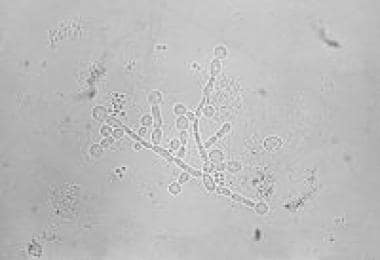
A 62-year-old man is brought to the emergency department from a senior-care facility after he was found with a decreased level of consciousness and fever. His personal history is relevant for colorectal cancer that was managed with surgical excision of the tumor. Upon admission, he is found to have a blood pressure of 130/80 mm Hg, a pulse of 102/min, a respiratory rate of 20/min, and a body temperature 38.8°C (101.8°F). There is no rash on physical examination; he is found to have neck rigidity, confusion, and photophobia. There are no focal neurological deficits. A head CT is normal without mass or hydrocephalus. A lumbar puncture was performed and cerebrospinal fluid (CSF) is sent to analysis while ceftriaxone and vancomycin are started. Which of the following additional antimicrobials should be added in the management of this patient?
A potassium hydroxide preparation is conducted on a skin scraping of the hypopigmented area. Microscopy of the preparation shows long hyphae among clusters of yeast cells. Based on these findings, which of the following is the most appropriate pharmacotherapy?
A 45-year-old man presents to the emergency department with difficulties swallowing food. He states that he experiences pain when he attempts to swallow his medications or when he drinks water. He reveals that he was diagnosed with HIV infection five years ago. He asserts that he has been taking his antiretroviral regimen, including emtricitabine, rilpivirine, and tenofovir. His temperature is 98°F (37°C), blood pressure is 100/60 mmHg, pulse is 90/min, respirations are 22/min, and oxygen saturation is 99% on room air. His physical exam is notable for a clear oropharynx, no lymphadenopathy, and a normal cardiac and pulmonary exam. No rashes are noted throughout his body. His laboratory results are displayed below: Hemoglobin: 12 g/dL Hematocrit: 37 % Leukocyte count: 8,000/mm^3 with normal differential Platelet count: 160,000/mm^3 Serum: Na+: 138 mEq/L Cl-: 108 mEq/L K+: 3.5 mEq/L HCO3-: 26 mEq/L BUN: 35 mg/dL Glucose: 108 mg/dL Creatinine: 1.1 mg/dL CD4+ count: 90/mm^3 HIV viral load: 59,000 copies/mL What is the best next step in management?
A 57-year-old woman with non-small cell lung cancer comes to the physician 4 weeks after her tumor was resected. She takes no medications. The physician starts her on a treatment regimen that includes vinblastine. This treatment puts the patient at highest risk for which of the following?
A 54-year-old man presents with fever, abdominal pain, nausea, and bloody diarrhea. He says that his symptoms started 36 hours ago and have not improved. Past medical history is significant for a left-leg abscess secondary to an injury he sustained from a fall 4 days ago while walking his dog. He has been taking clindamycin for this infection. In addition, he has long-standing gastroesophageal reflux disease, managed with omeprazole. His vital signs include: temperature 38.5°C (101.3°F), respiratory rate 19/min, heart rate 90/min, and blood pressure 110/70 mm Hg. Which of the following is the best course of treatment for this patient’s most likely diagnosis?
A person presents to the hospital with fever and chills. Fever profile is ordered and is found to be negative for malaria and dengue. Rk39 test is found to be positive. What is the treatment of choice?
Want unlimited practice?
Get full access to all questions, explanations, and performance tracking.
Scan to download app