A 19-year-old woman comes to the physician because of worsening pain with swallowing for 3 days and a dry sensation in the mouth over the past week. She has a history of asthma controlled with inhaled fluticasone and albuterol. Physical examination shows white plaques on the dorsal surface of the tongue and buccal mucosa that bleed when scraped off. Which of the following is the most appropriate pharmacotherapy?
Q32
A 55-year-old man, who underwent a kidney transplant 2 years ago, presents in septic shock. He is compliant with his immunosuppressive therapy. He does not use any drugs and is sexually active with one male partner. His complete blood count returns as follows: Hemoglobin: 13.7 g/dL, white blood cell count: 4000 cells/microliter, platelets 250,000 cells/microliter. Of note, from his differential: neutrophils: 10%, lymphocytes: 45%, and monocytes: 7%. His basic metabolic profile is notable for a creatinine remaining at his baseline of 0.9 mg/dL. The patient is started on broad spectrum antibiotics, but his condition does not improve. Fungal blood cultures are obtained and grow Candida species. Which of the following was the most-likely predisposing factor?
Q33
A 15-year-old boy is brought to the physician with an ongoing pruritic rash for 1 week. The rash is on his right forearm (refer to the image). He has not had a similar rash in the past. He has no history of allergies, and he is not taking any medications. He frequently enjoys gardening in their backyard. They have no household pets. The physical examination reveals no other abnormalities. Given the most likely diagnosis, which of the following is the most appropriate treatment of the condition described in this case?
Q34
A 62-year-old man presents with dry and brittle toenails. On physical examination, his toenails are shown in the image. Which of the following is an adverse effect of the recommended treatment for this patient’s most likely condition?
Q35
A 57-year-old florist presents to his family physician with nodular lesions on his right hand and forearm. He explains that he got pricked by a rose thorn on his right "pointer finger" where the first lesions appeared, and the other lesions then began to appear in an ascending manner. The physician prescribed a medication and warned him of gynecomastia as a side effect if taken for long periods of time. Which of the following is the mechanism of action of the medication?
Antifungals US Medical PG Practice Questions and MCQs
Question 31: A 19-year-old woman comes to the physician because of worsening pain with swallowing for 3 days and a dry sensation in the mouth over the past week. She has a history of asthma controlled with inhaled fluticasone and albuterol. Physical examination shows white plaques on the dorsal surface of the tongue and buccal mucosa that bleed when scraped off. Which of the following is the most appropriate pharmacotherapy?
A. Amphotericin B
B. Nystatin (Correct Answer)
C. Acyclovir
D. Griseofulvin
E. Triamcinolone
Explanation: **Nystatin**
- The patient's presentation with **white plaques on the dorsal surface of the tongue and buccal mucosa that bleed when scraped off**, along with a history of inhaled fluticasone use, is highly suggestive of **oral candidiasis (thrush)**.
- **Nystatin** is an antifungal medication typically used as a **topical swish and swallow solution** for oral candidiasis, effectively treating localized infections with minimal systemic absorption.
*Amphotericin B*
- **Amphotericin B** is a potent systemic antifungal used for **severe, invasive fungal infections**, often given intravenously due to significant side effects.
- It is **not the first-line treatment** for localized oral candidiasis, which is typically managed with less toxic topical agents.
*Acyclovir*
- **Acyclovir** is an **antiviral medication** used to treat **herpes simplex virus (HSV)** infections, such as oral herpes or cold sores.
- The patient's symptoms are characteristic of a fungal infection, not a viral one.
*Griseofulvin*
- **Griseofulvin** is an **oral antifungal primarily used for dermatophyte infections** of the skin, hair, and nails (e.g., tinea capitis, onychomycosis).
- It is ineffective against *Candida* species and therefore not appropriate for oral candidiasis.
*Triamcinolone*
- **Triamcinolone** is a **corticosteroid** used to reduce inflammation and is often found in topical creams or inhaled formulations.
- Corticosteroids can actually **worsen fungal infections** like candidiasis by suppressing the immune response, and are therefore contraindicated.
Question 32: A 55-year-old man, who underwent a kidney transplant 2 years ago, presents in septic shock. He is compliant with his immunosuppressive therapy. He does not use any drugs and is sexually active with one male partner. His complete blood count returns as follows: Hemoglobin: 13.7 g/dL, white blood cell count: 4000 cells/microliter, platelets 250,000 cells/microliter. Of note, from his differential: neutrophils: 10%, lymphocytes: 45%, and monocytes: 7%. His basic metabolic profile is notable for a creatinine remaining at his baseline of 0.9 mg/dL. The patient is started on broad spectrum antibiotics, but his condition does not improve. Fungal blood cultures are obtained and grow Candida species. Which of the following was the most-likely predisposing factor?
A. Defective IL-2 receptor
B. HIV infection
C. Decreased phagocytic cell count (Correct Answer)
D. Renal failure
E. Failure to take suppressive trimethoprim/sulfamethoxazole therapy
Explanation: **Decreased phagocytic cell count**
- The patient's **neutrophil count is 10%** of 4000 WBCs, which is 400 cells/microliter. This profound **neutropenia** is a major risk factor for fungal infections like *Candida*.
- Immunosuppressive therapy post-transplant often suppresses **myeloid cell lines**, leading to a decreased phagocytic cell count and increased susceptibility to opportunistic infections.
*Defective IL-2 receptor*
- A defective **IL-2 receptor** would impair T-cell proliferation and function, predisposing to disseminated viral infections (e.g., CMV, EBV) or specific intracellular bacterial infections, rather than typically *Candida* fungemia.
- While broad immunosuppression occurs, the direct link to *Candida* septic shock with severe neutropenia is less direct than a primary phagocytic defect.
*HIV infection*
- HIV infection causes **CD4+ T-cell depletion**, leading to susceptibility to various opportunistic infections, including *Candida* (especially oral/esophageal). However, the patient's lymphocyte count (45%) is not critically low, and the primary issue here is severe neutropenia, which HIV does not directly cause to this extent.
- The patient also reports being sexually active with one male partner but does not use drugs and the complete blood count (CBC) does not show direct signs of HIV-related immune deficiency such as extremely low lymphocyte counts.
*Renal failure*
- The patient's **creatinine is at baseline (0.9 mg/dL)**, indicating that his transplanted kidney is functioning well and he is not in renal failure.
- While chronic kidney disease can cause some immune dysfunction, acute renal failure is not present and cannot be the predisposing factor here.
*Failure to take suppressive trimethoprim/sulfamethoxazole therapy*
- **Trimethoprim/sulfamethoxazole (TMP/SMX)** is primarily prophylactic against *Pneumocystis jirovecii* pneumonia and certain bacterial infections, not typically systemic fungal infections like *Candida* septicemia.
- Although broad-spectrum, its main role is not preventing disseminated candidemia, especially in a severely neutropenic patient.
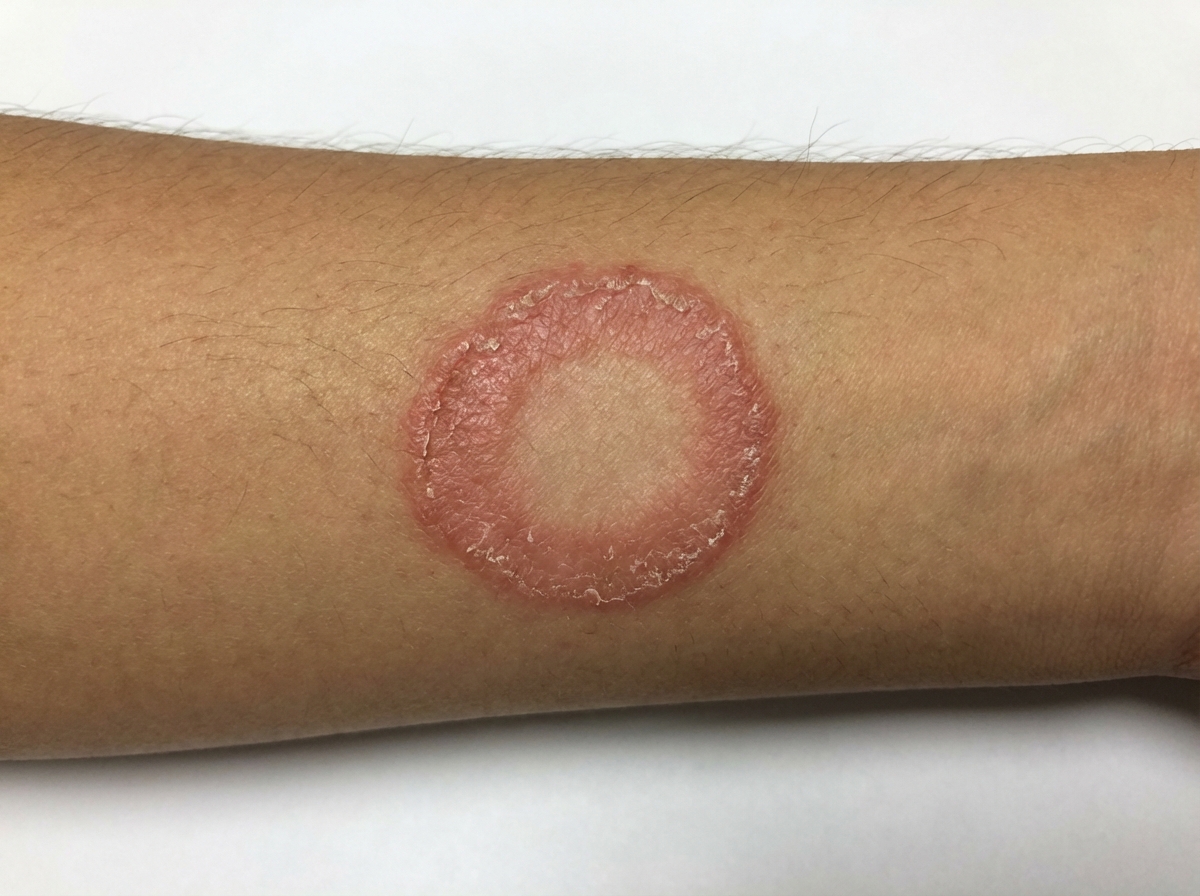
Question 33: A 15-year-old boy is brought to the physician with an ongoing pruritic rash for 1 week. The rash is on his right forearm (refer to the image). He has not had a similar rash in the past. He has no history of allergies, and he is not taking any medications. He frequently enjoys gardening in their backyard. They have no household pets. The physical examination reveals no other abnormalities. Given the most likely diagnosis, which of the following is the most appropriate treatment of the condition described in this case?
A. Topical salicylic acid
B. Oral terbinafine
C. Topical hydrocortisone
D. Topical clotrimazole (Correct Answer)
E. Oral acitretin
Explanation: ***Topical clotrimazole***
- This patient's symptoms (pruritic rash, gardening hobby) are highly suggestive of **tinea corporis** (ringworm), a **fungal infection** often acquired from contact with infected soil or plants.
- **Topical imidazole antifungals** like clotrimazole are the first-line treatment for localized tinea corporis.
*Oral terbinafine*
- Oral antifungals like terbinafine are reserved for **widespread, severe, or recalcitrant fungal infections**, or involvement of the hair/nails (tinea capitis or onychomycosis).
- Given the localized nature of the rash on the forearm and no previous history, a topical agent is generally sufficient.
*Topical salicylic acid*
- Salicylic acid is a **keratolytic agent** used to treat conditions with thickened or scaly skin, such as **acne, psoriasis, or warts**.
- It does not have primary antifungal properties and would not be effective against tinea corporis.
*Topical hydrocortisone*
- Hydrocortisone is a **low-potency topical corticosteroid** used to reduce inflammation and itching in conditions like **eczema or contact dermatitis**.
- While it may temporarily relieve itching, it can **worsen fungal infections** by suppressing the local immune response, making it inappropriate for tinea.
*Oral acitretin*
- Acitretin is a **retinoid medication** primarily used to treat **severe psoriasis** and other keratinization disorders.
- It has no role in the direct treatment of fungal infections like tinea corporis.
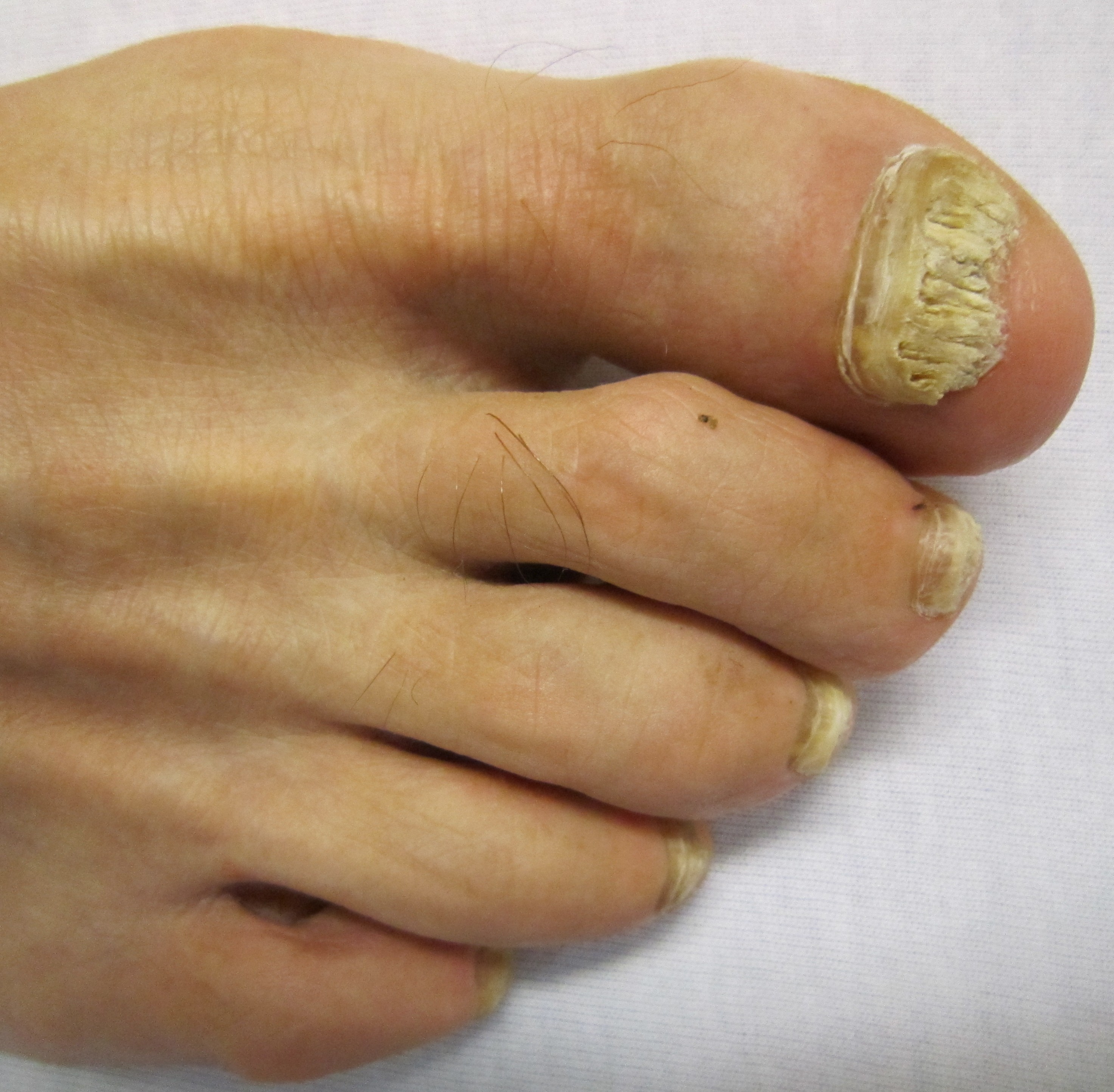
Question 34: A 62-year-old man presents with dry and brittle toenails. On physical examination, his toenails are shown in the image. Which of the following is an adverse effect of the recommended treatment for this patient’s most likely condition?
A. Chronic renal failure
B. Chronic depression
C. Pancytopenia
D. Hepatitis (Correct Answer)
E. Hypothyroidism
Explanation: ***Hepatitis***
- The patient's presentation of dry, brittle toenails with thickened, discolored nails is highly suggestive of **onychomycosis** (fungal nail infection)
- The recommended oral treatments for onychomycosis, such as **terbinafine** and **itraconazole**, are known to cause **hepatotoxicity**, which can manifest as hepatitis
- Baseline and periodic monitoring of liver function tests (LFTs) is recommended during treatment due to this risk
*Chronic renal failure*
- While some medications can cause renal impairment, antifungal treatments for onychomycosis are not typically associated with chronic renal failure as a primary adverse effect
- Renal failure is more commonly linked to conditions like diabetes, hypertension, or direct nephrotoxic drugs
*Chronic depression*
- Depression is not a common or direct adverse effect of oral antifungal agents used for onychomycosis like terbinafine or itraconazole
- While chronic illness can affect mood, it is not a direct drug-induced side effect in this context
*Pancytopenia*
- Although rare, some medications can cause bone marrow suppression leading to pancytopenia; however, this is not a prominent or common adverse effect of standard oral antifungal treatments for onychomycosis
- Pancytopenia is more commonly associated with chemotherapy, radiation, or specific autoimmune conditions
*Hypothyroidism*
- Hypothyroidism is not a known or significant adverse effect of the common oral antifungal drugs used to treat onychomycosis
- Thyroid dysfunction is typically associated with specific medications like amiodarone or lithium, or autoimmune conditions
Question 35: A 57-year-old florist presents to his family physician with nodular lesions on his right hand and forearm. He explains that he got pricked by a rose thorn on his right "pointer finger" where the first lesions appeared, and the other lesions then began to appear in an ascending manner. The physician prescribed a medication and warned him of gynecomastia as a side effect if taken for long periods of time. Which of the following is the mechanism of action of the medication?
A. Inhibits squalene epoxidase
B. Binds to ergosterol, forming destructive pores in cell membrane
C. Disrupts microtubule function
D. Inhibits ergosterol synthesis (Correct Answer)
E. Inhibits formation of beta glucan
Explanation: ***Inhibits ergosterol synthesis***
- The clinical presentation of **nodular lesions** on the hand and forearm in an **ascending manner** after a rose thorn prick is characteristic of **sporotrichosis**, caused by *Sporothrix schenckii*.
- **Itraconazole** is the treatment of choice for sporotrichosis, and it works by **inhibiting ergosterol synthesis** via the inhibition of **lanosterol 14-alpha-demethylase**. Gynecomastia is a known side effect of long-term itraconazole use.
*Inhibits squalene epoxidase*
- This is the mechanism of action of **terbinafine**, another antifungal agent.
- While terbinafine is used for some fungal infections, it is **not the first-line treatment for sporotrichosis** and is not typically associated with gynecomastia as a common side effect.
*Binds to ergosterol, forming destructive pores in cell membrane*
- This describes the mechanism of action of **amphotericin B** and **nystatin**.
- Amphotericin B is used for severe systemic fungal infections, but sporotrichosis typically responds well to oral itraconazole, and amphotericin B is reserved for severe or disseminated cases.
*Disrupts microtubule function*
- This is the mechanism of action of **griseofulvin**, an antifungal agent primarily used for dermatophyte infections of the skin, hair, and nails.
- It is **not effective against *Sporothrix schenckii*** and is not associated with the clinical scenario described.
*Inhibits formation of beta glucan*
- This is the mechanism of action of **echinocandins** (e.g., caspofungin, micafungin, anidulafungin).
- Echinocandins are effective against *Candida* and *Aspergillus* species but have **limited activity against dimorphic fungi** like *Sporothrix schenckii*.