
Immunotherapies and checkpoint inhibitors — MCQs

Two weeks after undergoing allogeneic stem cell transplant for multiple myeloma, a 55-year-old man develops a severely pruritic rash, abdominal cramps, and profuse diarrhea. He appears lethargic. Physical examination shows yellow sclerae. There is a generalized maculopapular rash on his face, trunk, and lower extremities, and desquamation of both soles. His serum alanine aminotransferase is 115 U/L, serum aspartate aminotransferase is 97 U/L, and serum total bilirubin is 2.7 mg/dL. Which of the following is the most likely underlying cause of this patient's condition?
A 23-year-old woman presents to her primary care provider complaining of diarrhea. She reports a 2 month history of 3-4 bloody stools per day as well as 10 pounds of unexpected weight loss. She has also developed intermittent mild gnawing lower abdominal pain. Her past medical history is unremarkable. She takes no medications and denies any drug allergies. Her family history is notable for colon cancer in her maternal aunt, rheumatoid arthritis in her paternal aunt, and Sjogren syndrome in her paternal grandmother. Her temperature is 99.1°F (37.3°C), blood pressure is 120/85 mmHg, pulse is 85/min, and respirations are 18/min. On exam, she has mild hypogastric tenderness to palpation. A stool guaiac test is positive. Flexible sigmoidoscopy demonstrates hyperemic and friable rectal mucosa. She is started on a medication to address her condition but presents to her physician one week later with a severe sunburn and skin itchiness following limited exposure to sunlight. Which of the following is the mechanism of action of the medication she received?
During a study on the immune system, an investigator isolates and labels T cells from the cortex of the thymus. The T cells that do not bind cortical epithelial cells expressing MHC molecules undergo apoptosis within 3–4 days. Which of the following best describes the T cells during this phase of differentiation?
A 28-year-old woman has a follow-up visit with her physician. She was diagnosed with allergic rhinitis and bronchial asthma at 11 years of age. Her regular controller medications include daily high-dose inhaled corticosteroids and montelukast, but she still needs to use a rescue inhaler 3–4 times a week following exercise. She also becomes breathless with moderate exertion. After a thorough evaluation, the physician explains that her medication dosages need to be increased. She declines taking oral corticosteroids daily due to concerns about side effects. The physician prescribes omalizumab, which is administered subcutaneously every 3 weeks. Which of the following best explains the mechanism of action of the new medication that has been added to the controller medications?
A 50-year-old woman comes to the physician for the evaluation of excessive hair growth on her chin over the past 2 weeks. She also reports progressive enlargement of her gums. Three months ago, she underwent a liver transplantation due to Wilson disease. Following the procedure, the patient was started on transplant rejection prophylaxis. She has a history of poorly-controlled type 2 diabetes mellitus. Temperature is 37°C (98.6°F), pulse is 80/min, respirations are 22/min, and blood pressure is 150/80 mm Hg. Physical examination shows dark-pigmented, coarse hair on the chin, upper lip, and chest. The gingiva and the labial mucosa are swollen. There is a well-healed scar on her right lower abdomen. Which of the following drugs is the most likely cause of this patient's findings?
A 35-year-old man comes to the physician because of a 6-month history of fatigue and increased sweating at night. He says that he feels “constantly tired” and needs more rest than usual although he sleeps well. In the morning, his sheets are often wet and his skin is clammy. He has not had any sore throat, runny nose, or cough recently. He has not traveled anywhere. Over the past 4 months, he has had a 6.8-kg (15-lb) weight loss, despite having a normal appetite. He does not drink or urinate more than usual. He is 181 cm (5 ft 11 in) tall and weighs 72 kg (159 lb); BMI is 22 kg/m2. His temperature is 37.9°C (100.2°F), pulse is 65/min, and blood pressure is 120/70 mm Hg. Physical examination shows no abnormalities. An HIV screening test and confirmatory test are both positive. The CD4 count is 600 cells/μl and the viral load is 104 copies/mL. Treatment with lamivudine, zidovudine, and indinavir is begun. The patient is at greatest risk for which of the following adverse effects?
A 66-year-old man comes to the physician because of a 3-month history of constipation and streaks of blood in his stool. He has had a 10-kg (22-lb) weight loss during this period. Colonoscopy shows an exophytic tumor in the sigmoid colon. A CT scan of the abdomen shows liver metastases and enlarged mesenteric and para-aortic lymph nodes. A diagnosis of stage IV colorectal cancer is made, and palliative chemotherapy is initiated. The chemotherapy regimen includes a monoclonal antibody that inhibits tumor growth by preventing ligand binding to a protein directly responsible for epithelial cell proliferation and organogenesis. Which of the following proteins is most likely inhibited by this drug?
A 24-year-old woman presents to the emergency department because she started experiencing dyspnea and urticaria after dinner. Her symptoms began approximately 15 minutes after eating a new type of shellfish that she has never had before. On physical exam her breathing is labored, and pulmonary auscultation reveals wheezing bilaterally. Given this presentation, she is immediately started on intramuscular epinephrine for treatment of her symptoms. If part of this patient's symptoms were related to the systemic release of certain complement components, which of the following is another function of the responsible component?
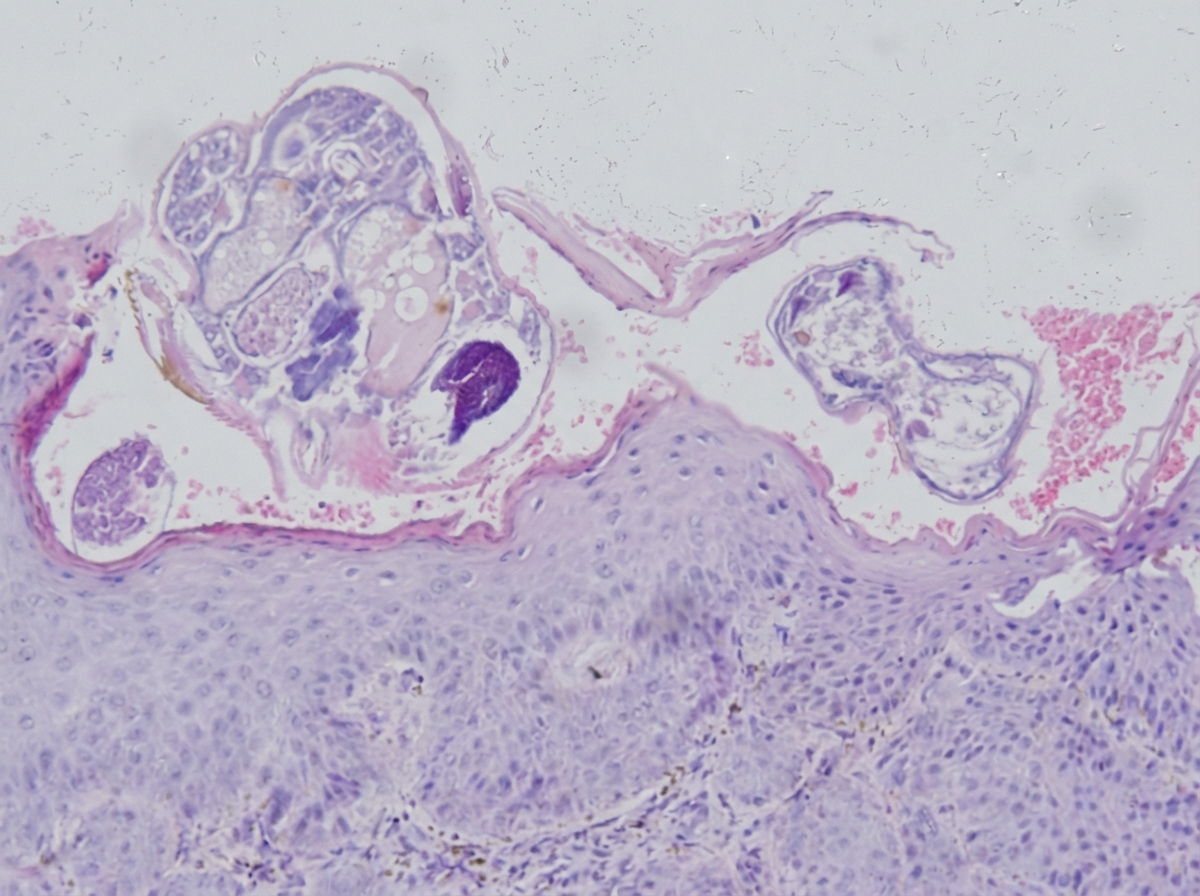
A 37-year-old woman with a history of systemic lupus erythematosus, on prednisone and methotrexate, presents to the dermatology clinic with three weeks of a diffuse, itchy rash. Physical exam is remarkable for small red papules in her bilateral axillae and groin and thin reddish-brown lines in her interdigital spaces. The following skin biopsy is obtained. Which of the following is the most appropriate treatment?
A 35-year-old woman comes to the physician for the evaluation of fatigue over the past 6 months. During this period, she has also had fever, joint pain, and a recurrent skin rash on her face. She has smoked one pack of cigarettes daily for the past 15 years. Her temperature is 38.5°C (101.3°F), pulse is 90/min, and blood pressure is 130/80 mm Hg. Physical examination shows a facial rash that spares the nasolabial folds and several oral ulcers. Joints of the upper and lower extremities are tender with no reddening or swelling. Laboratory studies show anti-dsDNA antibodies. The patient is diagnosed with systemic lupus erythematosus and treatment of choice is initiated. Eight months later, the patient has weakness in her shoulders and hips. Examination shows slight weakness of the proximal muscles. Deep tendon reflexes are 2+ bilaterally. Laboratory studies show normal erythrocyte sedimentation rate and creatine kinase. Which of the following is the most likely underlying cause of this patient's symptoms?
Want unlimited practice?
Get full access to all questions, explanations, and performance tracking.
Scan to download app