
Vaccine adverse events — MCQs

A 29-year-old man comes to the physician for a routine health maintenance examination. He feels well. He works as a nurse at a local hospital in the city. Three days ago, he had a needlestick injury from a patient whose serology is positive for hepatitis B. He completed the 3-dose regimen of the hepatitis B vaccine 2 years ago. His other immunizations are up-to-date. He appears healthy. Physical examination shows no abnormalities. He is concerned about his risk of being infected with hepatitis B following his needlestick injury. Serum studies show negative results for hepatitis B surface antigen, hepatitis B surface antibody, and hepatitis C antibody. Which of the following is the most appropriate next step in management?
An 18-year-old girl is brought to the emergency department because of a 1-day history of severe headache with photophobia and diffuse myalgias. She is a college student and lives in a dormitory in a large urban area. She has not traveled recently. On arrival, she is lethargic. Her temperature is 39.3°C (102.7°F), pulse is 120/min, and blood pressure is 88/58 mm Hg. Examination shows scattered petechiae and ecchymoses on the trunk and lower extremities. There is decreased range of motion of the neck. Cerebrospinal fluid analysis shows a cell count of 1,600/μL (80% neutrophils) and a lactate concentration of 5.1 mmol/L. Which of the following is most likely to have prevented this patient's condition?
A 12-month-old boy presents for a routine checkup. The patient immigrated from the Philippines with his parents a few months ago. No prior immunization records are available. The patient’s mother claims that he had a series of shots at 6 months of age which gave him a severe allergic reaction with swelling of the tongue and the face. She also remembers that he had the same reaction when she introduced solid foods to his diet, including carrots, eggs, and bananas. Which of the following vaccinations are not recommended for this patient?
A 4-month-old boy is brought to the physician by his parents for a well-child examination. He has cystic fibrosis diagnosed by newborn screening. His parents report frequent feedings and large-volume and greasy stools. His 4-year-old brother has autism. Current medications include bronchodilators, pancreatic enzyme supplements, and fat-soluble vitamins. He is at the 18th percentile for height and 15th percentile for weight. Scattered wheezes are heard throughout both lung fields. Examination shows a distended and tympanic abdomen with no tenderness or guarding. Which of the following is a contraindication for administering one or more routine vaccinations?
A young man about to leave for his freshman year of college visits his physician in order to ensure that his immunizations are up-to-date. Because he is living in a college dormitory, his physician gives him a vaccine that prevents meningococcal disease. What type of vaccine did this patient likely receive?
A 14-year-old girl is brought to the physician after she accidentally cut her right forearm earlier that morning while working with her mother's embroidery scissors. She has no history of serious illness. The mother says she went to elementary and middle school abroad and is not sure if she received all of her childhood vaccinations. She appears healthy. Her temperature is 37°C (98.6 °F), pulse 90/min, and blood pressure is 102/68 mm Hg. Examination shows a clean 2-cm laceration on her right forearm with surrounding edema. There is no erythema or discharge. The wound is irrigated with water and washed with soap. Which of the following is the most appropriate next step in management?
A 9-month-old boy is brought to a pediatrician by his parents for routine immunization. The parents say they have recently immigrated to the United States from a developing country, where the infant was receiving immunizations as per the national immunization schedule for that country. The pediatrician prepares a plan for the infant’s immunizations as per standard US guidelines. Looking at the plan, the parents ask why the infant needs to be vaccinated with injectable polio vaccine, as he had already received an oral polio vaccine back in their home country. The pediatrician explains to them that, as per the recommended immunization schedule for children and adolescents in the United States, it is important to complete the schedule of immunizations using the injectable polio vaccine (IPV). He also mentions that IPV is considered safer than OPV, and IPV has some distinct advantages over OPV. Which of the following statements best explains the advantage of IPV over OPV to which the pediatrician is referring?
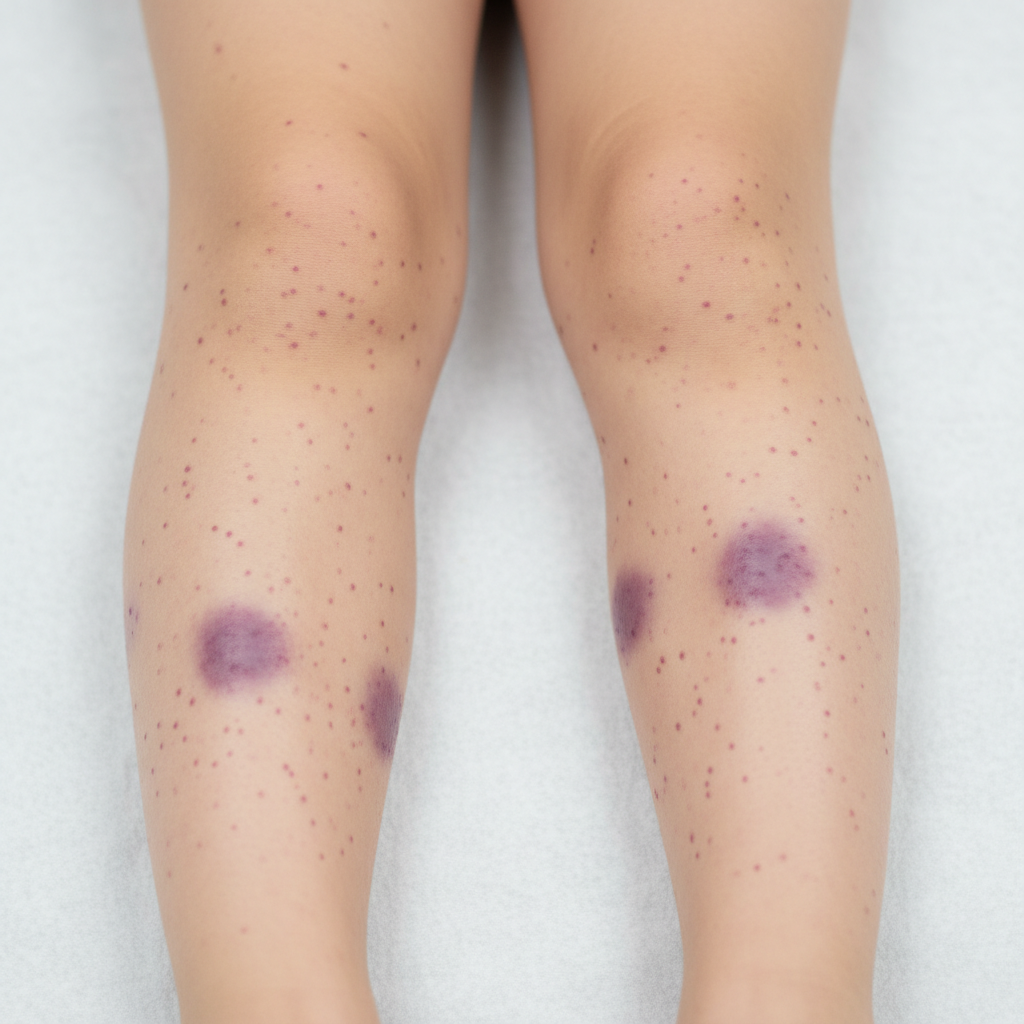
A 12-year-old boy, otherwise healthy, presents with frequent nosebleeds and lower extremity bruising. His mother reports that his symptoms started about 2 weeks ago and have not improved. The patient received the Tdap vaccine 2 weeks ago. He has no current medications. The review of systems is significant for the patient having a stomach ache after winning a hamburger eating competition 2 weeks ago. The vital signs include: temperature 37.0°C (98.6°F), blood pressure 110/75 mm Hg, pulse 95/min, respirations 15/min, and oxygen saturation 99% on room air. On physical exam, the patient is alert and cooperative. The cardiac exam is normal. The lungs are clear to auscultation bilaterally. The lower extremities findings are shown in the image. Laboratory results are pending. Which of the following best describes the pathogenesis of this patient’s condition?
A 15-month-old girl is brought to her primary care physician for a follow-up visit to receive the 4th dose of her DTaP vaccine. She is up-to-date on her vaccinations. She received her 1st dose of MMR, 1st dose of varicella, 3rd dose of HiB, 4th dose of PCV13, and 3rd dose of polio vaccine 3 months ago. Thirteen days after receiving these vaccinations, the child developed a fever up to 40.5°C (104.9°F) and had one generalized seizure that lasted for 2 minutes. She was taken to the emergency department. The girl was sent home after workup for the seizure was unremarkable and her temperature subsided with acetaminophen therapy. She has not had any other symptoms since then. She has no history of serious illness and takes no medications. Her mother is concerned about receiving further vaccinations because she is afraid of the girl having more seizures. Her vital signs are within normal limits. Examination shows no abnormalities. Which of the following is the most appropriate recommendation at this time?
A 4-year-old boy is brought to the emergency department with difficulty breathing. His mother reports that he developed a fever last night and began to have trouble breathing this morning. The boy was born at 39 weeks gestation via spontaneous vaginal delivery. He is unvaccinated (conscientious objection by the family) and is meeting all developmental milestones. At the hospital, his vitals are temperature 39.8°C (103.6°F), pulse 122/min, respiration rate 33/min, blood pressure 110/66 mm Hg, and SpO2 93% on room air. On physical examination, he appears ill with his neck hyperextended and chin protruding. His voice is muffled and is drooling. The pediatrician explains that there is one particular bacteria that commonly causes these symptoms. At what age should the patient have first received vaccination to prevent this condition from this particular bacteria?
Want unlimited practice?
Get full access to all questions, explanations, and performance tracking.
Scan to download app