
Vaccination documentation — MCQs

A 40-year-old pregnant woman, G4 P3, visits your office at week 30 of gestation. She is very excited about her pregnancy and wants to be the healthiest she can be in preparation for labor and for her baby. What vaccination should she receive at this visit?
A 42-year-old woman presents to the physician with symptoms of vague abdominal pain and bloating for several months. Test results indicate that she has ovarian cancer. Her physician attempts to reach her by phone multiple times but cannot reach her. Next of kin numbers are in her chart. According to HIPAA regulations, who should be the primary person the doctor discusses this information with?
An 11-year-old boy is brought to his pediatrician by his parents for the routine Tdap immunization booster dose that is given during adolescence. Upon reviewing the patient’s medical records, the pediatrician notes that he was immunized according to CDC recommendations, with the exception that he received a catch-up Tdap immunization at the age of 8 years. When the pediatrician asks the boy’s parents about this delay, they inform the doctor that they immigrated to this country 3 years ago from Southeast Asia, where the child had not been immunized against diphtheria, tetanus, and pertussis. Therefore, he received a catch-up series at 8 years of age, which included the first dose of the Tdap vaccine. Which of the following options should the pediatrician choose to continue the boy’s immunization schedule?
A 20-year-old primigravid woman comes to the physician in October for her first prenatal visit. She has delayed the visit because she wanted a “natural birth” but was recently convinced to get a checkup after feeling more tired than usual. She feels well. Menarche was at the age of 12 years and menses used to occur at regular 28-day intervals and last 3–7 days. The patient emigrated from Mexico 2 years ago. Her immunization records are unavailable. Pelvic examination shows a uterus consistent in size with a 28-week gestation. Laboratory studies show: Hemoglobin 12.4 g/dL Leukocyte count 8,000/mm3 Blood group B negative Serum Glucose 88 mg/dL Creatinine 1.1 mg/dL TSH 3.8 μU/mL Rapid plasma reagin negative HIV antibody negative Hepatitis B surface antigen negative Urinalysis shows no abnormalities. Urine culture is negative. Chlamydia and gonorrhea testing are negative. A Pap smear is normal. Administration of which of the following vaccines is most appropriate at this time?
A 52-year-old farmer presents to his physician with a puncture wound on his left shin. He got this wound accidentally when he felt unwell and went out to his garden "to catch some air". He reports he had been treated for tetanus 35 years ago and has received the Tdap vaccine several times since then, but he does not remember when he last received the vaccine. His vital signs are as follows: the blood pressure is 110/80 mm Hg, heart rate is 91/min, respiratory rate is 19/min, and temperature is 37.8°C (100.0°F). On physical examination, he is mildly dyspneic and pale. Lung auscultation reveals diminished vesicular breath sounds in the lower lobes bilaterally with a few inspiratory crackles heard over the left lower lobe. There is a puncture wound 1 cm in diameter that is contaminated with soil in the middle third of the patient’s shin. You order blood tests and an X-ray, and now you are arranging his wound treatment. How should tetanus post-exposure prevention be performed in this case?
A young man about to leave for his freshman year of college visits his physician in order to ensure that his immunizations are up-to-date. Because he is living in a college dormitory, his physician gives him a vaccine that prevents meningococcal disease. What type of vaccine did this patient likely receive?
A 9-month-old boy is brought to a pediatrician by his parents for routine immunization. The parents say they have recently immigrated to the United States from a developing country, where the infant was receiving immunizations as per the national immunization schedule for that country. The pediatrician prepares a plan for the infant’s immunizations as per standard US guidelines. Looking at the plan, the parents ask why the infant needs to be vaccinated with injectable polio vaccine, as he had already received an oral polio vaccine back in their home country. The pediatrician explains to them that, as per the recommended immunization schedule for children and adolescents in the United States, it is important to complete the schedule of immunizations using the injectable polio vaccine (IPV). He also mentions that IPV is considered safer than OPV, and IPV has some distinct advantages over OPV. Which of the following statements best explains the advantage of IPV over OPV to which the pediatrician is referring?
A 2-month-old girl is brought to the physician by her father for a routine well-child examination. She is given a vaccine that contains polyribosylribitol phosphate conjugated to a toxoid carrier. The vaccine is most likely to provide immunity against which of the following pathogens?
A 15-month-old girl is brought to her primary care physician for a follow-up visit to receive the 4th dose of her DTaP vaccine. She is up-to-date on her vaccinations. She received her 1st dose of MMR, 1st dose of varicella, 3rd dose of HiB, 4th dose of PCV13, and 3rd dose of polio vaccine 3 months ago. Thirteen days after receiving these vaccinations, the child developed a fever up to 40.5°C (104.9°F) and had one generalized seizure that lasted for 2 minutes. She was taken to the emergency department. The girl was sent home after workup for the seizure was unremarkable and her temperature subsided with acetaminophen therapy. She has not had any other symptoms since then. She has no history of serious illness and takes no medications. Her mother is concerned about receiving further vaccinations because she is afraid of the girl having more seizures. Her vital signs are within normal limits. Examination shows no abnormalities. Which of the following is the most appropriate recommendation at this time?
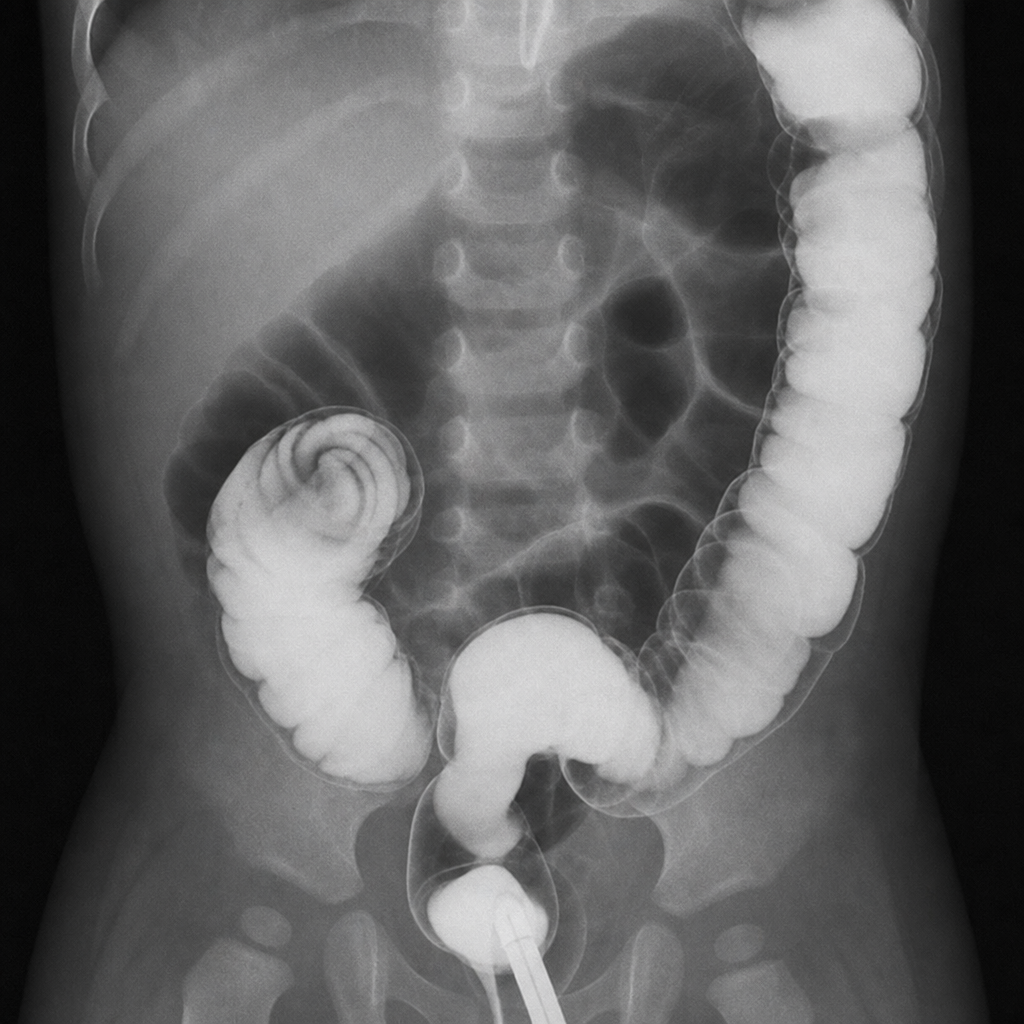
A 9-month-old male infant is brought to the emergency department with a 6-hour history of intermittent, severe, colicky crying episodes lasting 2–3 minutes each, separated by periods of normal behavior. He has vomited twice and passed one stool described as 'currant jelly.' On examination, he is afebrile, with a soft abdomen but a palpable sausage-shaped mass in the right upper quadrant. An abdominal ultrasound confirms the clinical suspicion. The infant is hemodynamically stable with no peritoneal signs. Which of the following is the most appropriate next step in management?
Want unlimited practice?
Get full access to all questions, explanations, and performance tracking.
Scan to download app