
Transport of critically ill children — MCQs

A newborn male is evaluated one minute after birth. He was born at 38 weeks gestation to a 28-year-old gravida 3 via vaginal delivery. The patient’s mother received sporadic prenatal care, and the pregnancy was complicated by gestational diabetes. The amniotic fluid was clear. The patient’s pulse is 70/min, and his breathing is irregular with a slow, weak cry. He whimpers in response to a soft pinch on the thigh, and he has moderate muscle tone with some flexion of his extremities. His body is pink and his extremities are blue. The patient is dried with a warm towel and then placed on his back on a flat warmer bed. His mouth and nose are suctioned with a bulb syringe. Which of the following is the best next step in management?
An 8-year-old boy and his 26-year-old babysitter are brought into the emergency department with severe injuries caused by a motor vehicle accident. The child is wheeled to the pediatric intensive care unit with a severe injury to his right arm, as well as other external and internal injuries. He is hemorrhaging and found to be hemodynamically unstable. He subsequently requires transfusion and surgery, and he is currently unconscious. The pediatric trauma surgeon evaluates the child’s arm and realizes it will need to be amputated at the elbow. Which of the following is the most appropriate course of action to take with regards to the amputation?
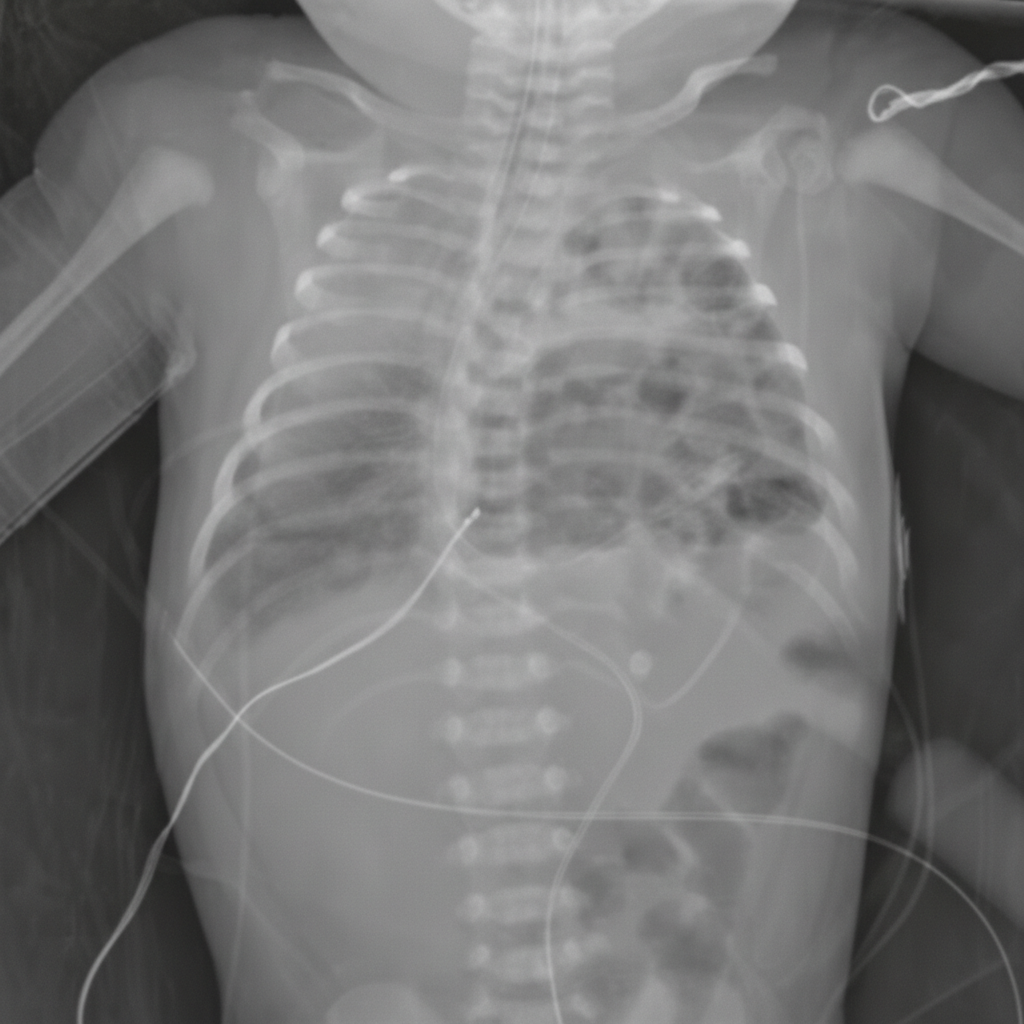
A 3900-g (8.6-lb) newborn is delivered at 38 weeks' gestation to a 27-year-old woman, gravida 3, para 2, via spontaneous vaginal delivery. Immediately after delivery, he spontaneously cries, grimaces, and moves all four extremities. Over the next five minutes, he becomes cyanotic, dyspneic, and tachypneic. Mask ventilation with 100% oxygen is begun, but ten minutes after delivery the baby continues to appear cyanotic. His temperature is 37.2°C (99.0°F), pulse is 155/min, respirations are 65/min, and blood pressure is 90/60 mm Hg. Pulse oximetry on 100% oxygen mask ventilation shows an oxygen saturation of 83%. Breath sounds are normal on the right and absent on the left. Heart sounds are best heard in the right midclavicular line. The abdomen appears concave. An x-ray of the chest is shown below. Which of the following is the most appropriate initial step in the management of this patient?
A 35-year-old man is brought into the emergency department by emergency medical services with his right hand wrapped in bloody bandages. The patient states that he is a carpenter and was cutting some wood for a home renovation project when he looked away and injured one of his digits with a circular table saw. He states that his index finger was sliced off and is being brought in by his wife. On exam, his vitals are within normal limits and stable, and he is missing part of his second digit on his right hand distal to the proximal interphalangeal joint. How should the digit be transported to the hospital for the best outcome?
A 16-month-old male patient, with no significant past medical history, is brought into the emergency department for the second time in 5 days with tachypnea, expiratory wheezes and hypoxia. The patient presented to the emergency department initially due to rhinorrhea, fever and cough. He was treated with nasal suctioning and discharged home. The mother states that, over the past 5 days, the patient has started breathing faster with chest retractions. His vital signs are significant for a temperature of 100.7 F, respiratory rate of 45 and oxygen saturation of 90%. What is the most appropriate treatment for this patient?
A 3-week-old boy is brought to the emergency department by his parents because of a 3-day history of progressive lethargy and difficulty feeding. He was born at term and did not have difficulty feeding previously. His temperature is 39.4°C (103°F), pulse is 220/min, respirations are 45/min, and blood pressure is 50/30 mm Hg. Pulse oximetry on 100% oxygen shows an oxygen saturation of 97%. Examination shows dry mucous membranes, delayed capillary refill time, and cool skin with poor turgor. Despite multiple attempts by the nursing staff, they are unable to establish peripheral intravenous access. Which of the following is the most appropriate next step in management?
A 27-year-old man presents to the emergency department after being hit by a car while riding his bike. The patient was brought in with his airway intact, vitals stable, and with a C-collar on. Physical exam is notable for bruising over the patient’s head and a confused man with a Glasgow coma scale of 11. It is noticed that the patient has a very irregular pattern of breathing. Repeat vitals demonstrate his temperature is 97.5°F (36.4°C), blood pressure is 172/102 mmHg, pulse is 55/min, respirations are 22/min and irregular, and oxygen saturation is 94% on room air. Which of the following interventions are most likely to improve this patient's vital signs?
A 54-year-old woman comes to the emergency department because of two episodes of bright red blood per rectum within the past day. She has a history of migraine, which is treated prophylactically with verapamil. She appears well and is hemodynamically stable. Cardiac exam reveals a regular heart rate without any murmurs or gallops. Lungs are clear to auscultation. Her abdomen is mildly tender without rebound or guarding. Digital rectal examination shows fresh blood on the glove. Laboratory studies show: Hemoglobin 10.4 g/dL Leukocyte count 5,000/mm3 Platelet count 175,000/mm3 Partial thromboplastin time 35 seconds Serum Na+ 140 mEq/L K+ 3.7 mEq/L Cl- 101 mEq/L HCO3- 25 mEq/L Mg2+ 1.8 mEq/L A routine ECG shows a heart rate of 75/min, a normal axis, PR interval of 280 ms, QRS interval of 80 ms with a QRS complex following each p wave, and no evidence of ischemic changes. Which of the following is the most appropriate next step in management with respect to this patient's cardiovascular workup?
A 14-year-old girl presents to the emergency room complaining of abdominal pain. She was watching a movie 3 hours prior to presentation when she developed severe non-radiating right lower quadrant pain. The pain has worsened since it started. She also had non-bloody non-bilious emesis 1 hour ago and continues to feel nauseated. Her temperature is 101°F (38.3°C), blood pressure is 130/90 mmHg, pulse is 110/min, and respirations are 22/min. On exam, she has rebound tenderness at McBurney point and a positive Rovsing sign. She is stabilized with intravenous fluids and pain medication and is taken to the operating room to undergo a laparoscopic appendectomy. While in the operating room, the circulating nurse leads the surgical team in a time out to ensure that introductions are made, the patient’s name and date of birth are correct, antibiotics have been given, and the surgical site is marked appropriately. This process is an example of which of the following human factor engineering elements?
A boy with diabetic ketoacidosis is admitted to the pediatric intensive care unit for closer monitoring. Peripheral venous access is established. He is treated with IV isotonic saline and started on an insulin infusion. This patient is at the highest risk for which of the following conditions in the next 24 hours?
Want unlimited practice?
Get full access to all questions, explanations, and performance tracking.
Scan to download app