
Pediatric advanced life support — MCQs

A newborn male is evaluated one minute after birth. He was born at 38 weeks gestation to a 28-year-old gravida 3 via vaginal delivery. The patient’s mother received sporadic prenatal care, and the pregnancy was complicated by gestational diabetes. The amniotic fluid was clear. The patient’s pulse is 70/min, and his breathing is irregular with a slow, weak cry. He whimpers in response to a soft pinch on the thigh, and he has moderate muscle tone with some flexion of his extremities. His body is pink and his extremities are blue. The patient is dried with a warm towel and then placed on his back on a flat warmer bed. His mouth and nose are suctioned with a bulb syringe. Which of the following is the best next step in management?
A 7-year-old boy is brought to the emergency room because of severe, acute diarrhea. He is drowsy with a dull, lethargic appearance. He has sunken eyes, poor skin turgor, and dry oral mucous membranes and tongue. He has a rapid, thready pulse with a systolic blood pressure of 60 mm Hg and his respirations are 33/min. His capillary refill time is 6 sec. He has had no urine output for the past 24 hours. Which of the following is the most appropriate next step in treatment?
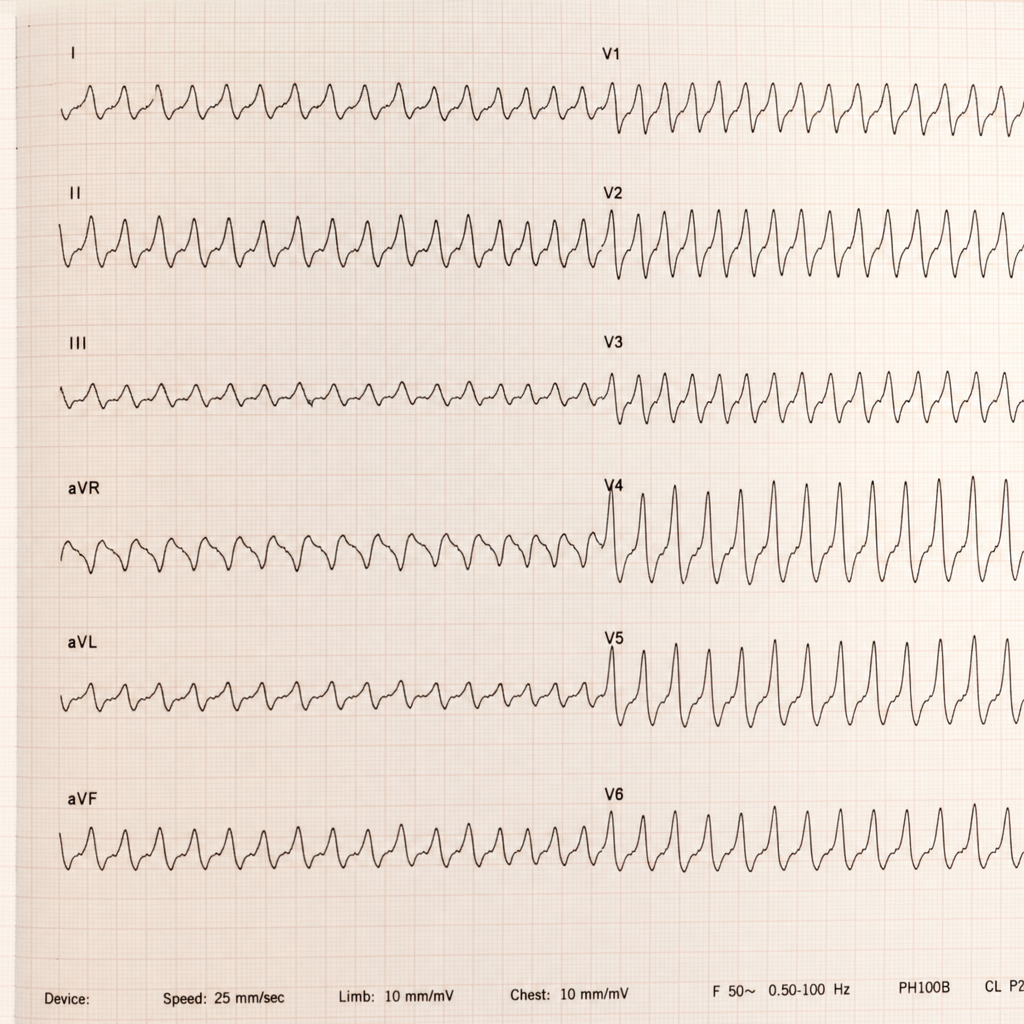
One week after an aortic valve replacement surgery, a 55-year-old man is brought to the emergency room 30 minutes after the onset of severe, sharp chest pain. He appears pale and dyspneic but is alert, oriented, and speaks in full sentences. His temperature is 38°C (100.4°F), pulse is 192/min and thready, respirations are 22/min, and blood pressure is 80/50 mm Hg. Faint rales can be heard in the lower lung fields on both sides on auscultation. There is a midline thoracotomy scar with mild reddening but without warmth or discharge. A portion of an ECG is shown. The pattern remains unchanged after 1 minute. Which of the following is the most appropriate intervention?
A first time mother of a healthy, full term, newborn girl is anxious about sudden infant death syndrome. Which of the following pieces of advice can reduce the risk of SIDS?
A 57-year-old man was brought into the emergency department unconscious 2 days ago. His friends who were with him at that time say he collapsed on the street. Upon arrival to the ED, he had a generalized tonic seizure. At that time, he was intubated and is being treated with diazepam and phenytoin. A noncontrast head CT revealed hemorrhages within the pons and cerebellum with a mass effect and tonsillar herniation. Today, his blood pressure is 110/65 mm Hg, heart rate is 65/min, respiratory rate is 12/min (intubated, ventilator settings: tidal volume (TV) 600 ml, positive end-expiratory pressure (PEEP) 5 cm H2O, and FiO2 40%), and temperature is 37.0°C (98.6°F). On physical examination, the patient is in a comatose state. Pupils are 4 mm bilaterally and unresponsive to light. Cornea reflexes are absent. Gag reflex and cough reflex are also absent. Which of the following is the next best step in the management of this patient?
A 3-month-old boy is brought to the emergency department by his mom for breathing difficulty after a recent fall. His parents say that he rolled off of the mattress and landed on the hard wood floor earlier today. After an extensive physical exam, he is found to have many purplish bruises and retinal hemorrhages. A non-contrast head CT scan shows a subdural hemorrhage. He was treated in the hospital with full recovery from his symptoms. Which of the following is the most important follow up plan?
A 3-week-old boy is brought to the emergency department by his parents because of a 3-day history of progressive lethargy and difficulty feeding. He was born at term and did not have difficulty feeding previously. His temperature is 39.4°C (103°F), pulse is 220/min, respirations are 45/min, and blood pressure is 50/30 mm Hg. Pulse oximetry on 100% oxygen shows an oxygen saturation of 97%. Examination shows dry mucous membranes, delayed capillary refill time, and cool skin with poor turgor. Despite multiple attempts by the nursing staff, they are unable to establish peripheral intravenous access. Which of the following is the most appropriate next step in management?
A 5-year-old is brought into the emergency department for trouble breathing. He was at a family picnic playing when his symptoms began. The patient is currently struggling to breathe and has red, warm extremities. The patient has an unknown medical history and his only medications include herbs that his parents give him. His temperature is 99.5°F (37.5°C), pulse is 112/min, blood pressure is 70/40 mmHg, respirations are 18/min, and oxygen saturation is 82% on 100% O2. Which of the following is the best initial step in management?
An inconsolable mother brings her 2-year-old son to the emergency room after finding a large amount of bright red blood in his diaper, an hour ago. She states that for the past week her son has been having crying fits while curling his legs towards his chest in a fetal position. His crying resolves either after vomiting or passing fecal material. Currently, the child is in no apparent distress. Physical examination with palpation in the gastric region demonstrates no acute findings. X-ray of the abdominal area demonstrates no acute findings. His current temperature is 36.5°C (97.8°F), heart rate is 93/min, blood pressure is 100/64 mm Hg, and respiratory rate is 26/min. His weight is 10.8 kg (24.0 lb), and height is 88.9 cm (35.0 in). Laboratory tests show the following: RBC count 5 million/mm3 Hematocrit 36% Hemoglobin 12 g/dL WBC count 6,000/mm3 Mean corpuscular volume 78 fL What is the most likely underlying embryological cause predisposing to this condition?
An 11-year-old boy presents to the emergency department with heavy drooling. The patient was being watched by his babysitter when she found him in this manner. His temperature is 99.1°F (37.3°C), blood pressure is 107/58 mmHg, pulse is 119/min, respirations are 14/min, and oxygen saturation is 98% on room air. Physical exam is notable for a young boy in acute distress who is drooling. The boy states he is in pain and can’t swallow. The patient’s tongue seems abnormally enlarged and erythematous. Which of the following is the most likely diagnosis?
Want unlimited practice?
Get full access to all questions, explanations, and performance tracking.
Scan to download app