
Iron deficiency and anemia — MCQs

A 25-year-old African-American woman visits the doctor’s office complaining of fatigue for a couple of months. She says that she feels exhausted by the end of the day. She works as a dental assistant and is on her feet most of the time. However, she eats well and also tries to walk for 30 minutes every morning. She also says that she sometimes feels breathless and has to gasp for air, especially when she is walking or jogging. Her past medical history is insignificant, except for occasional bouts of cold during the winters. Her physical exam findings are within normal limits except for moderate conjunctival pallor. Complete blood count results and iron profile are as follows: Hemoglobin 9 g/dL Hematocrit 28.5% RBC count 5.85 x 10⁶/mm3 WBC count 5,500/mm3 Platelet count 212,000/mm3 MCV 56.1 fl MCH 20.9 pg/cell MCHC 25.6 g/dL RDW 11.7% Hb/cell Serum iron 170 mcg/dL Total iron-binding capacity (TIBC) 458 mcg/dL Transferrin saturation 60% A peripheral blood smear is given. When questioned about her family history of anemia, she says that all she remembers is her dad was never allowed to donate blood as he was anemic. Which of the following most likely explains her cell counts and blood smear results?
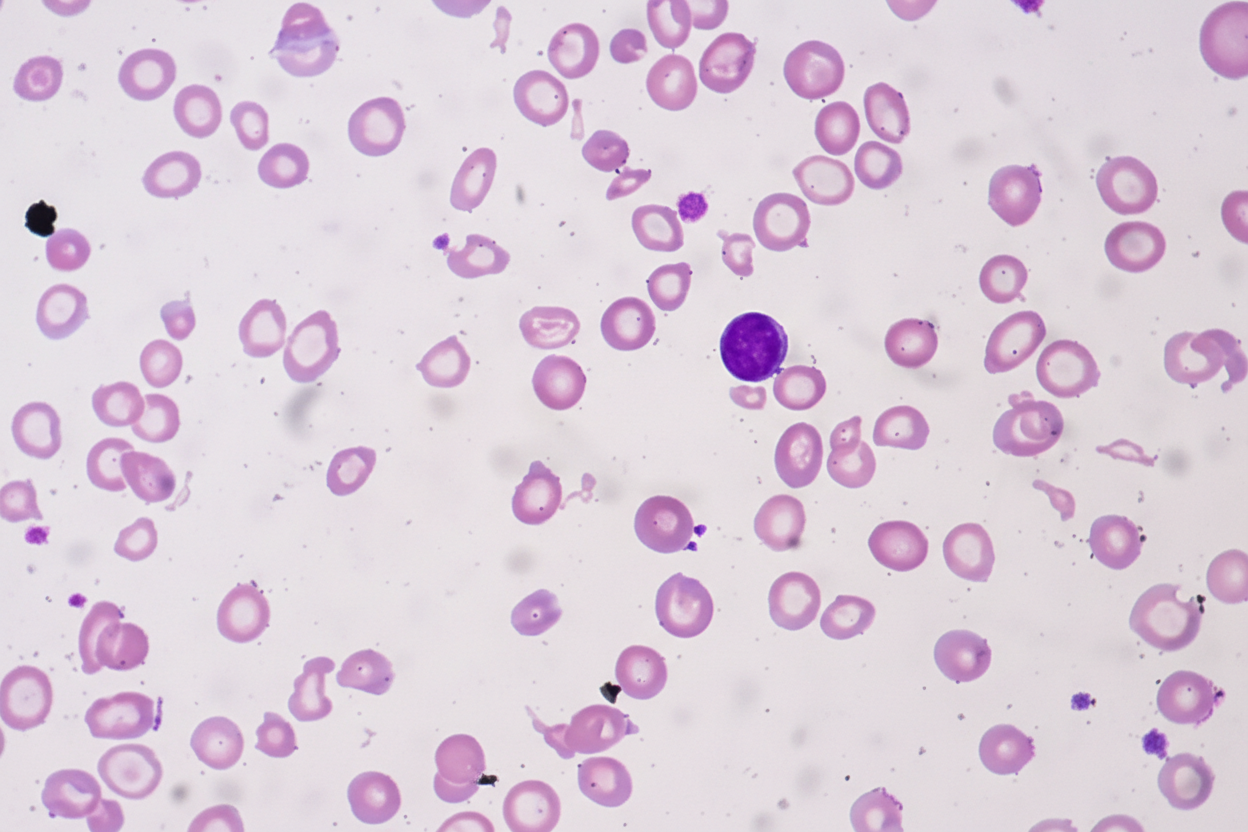
A 44-year-old male immigrant presents to his primary care physician for a new patient visit. The patient reports chronic fatigue but states that he otherwise feels well. His past medical history is not known, and he is not currently taking any medications. The patient admits to drinking 7 alcoholic beverages per day and smoking 1 pack of cigarettes per day. His temperature is 99.4°F (37.4°C), blood pressure is 157/98 mmHg, pulse is 99/min, respirations are 18/min, and oxygen saturation is 100% on room air. Physical exam demonstrates mild pallor but is otherwise not remarkable. Laboratory studies are ordered as seen below. Hemoglobin: 9 g/dL Hematocrit: 33% Leukocyte count: 6,500/mm^3 with normal differential Platelet count: 190,000/mm^3 Mean corpuscular volume (MCV): 60 femtoliters Free iron: 272 mcg/dL Total iron binding capacity (TIBC): 175 mcg/dL Ferritin: 526 ng/mL Reticulocyte count: 2.8% Which of the following is the most likely diagnosis?
A 2-year-old boy is brought to the physician for generalized fatigue and multiple episodes of abdominal pain and vomiting for the past week. His last bowel movement was 4 days ago. He has been having behavioral problems at home for the past few weeks as well. He can walk up stairs with support and build a tower of 3 blocks. He cannot use a fork. He does not follow simple instructions and speaks in single words. His family emigrated from Bangladesh 6 months ago. He is at the 40th percentile for height and weight. His temperature is 37°C (98.6°F), pulse is 115/min, and blood pressure is 84/45 mm Hg. Examination shows pale conjunctivae and gingival hyperpigmentation. His hemoglobin concentration is 10.1 g/dL, mean corpuscular volume is 68 μm3, and mean corpuscular hemoglobin is 24.5 pg/cell. The patient is most likely going to benefit from administration of which of the following?
A 2-month-old girl is brought to the physician for a well-child examination. She was born at 32 weeks' gestation and weighed 1616 g (3 lb 9 oz); she currently weighs 2466 g (5 lb 7 oz). She is exclusively breastfed and receives vitamin D supplementation. Physical examination shows no abnormalities apart from low height and weight. This patient is at increased risk for which of the following complications?
A 4-year-old boy is brought to the physician for the evaluation of fatigue since he returned from visiting family in South Africa one week ago. The day after he returned, he had fever, chills, and diffuse joint pain for 3 days. His symptoms improved with acetaminophen. He was born at term and has been healthy. His immunizations are up-to-date. His temperature is 37.6°C (99.68°F), pulse is 100/min, and blood pressure is 100/60 mm Hg. Examination shows conjunctival pallor. The remainder of the examination shows no abnormalities. Laboratory studies show: Hemoglobin 10.8 g/dL Mean corpuscular volume 68 μm3 Red cell distribution width 14% (N = 13%–15%) Hemoglobin A2 6% (N < 3.5%) A peripheral smear shows microcytic, hypochromic erythrocytes, some of which have a darkly stained center and peripheral rim, separated by a pale ring. Which of the following is the most appropriate next step in the management of this patient?
A 55-year-old woman presents with fatigue. She says her symptoms are present throughout the day and gradually started 4 months ago. Her past medical history is significant for rheumatoid arthritis–treated with methotrexate, and diabetes mellitus type 2–treated with metformin. The patient is afebrile, and her vital signs are within normal limits. A physical examination reveals pallor of the mucous membranes. Initial laboratory tests show hemoglobin of 7.9 g/dL, hematocrit of 22%, and mean corpuscular volume of 79 fL. Which of the following is the best next diagnostic step in this patient?
An 11-year-old boy presents to his pediatrician for a wellness checkup. The child is an immigrant, and this is his first visit. The patient is in the 99th percentile for height and 50th percentile for weight. The child is struggling in school, and basic cognitive testing suggests he is moderately mentally disabled. His temperature is 99.5°F (37.5°C), blood pressure is 107/68 mmHg, pulse is 90/min, respirations are 17/min, and oxygen saturation is 98% on room air. Laboratory values are obtained and shown below. Hemoglobin: 9 g/dL Hematocrit: 30% MCV: 110 fL Leukocyte count: 5,500/mm^3 with normal differential Platelet count: 192,000/mm^3 Serum: Na+: 140 mEq/L Cl-: 101 mEq/L K+: 4.4 mEq/L HCO3-: 24 mEq/L BUN: 20 mg/dL Glucose: 90 mg/dL Creatinine: 1.0 mg/dL Ca2+: 10.0 mg/dL AST: 12 U/L ALT: 10 U/L The patient is started on vitamin B9 and B12. Which of the following interventions could decrease the risk for cardiac complications the most in this patient?
A 12-month-old boy is brought to the pediatrician for a routine examination. Past medical history is significant for a pyloric myomectomy at 2 months of age after a few episodes of projectile vomiting. He has reached all appropriate developmental milestones. He currently lives with his parents and pet cat in a house built in the 1990s. He was weaned off of breast milk at 6 months of age. He is a very picky eater, but drinks 5–6 glasses of whole milk a day. The patient's height and weight are in the 50th percentile for his age and sex. The vital signs are within normal limits except for the presence of slight tachycardia. Physical examination reveals an alert infant with a slight pallor. Abdomen is soft and nondistended. A grade 2/6 systolic ejection murmur is noted in the left upper sternal border. Which of the following will most likely be expected in this patient's laboratory results?
A 19-year-old African female refugee has been granted asylum in Stockholm, Sweden and has been living there for the past month. She arrived in Sweden with her 2-month-old infant, whom she exclusively breast feeds. Which of the following deficiencies is the infant most likely to develop?
A 5-month-old male presents to the pediatrician with his mother for a well visit. The patient was born at 35 weeks gestation to a 30-year-old gravida 2 via vaginal delivery. The pregnancy and labor were uncomplicated. The patient required no resuscitation after delivery and was discharged from the hospital on day two of life. His mother now reports that the patient has been exclusively breastfed since birth, and she says that feedings have been going well, and that the patient appears satisfied afterwards. The patient feeds for 30 minutes every two hours and urinates 8-10 times per day. The patient’s mother reports that she eats a varied diet that includes animal products, but she worries that the patient is not meeting his nutritional needs with breastmilk alone. The patient’s height and weight at birth were in the 15th and 20th percentile, respectively. His height and weight are now in the 20th and 25th percentile, respectively. His temperature is 98.1°F (36.7°C), blood pressure is 58/46 mmHg, pulse is 128/min, and respirations are 34/min. On physical exam, the patient appears well-developed and well-nourished. He has mild conjunctival pallor. Which of the following is the most appropriate guidance regarding this patient’s nutritional needs?
Want unlimited practice?
Get full access to all questions, explanations, and performance tracking.
Scan to download app