
Late-onset sepsis — MCQs

A newborn infant is born at 40 weeks gestation to a G1P1 mother. The pregnancy was uncomplicated and was followed by the patient's primary care physician. The mother has no past medical history and is currently taking a multi-vitamin, folate, B12, and iron. The infant is moving its limbs spontaneously and is crying. His temperature is 98.7°F (37.1°C), blood pressure is 60/38 mmHg, pulse is 150/min, respirations are 33/min, and oxygen saturation is 99% on room air. Which of the following is the best next step in management?
A neonate born at 33 weeks is transferred to the NICU after a complicated pregnancy and C-section. A week after being admitted, he developed a fever and became lethargic and minimally responsive to stimuli. A lumbar puncture is performed that reveals the following: Appearance Cloudy Protein 64 mg/dL Glucose 22 mg/dL Pressure 330 mm H20 Cells 295 cells/mm³ (> 90% PMN) A specimen is sent to microbiology and reveals gram-negative rods. Which of the following is the next appropriate step in management?
A 6-year-old boy and his parents present to the emergency department with high-grade fever, headache, and projectile vomiting. The boy was born at 39 weeks gestation via spontaneous vaginal delivery. He is up to date on all vaccines and is meeting all developmental milestones. Past medical history is noncontributory. He has had no sick contacts at school or at home. The family has not traveled out of the area recently. He likes school and playing videogames with his younger brother. Today, his blood pressure is 115/76 mm Hg, heart rate is 110/min, respiratory rate is 22/min, and temperature is 38.4°C (101.2°F). On physical exam, the child is disoriented. Kernig’s sign is positive. A head CT was performed followed by a lumbar puncture. Several aliquots of CSF were distributed throughout the lab. Cytology showed high counts of polymorphs, biochemistry showed low glucose and elevated protein levels, and a gram smear shows gram-positive lanceolate-shaped cocci alone and in pairs. A smear is prepared on blood agar in an aerobic environment and grows mucoid colonies with clearly defined edges and alpha hemolysis. On later evaluation they develop a ‘draughtsman’ appearance. Which one of the following is the most likely pathogen?
Five days after being admitted to the hospital for a scald wound, a 2-year-old boy is found to have a temperature of 40.2°C (104.4°F). He does not have difficulty breathing, cough, or painful urination. He initially presented one hour after spilling a pot of boiling water on his torso while his mother was cooking dinner. He was admitted for fluid resuscitation, nutritional support, pain management, and wound care, and he was progressing well until today. He has no other medical conditions. Other than analgesia during this hospital stay, he does not take any medications. He appears uncomfortable but not in acute distress. His pulse is 150/min, respirations are 41/min, and blood pressure is 90/50 mm Hg. Pulse oximetry on room air shows an oxygen saturation of 99%. Examination shows uneven, asymmetrical scalding covering his anterior torso in arrow-like patterns with surrounding erythema and purulent discharge. The remainder of the examination shows no abnormalities. His hemoglobin is 13.4 g/dL, platelet count is 200,000/mm3, and leukocyte count is 13,900/mm3. Which of the following is the most appropriate initial pharmacological treatment for this patient?
A 25-day-old male infant presents to the emergency department because his mother states that he has been acting irritable for the past 2 days and has now developed a fever. On exam, the infant appears uncomfortable and has a temperature of 39.1 C. IV access is immediately obtained and a complete blood count and blood cultures are drawn. Lumbar puncture demonstrates an elevated opening pressure, elevated polymorphonuclear neutrophil, elevated protein, and decreased glucose. Ampicillin and cefotaxime are immediately initiated and CSF culture eventually demonstrates infection with a Gram-negative rod. Which of the following properties of this organism was necessary for the infection of this infant?
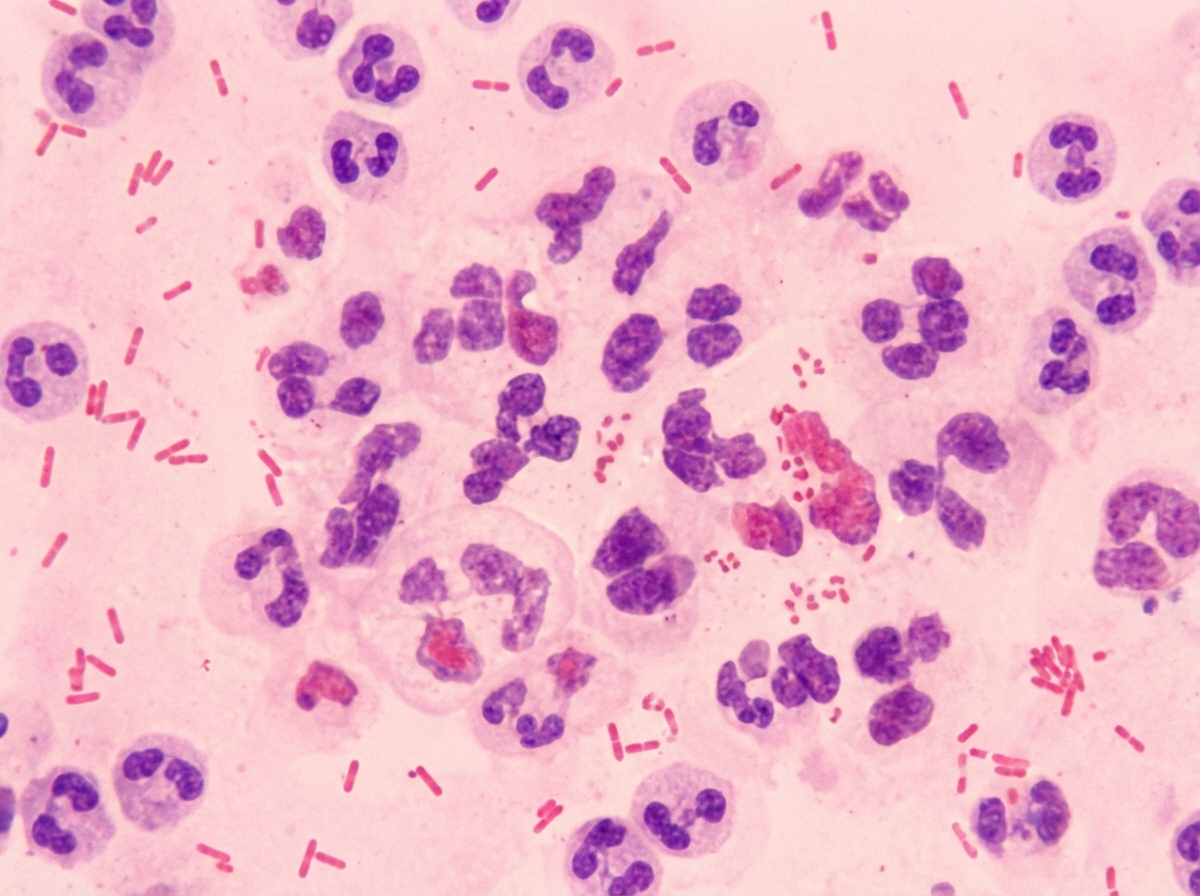
A 3-day-old boy is brought to the physician by his mother because of irritability and feeding intolerance for 1 day. His temperature is 39.2°C (102.6°F). Physical examination shows a bulging anterior fontanelle. A photomicrograph of a Gram stain of the cerebrospinal fluid is shown. Further evaluation shows that the organism expresses the K1 capsular polysaccharide. Which of the following is the most likely causal pathogen?
A 7-year-old boy is brought to the emergency department because of a 3-day history of generalized fatigue, myalgia, and fever. He has sickle cell disease. His current medications include hydroxyurea and folic acid. He appears ill. His temperature is 39.2°C (102.6°F), pulse is 103/min, and respirations are 28/min. Examination shows pale conjunctivae. The lungs are clear to auscultation. The abdomen is soft and nontender. Neurologic examination shows no focal findings, His hemoglobin concentration is 10.3 g/dL and leukocyte count is 14,100/mm3. Intravenous fluid is administered and blood cultures are obtained. Which of the following is the most appropriate next step in treatment?
A 3580-g (7-lb 14-oz) male newborn is delivered at 36 weeks' gestation to a 26-year-old woman, gravida 2, para 1 after an uncomplicated pregnancy. His temperature is 36.7°C (98.1°F), heart rate is 96/min, and respirations are 55/min and irregular. Pulse oximetry on room air shows an oxygen saturation of 65% measured in the right hand. He sneezes and grimaces during suction of secretions from his mouth. There is some flexion movement. The trunk is pink and the extremities are blue. The cord is clamped and the newborn is dried and wrapped in a prewarmed towel. Which of the following is the most appropriate next best step in management?
A worried mother brings her 12-day-old son to the emergency room concerned that his body is turning "yellow". The patient was born at 39 weeks via spontaneous vaginal delivery without complications. The mother received adequate prenatal care and has been breastfeeding her son. The patient has had adequate urine and stool output. Physical exam demonstrates a comfortable, well nourished neonate with a jaundiced face and chest. The patient's indirect bilirubin was 4 mg/dL at 48 hours of life. Today, indirect bilirubin is 10 mg/dL, and total bilirubin is 11 mg/dL. All other laboratory values are within normal limits. What is the next best treatment in this scenario?
Five weeks after delivery, a 1350-g (3-lb 0-oz) male newborn has respiratory distress. He was born at 26 weeks' gestation. He required intubation and mechanical ventilation for a month following delivery and has been on noninvasive pressure ventilation for 5 days. His temperature is 36.8°C (98.2°F), pulse is 148/min, respirations are 63/min, and blood pressure is 60/32 mm Hg. Pulse oximetry on 40% oxygen shows an oxygen saturation of 91%. Examination shows moderate intercostal and subcostal retractions. Scattered crackles are heard in the thorax. An x-ray of the chest shows diffuse granular densities and basal atelectasis. Which of the following is the most likely diagnosis?
Want unlimited practice?
Get full access to all questions, explanations, and performance tracking.
Scan to download app