
Fine motor milestones — MCQs

A 4-month-old boy is brought to the physician for a well-child examination. He was born at 39 weeks gestation via spontaneous vaginal delivery and is exclusively breastfed. He weighed 3,400 g (7 lb 8 oz) at birth. At the physician's office, he appears well. His pulse is 146/min, the respirations are 39/min, and the blood pressure is 78/44 mm Hg. He weighs 7.5 kg (16 lb 9 oz) and measures 65 cm (25.6 in) in length. The remainder of the physical examination is normal. Which of the following developmental milestones has this patient most likely met?
A 13-month-old girl is brought to the physician for a well-child examination. She was born at 38 weeks' gestation. There is no family history of any serious illnesses. She cannot pull herself to stand from a sitting position. She can pick an object between her thumb and index finger but cannot drink from a cup or feed herself using a spoon. She comes when called by name and is willing to play with a ball. She cries if she does not see her parents in the same room as her. She coos “ma” and “ba.” She is at the 50th percentile for height and weight. Physical examination including neurologic examination shows no abnormalities. Which of the following is the most appropriate assessment of her development?
During subject selection for an infant neurological development study, a child is examined by the primary investigator. She is at the 80th percentile for length and weight. She has started crawling. She looks for dropped objects. She says mama and dada non-specifically. She can perform the pincer grasp. Which of the following additional skills or behaviors would be expected in a healthy patient of this developmental age?
A 3-year-old girl is brought to the physician for a well-child examination. She was born at term and has been healthy since. She can climb up and down the stairs and can pedal a tricycle. She has difficulty using a spoon to feed herself but can copy a line. She speaks in 2- to 3-word sentences that can be understood by most people. She is selfish while playing with children her age and throws tantrums quite often. She cannot put on her own shoes and socks. She does not tolerate separation from her parents. She is at 60th percentile for height and weight. Physical examination including neurologic examination reveals no abnormalities. Which of the following is the most appropriate assessment of her development?
A 3-year-old boy is brought for general developmental evaluation. According to his parents he is playing alongside other children but not in a cooperative manner. He has also recently begun to ride a tricycle. Upon questioning you also find that he is toilet trained and can stack 9 blocks. Upon examination you find that he can copy a circle though he cannot yet copy a triangle or draw stick figures. In addition he is currently speaking in two word phrases but cannot yet use simple sentences. Based on these findings you tell the parents that their child's development is consistent with which of the following?
A child presents to his pediatrician’s clinic for a routine well visit. He can bend down and stand back up without assistance and walk backward but is not able to run or walk upstairs. He can stack 2 blocks and put the blocks in a cup. He can bring over a book when asked, and he will say “mama” and “dada” to call for his parents, as well as 'book', 'milk', and 'truck'. How old is this child if he is developmentally appropriate for his age?
A 1-year-old male presents to his pediatrician for a well-child visit. Through a history from the mother and physical examination, the pediatrician learns that the baby babbles non-specifically, takes several steps independently, and picks up his cereal using two fingers. His weight is currently 22 lbs (birth-weight 6 lbs, 9 oz), and his height is 30 inches (birth length 18 inches). Are there any aspects of this child's development that are delayed?
An 8-year-old boy is brought to the physician by his parents because of repeated episodes of “daydreaming.” The mother reports that during these episodes the boy interrupts his current activity and just “stares into space.” She says that he sometimes also smacks his lips. The episodes typically last 1–2 minutes. Over the past 2 months, they have occurred 2–3 times per week. The episodes initially only occurred at school, but last week the patient had one while he was playing baseball with his father. When his father tried to talk to him, he did not seem to listen. After the episode, he was confused for 10 minutes and too tired to play. The patient has been healthy except for an episode of otitis media 1 year ago that was treated with amoxicillin. Vital signs are within normal limits. Physical and neurological examinations show no other abnormalities. Further evaluation of this patient is most likely to show which of the following findings?
A female child presents to her pediatrician for a well child visit. Her mother reports that she is eating well at home and sleeping well throughout the night. She can jump and walk up and down stairs with both feet on each step. In the doctor’s office, the patient builds a six-cube tower and imitates a circle. She seems to have a vocabulary of over 50 words that she uses in two-word sentences. Her mother reports that the patient enjoys playing near other children and sometimes argues over toys with her older brother. On physical exam, she appears well developed and well nourished, and she is following along her growth curves. The child is assessed as developmentally normal. Which of the following is an additional milestone associated with this child’s age?
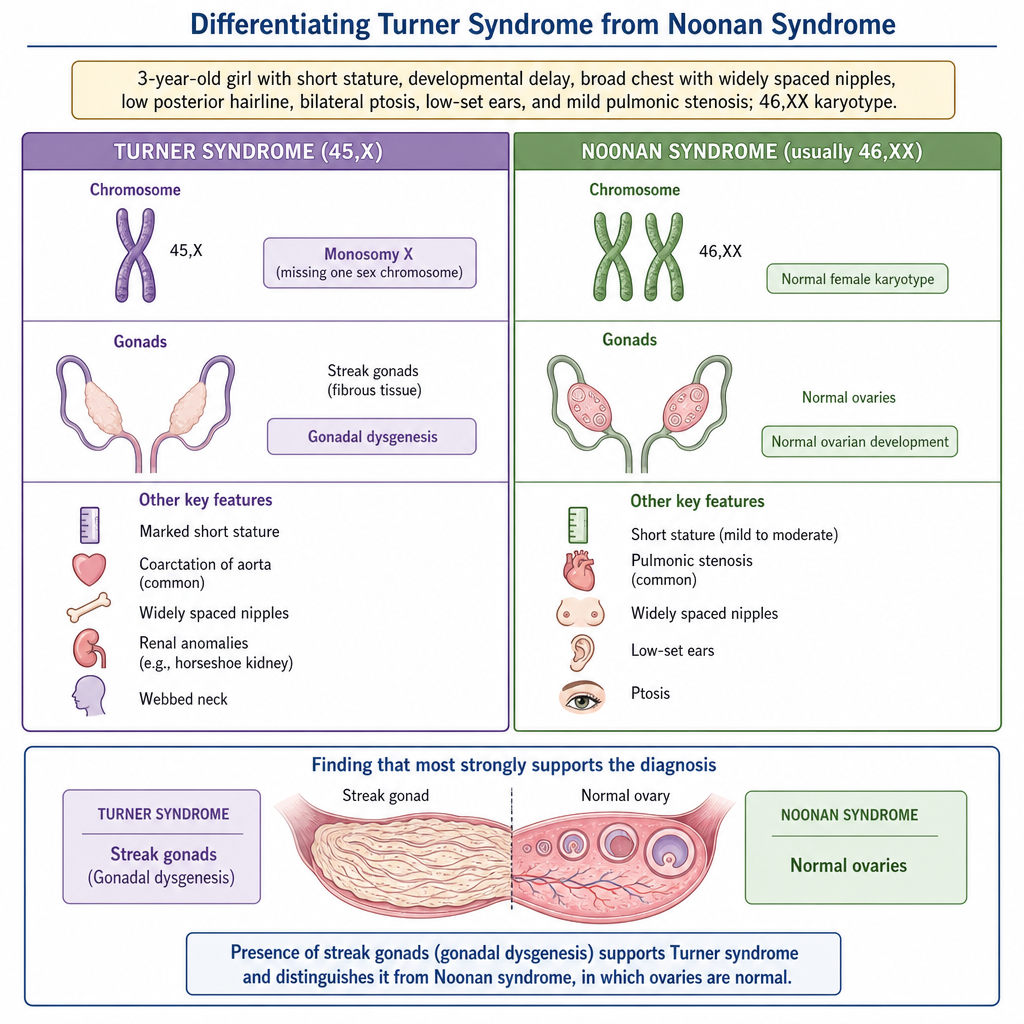
A 3-year-old girl is referred for evaluation of short stature and developmental concerns. On examination, she has a broad chest with widely spaced nipples, low posterior hairline, bilateral ptosis, low-set ears, and mild pulmonic stenosis on echocardiogram. Her chromosomal analysis reveals a 46,XX karyotype. Which of the following additional findings would most strongly support the unifying diagnosis in this child compared with the most phenotypically similar condition in the differential?
Want unlimited practice?
Get full access to all questions, explanations, and performance tracking.
Scan to download app