
Early intervention services — MCQs

A 6-month-old male infant is brought to a pediatrician by his guardian for scheduled immunizations. The boy was born at 39 weeks gestation via spontaneous vaginal delivery. He is up to date on all vaccines and is meeting all developmental milestones. The infant is generally healthy; however, the guardian is concerned about multiple patches of bluish discolorations on the skin overlying the lower back and sacrum. A review of medical records indicates that these patches have been present since birth. On further review the child was placed into protective services due to neglect and abuse by his biological family. On physical examination, his vital signs are normal. The pediatrician notes the presence of multiple blue-brown patches over the lumbosacral region, buttocks, and back. These patches are soft and nontender on palpation. Which of the following is the best next step in management of the infant?
A 5-year-old child is brought to the emergency department after being hit by a motor vehicle on the way to school. According to paramedics, the child's right leg was severely crushed in the accident. After evaluation, the physician recommends immediate limb-saving surgery to preserve the leg and prevent complications. However, the parents refuse to consent to the surgery. They explain that they heard about a similar case where a child died after limb-saving surgery, and they believe the procedure might lead to amputation or death. Despite the physician's explanation that the surgery is intended to save the limb, the parents remain adamant in their refusal. What is the next best step?
A 1-year-old male presents to his pediatrician for a well-child visit. Through a history from the mother and physical examination, the pediatrician learns that the baby babbles non-specifically, takes several steps independently, and picks up his cereal using two fingers. His weight is currently 22 lbs (birth-weight 6 lbs, 9 oz), and his height is 30 inches (birth length 18 inches). Are there any aspects of this child's development that are delayed?
A 4-year-old boy is brought to the physician because of non-fluent speech. His mother worries that his vocabulary is limited for his age and because he cannot use simple sentences to communicate. She says he enjoys playing with his peers and parents, but he has always lagged behind in his speaking and communication. His speech is frequently not understood by strangers. He physically appears normal. His height and weight are within the normal range for his age. He responds to his name, makes eye contact, and enjoys the company of his mother. Which of the following is the most appropriate next step in management?
A 4-month-old boy is brought to the physician for a well-child examination. He was born at 39 weeks gestation via spontaneous vaginal delivery and is exclusively breastfed. He weighed 3,400 g (7 lb 8 oz) at birth. At the physician's office, he appears well. His pulse is 146/min, the respirations are 39/min, and the blood pressure is 78/44 mm Hg. He weighs 7.5 kg (16 lb 9 oz) and measures 65 cm (25.6 in) in length. The remainder of the physical examination is normal. Which of the following developmental milestones has this patient most likely met?
A 12-month-old boy is brought to the physician for a well-child examination. He was born at 38 weeks' gestation and was 48 cm (19 in) in length and weighed 3061 g (6 lb 12 oz); he is currently 60 cm (24 in) in length and weighs 7,910 g (17 lb 7 oz). He can walk with one hand held and can throw a small ball. He can pick up an object between his thumb and index finger. He can wave 'bye-bye'. He can say 'mama', 'dada' and 'uh-oh'. He cries if left to play with a stranger alone. Physical examination shows no abnormalities. Which of the following is most likely delayed in this child?
A 26-year-old G1P0 female who is 39 weeks pregnant presents to the emergency department in labor. She reports following her primary care physician’s recommendations throughout her pregnancy and has not had any complications. During delivery, the baby’s head turtled back into the vaginal canal and did not advance any further. The neonatal intensivist was called for shoulder dystocia and a baby girl was able to be delivered vaginally 6 minutes later. Upon initial assessment, the baby appeared pale throughout, had her arms and legs flexed without active motion, and had some flexion of extremities when stimulated. Her pulse is 120/min and had irregular respirations. What is this baby’s initial APGAR score?
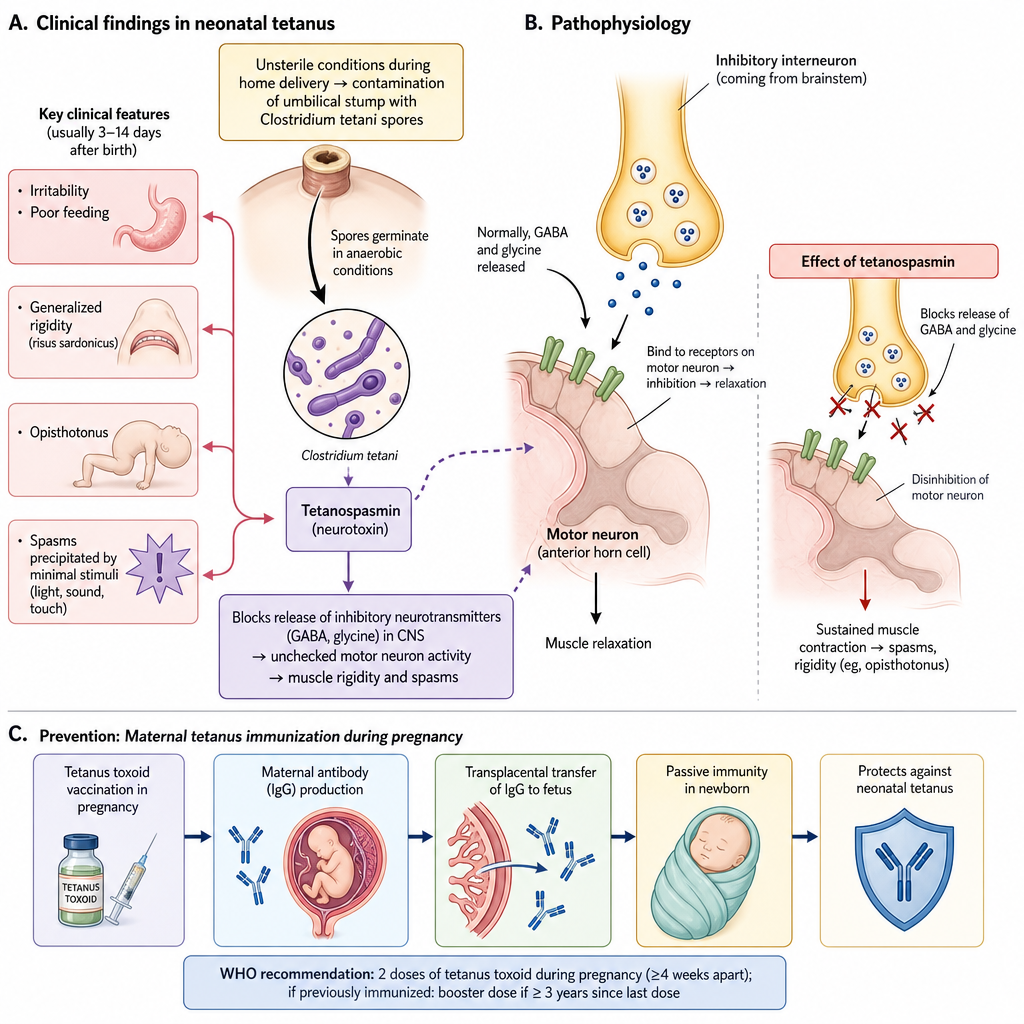
A one-week-old boy is brought to the emergency department by his mother, who recently immigrated to the United States and does not have health insurance. He was born at home, and has not received any medical care since birth. The mother states the boy has become irritable and has been feeding poorly. In the last day, she said he seems "stiff" and is having apparent muscle spasms. On your exam, you note the findings in figure A. Which of the following interventions might have prevented this disease?
A 1-minute-old newborn is being examined by the pediatric nurse. The nurse auscultates the heart and determines that the heart rate is 89/min. The respirations are spontaneous and regular. The chest and abdomen are both pink while the tips of the fingers and toes are blue. When the newborn’s foot is slapped the face grimaces and he cries loud and strong. When the arms are extended by the nurse they flex back quickly. What is this patient’s Apgar score?
A six-year-old male presents to the pediatrician for a well child visit. The patient’s parents report that they are struggling to manage his temper tantrums, which happen as frequently as several times per day. They usually occur in the morning before school and during mealtimes, when his parents try to limit how much he eats. The patient often returns for second or third helpings at meals and snacks throughout the day. The patient’s parents have begun limiting the patient’s food intake because he has been gaining weight. They also report that the patient recently began first grade but still struggles with counting objects and naming letters consistently. The patient sat without support at 11 months of age and walked at 17 months of age. He is in the 99th percentile for weight and 5th percentile for height. On physical exam, he has almond-shaped eyes and a downturned mouth. He has poor muscle tone. Which of the following additional findings would most likely be seen in this patient?
Want unlimited practice?
Get full access to all questions, explanations, and performance tracking.
Scan to download app