
Laboratory findings — MCQs

A 52-year-old man comes to the emergency department because of a 3-week history of abdominal distention, yellow coloring of the skin, and dark urine. He also reports malaise and progressive shortness of breath, associated with slight exertion, for several weeks. The patient is a chronic drinker, and he was diagnosed with cirrhosis 2 years ago. He was warned to stop drinking alcohol, but he continues to drink. He hasn't accepted any more testing and has refused to visit the doctor until now. His vital signs are heart rate 62/min, respiratory rate 26/min, temperature 37.4°C (99.3°F), and blood pressure 117/95 mm Hg. On physical examination, there is dyspnea and polypnea. Skin and sclera are jaundiced. The abdomen has visible collateral circulation and looks distended. There is diffuse abdominal pain upon palpation in the right hemiabdomen, and the liver is palpated 10 cm below the right costal border. The legs show significant edema. CT scan shows cirrhosis with portal hypertension and collateral circulation. During the fifth day of his hospital stay, the patient presents with oliguria and altered mental status. Laboratory studies show: Day 1 Day 5 Hemoglobin 12.1 g/dL 11.2 g/dL Hematocrit 33.3% 31.4% Leukocyte count 7,000/mm3 6,880/mm3 Platelet count 220,000/mm3 134,000/mm3 Total bilirubin 20.4 mg/dL 28.0 mg/dL Direct bilirubin 12.6 mg/dL 21.7 mg/dL Creatinine 2.2 mg/dL 2.9 mg/dL Albumin 3.4 g/dL 2.6 g/dL PT 15 s 16.9 s aPTT 19 s 35 s Urinalysis Negative for nitrite Negative for leukocyte esterase 0–2 RBCs per high power field 0–1 WBC per high power field No evidence of casts or proteinuria What is the most likely cause of this patient's increased creatinine?
A 6-year-old boy presents to his pediatrician accompanied by his mother for evaluation of a rash. The rash appeared a little over a week ago, and since that time the boy has felt tired. He is less interested in playing outside, preferring to remain indoors because his knees and stomach hurt. His past medical history is significant for an upper respiratory infection that resolved uneventfully without treatment 2 weeks ago. Temperature is 99.5°F (37.5°C), blood pressure is 115/70 mmHg, pulse is 90/min, and respirations are 18/min. Physical exam shows scattered maroon macules and papules on the lower extremities. The abdomen is diffusely tender to palpation. There is no cervical lymphadenopathy or conjunctival injection. Which of the following will most likely be found in this patient?
A 44-year-old woman with recurrent urinary tract infections is brought to the emergency department by ambulance after sudden onset of severe headache 30 minutes ago. She has a history of occasional, mild headaches in the morning. There is no other history of serious illness. Both her father and her paternal grandmother died of chronic kidney disease. Her temperature is 37.2°C (99.1°F) and blood pressure is 145/90 mm Hg. Physical examination shows neck stiffness. When her hip is flexed, she is unable to fully extend her knee because of pain. Lumbar puncture performed 12 hours after headache onset yields 10 mL of yellow-colored fluid with no leukocytes. Which of the following is the most likely predisposing factor for this patient's current condition?
A 33-year-old man with a history of IV drug and alcohol abuse presents to the emergency department with back pain. He states that his symptoms started 3 days ago and have been gradually worsening. His temperature is 102°F (38.9°C), blood pressure is 127/68 mmHg, pulse is 120/min, respirations are 17/min, and oxygen saturation is 98% on room air. Physical exam is notable for tenderness over the mid thoracic spine. Laboratory values are only notable for a leukocytosis and an elevated ESR and CRP. Which of the following is the most likely diagnosis?
A 25-year-old man of Mediterranean descent makes an appointment with his physician because his skin and sclera have become yellow. He complains of fatigue and fever that started at the same time icterus appeared. On examination, he is tachycardic and tachypneic. The oxygen (O2) saturation is < 90%. He has increased unconjugated bilirubin, hemoglobinemia, and an increased number of reticulocytes in the peripheral blood. What is the most likely diagnosis?
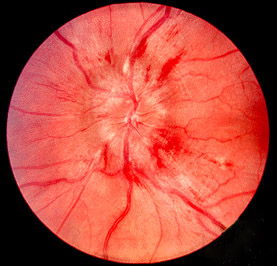
A 72-year-old woman comes to the emergency department 1 hour after the sudden onset of a diffuse, dull, throbbing headache. She also reports blurred vision, nausea, and one episode of vomiting. She has a history of poorly controlled hypertension. A photograph of her fundoscopic examination is shown. Which of the following is the most likely underlying cause of this patient's symptoms?
A 69-year-old woman is brought to the emergency department because of fatigue and lethargy for 5 days. She has also had weakness and nausea for the last 3 days. She has sarcoidosis, major depressive disorder, and hypertension. She had a stroke 5 years ago. Current medications include aspirin, nifedipine, prednisolone, fluoxetine, and rosuvastatin, but she has not taken any of her medications for 7 days due to international travel. Her temperature is 36.1°C (96.9°F), pulse is 95/min, and blood pressure is 85/65 mm Hg. She is lethargic but oriented. Examination shows no other abnormalities. Her hemoglobin concentration is 13.4 g/dL and leukocyte count is 9,600/mm3. Both serum cortisol and ACTH levels are decreased. This patient is most likely to have which of the following additional laboratory abnormalities?
A patient in a phase 1 trial for a novel epoxide reductase inhibitor, being studied for stroke prophylaxis, develops pain and erythema on the right thigh two days after starting the trial. This rapidly progresses to a purpuric rash with necrotic bullae within 24 hours. Lab results show a PTT of 29 seconds, PT of 28 seconds, and INR of 2.15. What is the most likely pathogenesis of this condition?
A 2-year-old boy is brought to the emergency department by his parents because of facial swelling that has now progressed to total body swelling. He also complains of nausea and abdominal pain. The child was in his usual state of health a week ago when they first notice swelling around his eyes. A few days later his legs started to swell. The boy was born at 39 weeks gestation via spontaneous vaginal delivery. He is up to date on all vaccines and is meeting all developmental milestones. Today, his blood pressure is 104/60 mm Hg, the heart rate is 90/min, the respiratory rate is 25/min, and the temperature is 37.1°C (98.8°F). On examination, he has facial edema, abdominal shifting dullness, and bilateral leg edema up to the knees. Urine dipstick shows 4+ protein and urinalysis shows fatty casts. Serum albumin is 2.2 g/dL. Which of the following is the most likely etiology of this patient condition?
A 3500-g (7.7-lbs) girl is delivered at 39 weeks' gestation to a 27-year-old woman, gravida 2, para 1. Apgar scores are 8 and 9 at 1 and 5 minutes, respectively. The mother had regular prenatal visits throughout the pregnancy. She did not smoke or drink alcohol. She took multivitamins as prescribed by her physician. The newborn appears active. The girl's temperature is 37°C (98.6°F), pulse is 120/min, and blood pressure is 55/35 mm Hg. Examination in the delivery room shows clitoromegaly. One day later, laboratory studies show: Hemoglobin 12.8 g/dL Leukocyte count 6,000/mm3 Platelet count 240,000/mm3 Serum Na+ 133 mEq/L K+ 5.2 mEq/L Cl− 101 mEq/L HCO3− 21 mEq/L Urea nitrogen 15 mg/dL Creatinine 0.8 mg/dL Ultrasound of the abdomen and pelvis shows normal uterus and normal ovaries. Which of the following is the most appropriate next step in the management of this newborn patient?
Want unlimited practice?
Get full access to all questions, explanations, and performance tracking.
Scan to download app