
Post-infectious immune complications — MCQs

A 53-year-old female presents with worsening shortness of breath with activity. Physical exam reveals a diastolic murmur with an opening snap. The patient’s medical history is significant for a left hip replacement 10 years ago, and she vaguely recalls an extended period of illness as a child described as several severe episodes of sore throat followed by rash, fever, and joint pains. Administration of which of the following treatments at that time would have been most effective in reducing her risk of developing cardiac disease?
A 6-year-old boy presents to his pediatrician accompanied by his mother for evaluation of a rash. The rash appeared a little over a week ago, and since that time the boy has felt tired. He is less interested in playing outside, preferring to remain indoors because his knees and stomach hurt. His past medical history is significant for an upper respiratory infection that resolved uneventfully without treatment 2 weeks ago. Temperature is 99.5°F (37.5°C), blood pressure is 115/70 mmHg, pulse is 90/min, and respirations are 18/min. Physical exam shows scattered maroon macules and papules on the lower extremities. The abdomen is diffusely tender to palpation. There is no cervical lymphadenopathy or conjunctival injection. Which of the following will most likely be found in this patient?
A 7-year-old boy is brought to the physician because of a 5-day history of fever, malaise, and joint pain. He had a sore throat 4 weeks ago that resolved without treatment. His temperature is 38.6°C (101.5°F) and blood pressure is 84/62 mm Hg. Physical examination shows several firm, painless nodules under the skin near his elbows and the dorsal aspect of both wrists. Cardiopulmonary examination shows bilateral basilar crackles and a blowing, holosystolic murmur heard best at the cardiac apex. Both knee joints are warm. Laboratory studies show an erythrocyte sedimentation rate of 129 mm/h. The immune response seen in this patient is most likely due to the presence of which of the following?
A 14-year-old male is brought to the Emergency Department by his mother. She is worried because his face has become puffy and his urine has turned a tea-color. Patient history reveals the child recently suffered from a sore throat. The physician suspects a bacterial infection. Which of the following describes the likely bacteria responsible?
A 2-year-old girl who emigrated from Pakistan 2 weeks ago is brought to the emergency department because of lower limb weakness for one-day. One week ago, she had a 3-day episode of flu-like symptoms that resolved without treatment. She has not yet received any routine childhood vaccinations. Deep tendon reflexes are 1+ in the right lower extremity and absent in the left lower extremity. Analysis of cerebrospinal fluid shows a leukocyte count of 38 cells/mm3 (68% lymphocytes), a protein concentration of 49 mg/dL, and a glucose concentration of 60 mg/dL. Which of the following is the most likely diagnosis in this patient?
A 4-year-old boy is brought to the emergency department by his mother with a rash on his trunk, malaise, and fever with spikes up to 38.5°C (101.3°F) for the past 2 weeks. The patient's mother says she tried giving him Tylenol with little improvement. Past medical history includes a spontaneous vaginal delivery at full term. The patient's vaccines are up-to-date and he has met all developmental milestones. On physical examination, his lips are cracking, and he has painful cervical lymphadenopathy. The rash is morbilliform and involves his trunk, palms, and the soles of his feet. There is fine desquamation of the skin of the perianal region. Which of the following anatomical structures is most important to screen for possible complications in this patient?
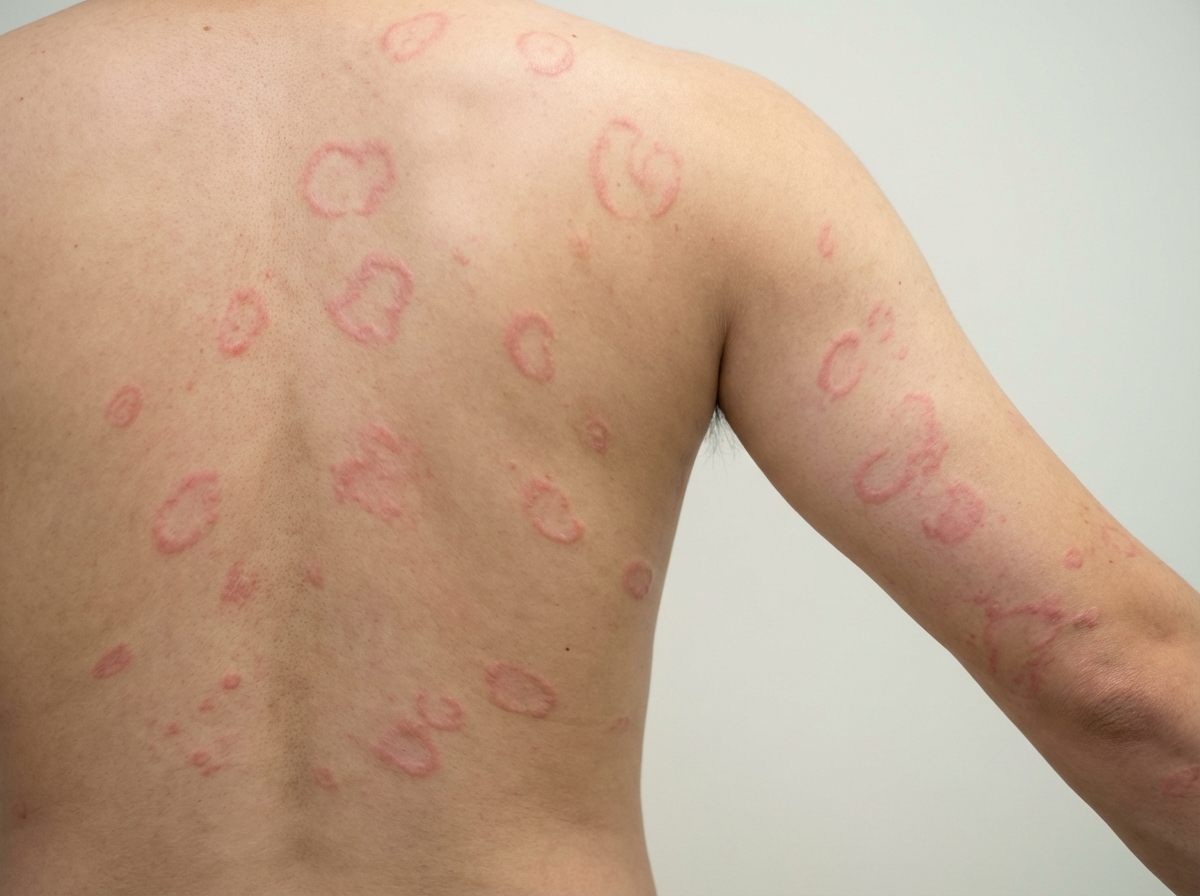
An 11-year-old boy presents with fever and joint pain for the last 3 days. His mother says that he had a sore throat 3 weeks ago but did not seek medical care at that time. The family immigrated from the Middle East 3 years ago. The patient has no past medical history. The current illness started with a fever and a swollen right knee that was very painful. The following day, his knee improved but his left elbow became swollen and painful. While in the waiting room, his left knee is also becoming swollen and painful. Vital signs include: temperature 38.7°C (101.6°F), and blood pressure 110/80 mm Hg. On physical examination, the affected joints are swollen and very tender to touch, and there are circular areas of redness on his back and left forearm (as shown in the image). Which of the following is needed to establish a diagnosis of acute rheumatic fever in this patient?
A 54-year-old man is brought to the emergency department because of progressive tingling and weakness in both of his legs for the past two days. The patient reports that his symptoms interfere with his ability to walk. Two weeks ago, he had an upper respiratory tract infection, which resolved spontaneously. His vital signs are within normal limits. Examination shows weakness in the lower extremities with absent deep tendon reflexes. Reflexes are 1+ in the upper extremities. Sensation to pinprick and light touch is intact. Romberg's test is negative. Laboratory studies show a leukocyte count of 12,000/mm3. Cerebrospinal fluid analysis results show: Opening pressure normal Protein 200 mg/dL Glucose 70 mg/dL White blood cells 4/mm3 This patient is at increased risk for which of the following conditions?
A 24-year-old man presents to the emergency department with sudden onset of fever for the past few hours as well as pain and swelling in his right knee and left ankle. He denies any recent history of trauma or injury. The patient is otherwise a healthy, active young man. He recently recovered from a case of gastroenteritis which caused significant abdominal pain and bloody stool 4 weeks ago. He believes the infection was related to eating undercooked chicken while camping. His blood pressure is 124/76 mm Hg, his heart rate is 76/min, and his temperature is 36.9 ℃ (98.4 ℉). Physical examination reveals tenderness to palpation of his right knee and left ankle as well as erythematous conjunctiva. Which of the following features would be least likely to develop in patients with this condition?
A 14-year-old girl is brought to the physician because of a 1-week history of fever, malaise, and chest pain. She describes the pain as 6 out of 10 in intensity and that it is more severe if she takes a deep breath. The pain is centrally located in the chest and does not radiate. Three weeks ago, she had a sore throat that resolved without treatment. She has no personal history of serious illness. She appears ill. Her temperature is 38.7°C (101.7°F). Examination shows several subcutaneous nodules on the elbows and wrist bilaterally. Breath sounds are normal. A soft early systolic murmur is heard best at the apex in the left lateral position. Abdominal examination is unremarkable. Laboratory studies show: Hemoglobin 12.6 g/dL Leukocyte count 12,300/mm3 Platelet count 230,000/mm3 Erythrocyte sedimentation rate 40 mm/hr Serum Antistreptolysin O titer 327 U/mL (N < 200 U/mL) She is treated with aspirin and penicillin and her symptoms resolve. An echocardiography of the heart done 14 days later shows no abnormalities. Which of the following is the most appropriate next step in management?
Want unlimited practice?
Get full access to all questions, explanations, and performance tracking.
Scan to download app