
Fever of unknown origin approach — MCQs

A scientist in Chicago is studying a new blood test to detect Ab to EBV with increased sensitivity and specificity. So far, her best attempt at creating such an exam reached 82% sensitivity and 88% specificity. She is hoping to increase these numbers by at least 2 percent for each value. After several years of work, she believes that she has actually managed to reach a sensitivity and specificity much greater than what she had originally hoped for. She travels to China to begin testing her newest blood test. She finds 2,000 patients who are willing to participate in her study. Of the 2,000 patients, 1,200 of them are known to be infected with EBV. The scientist tests these 1,200 patients' blood and finds that only 120 of them tested negative with her new exam. Of the patients who are known to be EBV-free, only 20 of them tested positive. Given these results, which of the following correlates with the exam's specificity?
A 3-year-old patient is brought to the emergency department by her mother due to inability to walk. The child has been limping recently and as of this morning, has refused to walk. Any attempts to make the child walk or bear weight result in crying. She was recently treated for impetigo and currently takes a vitamin D supplement. Physical exam is remarkable for an anxious appearing toddler with knee swelling, erythema, and limited range of motion due to pain. Her mother denies any recent trauma to the child's affected knee. Temperature is 103°F (39.4°C), pulse is 132/min, blood pressure is 90/50 mmHg, respirations are 18/min, and oxygen saturation is 99% on room air. Which of the following is the best initial step in management?
A 15-year-old boy is brought to the Emergency department by ambulance from school. He started the day with some body aches and joint pain but then had several episodes of vomiting and started complaining of a terrible headache. The school nurse called for emergency services. The boy was born at 39 weeks gestation via spontaneous vaginal delivery. He is up to date on all vaccines and is meeting all developmental milestones. Past medical history is noncontributory. He is a good student and enjoys sports. At the hospital, his blood pressure is 120/80 mm Hg, heart rate is 105/min, respiratory rate is 21/min, and his temperature is 38.9°C (102.0°F). On physical exam, he appears drowsy with neck stiffness and sensitivity to light. Kernig’s sign is positive. An ophthalmic exam is performed followed by a lumbar puncture. An aliquot of cerebrospinal fluid is sent to microbiology. A gram stain shows gram-negative diplococci. A smear is prepared on blood agar and grows round, smooth, convex colonies with clearly defined edges. Which of the following would identify the described pathogen?
A 38-year-old woman comes to the physician because of a 4-day history of swelling and pain in her left knee. She has had similar episodes of swollen joints over the past 3 weeks. Two months ago, she had a rash on her upper back that subsided after a few days. She lives in Pennsylvania and works as a forest ranger. Her temperature is 37.8°C (100°F). Physical examination shows a tender and warm left knee. Arthrocentesis of the knee joint yields cloudy fluid with a leukocyte count of 65,000/mm3 and 80% neutrophils. A Gram stain of synovial fluid does not show any organisms. Which of the following is the most likely cause of this patient's condition?
A 2-year-old boy presents for a routine checkup. The patient’s mother says that he has been ‘under the weather’ for the past few days. She did not measure his temperature at home but states that he has felt warm. She denies any episodes of diarrhea or vomiting. No significant past medical history or current medications. The patient attends daycare. He is due for a hepatitis A vaccine. The patient was born at term with no prenatal or perinatal complications. The vital signs include: temperature 37.8°C (100.1°F), blood pressure 112/62 mm Hg, pulse 80/min, respiratory rate 18/min, and oxygen saturation 99% on room air. The patient is alert and responsive. The physical exam is unremarkable. Which of the following is the most appropriate next step in the management of this patient?
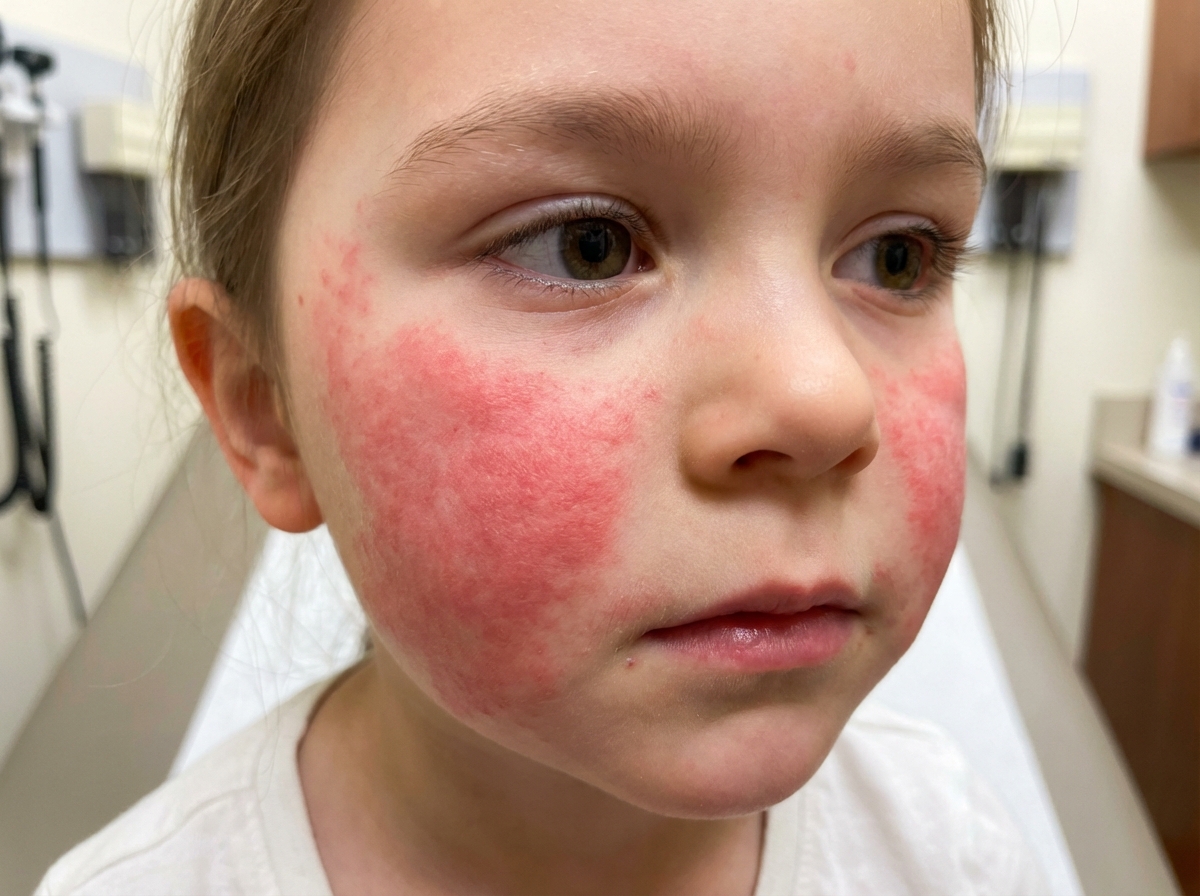
A 4-year-old boy is brought to the clinic by his mother with fever and a rash. The patient’s mother says his symptoms started 1 week ago with the acute onset of fever and a runny nose, which resolved over the next 3 days. Then, 4 days later, she noted a rash on his face, which, after a day, spread to his neck, torso, and extremities. The patient denies any pruritus or pain associated with the rash. No recent history of sore throat, chills, or upper respiratory infection. The patient has no significant past medical history and takes no medications. The vital signs include: temperature 37.2°C (99.9°F) and pulse 88/min. On physical examination, there is a maculopapular rash on his face, torso, and extremities, which spares the palms and soles. The appearance of the rash is shown in the exhibit (see image below). Which of the following would most likely confirm the diagnosis in this patient?
A 13-year-old girl is brought to the physician because of worsening fever, headache, photophobia, and nausea for 2 days. One week ago, she returned from summer camp. She has received all age-appropriate immunizations. Her temperature is 39.1°C (102.3°F). She is oriented to person, place, and time. Physical examination shows a maculopapular rash. There is rigidity of the neck; forced flexion of the neck results in involuntary flexion of the knees and hips. Cerebrospinal fluid studies show: Opening pressure 120 mm H2O Appearance Clear Protein 47 mg/dL Glucose 68 mg/dL White cell count 280/mm3 Segmented neutrophils 15% Lymphocytes 85% Which of the following is the most likely causal organism?
Five days after being admitted to the hospital for a scald wound, a 2-year-old boy is found to have a temperature of 40.2°C (104.4°F). He does not have difficulty breathing, cough, or painful urination. He initially presented one hour after spilling a pot of boiling water on his torso while his mother was cooking dinner. He was admitted for fluid resuscitation, nutritional support, pain management, and wound care, and he was progressing well until today. He has no other medical conditions. Other than analgesia during this hospital stay, he does not take any medications. He appears uncomfortable but not in acute distress. His pulse is 150/min, respirations are 41/min, and blood pressure is 90/50 mm Hg. Pulse oximetry on room air shows an oxygen saturation of 99%. Examination shows uneven, asymmetrical scalding covering his anterior torso in arrow-like patterns with surrounding erythema and purulent discharge. The remainder of the examination shows no abnormalities. His hemoglobin is 13.4 g/dL, platelet count is 200,000/mm3, and leukocyte count is 13,900/mm3. Which of the following is the most appropriate initial pharmacological treatment for this patient?
A 5-year-old boy presents to your office with his mother. The boy has been complaining of a sore throat and headache for the past 2 days. His mother states that he had a fever of 39.3°C (102.7°F) and had difficulty eating. On examination, the patient has cervical lymphadenopathy and erythematous tonsils with exudates. A streptococcal rapid antigen detection test is negative. Which of the following is the most likely causative agent?
A 12-year-old boy is brought in by his mother to the emergency department. He has had abdominal pain, fever, nausea, vomiting, and loss of appetite since yesterday. At first, the mother believed it was just a "stomach flu," but she is growing concerned about his progressive decline. Vitals include: T 102.3 F, HR 110 bpm, BP 120/89 mmHg, RR 16, O2 Sat 100%. Abdominal exam is notable for pain over the right lower quadrant. What is the next best step in management in addition to IV hydration and analgesia?
Want unlimited practice?
Get full access to all questions, explanations, and performance tracking.
Scan to download app