
Prenatal diagnosis of congenital defects — MCQs

A 40-year-old woman in her 18th week of pregnancy based on the last menstrual period (LMP) presents to her obstetrician for an antenatal check-up. The antenatal testing is normal, except the quadruple screen results which are given below: Maternal serum alpha-fetoprotein (MS-AFP) low Unconjugated estriol low Human chorionic gonadotropin (hCG) high Inhibin-A high Which of the following conditions is the most likely the cause of the abnormal quadruple screen?
A 37-year-old woman presents for prenatal counseling at 18 weeks gestation. The patient tells you that her sister recently had a child with Down's syndrome, and the patient would like prenatal screening for Down's in her current pregnancy. Which of the following prenatal screening tests and results would raise concern for Down's syndrome?
A 36-year-old G3P2002 presents to her obstetrician’s office for her first prenatal visit at ten weeks and two days gestation. She notes that she has felt nauseous the last several mornings and has been especially tired for a few weeks. Otherwise, she feels well. The patient has had two uncomplicated spontaneous vaginal deliveries at full term with her last child born six years ago. She is concerned about the risk of Down syndrome in this fetus, as her sister gave birth to an affected child at age 43. The patient has a history of generalized anxiety disorder, atopic dermatitis, and she is currently on escitalopram. At this visit, this patient’s temperature is 98.6°F (37.0°C), pulse is 70/min, blood pressure is 121/67 mmHg, and respirations are 13/min. The patient appears anxious, but overall comfortable, and cardiopulmonary and abdominal exams are unremarkable. Pelvic exam reveals normal female external genitalia, a closed and slightly soft cervix, a ten-week-sized uterus, and no adnexal masses. Which of the following is the best next step for definitively determining whether this patient’s fetus has Down syndrome?
A 37-year-old woman comes for a follow-up prenatal visit at 18 weeks' gestation. At 12 weeks' gestation, ultrasonography showed increased nuchal translucency and pregnancy-associated plasma protein A (PAPP-A) was decreased by 2 standard deviations. Chorionic villus sampling showed a 47, XX, +21 karyotype. During this visit, ultrasonography shows a hypoplastic nasal bone, shortened femur length, shortened middle phalanges of the fifth digits with clinodactyly. A quadruple marker test would most likely show which of the following sets of findings? $$$ α-Fetoprotein (AFP) %%% Estriol %%% β-Human chorionic gonadotropin (HCG) %%% Inhibin A $$$
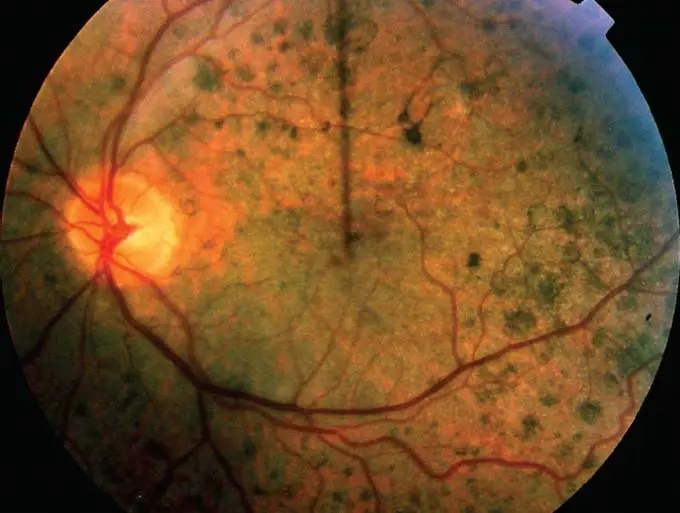
A male neonate is being examined by a pediatrician. His mother informs the doctor that she had a mild fever with rash, muscle pain, and swollen and tender lymph nodes during the second month of gestation. The boy was born at 39 weeks gestation via spontaneous vaginal delivery with no prenatal care. On physical examination, the neonate has normal vital signs. Retinal examination reveals the findings shown in the image. Which of the following congenital heart defects is most likely to be present in this neonate?
A 26-year-old G1P0 mother is in the delivery room in labor. Her unborn fetus is known to have a patent urachus. Which of the following abnormalities would you expect to observe in the infant?
A 6-year-old boy is brought in for evaluation by his adopted mother due to trouble starting 1st grade. His teacher has reported that he has been having trouble focusing on tasks and has been acting out while in class. His family history is unknown as he was adopted 2 years ago. His temperature is 36.2°C (97.2°F), pulse is 80/min, respirations are 20/min, and blood pressure 110/70 mm Hg. Visual inspection of the boy's face shows a low set nasal bridge, a smooth philtrum, and small lower jaw. Which of the following findings would also likely be found on physical exam?
A 45-day-old male infant is brought to a pediatrician by his parents with concerns of poor feeding and excessive perspiration for one week. On physical examination, his temperature is 37.7°C (99.8°F), pulse rate is 190/min, and respiratory rate is 70/min. Mild cyanosis is present over the lips, and over the nail beds. Oxygen is provided and his oxygen saturation is carefully monitored. The pediatrician orders a bedside echocardiogram of the infant. It reveals a single arterial trunk arising from 2 normally formed ventricles. The arterial trunk is separated from the ventricles by a single semilunar valve. There is a defect in the interventricular septum, and the arterial trunk overrides the defect. Which of the following congenital heart diseases can also present with similar clinical features?
A 25-year-old woman, gravida 2, para 1, comes to the physician for her initial prenatal visit at 18 weeks’ gestation. She is a recent immigrant from Thailand. Her history is significant for anemia since childhood that has not required any treatment. Her mother and husband have anemia, as well. She has no history of serious illness and takes no medications. Her vital signs are within normal limits. Fundal height measures at 22 weeks. Ultrasound shows polyhydramnios and pleural and peritoneal effusion in the fetus with fetal subcutaneous edema. Which of the following is the most likely clinical course for this fetus?
An 8-year-old boy presents to your office for a routine well-child visit. Upon physical examination, he is found to have a harsh-sounding, holosystolic murmur that is best appreciated at the left sternal border. The murmur becomes louder when you ask him to make fists with his hands. Which of the following is the most likely explanation for these findings?
Want unlimited practice?
Get full access to all questions, explanations, and performance tracking.
Scan to download app