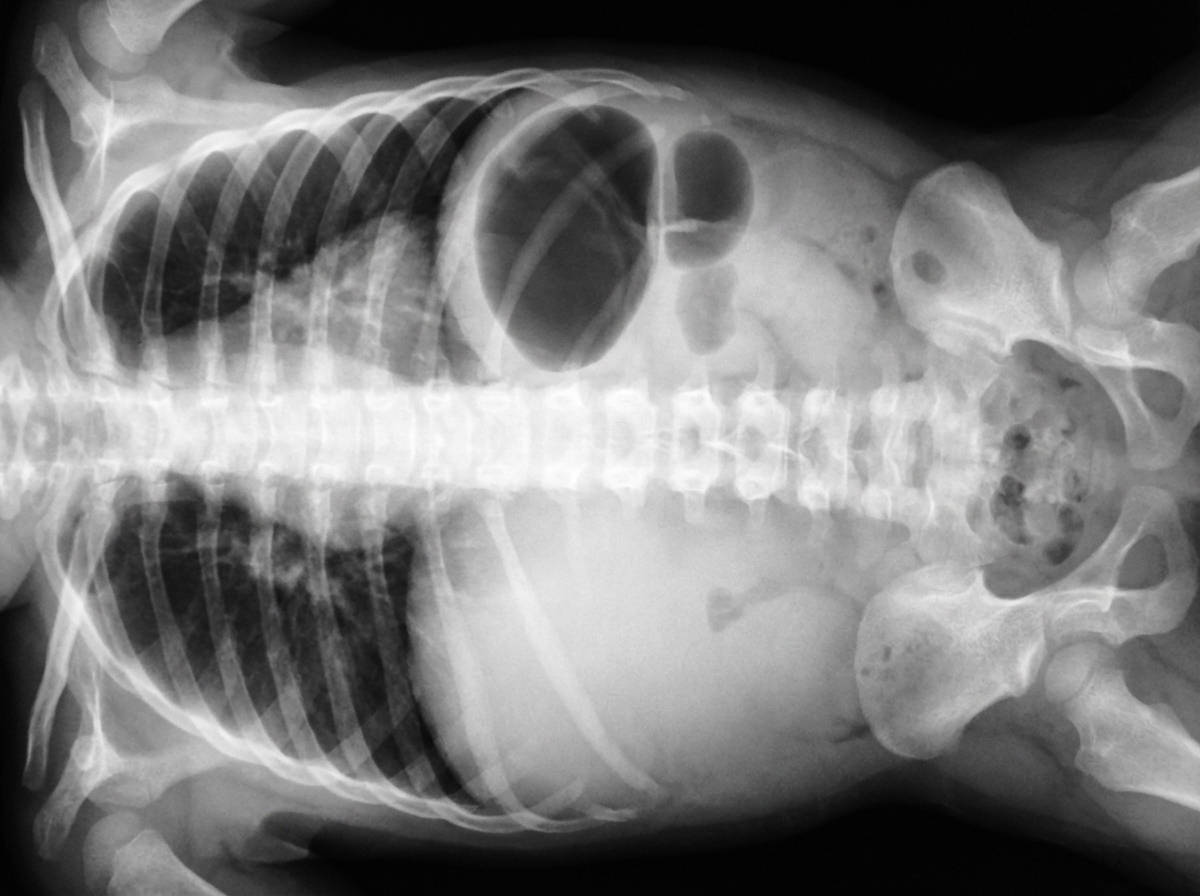
A female newborn delivered at 38 weeks’ gestation is evaluated for abdominal distention and bilious vomiting 24 hours after delivery. The pregnancy and delivery were uncomplicated. She appears lethargic and her fontanelles are sunken. An x-ray of the abdomen is shown. This infant most likely has a congenital obstruction affecting which of the following anatomic structures?
Q22
A 16-year-old boy is brought to the physician by his parents because of a 6-month history of progressive fatigue and worsening shortness of breath on exertion. The parents report that the boy “has always been tired out a bit more easily than other kids.” The family recently immigrated to the United States from rural South Korea. Pulse oximetry on room air shows an oxygen saturation of 96% on bilateral index fingers. Radial pulses are bounding. There is mild bluish discoloration and bulbous enlargement of the distal toes bilaterally. Echocardiography is most likely to show which of the following?
Q23
A 2-year-old boy is brought to the physician because of progressive difficulty breathing and a productive cough for the past 2 days. During the past 6 months, he has had recurrent episodes of pneumonia treated with antibiotics. He has not gained weight in this time period. His temperature is 38.5°C (101.3°F), pulse is 130/min, respirations are 18/min, and blood pressure is 100/60 mm Hg. Auscultation of the lungs shows decreased breath sounds over the right lung fields. Ocular examination shows periorbital subcutaneous bleeding and bulging of both eyes. His leukocyte count is 16,000/mm3. An x-ray of the chest shows a right-sided opacity and a collapsed right lung. An MRI of the chest shows a heterogeneous mass in the posterior mediastinum that compresses the heart and the great vessels to the left side. Further evaluation is most likely to show which of the following?
Q24
A 9-month-old infant is brought to the pediatrician for immunizations and assessment. His parents report that he is eating well and produces several wet diapers every day. He is a happy and curious child. The boy was born at 39 weeks gestation via spontaneous vaginal delivery. He is up to date on all vaccines and is meeting all developmental milestones. The infant's vital signs are normal. Physical growth is appropriate for his age. The physician notes a loud holosystolic murmur at the left sternal border (grade IV) and orders an echocardiogram which confirms the diagnosis of congenital heart defect. Based on echocardiogram findings, the pediatrician reassures the parents that the infant will be monitored, but most likely will not require surgical intervention. Which of the following is the most likely diagnosis?
Q25
A 7-year-old child with a history of abdominal and thigh pain that runs in his family is brought into the emergency room by his mother. His mother states they have a "blood disease." She also states the child was coughing and had fever to 101.1 F over the last three days and has been suddenly feeling much worse. On exam, the vitals are HR 110, BP 100/60, RR 20, T 101.5 F. CBC is significant for Hgb 3.2, WBC 2.1, Hct 10, Plts 30000. The reticulocyte count is 1% and the MCV is 81. Bone marrow biopsy shows hypocellular marrow with fatty tissue. What is the most likely diagnosis?
Q26
A 3-year-old boy is brought to the physician for a follow-up examination. He has suffered from seizures since the age of 8 months. His mother has noticed he often has unprovoked bouts of laughter and loves playing with water. She describes him as having a happy, excitable demeanor. He can stand without support but cannot walk. His responses are rarely verbal, and when they are, he uses single words only. His only medication is sodium valproate. He is at the 2nd percentile for head circumference, 30th percentile for height, and 60th percentile for weight. Examination shows a wide-based stance and mandibular prognathism. Tongue thrusting and difficulty standing is present. Muscle tone is increased in all extremities. Deep tendon reflexes are 4+ bilaterally. Which of the following is the mechanism most likely to explain these findings?
Q27
A 5-month-old boy is brought to the emergency department by his mother because his lips turned blue for several minutes while playing earlier that evening. She reports that he has had similar episodes during feeding that resolved quickly. He was born at term following an uncomplicated pregnancy and delivery. He is at the 25th percentile for length and below the 5th percentile for weight. His temperature is 37°C (98.6°F), pulse is 130/min, blood pressure is 83/55 mm Hg, and respirations are 42/min. Pulse oximetry on room air shows an oxygen saturation of 90%. During the examination, he sits calmly in his mother's lap. He appears well. The patient begins to cry when examination of his throat is attempted; his lips and fingers begin to turn blue. Further evaluation of this patient is most likely to show which of the following?
Q28
A 4-week-old newborn is brought to the physician for a well-child examination. He was born at 40 weeks' gestation and weighed 3300 g (7 lb 4 oz). He now weighs 4300 g (9 lbs 1 oz). There is no family history of serious illness. He is at the 50th percentile for height and 50th percentile for weight. Vital signs are within normal limits. Examination shows a grade 3/6 harsh holosystolic murmur at the left lower sternal border and a soft mid-diastolic murmur over the cardiac apex. The lungs are clear to auscultation. The remainder of the examination shows no abnormalities. Which of the following is the most likely explanation for this patient's physical findings?
Q29
A 2-year-old, previously healthy female presents to the emergency department complaining of 7 hours of 10/10 intermittent abdominal pain, vomiting, and dark red stools. On exam, there is tenderness to palpation in the right lower quadrant and high-pitched bowel sounds. Technetium-99m pertechnetate scan was performed (Image A). Which of the following is true about this patient's condition?
Q30
A 2-year-old boy is brought to the emergency department because of a 5-minute episode of repetitive, involuntary, twitching movements of his left arm that occurred 1 hour ago. His symptoms began while playing with some toys. His parents say that he began to stand with support at 18 months and has recently started to walk with support. He speaks in bisyllables. He is at the 70th percentile for length and 80th percentile for weight. His vital signs are within normal limits. Examination shows a purple-pink patch over the right cheek that extends to the right eyelid. The right eyeball is firm. Neurologic examination shows left arm hypotonia and absent bicep reflex on the left side. Fundoscopy shows cupping of the right optic disc. Which of the following is the most likely cause of this patient's symptoms?
Congenital defects US Medical PG Practice Questions and MCQs
Question 21: A female newborn delivered at 38 weeks’ gestation is evaluated for abdominal distention and bilious vomiting 24 hours after delivery. The pregnancy and delivery were uncomplicated. She appears lethargic and her fontanelles are sunken. An x-ray of the abdomen is shown. This infant most likely has a congenital obstruction affecting which of the following anatomic structures?
A. Esophagus
B. Pylorus
C. Duodenum (Correct Answer)
D. Ileum
E. Common bile duct
Explanation: ***Duodenum***
- The abdominal X-ray shows the classic **"double bubble" sign**, indicating duodenal obstruction. This sign is formed by gas trapped in the stomach and the proximal duodenum, separated by the pylorus.
- **Bilious vomiting** in a neonate strongly suggests an obstruction distal to the ampulla of Vater, which is located in the second part of the duodenum.
*Esophagus*
- Esophageal obstruction, such as esophageal atresia, would primarily present with **inability to feed**, drooling, and respiratory distress, not typically with significant abdominal distention or bilious vomiting.
- An abdominal X-ray in this case would show a **small or absent stomach bubble** if there is complete atresia and no tracheoesophageal fistula.
*Pylorus*
- Pyloric obstruction, such as pyloric stenosis, typically presents with **non-bilious vomiting** and generally occurs later, around 3-6 weeks of age, not within 24 hours of birth.
- The X-ray would show a **dilated stomach** but without the second bubble characteristic of duodenal obstruction.
*Ileum*
- Obstruction in the ileum (e.g., meconium ileus, ileal atresia) would lead to widespread **multiple dilated loops of small bowel** on X-ray, sometimes with air-fluid levels, and more generalized abdominal distention, not the localized double bubble sign.
- While it causes bilious vomiting, the X-ray findings are distinct.
*Common bile duct*
- Obstruction of the common bile duct, like biliary atresia, causes **jaundice** (often appearing later, after 1-2 weeks of age) and **acholic (pale) stools**, but usually does not cause significant intestinal obstruction, abdominal distention, or bilious vomiting in the immediate newborn period.
- The X-ray would not show a characteristic "double bubble" sign.
Question 22: A 16-year-old boy is brought to the physician by his parents because of a 6-month history of progressive fatigue and worsening shortness of breath on exertion. The parents report that the boy “has always been tired out a bit more easily than other kids.” The family recently immigrated to the United States from rural South Korea. Pulse oximetry on room air shows an oxygen saturation of 96% on bilateral index fingers. Radial pulses are bounding. There is mild bluish discoloration and bulbous enlargement of the distal toes bilaterally. Echocardiography is most likely to show which of the following?
A. Persistent blood flow between the pulmonary artery and descending aorta (Correct Answer)
B. Single overriding great vessel arising from the heart
C. Abnormal narrowing of the aorta at the aortic isthmus
D. Anomalous shunting of blood through a defect in atrial septum
E. Positioning of the ascending aorta directly over a ventricular septal defect
Explanation: ***Persistent blood flow between the pulmonary artery and descending aorta***
- The combination of **bounding radial pulses**, **differential cyanosis** (bluish discoloration and bulbous enlargement of distal toes with normal finger oxygen saturation), and **shortness of breath on exertion** in an older child suggests a patent ductus arteriosus (PDA) with **Eisenmenger syndrome**.
- In PDA, the **ductus arteriosus** (a fetal connection between the pulmonary artery and aorta) fails to close, leading to persistent blood flow. If unrepaired, pulmonary hypertension can develop, eventually causing right-to-left shunting and the observed differential cyanosis where deoxygenated blood from the pulmonary artery shunts into the descending aorta.
*Single overriding great vessel arising from the heart*
- This describes **truncus arteriosus**, a complex congenital heart defect where a single great artery arises from both ventricles, overriding a ventricular septal defect.
- While it causes cyanosis and pulmonary hypertension, it typically presents much earlier with severe symptoms and **does not cause differential cyanosis** as observed in this patient.
*Abnormal narrowing of the aorta at the aortic isthmus*
- This is **coarctation of the aorta**, characterized by a narrowing of the aorta, often presenting with **hypertension in the upper extremities**, diminished femoral pulses, and a **difference in blood pressure** between the upper and lower limbs.
- It does not typically cause the described differential cyanosis or bounding radial pulses unless there's a coexisting PDA with right-to-left shunting through it, but the primary pathology is the narrowing.
*Anomalous shunting of blood through a defect in atrial septum*
- This describes an **atrial septal defect (ASD)**, which typically involves left-to-right shunting, leading to volume overload of the right heart.
- While large, unrepaired ASDs can eventually lead to pulmonary hypertension and Eisenmenger syndrome, they usually present with **generalized cyanosis** (if present) and **do not cause differential cyanosis** with normal finger saturation and toe cyanosis.
*Positioning of the ascending aorta directly over a ventricular septal defect*
- This is a characteristic feature of **tetralogy of Fallot**, a complex congenital heart defect including a **ventricular septal defect**, **pulmonary stenosis**, an **overriding aorta**, and **right ventricular hypertrophy**.
- Patients with tetralogy of Fallot typically present with **generalized cyanosis** (blue spells), clubbing, and exertional dyspnea, but not the specific differential cyanosis pattern described with bounding radial pulses.
Question 23: A 2-year-old boy is brought to the physician because of progressive difficulty breathing and a productive cough for the past 2 days. During the past 6 months, he has had recurrent episodes of pneumonia treated with antibiotics. He has not gained weight in this time period. His temperature is 38.5°C (101.3°F), pulse is 130/min, respirations are 18/min, and blood pressure is 100/60 mm Hg. Auscultation of the lungs shows decreased breath sounds over the right lung fields. Ocular examination shows periorbital subcutaneous bleeding and bulging of both eyes. His leukocyte count is 16,000/mm3. An x-ray of the chest shows a right-sided opacity and a collapsed right lung. An MRI of the chest shows a heterogeneous mass in the posterior mediastinum that compresses the heart and the great vessels to the left side. Further evaluation is most likely to show which of the following?
A. Unregulated B-cell proliferation in the mediastinum
B. Acid-fast bacteria on sputum microscopy
C. Increased lymphoblast count in the bone marrow
D. Overexpression of the N-myc oncogene (Correct Answer)
E. Autoantibodies against nicotinic acetylcholine receptors
Explanation: ***Overexpression of the N-myc oncogene***
- The combination of a posterior mediastinal mass, periorbital bruising (**raccoon eyes**), and proptosis in a 2-year-old child with recurrent infections and failure to thrive is highly suggestive of **neuroblastoma**.
- **N-myc oncogene amplification** is a common genetic abnormality found in high-risk neuroblastoma and correlates with aggressive disease and poor prognosis.
*Unregulated B-cell proliferation in the mediastinum*
- This would suggest a **lymphoma**, which typically presents with anterior or superior mediastinal masses and often involves lymphadenopathy.
- The specific ocular findings of periorbital ecchymoses and proptosis are not characteristic of lymphoma but are classic for metastatic neuroblastoma.
*Acid-fast bacteria on sputum microscopy*
- This finding is indicative of **tuberculosis**, which can cause mediastinal lymphadenopathy and pulmonary symptoms.
- However, tuberculosis would not typically cause a large heterogeneous posterior mediastinal mass with associated periorbital ecchymoses and proptosis.
*Increased lymphoblast count in the bone marrow*
- This points to **acute lymphoblastic leukemia (ALL)**. While ALL can cause mediastinal masses (T-cell ALL often presents with an anterior mediastinal mass) and systemic symptoms, the **periorbital bruising and proptosis** are specific features that distinguish neuroblastoma.
- Also, a significantly increased lymphoblast count in the bone marrow is the defining diagnostic criterion for leukemia, which is not directly suggested by the initial presentation beyond general systemic illness.
*Autoantibodies against nicotinic acetylcholine receptors*
- This finding is characteristic of **myasthenia gravis**, an autoimmune neuromuscular disorder.
- Myasthenia gravis presents with **muscle weakness and fatigue**, not a posterior mediastinal mass, recurrent pneumonia, failure to thrive, or ocular bulging/bruising as described.
Question 24: A 9-month-old infant is brought to the pediatrician for immunizations and assessment. His parents report that he is eating well and produces several wet diapers every day. He is a happy and curious child. The boy was born at 39 weeks gestation via spontaneous vaginal delivery. He is up to date on all vaccines and is meeting all developmental milestones. The infant's vital signs are normal. Physical growth is appropriate for his age. The physician notes a loud holosystolic murmur at the left sternal border (grade IV) and orders an echocardiogram which confirms the diagnosis of congenital heart defect. Based on echocardiogram findings, the pediatrician reassures the parents that the infant will be monitored, but most likely will not require surgical intervention. Which of the following is the most likely diagnosis?
A. Patent ductus arteriosus
B. Coarctation of aorta
C. Ventricular septal defect (Correct Answer)
D. Tetralogy of Fallot
E. Atrial septal defect
Explanation: ***Ventricular septal defect***
- A **small ventricular septal defect (VSD)** often presents with a loud **holosystolic murmur** at the left sternal border and can close spontaneously, explaining why surgical intervention may not be required.
- The infant's normal growth, activity, and lack of symptoms suggest a less severe defect, consistent with a small VSD with **left-to-right shunting**.
*Patent ductus arteriosus*
- This condition presents with a **continuous "machinery" murmur** at the upper left sternal border, not a holosystolic murmur.
- Though it can spontaneously close, the characteristic murmur is different from what is described.
*Coarctation of aorta*
- This defect typically causes **differential blood pressures** between the upper and lower extremities and can lead to absent or weak femoral pulses, which are not mentioned.
- While it can present with a murmur, it is usually not holosystolic and the clinical picture does not fit.
*Tetralogy of Fallot*
- This is a cyanotic heart defect characterized by **four distinct anomalies** leading to right-to-left shunting and **cyanosis**, which is absent in this thriving infant.
- Infants with Tetralogy of Fallot often experience **"tet spells"** and have failure to thrive.
*Atrial septal defect*
- An ASD typically presents with a **systolic ejection murmur** at the upper left sternal border due to increased pulmonary flow, and often a fixed split S2.
- While many ASDs can be asymptomatic and close spontaneously, the murmur described as holosystolic is more characteristic of a VSD.
Question 25: A 7-year-old child with a history of abdominal and thigh pain that runs in his family is brought into the emergency room by his mother. His mother states they have a "blood disease." She also states the child was coughing and had fever to 101.1 F over the last three days and has been suddenly feeling much worse. On exam, the vitals are HR 110, BP 100/60, RR 20, T 101.5 F. CBC is significant for Hgb 3.2, WBC 2.1, Hct 10, Plts 30000. The reticulocyte count is 1% and the MCV is 81. Bone marrow biopsy shows hypocellular marrow with fatty tissue. What is the most likely diagnosis?
A. Iron deficiency anemia
B. Hypersplenism associated anemia
C. Anemia of chronic disease
D. Aplastic anemia (Correct Answer)
E. Folate deficiency anemia
Explanation: ***Aplastic anemia***
- The combination of **pancytopenia** (very low Hgb, WBC, and platelets), a **low reticulocyte count** (indicating bone marrow failure), and a **hypocellular bone marrow with fatty tissue** is diagnostic for aplastic anemia.
- Aplastic anemia represents **bone marrow failure affecting all cell lines**, leading to the production of insufficient red blood cells, white blood cells, and platelets.
- This can be **triggered by viral infections** (such as Parvovirus B19, EBV, hepatitis viruses) in susceptible individuals, as well as medications, toxins, or idiopathic causes.
- The history of **abdominal and thigh pain** with family history of "blood disease" is a red herring suggesting sickle cell disease, but the profound pancytopenia with hypocellular bone marrow clearly indicates aplastic anemia rather than a hemolytic process.
*Iron deficiency anemia*
- This typically presents with **microcytic hypochromic anemia (MCV <80)**, but not severe pancytopenia.
- While the MCV of 81 is on the lower end of normal, the profound leukopenia and thrombocytopenia are not characteristic of iron deficiency.
- Bone marrow would show **increased iron stores absent** but normal cellularity.
*Hypersplenism associated anemia*
- While hypersplenism can cause **cytopenias through sequestration and destruction**, it leads to a **compensatory increase in reticulocytes** as the bone marrow attempts to compensate.
- The bone marrow would typically appear **hypercellular** (due to increased production), which contradicts the hypocellular marrow with fatty replacement described.
*Anemia of chronic disease*
- This usually presents as a **mild to moderate normocytic or microcytic anemia** with normal or slightly reduced WBC and platelet counts.
- It would not explain the severe pancytopenia or the extremely hypocellular bone marrow seen in this case.
- Bone marrow iron studies would show **increased storage iron but decreased availability**.
*Folate deficiency anemia*
- This is a **macrocytic anemia** (MCV >100), often with hypersegmented neutrophils on peripheral smear.
- The **MCV of 81** is not consistent with macrocytic anemia, and the bone marrow would typically be **hypercellular with megaloblastic changes**, not hypocellular with fatty replacement.
Question 26: A 3-year-old boy is brought to the physician for a follow-up examination. He has suffered from seizures since the age of 8 months. His mother has noticed he often has unprovoked bouts of laughter and loves playing with water. She describes him as having a happy, excitable demeanor. He can stand without support but cannot walk. His responses are rarely verbal, and when they are, he uses single words only. His only medication is sodium valproate. He is at the 2nd percentile for head circumference, 30th percentile for height, and 60th percentile for weight. Examination shows a wide-based stance and mandibular prognathism. Tongue thrusting and difficulty standing is present. Muscle tone is increased in all extremities. Deep tendon reflexes are 4+ bilaterally. Which of the following is the mechanism most likely to explain these findings?
A. Microdeletion of paternal 15q11-q13
B. Microdeletion of maternal 15q11-q13 (Correct Answer)
C. MECP2 gene mutation
D. Trisomy of chromosome 21
E. Microdeletion of 22q11.2
Explanation: ***Microdeletion of maternal 15q11-q13***
- This describes **Angelman syndrome**, characterized by **developmental delay**, severe speech impairment, ataxia, prominent **happy demeanor with inappropriate laughter**, and seizures, consistent with the patient's presentation.
- Angelman syndrome results from the absence of expression of the maternally inherited copy of the **UBE3A gene** within the 15q11-q13 region, often due to a microdeletion.
*Microdeletion of paternal 15q11-q13*
- This genetic abnormality leads to **Prader-Willi syndrome**, which presents with **neonatal hypotonia**, feeding difficulties in infancy, intellectual disability, and later **hyperphagia leading to obesity**.
- While both syndromes involve the same chromosomal region, the specific clinical features and parent-of-origin effect differentiate them from the given case.
*MECP2 gene mutation*
- A mutation in the **MECP2 gene** is the cause of **Rett syndrome**, which almost exclusively affects girls.
- It presents with **normal early development followed by regression** of language and motor skills, **stereotypic hand movements**, and microcephaly, distinct from the boy's symptoms.
*Trisomy of chromosome 21*
- This is the genetic basis for **Down syndrome**, characterized by specific **facial features** (e.g., epicanthic folds, upslanting palpebral fissures), intellectual disability, and often **hypotonia**, but not the characteristic happy demeanor or severe motor and speech delays seen here.
- While intellectual disability is present, the specific constellation of symptoms, particularly the unique behavioral traits and motor dysfunction, does not align with Down syndrome.
*Microdeletion of 22q11.2*
- This microdeletion causes **DiGeorge syndrome**, known for **cardiac defects** (e.g., conotruncal abnormalities), **T-cell immunodeficiency**, **palatal abnormalities**, and **hypocalcemia**.
- None of the key features described in the patient, such as the characteristic behavioral profile or motor difficulties, are typical of DiGeorge syndrome.
Question 27: A 5-month-old boy is brought to the emergency department by his mother because his lips turned blue for several minutes while playing earlier that evening. She reports that he has had similar episodes during feeding that resolved quickly. He was born at term following an uncomplicated pregnancy and delivery. He is at the 25th percentile for length and below the 5th percentile for weight. His temperature is 37°C (98.6°F), pulse is 130/min, blood pressure is 83/55 mm Hg, and respirations are 42/min. Pulse oximetry on room air shows an oxygen saturation of 90%. During the examination, he sits calmly in his mother's lap. He appears well. The patient begins to cry when examination of his throat is attempted; his lips and fingers begin to turn blue. Further evaluation of this patient is most likely to show which of the following?
A. Pulmonary vascular congestion on x-ray of the chest
B. Right axis deviation on ECG (Correct Answer)
C. Anomalous pulmonary venous return on MR angiography
D. Diminutive left ventricle on echocardiogram
E. Machine-like hum on auscultation
Explanation: ***Right axis deviation on ECG***
- The presentation of **cyanotic spells** ("blue lips for several minutes", "lips and fingers begin to turn blue" with crying), **poor weight gain**, and **hypoxemia** (SpO2 90%) in an infant strongly suggests a **cyanotic congenital heart defect** like **Tetralogy of Fallot** (TOF).
- TOF is characterized by **right ventricular outflow tract obstruction**, leading to **right ventricular hypertrophy** and subsequently **right axis deviation** on ECG.
*Pulmonary vascular congestion on x-ray of the chest*
- **Pulmonary vascular congestion** is typically seen in conditions with **increased pulmonary blood flow** or **left-sided heart failure**, such as a large ventricular septal defect or patent ductus arteriosus.
- In Tetralogy of Fallot, there is often **decreased pulmonary blood flow** due to right ventricular outflow tract obstruction, leading to a **clear lung fields** on chest x-ray.
*Anomalous pulmonary venous return on MR angiography*
- **Total anomalous pulmonary venous return (TAPVR)** is a cyanotic heart defect where all pulmonary veins drain into the systemic circulation.
- While it causes cyanosis, it typically presents with **pulmonary congestion** and signs of **right heart strain**, which is less consistent with the spells described.
*Diminutive left ventricle on echocardiogram*
- A **diminutive left ventricle** is characteristic of **hypoplastic left heart syndrome**, which is a severe cyanotic defect.
- However, patients with hypoplastic left heart syndrome usually present with **severe heart failure** and shock much earlier in infancy, often in the neonatal period, which is not described here.
*Machine-like hum on auscultation*
- A **machine-like hum** is the classic auscultatory finding for a **patent ductus arteriosus (PDA)**.
- While a PDA can cause cyanosis if pulmonary hypertension is severe (Eisenmenger syndrome), isolated PDA typically presents with **left-to-right shunting** and **pulmonary overcirculation**, not the classic cyanotic spells seen with activities like crying, characteristic of TOF.
Question 28: A 4-week-old newborn is brought to the physician for a well-child examination. He was born at 40 weeks' gestation and weighed 3300 g (7 lb 4 oz). He now weighs 4300 g (9 lbs 1 oz). There is no family history of serious illness. He is at the 50th percentile for height and 50th percentile for weight. Vital signs are within normal limits. Examination shows a grade 3/6 harsh holosystolic murmur at the left lower sternal border and a soft mid-diastolic murmur over the cardiac apex. The lungs are clear to auscultation. The remainder of the examination shows no abnormalities. Which of the following is the most likely explanation for this patient's physical findings?
A. Communication between the pulmonary artery and the thoracic aorta
B. Right-to-left shunt through the ventricular septum
C. Right ventricular outflow obstruction
D. Right-to-left shunt through the atrial septum
E. Left-to-right shunt through the ventricular septum (Correct Answer)
Explanation: ***Left-to-right shunt through the ventricular septum***
- A **holosystolic murmur** at the **left lower sternal border** is characteristic of a **ventricular septal defect (VSD)**, an acyanotic congenital heart disease causing a **left-to-right shunt**.
- The **soft mid-diastolic murmur** at the apex is due to increased flow across the **mitral valve (relative mitral stenosis)**, resulting from the large volume of blood returning to the left atrium through the VSD and the pulmonary circulation.
*Communication between the pulmonary artery and the thoracic aorta*
- This describes a **patent ductus arteriosus (PDA)**, which typically presents with a **continuous "machinery-like" murmur** loudest at the left infraclavicular area, not a holosystolic murmur at the lower sternal border.
- A significant PDA can cause pulmonary overcirculation but presents with distinct auscultatory findings.
*Right-to-left shunt through the ventricular septum*
- A right-to-left shunt through the ventricular septum (e.g., in **Tetralogy of Fallot**) would typically cause **cyanosis**, which is not mentioned, and often a **systolic ejection murmur** (due to pulmonary stenosis), not a holosystolic murmur at the left lower sternal border.
- While there is a VSD component, the primary flow direction in this clinical scenario (acyanotic with good growth) points away from a significant right-to-left shunt.
*Right ventricular outflow obstruction*
- This would result in a **systolic ejection murmur** loudest at the upper left sternal border or pulmonary area (e.g., in **pulmonic stenosis**).
- It would not typically produce a holosystolic murmur at the left lower sternal border or a mid-diastolic murmur at the apex.
*Right-to-left shunt through the atrial septum*
- A right-to-left shunt through the atrial septum (e.g., in **tricuspid atresia** or severe pulmonary hypertension with an **atrial septal defect**) would cause **cyanosis**.
- The murmur associated with an isolated atrial septal defect is typically a **systolic ejection murmur** due to increased flow across the pulmonic valve, not a holosystolic murmur, and would not cause an apical diastolic rumble.
Question 29: A 2-year-old, previously healthy female presents to the emergency department complaining of 7 hours of 10/10 intermittent abdominal pain, vomiting, and dark red stools. On exam, there is tenderness to palpation in the right lower quadrant and high-pitched bowel sounds. Technetium-99m pertechnetate scan was performed (Image A). Which of the following is true about this patient's condition?
A. It is a remnant of the allantois
B. It contains all the layers of the GI tract (Correct Answer)
C. It is typically found in the descending colon
D. It typically affects females more than males
E. It is typically symptomatic
Explanation: ***It contains all the layers of the GI tract***
- Meckel's diverticulum is a **true diverticulum**, meaning it involves all three layers of the bowel wall: mucosa, submucosa, and muscularis propria.
- This is in contrast to a **pseudodiverticulum**, which only involves the mucosa and submucosa herniating through the muscular layer.
*It is a remnant of the allantois*
- The **allantois** is a fetal membrane that contributes to the formation of the urinary bladder and urachus, not Meckel's diverticulum.
- Meckel's diverticulum is a remnant of the **vitelline duct (omphalomesenteric duct)**, which connects the primitive gut to the yolk sac.
*It is typically found in the descending colon*
- Meckel's diverticulum is typically located in the **distal ileum**, usually within 2 feet (60 cm) of the ileocecal valve.
- The **descending colon** is a much more distal part of the large intestine.
*It typically affects females more than males*
- Meckel's diverticulum is more common in **males** than females, with a male-to-female ratio of about 2:1.
- It follows the "rule of 2s": 2% of the population, 2 feet from the ileocecal valve, 2 inches long, 2 types of ectopic tissue, symptomatic in 2% of cases, and typically presents before age 2.
*It is typically symptomatic*
- Only about **2-4%** of individuals with Meckel's diverticulum are ever symptomatic and the vast majority remain asymptomatic throughout their lives.
- When symptomatic, it can present with complications like **bleeding (most common in children)**, intussusception, obstruction, or diverticulitis.
Question 30: A 2-year-old boy is brought to the emergency department because of a 5-minute episode of repetitive, involuntary, twitching movements of his left arm that occurred 1 hour ago. His symptoms began while playing with some toys. His parents say that he began to stand with support at 18 months and has recently started to walk with support. He speaks in bisyllables. He is at the 70th percentile for length and 80th percentile for weight. His vital signs are within normal limits. Examination shows a purple-pink patch over the right cheek that extends to the right eyelid. The right eyeball is firm. Neurologic examination shows left arm hypotonia and absent bicep reflex on the left side. Fundoscopy shows cupping of the right optic disc. Which of the following is the most likely cause of this patient's symptoms?
A. Sturge-Weber syndrome (Correct Answer)
B. Neurofibromatosis type 1
C. Klippel-Trenaunay syndrome
D. Hereditary hemorrhagic telangiectasia
E. Ataxia telangiectasia
Explanation: ***Sturge-Weber syndrome***
- The patient's presentation with a **port-wine stain** (purple-pink patch) on the face, **seizures** (twitching movements of the left arm), and **glaucoma** (firm right eyeball, cupping of the right optic disc) is highly characteristic of Sturge-Weber syndrome.
- This neurocutaneous disorder is caused by a **vascular malformation** (angioma) that affects the brain, eye, and skin.
*Neurofibromatosis type 1*
- Characterized by **café-au-lait spots**, **axillary/groin freckling**, **neurofibromas**, and **Lisch nodules** in the iris.
- While it can cause seizures, the patient's specific constellation of facial birthmark, glaucoma, and focal neurological deficits points away from NF1.
*Klippel-Trenaunay syndrome*
- This syndrome involves a triad of **port-wine stain**, **venous malformations** (often varicose veins), and **limb overgrowth** of the affected extremity.
- It does not typically present with the neurological and ophthalmic findings such as seizures and glaucoma that are seen in this patient.
*Hereditary hemorrhagic telangiectasia*
- Also known as **Osler-Weber-Rendu disease**, it is characterized by **mucocutaneous telangiectasias** and **arteriovenous malformations (AVMs)**, primarily affecting the lungs, liver, and brain.
- While it can cause neurological symptoms due to brain AVMs, the characteristic facial birthmark and glaucoma are not typical features.
*Ataxia telangiectasia*
- This is a rare, neurodegenerative, inherited disorder characterized by progressive **cerebellar ataxia**, **oculocutaneous telangiectasias** (especially in the conjunctiva), and **immunodeficiency**.
- The patient's symptoms of a facial port-wine stain, seizures, and glaucoma do not align with the classic presentation of ataxia telangiectasia.