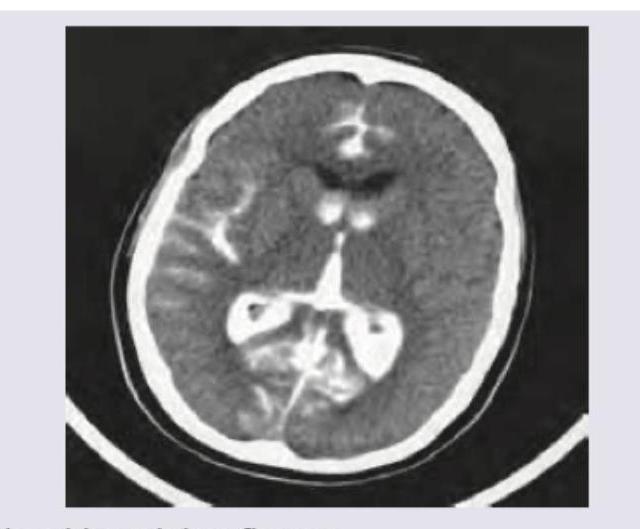
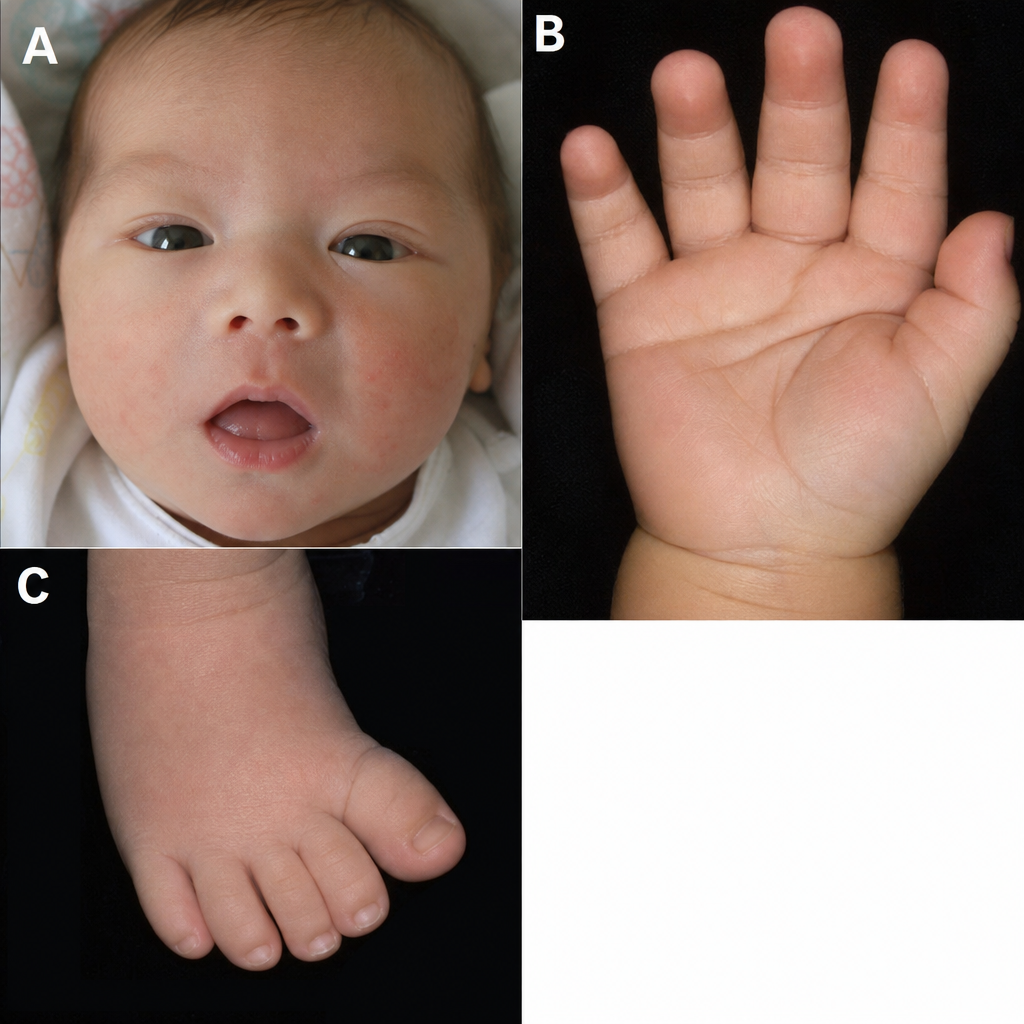
A pediatrician is called to examine a recently born dysmorphic boy. The birth weight was 1.6 kg (3.5 lb). On physical examination of the face and skull, the head was shown to be microcephalic with a prominent occiput and a narrow bifrontal diameter. The jaw was comparatively small with short palpebral fissures. The nose was narrow and the nasal ala was hypoplastic. Examination of the upper limbs revealed closed fists with the index fingers overlapping the 3rd fingers, and the 5th fingers overlapping the 4th fingers. The fingernails and toenails were hypoplastic and he had rocker-bottom feet. Based on these details, you suspect a particular chromosomal anomaly. Which of the following statements best describes this patient’s condition?
Q172
A 12-year-old female with no past medical history is found to have an abnormal cardiovascular exam during routine physical examination at her pediatrician's office. All other components of her physical exam are normal. During evaluation for potential causes for her abnormal exam, an echocardiogram with doppler is done that shows flow between the atria. Which of the following would have most likely been auscultated as a result of the pathology on her echocardiogram?
Q173
An 8-year-old girl is brought to the emergency department by her parents because she complained of very fast heartbeats. The patient has previously been healthy without any childhood illnesses and has not needed to visit a physician in the past 2 years. On examination, the heart rate is 198/min. Further examination by the physician reveals a grade III holosystolic murmur over the anterior chest wall. ECG is immediately performed after her heart rate is reduced, and shows a short P-R interval with a slow upstroke of the QRS complex. Which of the following is the most likely diagnosis in this patient?
Q174
A 26-year-old G1P0 mother is in the delivery room in labor. Her unborn fetus is known to have a patent urachus. Which of the following abnormalities would you expect to observe in the infant?
Q175
A 9-year-old boy is brought to the physician for a well-child examination. His mother says his teachers report him being easily distracted, lagging behind his classmates in most of the subjects, and frequently falling asleep during class. She says that her son has complained of leg pain on multiple occasions. He is at the 45th percentile for height and 35th percentile for weight. Vital signs are within normal limits. Examination shows ptosis and a high-arched palate. Muscle strength is decreased in the face and hands. Muscle strength of the quadriceps and hamstrings is normal. Sensation is intact. Percussion of the thenar eminence causes the thumb to abduct and then relax slowly. Which of the following is the most likely diagnosis?
Q176
A 22-year-old man presents to his physician with a chronic cough which he has had for the last five years. He mentions that his cough is usually productive; however, sometimes it is dry. His past medical records show seven episodes of sinusitis over the last two years and two episodes of community acquired pneumonia. He is a non-smoker and there is no history of long-term exposure to passive smoking or other airway irritants. There is no family history of an allergic disorder. On physical examination, his vital signs are stable. General examination shows mild clubbing of his fingers and examination of his nasal turbinates reveals nasal polyps. Auscultation of his chest reveals crackles and scattered wheezing bilaterally. A high-resolution computed tomography (HRCT) of the chest shows dilated, “tram track” bronchi, predominantly involving upper lung fields. Which of the following is the next best step in the diagnostic evaluation of the patient?
Q177
A 16-year-old male adolescent presents to his pediatrician with increasing fatigue and breathlessness with exercise. His parents inform the doctor that they have recently migrated from a developing country, where he was diagnosed as having a large ventricular septal defect (VSD). However, due to their poor economic condition and scarce medical facilities, surgical repair was not performed in that country. The pediatrician explains to the parents that patients with large VSDs are at increased risk for several complications, including Eisenmenger syndrome. If the patient has developed this complication, he is not a good candidate for surgical closure of the defect. Which of the following clinical signs, if present on physical examination, would suggest the presence of this complication?
Q178
A healthy 33-year-old gravida 1, para 0, at 15 weeks' gestation comes to the genetic counselor for a follow-up visit. Her uncle had recurrent pulmonary infections, chronic diarrhea, and infertility, and died at the age of 28 years. She does not smoke or drink alcohol. The results of amniotic fluid genetic analysis show a deletion of Phe508 on chromosome 7. This patient's fetus is at greatest risk for developing which of the following complications?
Q179
A 4-year-old girl is brought to the physician for a well-child examination. She has been healthy apart from an episode of bronchiolitis as an infant. Her 6-year-old sister recently underwent surgery for ventricular septal defect closure. She is at the 60th percentile for height and weight. Her mother is concerned about the possibility of the patient having a cardiovascular anomaly. Which of the following is most likely to indicate a benign heart murmur in this child?
Q180
An 8-year-old boy presents to your office for a routine well-child visit. Upon physical examination, he is found to have a harsh-sounding, holosystolic murmur that is best appreciated at the left sternal border. The murmur becomes louder when you ask him to make fists with his hands. Which of the following is the most likely explanation for these findings?
Congenital defects US Medical PG Practice Questions and MCQs
Question 171: A pediatrician is called to examine a recently born dysmorphic boy. The birth weight was 1.6 kg (3.5 lb). On physical examination of the face and skull, the head was shown to be microcephalic with a prominent occiput and a narrow bifrontal diameter. The jaw was comparatively small with short palpebral fissures. The nose was narrow and the nasal ala was hypoplastic. Examination of the upper limbs revealed closed fists with the index fingers overlapping the 3rd fingers, and the 5th fingers overlapping the 4th fingers. The fingernails and toenails were hypoplastic and he had rocker-bottom feet. Based on these details, you suspect a particular chromosomal anomaly. Which of the following statements best describes this patient’s condition?
A. Thrombocytopenia is the least common hematologic abnormality in these patients.
B. This condition is associated with teenage mothers.
C. The condition is more common in males.
D. The most common congenital heart disease is patent ductus arteriosus.
E. 95% of these patients die in the 1st year of life. (Correct Answer)
Explanation: ***95% of these patients die in the 1st year of life.***
- The constellation of findings, including **microcephaly**, prominent occiput, **closed fists with overlapping fingers**, **rocker-bottom feet**, hypoplastic nails, and low birth weight, is characteristic of **Edwards syndrome (Trisomy 18)**.
- Due to the severity of malformations and organ dysfunction in Trisomy 18, the prognosis is extremely poor, with **95% of affected infants dying within the first year of life**.
*Thrombocytopenia is the least common hematologic abnormality in these patients.*
- **Thrombocytopenia** is actually a **common hematologic abnormality** seen in patients with Trisomy 18.
- Other common hematologic issues include **anemia** and **leukopenia**.
*This condition is associated with teenage mothers.*
- Trisomy 18, like other aneuploidies, is strongly associated with **advanced maternal age (mothers older than 35 years old)**, not teenage mothers.
- The risk of non-disjunction errors increases significantly with increasing maternal age.
*The condition is more common in males.*
- Trisomy 18 shows a **slight female predominance** at birth, likely due to a higher mortality rate in affected male fetuses.
- The sex ratio is typically reported as approximately 4 females to 1 male among live births with Trisomy 18.
*The most common congenital heart disease is patent ductus arteriosus.*
- While **patent ductus arteriosus (PDA)** can occur, the **most common congenital heart defects** in Trisomy 18 are **ventricular septal defects (VSDs)** and **atrial septal defects (ASDs)**.
- Various other complex cardiac anomalies are also frequently observed.
Question 172: A 12-year-old female with no past medical history is found to have an abnormal cardiovascular exam during routine physical examination at her pediatrician's office. All other components of her physical exam are normal. During evaluation for potential causes for her abnormal exam, an echocardiogram with doppler is done that shows flow between the atria. Which of the following would have most likely been auscultated as a result of the pathology on her echocardiogram?
A. Increased splitting of S2 with inspiration
B. Normal splitting of S2
C. Increased splitting of S1 with inspiration
D. Decreased splitting of S1 with inspiration
E. Fixed splitting of S2 (splitting present during both inspiration and expiration) (Correct Answer)
Explanation: ***Fixed splitting of S2 (splitting present during both inspiration and expiration)***
- The echocardiogram finding of flow between the atria indicates an **atrial septal defect (ASD)**.
- An ASD causes a **left-to-right shunt**, leading to increased blood volume in the right atrium and ventricle, delaying pulmonary valve closure and resulting in a **fixed split S2** because the delay is constant and not affected by respiration.
*Increased splitting of S2 with inspiration*
- While increased splitting of S2 is often heard in ASD, the key characteristic indicating ASD would be a **fixed split S2**, meaning the splitting does not vary with respiration.
- **Normal physiological splitting** of S2 increases with inspiration due to delayed pulmonary valve closure and early aortic valve closure, but it is not fixed.
*Normal splitting of S2*
- This would not be expected in a patient with an **atrial septal defect (ASD)**, as the increased right ventricular volume invariably affects the timing of pulmonary valve closure.
- A significant left-to-right shunt through an ASD will lead to an **abnormal S2 splitting pattern**.
*Increased splitting of S1 with inspiration*
- Splitting of S1 is typically due to the asynchronous closure of the **mitral and tricuspid valves**.
- While various conditions can affect S1, a **fixed split S2** is the characteristic auscultatory finding for an ASD, not an altered S1 splitting due to respiration.
*Decreased splitting of S1 with inspiration*
- As with increased splitting of S1 with inspiration, changes in S1 splitting are not the hallmark auscultatory finding for an **atrial septal defect (ASD)**.
- Decreased splitting of S1 would likely be caused by conditions affecting mitral or tricuspid valve closure simultaneity, not the volume overload associated with an **ASD**.
Question 173: An 8-year-old girl is brought to the emergency department by her parents because she complained of very fast heartbeats. The patient has previously been healthy without any childhood illnesses and has not needed to visit a physician in the past 2 years. On examination, the heart rate is 198/min. Further examination by the physician reveals a grade III holosystolic murmur over the anterior chest wall. ECG is immediately performed after her heart rate is reduced, and shows a short P-R interval with a slow upstroke of the QRS complex. Which of the following is the most likely diagnosis in this patient?
A. Pulmonic stenosis
B. Atrial septal defect
C. Tricuspid atresia
D. Ebstein anomaly (Correct Answer)
E. Tetralogy of Fallot
Explanation: ***Ebstein anomaly***
- Ebstein anomaly is characterized by **apical displacement of the tricuspid valve leaflets**, leading to a large atrialized right ventricle and severe tricuspid regurgitation, which can cause a **holosystolic murmur**.
- This condition is frequently associated with **Wolff-Parkinson-White (WPW) syndrome**, which manifests on ECG as a **short PR interval** and a **delta wave** (slow upstroke of the QRS complex), explaining the patient's fast heartbeats (tachycardia due to re-entrant arrhythmias).
*Pulmonic stenosis*
- Pulmonic stenosis typically presents with a **systolic ejection murmur** heard best at the left upper sternal border, not a holosystolic murmur over the anterior chest.
- While it can cause right ventricular hypertrophy, it does not typically lead to the characteristic ECG findings of a short PR interval and delta wave associated with arrhythmias.
*Atrial septal defect*
- An atrial septal defect (ASD) typically causes a **fixed wide splitting of S2** and a **systolic ejection murmur** due to increased flow across the pulmonic valve, not a holosystolic murmur.
- While some arrhythmias can occur with ASDs over time, the specific ECG findings of a short PR interval and delta wave are not characteristic.
*Tricuspid atresia*
- Tricuspid atresia is characterized by the **absence of a tricuspid valve**, leading to complete obstruction of blood flow from the right atrium to the right ventricle.
- It usually presents with **cyanosis** and can be associated with other defects like a VSD or ASD, but the ECG findings described (short PR and delta wave) are not typical for tricuspid atresia.
*Tetralogy of Fallot*
- Tetralogy of Fallot presents with **cyanosis**, a **systolic ejection murmur** (due to right ventricular outflow tract obstruction), and often a **"boot-shaped" heart on chest X-ray**.
- While patients can experience syncopal episodes or "tet spells," the specific ECG abnormalities of a short PR interval and a delta wave are not a hallmark of Tetralogy of Fallot.
Question 174: A 26-year-old G1P0 mother is in the delivery room in labor. Her unborn fetus is known to have a patent urachus. Which of the following abnormalities would you expect to observe in the infant?
A. Myelomeningocele
B. Gastroschisis
C. Urine discharge from umbilicus (Correct Answer)
D. Omphalocele
E. Meconium discharge from umbilicus
Explanation: ***Urine discharge from umbilicus***
- A **patent urachus** is a congenital anomaly where the **urachus**, a remnant of the **allantois**, fails to close completely, allowing a direct connection between the bladder and the umbilicus.
- This patent tract results in the **continuous discharge of urine from the umbilicus**, especially upon crying or straining, as the bladder pressure increases.
*Myelomeningocele*
- **Myelomeningocele** is a severe form of **spina bifida** where the spinal cord and nerves protrude through an opening in the back.
- It results from incomplete closure of the neural tube and is not directly related to the urachus or umbilical discharge.
*Gastroschisis*
- **Gastroschisis** is a birth defect where the intestines protrude through an opening in the abdominal wall, typically to the right of the umbilicus.
- Unlike a patent urachus, it involves the protrusion of abdominal contents and is not associated with umbilical urine discharge.
*Omphalocele*
- An **omphalocele** is a birth defect in which parts of the abdominal organs, such as the intestines, liver, or stomach, protrude through the umbilical opening, covered by a sac.
- This condition is also an abdominal wall defect but distinct from a patent urachus, which specifically involves the connection between the bladder and the umbilicus.
*Meconium discharge from umbilicus*
- **Meconium discharge from the umbilicus** would suggest a persistent communication between the bowel and the umbilicus, rather than the bladder.
- This condition, known as a **patent vitelline duct** or omphalomesenteric duct, is anatomically distinct from a patent urachus.
Question 175: A 9-year-old boy is brought to the physician for a well-child examination. His mother says his teachers report him being easily distracted, lagging behind his classmates in most of the subjects, and frequently falling asleep during class. She says that her son has complained of leg pain on multiple occasions. He is at the 45th percentile for height and 35th percentile for weight. Vital signs are within normal limits. Examination shows ptosis and a high-arched palate. Muscle strength is decreased in the face and hands. Muscle strength of the quadriceps and hamstrings is normal. Sensation is intact. Percussion of the thenar eminence causes the thumb to abduct and then relax slowly. Which of the following is the most likely diagnosis?
A. Spinal muscular atrophy
B. Duchenne muscular dystrophy
C. McArdle disease
D. Myotonic dystrophy (Correct Answer)
E. Juvenile dermatomyositis
Explanation: ***Myotonic dystrophy***
- This condition presents with **facial weakness (ptosis, high-arched palate)**, **distractibility, daytime sleepiness**, and **myotonia**, as evidenced by the delayed relaxation of the thenar eminence after percussion (difficulty relaxing grip).
- The patient's **leg pain** and **school difficulties** are also consistent with the systemic manifestations of myotonic dystrophy.
*Spinal muscular atrophy*
- Characterized by **progressive muscle weakness and atrophy** due to degeneration of anterior horn cells, typically manifesting as symmetric weakness, poor muscle tone, and **absent deep tendon reflexes**.
- It does not present with **myotonia** or the specific facial features like **ptosis** or a **high-arched palate** described in the patient.
*Duchenne muscular dystrophy*
- Presents with **progressive proximal muscle weakness**, leading to difficulties with standing and walking (Gower's sign), and often **calf pseudohypertrophy**.
- While it can cause muscle weakness, it does not typically involve **myotonia**, **ptosis**, or significant **cognitive/sleep disturbances** as primary features.
*McArdle disease*
- This is a **glycogen storage disease (Type V)** characterized by **exercise intolerance**, muscle pain, and cramping, often with **myoglobinuria** during strenuous activity.
- It does not present with **ptosis**, **myotonia**, or cognitive issues like **distractibility and daytime sleepiness**.
*Juvenile dermatomyositis*
- An **inflammatory myopathy** causing proximal muscle weakness and characteristic skin rashes (heliotrope rash, Gottron papules).
- While it causes muscle weakness, it does not feature **myotonia**, cognitive symptoms like **distractibility**, or the specific facial findings seen in this patient.
Question 176: A 22-year-old man presents to his physician with a chronic cough which he has had for the last five years. He mentions that his cough is usually productive; however, sometimes it is dry. His past medical records show seven episodes of sinusitis over the last two years and two episodes of community acquired pneumonia. He is a non-smoker and there is no history of long-term exposure to passive smoking or other airway irritants. There is no family history of an allergic disorder. On physical examination, his vital signs are stable. General examination shows mild clubbing of his fingers and examination of his nasal turbinates reveals nasal polyps. Auscultation of his chest reveals crackles and scattered wheezing bilaterally. A high-resolution computed tomography (HRCT) of the chest shows dilated, “tram track” bronchi, predominantly involving upper lung fields. Which of the following is the next best step in the diagnostic evaluation of the patient?
A. Testing for swallowing function
B. Serum quantitative immunoglobulin levels
C. Sputum culture for acid-fast bacilli
D. Measurement of sweat chloride levels (Correct Answer)
E. Skin testing for Aspergillus reactivity
Explanation: ***Measurement of sweat chloride levels***
- The patient's presentation with **chronic productive cough**, recurrent **sinusitis** and **pneumonia**, **nasal polyps**, **clubbing**, and **bronchiectasis** (dilated, "tram track" bronchi on HRCT involving upper lung fields) is highly suggestive of **cystic fibrosis**.
- A **sweat chloride test** is the gold standard for diagnosing cystic fibrosis, which explains the constellation of symptoms.
*Testing for swallowing function*
- This test is primarily used to evaluate **dysphagia** or aspiration risk, neither of which are prominent features in this patient's presentation.
- While aspiration can lead to chronic lung issues, the specific pattern of bronchiectasis (upper lobe predominance) and extra-pulmonary symptoms point away from a primary swallowing disorder.
*Serum quantitative immunoglobulin levels*
- This test is used to identify **primary immunodeficiency syndromes**, which can cause recurrent infections.
- While immunodeficiency is a differential, the presence of **nasal polyps**, **clubbing**, and classic radiological findings of bronchiectasis make **cystic fibrosis** a more probable diagnosis to investigate first.
*Sputum culture for acid-fast bacilli*
- This test is used to diagnose **tuberculosis** or non-tuberculous mycobacterial infections.
- While chronic cough and lung infiltrates can be seen in tuberculosis, the patient's history includes recurrent sinusitis and nasal polyps, which are not typical features of tuberculosis, and the HRCT findings are more indicative of bronchiectasis.
*Skin testing for Aspergillus reactivity*
- This test is used to diagnose **allergic bronchopulmonary aspergillosis (ABPA)**, which can cause bronchiectasis, particularly in patients with asthma or cystic fibrosis.
- While ABPA is a possibility in patients with bronchiectasis, the prominent history of recurrent sinusitis and nasal polyps, along with systemic involvement suggested by clubbing, directs the initial investigation towards cystic fibrosis.
Question 177: A 16-year-old male adolescent presents to his pediatrician with increasing fatigue and breathlessness with exercise. His parents inform the doctor that they have recently migrated from a developing country, where he was diagnosed as having a large ventricular septal defect (VSD). However, due to their poor economic condition and scarce medical facilities, surgical repair was not performed in that country. The pediatrician explains to the parents that patients with large VSDs are at increased risk for several complications, including Eisenmenger syndrome. If the patient has developed this complication, he is not a good candidate for surgical closure of the defect. Which of the following clinical signs, if present on physical examination, would suggest the presence of this complication?
A. A loud first heart sound
B. Lateral displacement of the apical impulse
C. Right ventricular heave (Correct Answer)
D. Prominence of the left precordium
E. A mid-diastolic low-pitched rumble at the apex
Explanation: ***Right ventricular heave***
- A **right ventricular heave** indicates **right ventricular hypertrophy** and **pulmonary hypertension**, which are hallmarks of Eisenmenger syndrome.
- In Eisenmenger syndrome, increased pulmonary vascular resistance leads to shunting of deoxygenated blood from the right to the left side of the heart, resulting in cyanosis.
*A loud first heart sound*
- A **loud first heart sound (S1)** is often associated with **mitral stenosis** or **tachycardia**, not specifically with Eisenmenger syndrome.
- While other abnormal heart sounds may be present in Eisenmenger, an isolated loud S1 does not confirm this diagnosis.
*Lateral displacement of the apical impulse*
- **Lateral displacement of the apical impulse** suggests **left ventricular enlargement**, which is typically seen in conditions with chronic volume overload of the left ventricle like **a large VSD with left-to-right shunt**, but not specifically Eisenmenger syndrome where the shunt has reversed.
- In Eisenmenger syndrome, right ventricular hypertrophy becomes more prominent than left ventricular changes.
*Prominence of the left precordium*
- **Prominence of the left precordium** (e.g., precordial bulge) can occur with **chronic left ventricular enlargement** in young individuals.
- While a large VSD initially causes left-sided volume overload, the development of Eisenmenger syndrome involves significant right-sided heart changes, making left precordial prominence less specific for this advanced stage.
*A mid-diastolic low-pitched rumble at the apex*
- A **mid-diastolic low-pitched rumble at the apex** is characteristic of increased flow across the **mitral valve**, often due to a large left-to-right shunt in a VSD causing **relative mitral stenosis**.
- As Eisenmenger syndrome develops and the shunt reverses (right-to-left), the volume load on the left side of the heart decreases, making this murmur less prominent or absent.
Question 178: A healthy 33-year-old gravida 1, para 0, at 15 weeks' gestation comes to the genetic counselor for a follow-up visit. Her uncle had recurrent pulmonary infections, chronic diarrhea, and infertility, and died at the age of 28 years. She does not smoke or drink alcohol. The results of amniotic fluid genetic analysis show a deletion of Phe508 on chromosome 7. This patient's fetus is at greatest risk for developing which of the following complications?
A. Neural tube defects
B. Congenital megacolon
C. Meconium ileus (Correct Answer)
D. Duodenal atresia
E. Cardiac defects
Explanation: ***Meconium ileus***
- The patient's uncle's symptoms (recurrent pulmonary infections, chronic diarrhea, infertility) and early death are classic signs of **cystic fibrosis (CF)**.
- The **deletion of Phe508 on chromosome 7** is the most common mutation causing CF, and **meconium ileus** is the earliest manifestation of CF in approximately 10-20% of newborns, occurring when thick, sticky meconium blocks the small intestine.
*Neural tube defects*
- Neural tube defects (e.g., **spina bifida**, **anencephaly**) are associated with **folate deficiency** or genetic factors unrelated to cystic fibrosis.
- The CFTR mutation has no direct link to the development of neural tube defects.
*Congenital megacolon*
- Congenital megacolon, or **Hirschsprung disease**, is caused by a lack of ganglion cells in the distal bowel, leading to functional obstruction.
- While it can present with intestinal obstruction, it is a separate genetic or developmental disorder not directly related to CFTR mutations or the pathogenesis of cystic fibrosis.
*Duodenal atresia*
- **Duodenal atresia** is a congenital malformation where the lumen of the duodenum is absent or obstructed, often associated with **Down syndrome**.
- It is a structural defect of the gastrointestinal tract unrelated to the abnormal mucus production seen in cystic fibrosis.
*Cardiac defects*
- The CFTR gene primarily affects **exocrine glands**, leading to symptoms in the respiratory, digestive, and reproductive systems.
- While CF patients can have secondary cardiac complications due to chronic lung disease (e.g., **cor pulmonale**), direct congenital cardiac defects are not a primary manifestation of the CFTR mutation.
Question 179: A 4-year-old girl is brought to the physician for a well-child examination. She has been healthy apart from an episode of bronchiolitis as an infant. Her 6-year-old sister recently underwent surgery for ventricular septal defect closure. She is at the 60th percentile for height and weight. Her mother is concerned about the possibility of the patient having a cardiovascular anomaly. Which of the following is most likely to indicate a benign heart murmur in this child?
A. A grade 3/6 systolic ejection murmur heard along the left lower sternal border that increases on valsalva
B. A grade 2/6 continuous murmur heard at the right supraclavicular region (Correct Answer)
C. A grade 4/6 midsystolic murmur at the right upper sternal border that increases on rapid squatting
D. A grade 4/6 holosystolic murmur heard along the left lower sternal border that increases on hand grip
E. A grade 3/6 holosystolic murmur at the apex that increases on hand grip
Explanation: ***A grade 2/6 continuous murmur heard at the right supraclavicular region***
- A **venous hum** is a common **benign continuous murmur** in children, typically heard in the supraclavicular or infraclavicular region and often disappears with changes in head position or jugular venous compression. Its low grade (2/6) is also characteristic of a benign murmur.
- The murmur is caused by **turbulent blood flow** in the jugular veins, a normal physiological finding.
*A grade 3/6 systolic ejection murmur heard along the left lower sternal border that increases on valsalva*
- A **grade 3/6 murmur** is often louder than characteristic of a benign murmur, raising suspicion for a pathological cause.
- A murmur that **increases with Valsalva** maneuver suggests **hypertrophic obstructive cardiomyopathy**, which is a pathological condition.
*A grade 4/6 midsystolic murmur at the right upper sternal border that increases on rapid squatting*
- A **grade 4/6 murmur** indicates a significant intensity, typically associated with **pathological heart conditions**. Benign murmurs are usually grade 1 or 2.
- A murmur that **increases on squatting** may suggest conditions like **aortic stenosis** or **hypertrophic obstructive cardiomyopathy**, which are not benign.
*A grade 4/6 holosystolic murmur heard along the left lower sternal border that increases on hand grip*
- A **grade 4/6 murmur** is indicative of a **pathological condition**, such as a ventricular septal defect or tricuspid regurgitation, not a benign murmur.
- A **holosystolic murmur** heard at the left lower sternal border, especially if it **increases with handgrip**, suggests a **ventricular septal defect** or **tricuspid regurgitation**.
*A grade 3/6 holosystolic murmur at the apex that increases on hand grip*
- A **grade 3/6 holosystolic murmur** at the apex is suggestive of **mitral regurgitation**, a pathological condition, rather than a benign murmur.
- A murmur that **increases with handgrip** (which increases afterload) is characteristic of **mitral regurgitation** or **ventricular septal defect.**
Question 180: An 8-year-old boy presents to your office for a routine well-child visit. Upon physical examination, he is found to have a harsh-sounding, holosystolic murmur that is best appreciated at the left sternal border. The murmur becomes louder when you ask him to make fists with his hands. Which of the following is the most likely explanation for these findings?
A. Aortic stenosis
B. Ventricular septal defect (Correct Answer)
C. Left ventricular hypertrophy
D. Pulmonary hypertension
E. Tricuspid atresia
Explanation: ***Ventricular septal defect***
- A **holosystolic murmur** heard best at the **left sternal border** is characteristic of a VSD, caused by blood shunting from the left to the right ventricle during systole.
- The murmur becoming louder with a maneuver that increases **afterload** (like making fists, which increases systemic vascular resistance) is consistent with a VSD, as it enhances the pressure gradient and shunting.
*Aortic stenosis*
- An aortic stenosis murmur is typically a **systolic ejection murmur**, not holosystolic, and is often heard best at the right upper sternal border with radiation to the carotids.
- While it can be affected by maneuvers that change cardiac output, the description of a harsh, holosystolic murmur at the left sternal border is not typical for aortic stenosis.
*Left ventricular hypertrophy*
- **Left ventricular hypertrophy** (LVH) is an anatomical change in the heart muscle and is not a direct cause of a primary murmur itself. It is usually a consequence of other conditions like aortic stenosis or hypertension.
- While significant LVH can alter heart sounds or be associated with murmurs from underlying conditions, it does not directly produce a harsh, holosystolic murmur with these specific characteristics.
*Pulmonary hypertension*
- Pulmonary hypertension can cause murmurs related to pulmonary regurgitation (a diastolic murmur) or tricuspid regurgitation (a holosystolic murmur), but these are usually associated with symptoms like dyspnea and fatigue, and a holosystolic murmur from **tricuspid regurgitation** is typically louder at the xiphoid process rather than the left sternal border and is often associated with venous distension.
- An increase in systemic afterload (making fists) would generally decrease the intensity of a murmur due to tricuspid regurgitation, not increase it.
*Tricuspid atresia*
- **Tricuspid atresia** is a severe congenital heart defect where the tricuspid valve fails to form, resulting in no direct communication between the right atrium and right ventricle. It typically presents with cyanosis and severe symptoms early in life.
- While it often coexists with a VSD (which would produce a murmur), the primary defect itself is not directly associated with the specific holosystolic murmur description that becomes louder with increased afterload in an otherwise apparently well 8-year-old.