
Genitourinary anomalies — MCQs

A 16-year-old teenager presents to his pediatrician complaining of burning with urination and purulent urethral discharge. He states that he has had unprotected sex with his girlfriend several times and recently she told him that she has gonorrhea. His blood pressure is 119/78 mm Hg, pulse is 85/min, respiratory rate is 14/min, and temperature is 36.8°C (98.2°F). The urethral meatus appears mildly erythematous, but no pus can be expressed. A testicular examination is normal. An in-office urine test reveals elevated leukocyte esterase levels. An additional swab was taken for further analysis. The patient wants to get treated right away but is afraid because he does not want his parents to know he is sexually active. What is the most appropriate next step for the pediatrician?
A 16-year-old girl is brought to the physician because she has not attained menarche. There is no personal or family history of serious illness. She is 165 cm (5 ft 5 in) tall and weighs 60 kg (132 lb); BMI is 22 kg/m2. Breast development is Tanner stage 4, and pubic hair development is Tanner stage 1. Pelvic examination shows a blind vaginal pouch. This patient is most likely to have which of the following karyotypes?
A 46-year-old woman presents to the clinic complaining that she “wets herself.” She states that over the past year she has noticed increased urinary leakage. At first it occurred only during her job, which involves restocking shelves with heavy appliances. Now she reports that she has to wear pads daily because leakage of urine will occur with simply coughing or sneezing. She denies fever, chills, dysuria, hematuria, or flank pain. She has no significant medical or surgical history, and takes no medications. Her last menstrual period was 8 months ago. She has 3 healthy daughters that were born by vaginal delivery. Which of the following tests, if performed, would most likely identify the patient’s diagnosis?
A pregnant woman gives birth to her 1st child at the family farm. After delivery, the assisting midwife notices a triangular defect in the lower anterior abdominal wall of the baby. She clamps the umbilical cord with a cloth and urges the family to seek immediate medical care at the nearest hospital. Upon admission, the attending pediatrician further notices an open bladder plate with an exposed urethra, a low set umbilicus, an anteriorly displaced anus, and an inguinal hernia. No omphalocele is noted. The external genitalia is also affected. On physical exam, a shortened penis with a pronounced upward curvature and the urethral opening along the dorsal surface are also noted. What is the most likely diagnosis?
A 27-year-old female in her 20th week of pregnancy presents for a routine fetal ultrasound screening. An abnormality of the right fetal kidney is detected. It is determined that the right ureteropelvic junction has failed to recanalize. Which of the following findings is most likely to be seen on fetal ultrasound:
A 16-year-old girl is brought to the physician because she has not yet reached menarche. There is no personal or family history of serious illness. She is at the 20th percentile for weight and 50th percentile for height. Vital signs are within normal limits. Examination shows mild facial hair. There is no glandular breast tissue. Pubic hair is coarse and curly and extends to the inner surface of both thighs. Pelvic examination shows clitoromegaly. Ultrasound shows an absence of the uterus and ovaries. Which of the following is the most likely underlying cause for this patient's symptoms?
A 22-month-old girl is brought to the emergency department with a 24-hour history of fever, irritability, and poor feeding. The patient never experienced such an episode in the past. She met the normal developmental milestones, and her vaccination history is up-to-date. She takes no medications, currently. Her temperature is 38.9°C (102.0°F). An abdominal examination reveals general tenderness without organomegaly. The remainder of the physical examination shows no abnormalities. Laboratory studies show the following results: Urine Blood 1+ WBC 10–15/hpf Bacteria Many Nitrite Positive Urine culture from a midstream collection reveals 100,000 CFU/mL of Escherichia coli. Which of the following interventions is the most appropriate next step in evaluation?
A 5-year-old male visits his pediatrician for a check-up. His height corresponds to the 99th percentile for his age, and pubic hair is present upon physical examination. Serum renin and potassium levels are high, as is 17-hydroxyprogesterone. Which of the following is likely deficient in this patient?
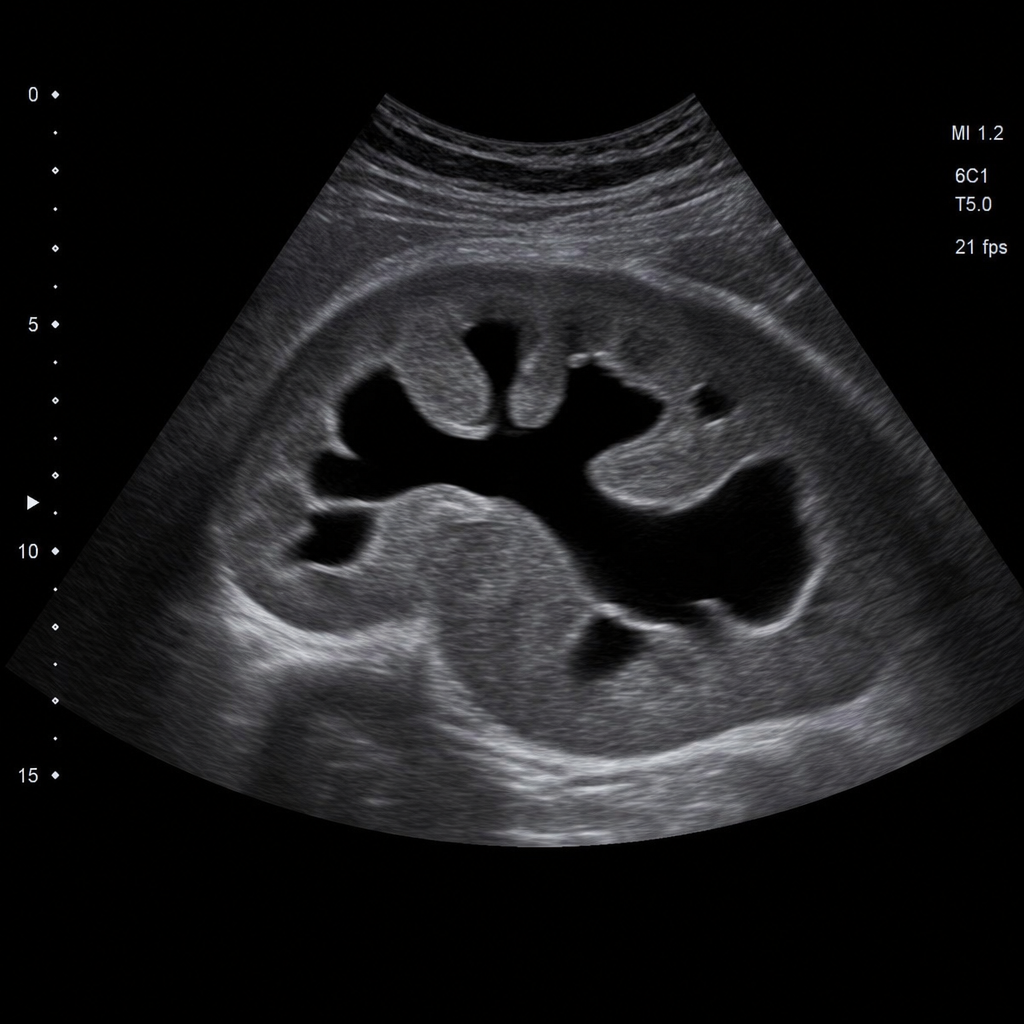
An 87-year-old man comes to the physician because of progressive involuntary urine dribbling over the past two years. He has to use the restroom more frequently than he used to and feels like he cannot fully empty his bladder. Physical examination shows a palpable suprapubic mass. An ultrasound image of the left kidney is shown. Which of the following is the most likely explanation of this patient's imaging findings?
A 1-week-old baby is brought to the pediatrician’s office for a routine checkup. On examination, she is observed to have microcephaly with a prominent occiput. She also has clenched fists and rocker-bottom feet with prominent calcanei. A cardiac murmur is evident on auscultation. Based on the clinical findings, a diagnosis of nondisjunction of chromosome 18 is suspected. The pediatrician orders a karyotype for confirmation. He goes on to explain to the mother that her child will face severe growth difficulties. Even if her daughter progresses beyond a few months, she will not be able to reach developmental milestones at the appropriate age. In addition to the above, which of the following is most likely a consequence of this genetic disturbance?
Want unlimited practice?
Get full access to all questions, explanations, and performance tracking.
Scan to download app