
Craniofacial anomalies — MCQs

A 4-year-old boy presents to his pediatrician for severe developmental delay. On exam he is noted to have macroorchidism, hypertelorism, large protruding ears, a large jaw, and a long thin face. Suspicious of what the diagnosis may be, the pediatrician orders a PCR and DNA sequencing. The results reveal an expansion of 250 repeats of CGG. What is the diagnosis of the boy?
A 10-year-old boy comes for a post-operative clinic visit with his ENT surgeon three months after airway reconstruction surgery and placement of a tracheostomy tube. Since the surgery, he says that he has been able to breathe better and is now getting used to tracheostomy care and tracheostomy tube changes. In addition to this surgery, he has had over twenty surgeries to implant hearing aids, reconstruct his cheekbones, and support his jaw to enable him to swallow. He was born with these abnormalities and had difficult breathing, hearing, and eating throughout his childhood. Fortunately, he is now beginning to feel better and is able to attend public school where he is one of the best students in the class. Abnormal development of which of the following structures is most likely responsible for this patient's malformations?
A 29-year-old mother brings in her 2-week-old baby boy to a pediatrician because he has been having difficulty feeding. The mother reveals that she had no prenatal care during her pregnancy and gave birth at home without complications. She says that her son seems to be having difficulty sucking, and she occasionally sees breast milk coming out of the infant’s nose. Physical exam reveals that this patient has a gap between his oral and nasal cavities behind the incisive foramen. He is therefore prescribed specialized bottles and his mom is taught positional techniques to ensure better feeding. Failure to fuse which of the following structures is most likely responsible for this patient's disorder?
A group of investigators studying embryological defects in mice knock out a gene that is responsible for the development of the ventral wing of the third branchial pouch. A similar developmental anomaly in a human embryo is most likely to result in which of the following findings after birth?
A 31-year-old woman delivers a healthy boy at 38 weeks gestation. The delivery is vaginal and uncomplicated. The pregnancy was unremarkable. On examination of the newborn, it is noted that his head is tilted to the left and his chin is rotated to the right. Palpation reveals no masses or infiltration in the neck. The baby also shows signs of left hip dysplasia. Nevertheless, the baby is active and exhibits no signs of other pathology. What is the most probable cause of this patient's condition?
A 1-week-old baby is brought to the pediatrician’s office for a routine checkup. On examination, she is observed to have microcephaly with a prominent occiput. She also has clenched fists and rocker-bottom feet with prominent calcanei. A cardiac murmur is evident on auscultation. Based on the clinical findings, a diagnosis of nondisjunction of chromosome 18 is suspected. The pediatrician orders a karyotype for confirmation. He goes on to explain to the mother that her child will face severe growth difficulties. Even if her daughter progresses beyond a few months, she will not be able to reach developmental milestones at the appropriate age. In addition to the above, which of the following is most likely a consequence of this genetic disturbance?
A 45-day-old male infant is brought to a pediatrician by his parents with concerns of poor feeding and excessive perspiration for one week. On physical examination, his temperature is 37.7°C (99.8°F), pulse rate is 190/min, and respiratory rate is 70/min. Mild cyanosis is present over the lips, and over the nail beds. Oxygen is provided and his oxygen saturation is carefully monitored. The pediatrician orders a bedside echocardiogram of the infant. It reveals a single arterial trunk arising from 2 normally formed ventricles. The arterial trunk is separated from the ventricles by a single semilunar valve. There is a defect in the interventricular septum, and the arterial trunk overrides the defect. Which of the following congenital heart diseases can also present with similar clinical features?
A 15-year-old boy is brought to the physician for a well-child visit. His parents are concerned that he has not had his growth spurt yet. As a child, he was consistently in the 60th percentile for height; now he is in the 25th percentile. His classmates make fun of his height and high-pitched voice. His parents are also concerned that he does not maintain good hygiene. He frequently forgets to shower and does not seem aware of his body odor. As an infant, he had bilateral orchidopexy for cryptorchidism and a cleft palate repair. He is otherwise healthy. Vital signs are within normal limits. On physical exam, axillary and pubic hair is sparse. Genitals are Tanner stage 1 and the testicles are 2 mL bilaterally. Which of the following is the most likely diagnosis?
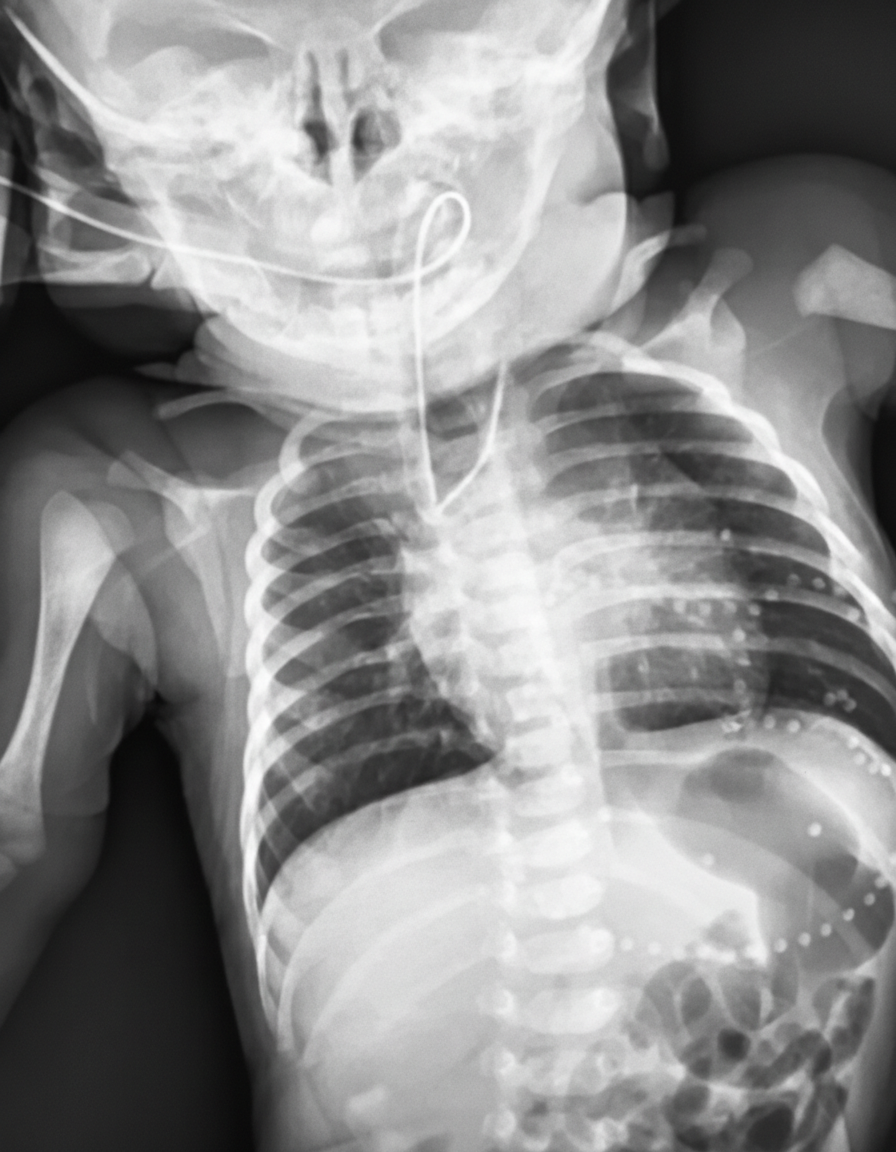
Thirty minutes after delivery, a 3400-g (7.5-lb) female newborn develops cyanosis of her lips and oral mucosa. She was born at 36 weeks of gestation to a 30-year-old woman, gravida 1, para 0. Apgar scores are 7 and 8 at 1 and 5 minutes, respectively. Pregnancy was complicated by polyhydramnios. The patient's temperature is 37°C (98.6°F), pulse is 144/min, respirations are 52/min, and blood pressure is 70/40 mm Hg. Examination shows foaming and drooling at the mouth. Bilateral crackles are heard at the lung bases. There is a harsh 3/6 systolic murmur along the left sternal border. The abdomen is soft and mildly distended. There is an anterior ectopic anus. Insertion of a nasogastric tube is attempted. An x-ray of the chest and abdomen is shown. Which of the following is the most likely diagnosis?
A 4-year-old boy is brought to a pediatrician with a history of repeated episodes of right-ear symptoms, including irritability, fever, ear pain, and pulling at the ear, for the last 2 years. Each episode has been treated with an appropriate antibiotic for the recommended duration of time as prescribed by the pediatrician. The boy had experienced 3 episodes during his 3rd year of life and 5 episodes during the last year; the last episode occurred 2 months ago. There is no history of recurrent rhinosinusitis or nasal obstruction. On physical examination, vital signs are stable. Otoscopic examination of the right ear reveals a white tympanic membrane with decreased mobility. There is no erythema or bulging of the tympanic membrane. Which of the following interventions is most likely to be considered for further management of this child?
Want unlimited practice?
Get full access to all questions, explanations, and performance tracking.
Scan to download app