
Wilms tumor — MCQs

A 63-year-old man presents with a 2-month history of increasing sensation of fullness involving his left flank. The patient reports recent episodes of constant pain. The patient is hypertensive (145/90 mm Hg) and is currently on medications including losartan and hydrochlorothiazide. His past medical history is otherwise unremarkable. He is a 30-pack-year smoker. His temperature is 37.7°C (99.9°F); pulse, 76/min; and respiratory rate, 14/min. Palpation of the left flank shows a 10 x 10-cm mass. The patient's laboratory parameters are as follows: Blood Hemoglobin 19.5 g/dL Leukocyte count 5,000/mm3 Platelet count 250,000/mm3 Urine Blood 2+ Protein negative RBC 45/hpf without dysmorphic features Abdominal CT scan confirms the presence of a large solid mass originating in the left kidney. These findings are most consistent with which of the following conditions?
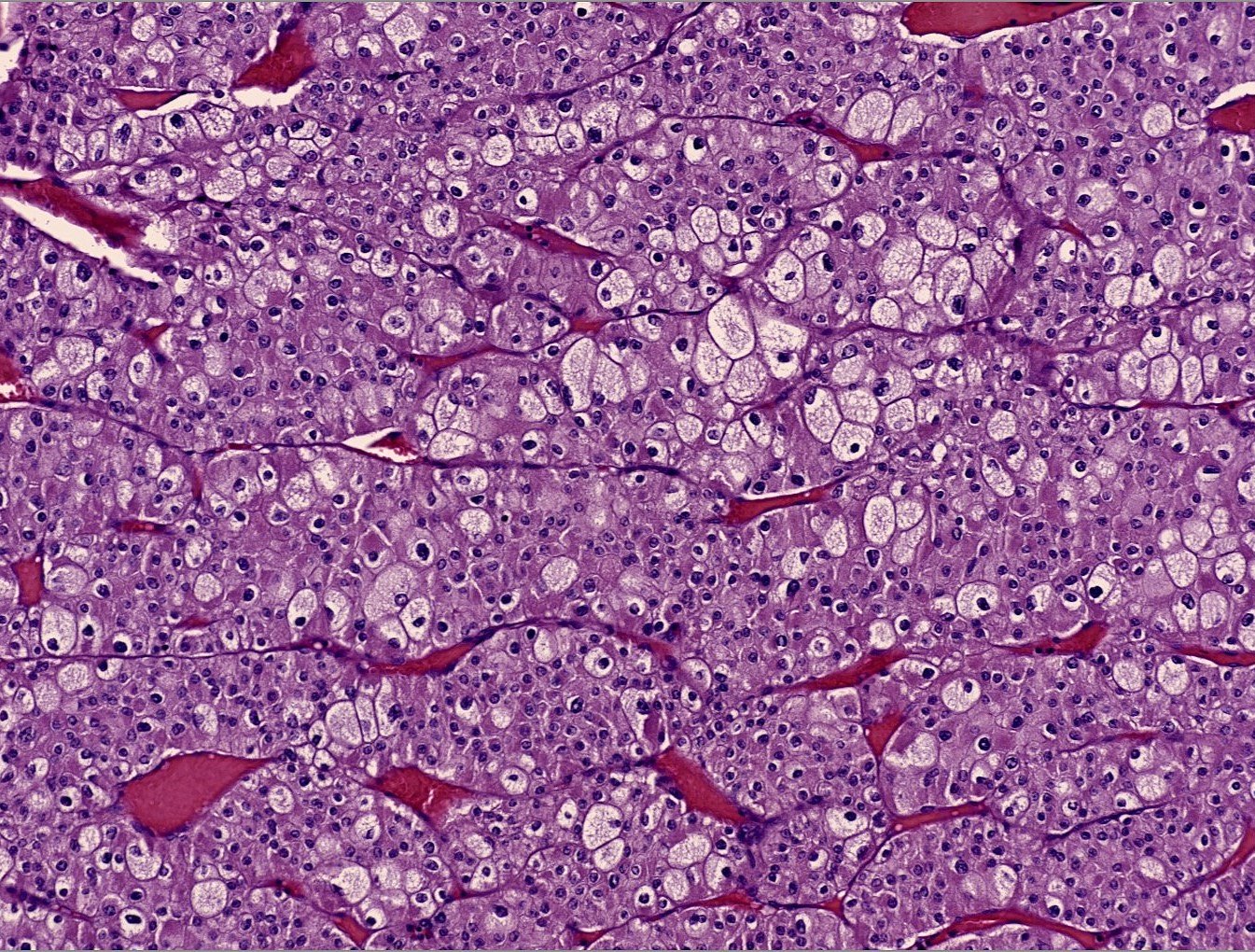
A 69-year-old man comes to the physician because of a 1-week history of blood in the urine and fatigue. He also has had a 5.0-kg (11-lb) weight loss during the past month. Physical examination shows pallor and cachexia. A nontender right flank mass is palpated. A CT scan of the chest, abdomen, and pelvis shows a 5-cm right upper pole renal mass and several pulmonary lesions. A biopsy specimen of an affected area of the lung is obtained. A photomicrograph of the biopsy specimen is shown. Molecular evaluation of the specimen is most likely to show which of the following genetic changes?
A laboratory physician investigates the chromosomes of a fetus with a suspected chromosomal anomaly. She processes a cell culture obtained by amniocentesis. Prior to staining and microscopic examination of the fetal chromosomes, a drug that blocks cell division is added to the cell culture. In order to arrest chromosomes in metaphase, the physician most likely added a drug that is also used for the treatment of which of the following conditions?
A 3-year-old girl is brought to her pediatrician with 2 days of fever and abdominal pain. She has also been crying and complaining of pain while urinating. She was born at term without incident and was previously healthy at regular checkups. On presentation, her temperature is 102.2°F (39°C), blood pressure is 137/85 mmHg, pulse is 122/min, and respirations are 24/min. Physical exam reveals a palpable, painless, abdominal mass that does not cross the midline. Which of the following additional findings would be associated with this patient's disorder?
A 12-year-old boy comes to the physician for the evaluation of intermittent blood-tinged urine for several months. Four months ago, he had an episode of fever and sore throat that resolved without treatment after 5 days. During the past 2 years, he has also had recurrent episodes of swelling of his face and feet. 5 years ago, he was diagnosed with mild bilateral sensorineural hearing loss. His brother died of a progressive kidney disease at the age of 23. The patient appears pale. His temperature is 37°C (98.6°F), pulse is 70/min, and blood pressure is 145/85 mm Hg. Slit lamp examination shows a conical protrusion of both lenses. Laboratory studies show a hemoglobin concentration of 11 g/dL, urea nitrogen concentration of 40 mg/dL, and creatinine concentration of 2.4 mg/dL. Urinalysis shows: Blood 2+ Protein 1+ RBC 5–7/hpf RBC casts rare Which of the following is the most likely underlying cause of this patient's symptoms?
A 61-year-old man comes to the physician because of several episodes of dark urine over the past 2 weeks. He does not have dysuria or flank pain. He works in a factory that produces dyes. Since an accident at work 5 years ago, he has had moderate hearing loss bilaterally. He takes no medications. He has smoked a pack of cigarettes daily for 29 years and drinks one alcoholic beverage daily. Vital signs are within normal limits. Physical examination shows no abnormalities. His urine is pink; urinalysis shows 80 RBC/hpf but no WBCs. Cystoscopy shows a 3-cm mass in the bladder mucosa. The mass is resected. Pathologic examination shows an urothelial carcinoma with penetration into the muscular layer. An x-ray of the chest and a CT scan of the abdomen and pelvis with contrast show a normal upper urinary tract and normal lymph nodes. Which of the following is the most appropriate next step in management?
A 28-year-old male presents to his primary care physician with complaints of intermittent abdominal pain and alternating bouts of constipation and diarrhea. His medical chart is not significant for any past medical problems or prior surgeries. He is not prescribed any current medications. Which of the following questions would be the most useful next question in eliciting further history from this patient?
A 25-year-old man comes to the physician because of right-sided painless scrotal swelling that he noticed yesterday while taking a shower. He is currently sexually active with two female partners and uses condoms inconsistently. He immigrated to the US from Argentina 2 years ago. His immunization records are unavailable. He has smoked one pack of cigarettes daily for the last 5 years. He is 170 cm (5 ft 7 in) tall and weighs 70 kg (154 lb); BMI is 24.2 kg/m2. He appears healthy and well nourished. His temperature is 37°C (98.6°F), pulse is 72/min, and blood pressure is 125/75 mm Hg. The lungs are clear to auscultation. Cardiac examination shows no abnormalities. The abdomen is soft with dull lower abdominal discomfort. Testicular examination shows a solid mass in the right testis that is firm and nontender. A light held behind the scrotum does not shine through. The mass is not reduced when the patient is in a supine position. The remainder of the physical examination shows no abnormalities. Which of the following is the most likely diagnosis in this patient?
A 7-month-old boy presents to the emergency room with three episodes of vomiting and severe abdominal pain that comes and goes for the past two hours. The patient's most recent vomit in the hospital appears bilious, and the patient had one stool that appears bloody and full of mucous. The mother explains that one stool at home appears to be "jelly-like." On physical exam, a palpable mass is felt in the right lower quadrant of the abdomen. What is the next best diagnostic test for this patient?
A 4-week-old male presents with his parents to the pediatrician for a well-child visit. The patient’s mother reports that the patient was eating well until about one week ago, when he began vomiting after breastfeeding. His mother has tried increasing the frequency of feeds and decreasing the amount of each feed, but the vomiting seems to be getting worse. The patient now vomits after every feed. His mother states the vomitus looks like breastmilk. The patient’s mother is exclusively breastfeeding and would prefer not to switch to formula but worries that the patient is not getting the nutrition he needs. Two weeks ago, the patient was in the 75th percentile for weight and 70th for height. He is now in the 60th percentile for weight and 68th percentile for height. On physical exam, the patient has dry mucous membranes. His abdomen is soft and non-distended. Which of the following is the best next step in management?
Want unlimited practice?
Get full access to all questions, explanations, and performance tracking.
Scan to download app