
Rhabdomyosarcoma — MCQs

A 33-year-old woman comes to the physician 1 week after noticing a lump in her right breast. Fifteen years ago, she was diagnosed with osteosarcoma of her left distal femur. Her father died of an adrenocortical carcinoma at the age of 41 years. Examination shows a 2-cm, firm, immobile mass in the lower outer quadrant of the right breast. A core needle biopsy of the mass shows adenocarcinoma. Genetic analysis in this patient is most likely to show a defect in which of the following genes?
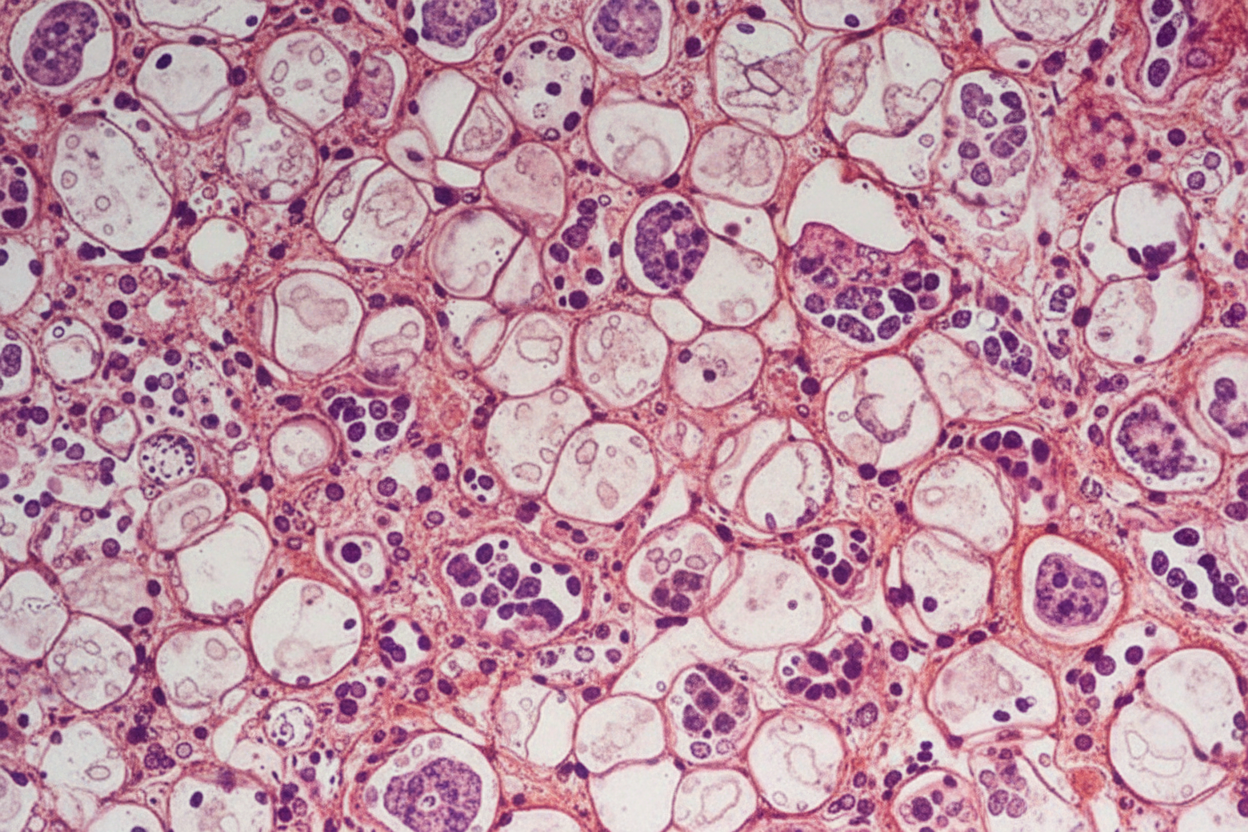
An 82-year-old woman presents to the emergency department because of excruciating right flank pain and fever for the past 2 days. She states that she is having trouble urinating. Her past medical history is unremarkable. A urinalysis is performed and comes back positive for leukocytes and gram-negative bacilli. A contrast computed tomography of the abdomen is performed and reveals a large retroperitoneal mass compressing the right ureter, leading to hydronephrosis of the right kidney. The mass is excised. Histopathologic evaluation of the mass is shown in the image below, and it is determined to be malignant. Which of the following is the most likely diagnosis in this patient?
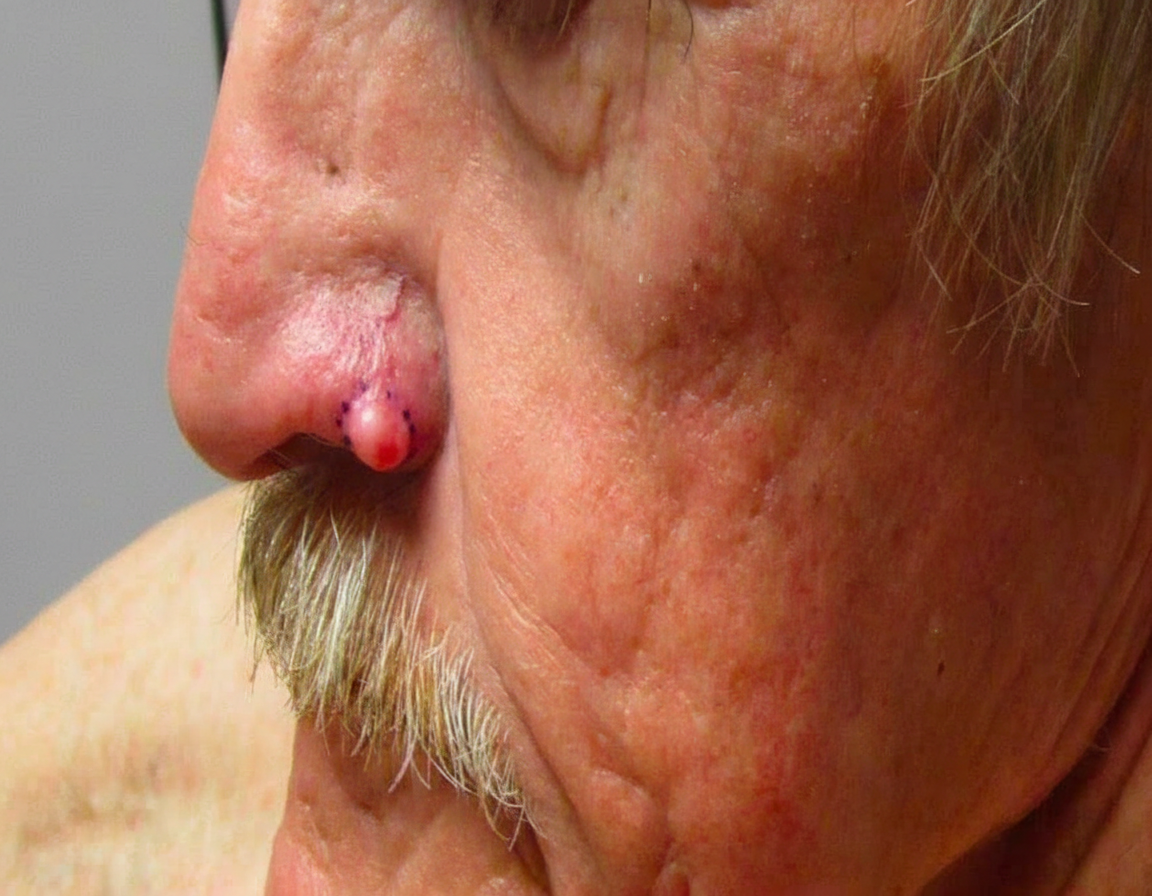
A 67-year-old man is referred to a dermatologist after a reddish mole appears on his nose. The mole’s size has changed over the last 2 years, and occasional bleeding is noted. The man’s medical history is unremarkable, and he does not take any medications. He retired from his construction job 15 years ago. Physical examination of his nose reveals a 2-cm pink papule with a pearly appearance and overlying telangiectasia on the ala of the nose (see image). Which of the following would be the best treatment modality if surgery is not an option?
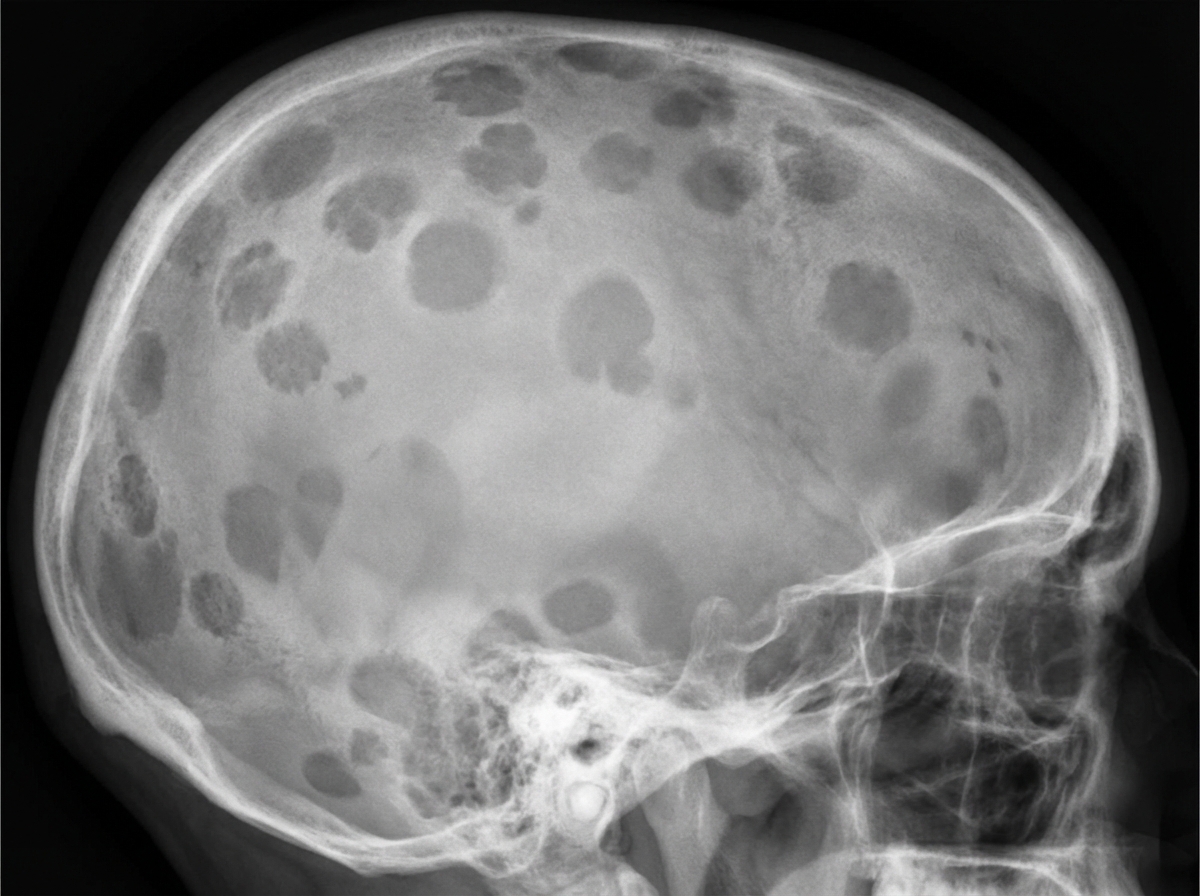
A 70-year-old man comes to the physician because of progressive fatigue and lower back pain for the past 4 months. The back pain worsened significantly after he had a minor fall while doing yard work the previous day. For the past year, he has had a feeling of incomplete emptying of his bladder after voiding. His vital signs are within normal limits. Examination shows bilateral paravertebral muscle spasm, severe tenderness over the second lumbar vertebra, and mild tenderness over the lower thoracic vertebrae. Neurologic examination shows no abnormalities. His hemoglobin is 10.5 g/dl, alkaline phosphatase is 110 U/L, and serum calcium is 11.1 mg/dl. An x-ray of the skull is shown. Which of the following is the most appropriate next step in diagnosis?
An investigator studying the molecular characteristics of various malignant cell lines collects tissue samples from several families with a known mutation in the TP53 tumor suppressor gene. Immunohistochemical testing performed on one of the cell samples stains positive for desmin. This sample was most likely obtained from which of the following neoplasms?
A 19-month-old girl is brought by her mother to the local walk-in clinic after noticing a mass protruding from her vagina. The mass had the appearance of "a bunch of grapes". She also says that she has been having a vaginal discharge for the past 6 months. Her family and personal history are not significant for malignancies or inherited disorders. The physical examination is unremarkable except for the presence of soft nodules protruding from the vaginal canal. A tissue sample is obtained for histologic evaluation. Several weeks later the patient returns to the walk-in clinic for a scheduled follow-up visit. The pathology report describes a polypoid mass beneath an epithelial surface with atypical stromal cells positive for polyclonal desmin. What is the most likely diagnosis in this patient?
An 8-year-old boy is brought to the physician by his mother because of a 3-week history of irritability and frequent bed wetting. She also reports that he has been unable to look upward without tilting his head back for the past 2 months. He is at the 50th percentile for height and weight. His vital signs are within normal limits. Ophthalmological examination shows dilated pupils that are not reactive to light and bilateral optic disc swelling. Pubic hair development is Tanner stage 2. The most likely cause of this patient's condition is a tumor in which of the following locations?
A 45-year-old man with HIV comes to the physician because of multiple lesions on his chest and lower extremities. The lesions have progressively increased in size and are not painful or pruritic. Current medications include abacavir, dolutegravir, and lamivudine. A photograph of the lesions is shown. His CD4+ T-lymphocyte count is 450/mm3 (normal ≥ 500/mm3). A skin biopsy shows multiple spindle-shaped cells and lymphocytic infiltrate. Which of the following is the most appropriate pharmacotherapy?

An 18-month-old boy is brought to the doctor’s office for evaluation of abdominal pain. The boy looks emaciated and he is now significantly below his growth chart predicted weight. The family history is non-contributory. The vital signs are unremarkable. On physical examination, a non-tender mass is felt in the upper part of the abdomen. A magnetic resonance image (MRI) scan of his abdomen demonstrates a mass in his right adrenal gland. Biopsy of the mass demonstrates an abundance of small round blue cells. With this biopsy result, which 1 of the following findings would confirm the diagnosis?
A 1-month-old boy is brought to the physician because of a 5-day history of generalized fatigue and multiple episodes of vomiting which is most pronounced after formula feeding. His vomiting progressed from 2–3 episodes on the first day to 6–8 episodes at present. The vomitus is whitish in color. The mother reports that he has been very hungry after each episode of vomiting. The patient was born at 38 weeks' gestation and weighed 3100 g (6 lb 13 oz); he currently weighs 3500 g (7 lb 11 oz). He appears irritable. His temperature is 37.1°C (98.8°F), pulse is 130/min, respirations are 43/min, and blood pressure is 74/36 mm Hg. Examination shows dry mucous membranes. The abdomen is soft and not distended. There is a round mass palpable in the epigastric region. The liver is palpated 1 cm below the right costal margin. Laboratory studies show: Hemoglobin 15.3 g/dL Leukocyte count 6300/mm3 Platelet count 230,000/mm3 Serum Na+ 133 mEq/L K+ 3.4 mEq/L Cl- 92 mEq/L Glucose 77 mg/dL Creatinine 1.0 mg/dL A urinalysis shows a decreased pH. Which of the following is the most appropriate next step in the management of this patient?
Want unlimited practice?
Get full access to all questions, explanations, and performance tracking.
Scan to download app