
Skeletal muscle diseases — MCQs

A 35-year-old woman presents for evaluation of symmetric proximal muscle weakness. The patient also presents with a blue-purple discoloration of the upper eyelids accompanied by rashes on the knuckles, as shown in the picture below. What is the most likely cause?
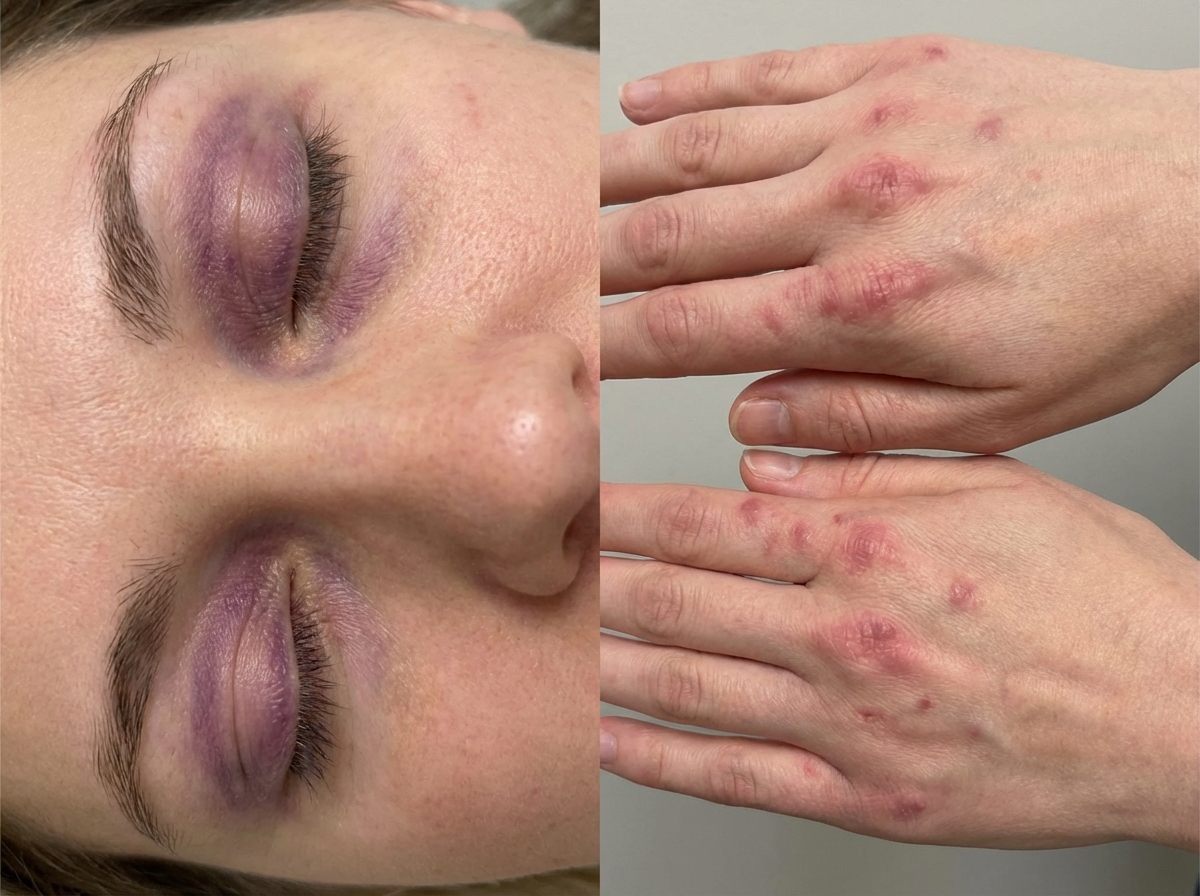
A 32-year-old woman presents to the clinic with the complaint of excessive fatigue for the past few weeks. After returning home from the office, she feels too tired to climb up the stairs, comb her hair, or chew her food. She has occasionally experienced double vision. She denies any history of fever, cough, weight loss, night sweats, or snoring. Past history is unremarkable. Physical examination reveals: blood pressure 124/86 mm Hg, heart rate 85/min, respiratory rate 14/min, temperature 37.0°C (98.6°F), and body mass index (BMI) 22.6 kg/m2. On examination, the right upper eyelid is slightly drooping when compared to the left side. Her eye movements are normal. Flexion of the neck is mildly weak. Muscle strength is 5/5 in all 4 limbs. When she is asked to alternately flex and extend her shoulder continuously for 5 minutes, the power in the proximal upper limb muscles becomes 4/5. The muscle tone and deep tendon reflexes are normal. What is the most appropriate test to diagnose this condition?
A 10-year-old boy is brought to the physician because of recurring episodes of achy muscle pain in his legs. He has a history of poor school performance despite tutoring and has been held back two grades. He is at the 40th percentile for height and 30th percentile for weight. Examination shows ptosis, a high-arched palate, and muscle weakness in the face and hands; muscle strength of the quadriceps and hamstrings is normal. Sensation is intact. Percussion of the thenar eminence causes the thumb to abduct and then relax slowly. Which of the following is the most likely underlying cause?
A 33-year-old woman comes to the clinic for a follow-up visit after recently starting high dose corticosteroids for a newly diagnosed autoimmune condition. She was first evaluated a month ago due to fatigue, muscle weakness, and a scaly rash on both hands. On examination, muscle strength was rated 2 out of 5 in the upper extremities. Creatine kinase-MB was elevated, and anti-Jo-1 antibodies were observed. A muscle biopsy later showed perimysial inflammation and treatment was initiated. Today, the patient says that her symptoms have not improved despite treatment with corticosteroids. It is agreed upon to initiate methotrexate with the hopes of achieving better symptom control. Which of the following is most often associated with this patient’s condition?
A 9-year-old boy is getting fitted for leg braces because he has become too weak to walk without them. He developed normally until age 3 but then he began to get tired more easily and fell a lot. Over time he started having trouble walking and would stand up by using the Gower maneuver. Despite this weakness, his neurologic development is normal for his age. On exam his calves appeared enlarged and he was sent for genetic testing. Sequence data showed that he had a mutation causing a shift in the reading frame, resulting in a severely truncated and non-functional protein. Which of the following types of mutations is most likely the cause of this patient's disorder?
A 3-year-old boy presents to the office with his mother. She states that her son seems weak and unwilling to walk. He only learned how to walk recently after a very notable delay. The boy was born at 39 weeks gestation via spontaneous vaginal delivery. He is up to date on all vaccines and is meeting all verbal and social milestones but he has a great deal of trouble with gross and fine motor skills. Past medical history is noncontributory. He takes a multivitamin every day. The mother states that some boys on her side of the family have had similar symptoms and worries that her son might have the same condition. Today, the boy’s vital signs include: blood pressure 110/65 mm Hg, heart rate 90/min, respiratory rate 22/min, and temperature 37.0°C (98.6°F). On physical exam, the boy appears well developed and pleasant. He sits and listens and follows direction. His heart has a regular rate and rhythm and his lungs are clear to auscultation bilaterally. He struggles to get up to a standing position after sitting on the floor. A genetic study is performed that reveals a significant deletion in the gene that codes for dystrophin. Which of the following is the most likely diagnosis?
A 7-year-old boy is brought to the emergency department by his parents. He is complaining of left-sided knee pain which has progressively increased in severity over the past 2 days. It started when he was playing football with his brothers but he does not recall falling or getting any injury. Past medical history is significant for prolonged bleeding and easy bruising. His maternal uncle has similar problems. Physical exam reveals swollen and painful left knee. His laboratory investigations reveal: Hemoglobin 11.8 g/dL WBC count 7,000/mL Platelets 250,000/mL INR 0.9 aPTT 62 sec, fully corrected with a mixing study Which of the following disorders have the same mode of inheritance as this patient’s disease?
A 15-year-old Caucasian male is brought to his pediatrician by his parents, who note the development of a tremor in their child. Urine and serum analysis reveal elevated levels of copper. Which of the following clinical manifestations would the physician most expect to see in this patient?
A 25-year-old woman presents to her primary care physician for her yearly physical exam. She has no past medical history and says that she does not currently have any health concerns. On physical exam, she is found to have hyperactive patellar reflexes but says that she has had this finding since she was a child. She asks her physician why this might be the case. Her physician explains that there are certain cells that are responsible for detecting muscle stretch and responding to restore the length of the muscle. Which of the following is most likely a characteristic of these structures?
You are conducting a lab experiment on skeletal muscle tissue to examine force in different settings. The skeletal muscle tissue is hanging down from a hook. The experiment has 3 different phases. In the first phase, you compress the muscle tissue upwards, making it shorter. In the second phase, you attach a weight of 2.3 kg (5 lb) to its lower vertical end. In the third phase, you do not manipulate the muscle length at all. At the end of the study, you see that the tension is higher in the second phase than in the first one. What is the mechanism underlying this result?
Want unlimited practice?
Get full access to all questions, explanations, and performance tracking.
Scan to download app