
Male reproductive pathology — MCQs

A 68-year-old man with hypertension comes to the physician because of fatigue and difficulty initiating urination. He wakes up several times a night to urinate. He does not take any medications. His blood pressure is 166/82 mm Hg. Digital rectal examination shows a firm, non-tender, and uniformly enlarged prostate. Which of the following is the most appropriate pharmacotherapy?
A 3-year-old boy was brought in by his parents for undescended testes. The physical examination showed an absence of the left testis in the scrotum. Inguinal swelling was noted on the left side and was surgically corrected. Which of the following conditions will most likely occur in the later stages of his life?
A 67-year-old man comes to the physician because of a 3-month history of difficulty initiating urination. He wakes up at least 3–4 times at night to urinate. Digital rectal examination shows a symmetrically enlarged, nontender prostate with a rubbery consistency. Laboratory studies show a prostate-specific antigen level of 2.1 ng/mL (N < 4). Which of the following is the most likely underlying cause of this patient's symptoms?
A 28-year-old man comes to the physician because of a 2-week history of testicular swelling and dull lower abdominal discomfort. Physical examination shows a firm, nontender left testicular nodule. Ultrasonography of the scrotum shows a well-defined hypoechoic lesion of the left testicle. Serum studies show an elevated β-hCG concentration and a normal α-fetoprotein concentration. The patient undergoes a radical inguinal orchiectomy. Histopathologic examination of the surgical specimen shows a mixed germ cell tumor with invasion of adjacent lymphatic vessels. Further evaluation is most likely to show malignant cells in which of the following lymph node regions?
A 16-year-old boy comes to the physician because of painless enlargement of his left testis for the past 2 weeks. The patient reports that the enlargement is worse in the evenings, especially after playing soccer. He has not had any trauma to the testes. There is no personal or family history of serious illness. Vital signs are within normal limits. Examination shows multiple cord-like structures above the left testes. The findings are more prominent while standing. The cord-like structures disappear in the supine position. The testes are normal on palpation. The patient is at greatest risk of developing which of the following complications?
A 25-year-old man presents to his primary care provider complaining of scrotal swelling. He is a college student and plays basketball with his friends regularly. Two days ago, he sustained an injury close to his thigh. He does not have any significant past medical history. Today, his vitals are normal. A focused scrotal examination reveals a firm painless lump on the right testicle which is irregular and small. Ultrasound of the scrotum reveals a vascular 0.6 x 0.5 cm testicular mass. A pelvic lymph node exam is negative. He undergoes a radical orchiectomy and subsequent histopathological examination reveals sheets of small cuboidal cells, multinucleated cells, and large eosinophilic cells with pleomorphic nuclei consistent with choriocarcinoma. Which of the following tumor marker is most likely elevated in this patient?
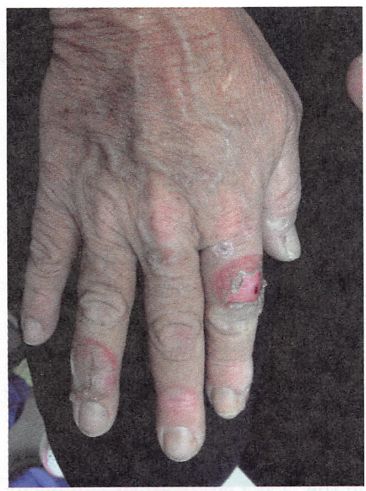
A 62-year-old man seeks evaluation at an outpatient clinic for a single, red, crusty lesion on the shaft of his penis and a similar lesion on the middle finger of his left hand. He recently immigrated to the US from Africa. The lesions are painless and the physicians in his country treated him for syphilis and eczema, with no improvement. He lives with his 4th wife. He smokes 2 packs of cigarette per day and has been doing so for the last 30 years. He is not aware of any family members with malignancies or hereditary diseases. The physical examination is remarkable for an erythematous plaque, with areas of crusting, oozing, and irregular borders on the dorsal surface of the penile shaft and a similar lesion on his left middle finger (shown in the picture). The regional lymph nodes are not affected. A biopsy is obtained and the pathologic evaluation reveals cells with nuclear hyperchromasia, multinucleation, and increased mitotic figures within the epidermis. What is the most likely diagnosis?
A 67-year-old man presents to his primary care physician complaining of frequent urination overnight. He states that for several years he has had trouble maintaining his urine stream along with the need for frequent urination, but the nighttime urination has only recently started. The patient also states that he has had 2 urinary tract infections in the last year, which he had never had previously. On exam, his temperature is 98.8°F (37.1°C), blood pressure is 124/68 mmHg, pulse is 58/min, and respirations are 13/min. On digital rectal exam, the prostate is enlarged but feels symmetric and smooth. Which of the following is a possible consequence of this condition?
A 68-year-old man comes to the physician for a routine health maintenance examination. Over the past six months, he has had an increase in the frequency of his bowel movements and occasional bloody stools. He has hypertension, coronary artery disease, and chronic obstructive pulmonary disease. He has smoked one pack of cigarettes daily for 40 years. His current medications include aspirin, lisinopril, and salmeterol. His temperature is 37°C (98.6°F), pulse is 75/min, and blood pressure is 128/75 mm Hg. The lungs are clear to auscultation. Cardiac examination shows no murmurs, rubs, or gallops. The abdomen is soft with no organomegaly. Digital rectal examination shows a large internal hemorrhoid. Test of the stool for occult blood is positive. Which of the following is the most appropriate next step in the management of this patient?
A 54-year-old woman comes to the physician because of an ulcer on her left ankle for 6 years. She has had multiple ulcers over her left lower extremity during this period that have subsided with wound care and dressing. She has type 2 diabetes mellitus and gastroesophageal reflux disease. Current medications include metformin, sitagliptin, and omeprazole. She appears anxious. She is 162 cm (5 ft 4 in) tall and weighs 89 kg (196 lb); BMI is 34 kg/m2. Vital signs are within normal limits. Examination shows a 7.5-cm (3-in) ulcer with elevated, indurated margins and a necrotic floor above the left medial malleolus. There are multiple dilated, tortuous veins along the left lower extremity. There is 2+ pretibial edema of the lower extremities bilaterally. The skin around the left ankle appears darker than the right and there are multiple excoriation marks. Cardiopulmonary examination shows no abnormalities. Which of the following is the most appropriate next step in management of this patient's current condition?
Want unlimited practice?
Get full access to all questions, explanations, and performance tracking.
Scan to download app