
Female reproductive pathology — MCQs

A 63-year-old woman, gravida 0, para 0 comes to the physician because of a 3-month history of abdominal distension, constipation, and weight loss. She has a history of endometriosis. Pelvic examination shows a nontender, irregular, left adnexal mass. Her serum level of CA-125 is elevated. Serum concentrations of human chorionic gonadotropin and alpha-fetoprotein are within the reference ranges. Microscopic examination of the mass is most likely to show which of the following findings?
A 39-year-old woman, gravida 3, para 2, at 32 weeks' gestation comes to the emergency department 1 hour after the sudden onset of severe abdominal pain and nausea. She has had one episode of nonbloody vomiting. Pregnancy has been uncomplicated, except for a blood pressure measurement of 150/90 mm Hg on her last prenatal visit. Her first child was delivered vaginally; her second child was delivered by lower segment transverse cesarean section because of a nonreassuring fetal heart rate. She appears anxious and pale. Her temperature is 36.1°C (96°F), pulse is 115/min, and blood pressure is 92/65 mm Hg. Extremities are cool and clammy. Pelvic examination shows a rigid, tender uterus. The cervix is 30% effaced and 1 cm dilated; the vertex is at -1 station. The fetal heart rate is 100/min. Which of the following is the most likely diagnosis?
A 42-year-old woman comes to the physician for the evaluation of a 1-month history of dull lower abdominal pain, decreased appetite, and a 5-kg (11-lb) weight loss. Physical examination shows no abnormalities. Pelvic ultrasonography shows bilateral ovarian enlargement and free fluid in the rectouterine pouch. Biopsy specimens from the ovaries show multiple, round, mucin-filled cells with flat, peripheral nuclei. Further evaluation of this patient is most likely to show which of the following findings?
A 40-year-old woman visits your office with her pathology report after being subjected to total abdominal hysterectomy a month ago. She explains that she went through this procedure after a long history of lower abdominal pain that worsened during menses and heavy menstrual bleeding. She is a mother of 5 children, and they are all delivered by cesarean section. The pathology gross examination report and microscopic examination report from the specimen from surgery describes an enlarged, globular uterus with invading clusters of endometrial tissue within the myometrium. What is the most likely diagnosis for this patient?
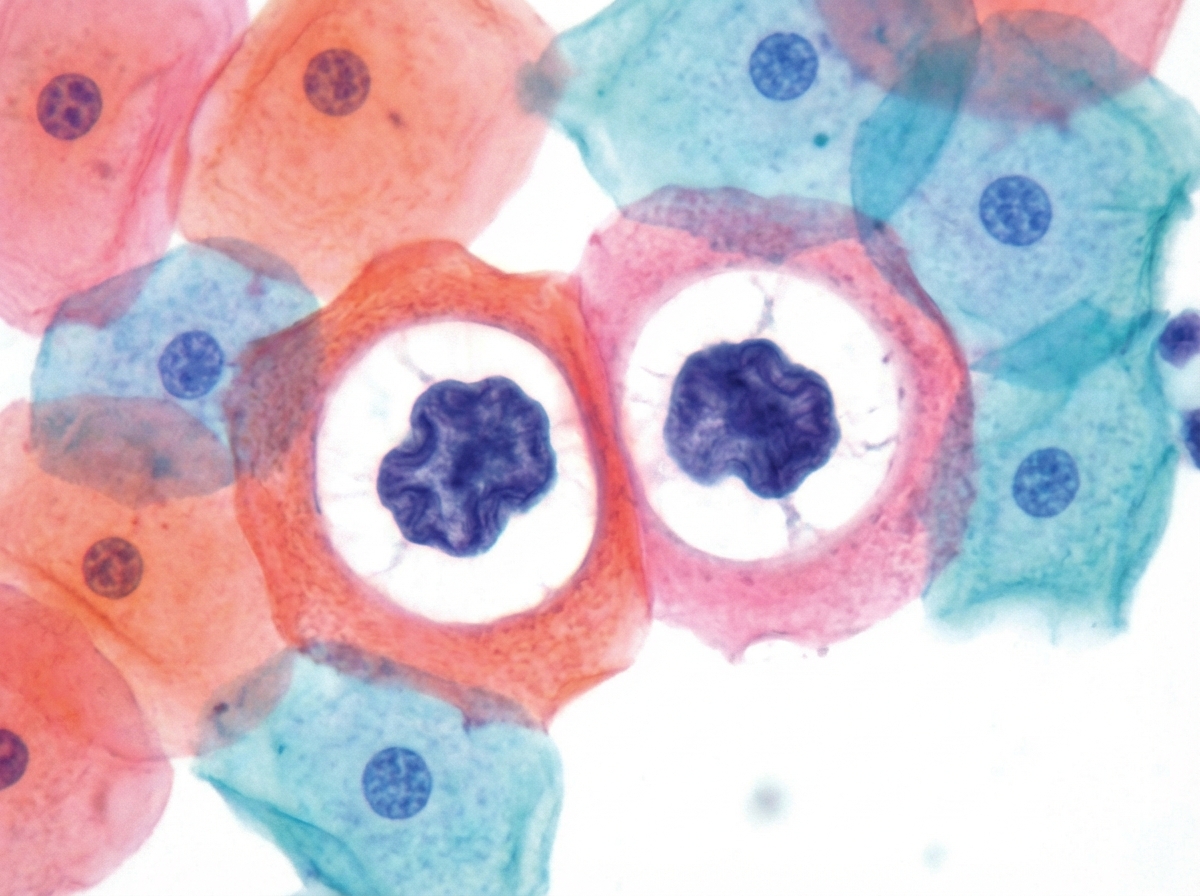
A 36-year-old woman comes to the physician for an annual pelvic examination and Pap smear. Her last Pap smear was 3 years ago. She has been sexually active with multiple male partners and takes an oral contraceptive. She has smoked one pack of cigarettes daily for 10 years. Pelvic examination shows no abnormalities. A photomicrograph of cervical cells from the Pap smear specimen is shown. Cells similar to the one indicated by the arrow are most likely to be seen in which of the following conditions?
A 17-year-old girl comes to the emergency department with a 5-day history of severe abdominal pain, cramping, nausea, and vomiting. She also has pain with urination. She is sexually active with one male partner, and they use condoms inconsistently. She experienced a burning pain when she last had sexual intercourse 3 days ago. Menses occur at regular 28-day intervals and last 5 days. Her last menstrual period was 3 weeks ago. Her temperature is 38.5°C (101.3°F), pulse is 83/min, and blood pressure is 110/70 mm Hg. Physical examination shows abdominal tenderness in the lower quadrants. Pelvic examination shows cervical motion tenderness and purulent cervical discharge. Laboratory studies show a leukocyte count of 15,000/mm3 and an erythrocyte sedimentation rate of 100 mm/h. Which of the following is the most likely diagnosis?
A 55-year-old postmenopausal woman comes to the physician for a screening Pap smear. She has no history of serious illness. Her last Pap smear was 10 years ago and showed no abnormalities. She has smoked one-half pack of cigarettes daily for 20 years and drinks 3 bottles of wine per week. She is sexually active with multiple male partners and uses condoms inconsistently. Her paternal grandmother had ovarian cancer and her maternal aunt had breast cancer. Pelvic examination shows multiple red, fleshy polypoid masses on the anterior vaginal wall. A biopsy is obtained and histology shows large cells with abundant clear cytoplasm. Which of the following is the most significant risk factor for this diagnosis?
A 21-year-old female presents to her primary care doctor for prenatal counseling before attempting to become pregnant for the first time. She is an avid runner, and the physician notes her BMI of 17.5. The patient complains of chronic fatigue, which she attributes to her busy lifestyle. The physician orders a complete blood count that reveals a Hgb 10.2 g/dL (normal 12.1 to 15.1 g/dL) with an MCV 102 µm^3 (normal 78 to 98 µm^3). A serum measurement of a catabolic derivative of methionine returns elevated. Which of the following complications is the patient at most risk for if she becomes pregnant?
A 68-year-old man comes to the physician for a routine health maintenance examination. Over the past six months, he has had an increase in the frequency of his bowel movements and occasional bloody stools. He has hypertension, coronary artery disease, and chronic obstructive pulmonary disease. He has smoked one pack of cigarettes daily for 40 years. His current medications include aspirin, lisinopril, and salmeterol. His temperature is 37°C (98.6°F), pulse is 75/min, and blood pressure is 128/75 mm Hg. The lungs are clear to auscultation. Cardiac examination shows no murmurs, rubs, or gallops. The abdomen is soft with no organomegaly. Digital rectal examination shows a large internal hemorrhoid. Test of the stool for occult blood is positive. Which of the following is the most appropriate next step in the management of this patient?
A 54-year-old woman comes to the physician because of an ulcer on her left ankle for 6 years. She has had multiple ulcers over her left lower extremity during this period that have subsided with wound care and dressing. She has type 2 diabetes mellitus and gastroesophageal reflux disease. Current medications include metformin, sitagliptin, and omeprazole. She appears anxious. She is 162 cm (5 ft 4 in) tall and weighs 89 kg (196 lb); BMI is 34 kg/m2. Vital signs are within normal limits. Examination shows a 7.5-cm (3-in) ulcer with elevated, indurated margins and a necrotic floor above the left medial malleolus. There are multiple dilated, tortuous veins along the left lower extremity. There is 2+ pretibial edema of the lower extremities bilaterally. The skin around the left ankle appears darker than the right and there are multiple excoriation marks. Cardiopulmonary examination shows no abnormalities. Which of the following is the most appropriate next step in management of this patient's current condition?
Want unlimited practice?
Get full access to all questions, explanations, and performance tracking.
Scan to download app