
Bone and joint pathology — MCQs

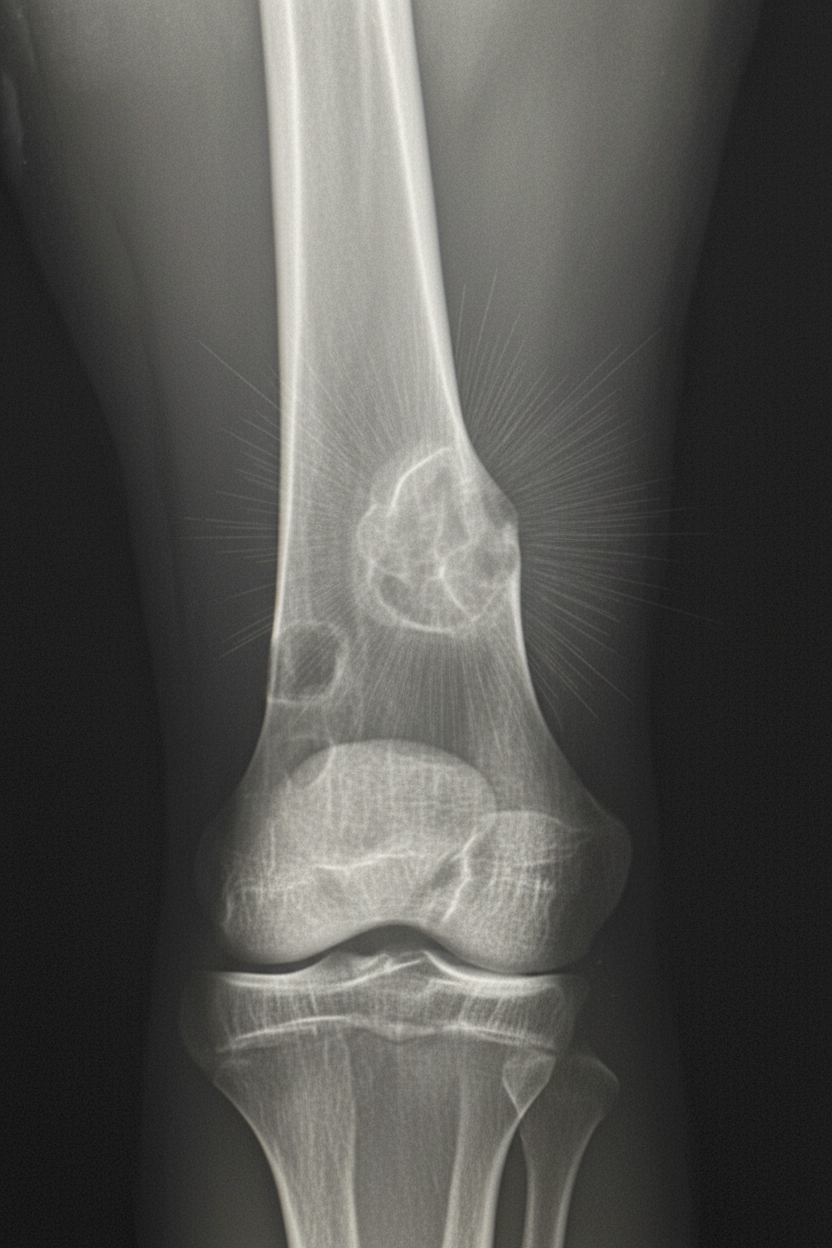
A 17-year-old boy is brought to the physician because of progressive right knee pain for the past 3 months. He reports that the pain is worse at night and while doing sports at school. He has not had any trauma to the knee or any previous problems with his joints. His vital signs are within normal limits. Examination of the right knee shows mild swelling and tenderness without warmth or erythema; the range of motion is limited. He walks with an antalgic gait. Laboratory studies show an alkaline phosphatase of 180 U/L and an erythrocyte sedimentation rate of 80 mm/h. An x-ray of the right knee is shown. Which of the following is the most likely diagnosis?
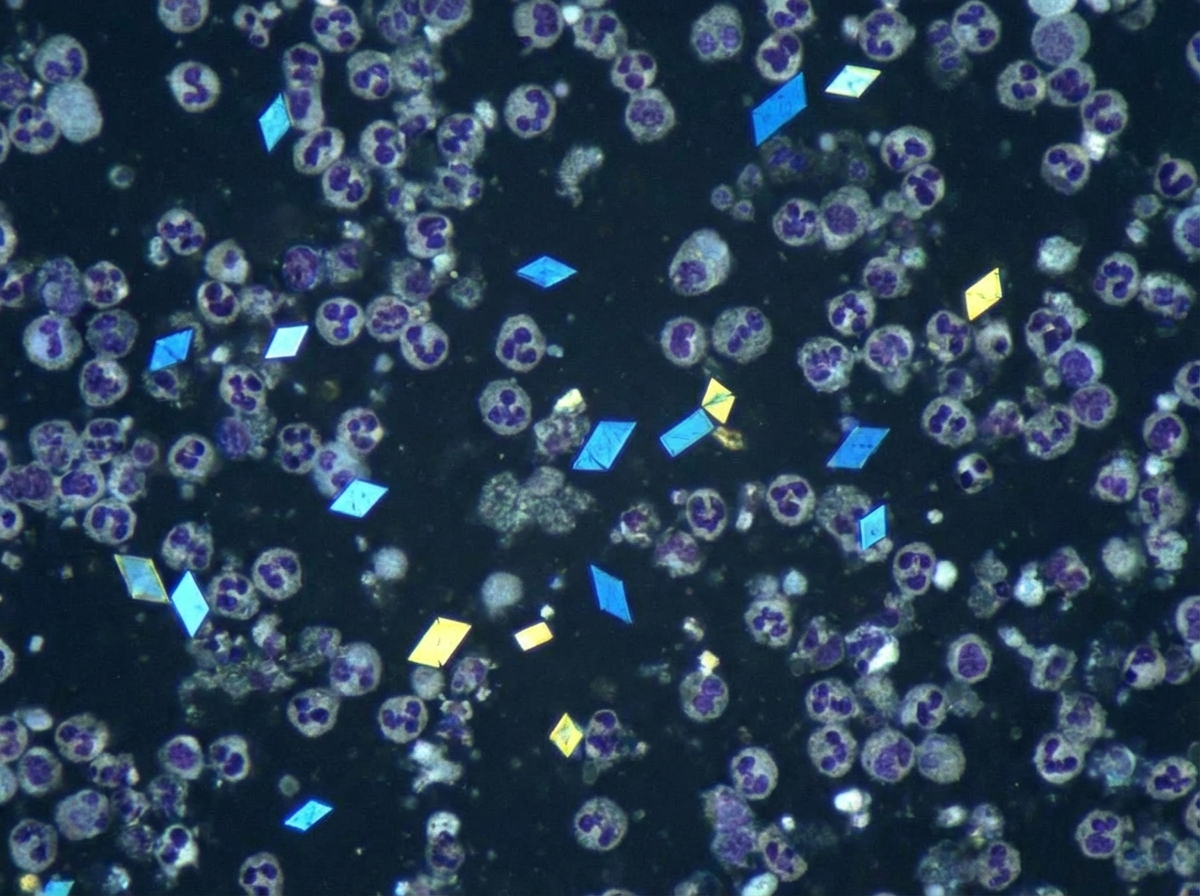
A 62-year-old man comes to the physician because of a swollen and painful right knee for the last 3 days. He has no history of joint disease. His vital signs are within normal limits. Examination shows erythema and swelling of the right knee, with limited range of motion due to pain. Arthrocentesis of the right knee joint yields 7 mL of cloudy fluid with a leukocyte count of 29,000/mm3 (97% segmented neutrophils). Compensated polarized light microscopy of the aspirate is shown. Which of the following is the most likely underlying mechanism of this patient's knee pain?
A 15-year-old boy presents to the emergency department for evaluation of an ‘infected leg’. The patient states that his right shin is red, swollen, hot, and very painful. The body temperature is 39.5°C (103.2°F). The patient states there is no history of trauma but states he has a history of poorly managed sickle cell anemia. A magnetic resonance imaging (MRI) scan is performed and confirms a diagnosis of osteomyelitis. Which of the following is the most likely causative agent?
A 4-year-old boy is brought to the pediatrician by his mother for a routine medical examination. His medical history is relevant for delayed gross motor milestones. The mother is concerned about a growth delay because both of his brothers were twice his size at this age. Physical examination reveals a well-groomed and healthy boy with a prominent forehead and short stature, in addition to shortened upper and lower extremities with a normal vertebral column. The patient’s vitals reveal: temperature 36.5°C (97.6°F); pulse 60/min; and respiratory rate 17/min and a normal intelligence quotient (IQ). A mutation in which of the following genes is the most likely cause underlying the patient’s condition?
A 6-year-old boy with a history of multiple fractures is brought to his pediatrician by his mother, because she is concerned her child cannot hear her. On physical exam, kyphoscoliosis, poor dentition, bowing of long bones, and conductive hearing loss is noted. On genetic analysis, the patient has a COL1A1 gene mutation. The defect found in this patient is most likely associated with impaired formation of which of the following?
A 67-year-old male presents with left hip pain. Examination reveals mild effusions in both knees, with crepitus in both patellofemoral joints. He states his hearing has worsened recently and that he feels like his hats don't fit anymore. Bone scan reveals diffuse uptake in the calvarium, right proximal femur, and left ilium. Which of the following laboratory abnormalities would be expected in this patient?
A 23-year-old woman comes to the office because of a 2-day history of right knee pain. She says, "I can't run anymore because my knee hurts." The pain is localized "somewhere under the kneecap" and is achy, rated 5/10, but increases to 8/10 with prolonged sitting. She reports an occasional "popping" sound and sensation when she rises from a seated position. She has no history of trauma to the knee. She had a right clavicular fracture 2 years ago that was treated with a shoulder sling. She takes a daily multivitamin and has no known drug allergies. She does not smoke and drinks up to three glasses of wine weekly. Vital signs: Temperature 37°C (98.6°F), pulse 65/min, respirations 15/min, blood pressure 108/62 mm Hg. Height 173 cm (5 ft 8 in), weight 54 kg (119 lb), BMI 18 kg/m². Physical examination shows no acute distress. Pulmonary examination shows lungs clear to auscultation. Cardiac examination shows regular rate and rhythm with normal S1 and S2; no murmurs, rubs, or gallops. The abdomen is thin with no tenderness, guarding, masses, bruits, or hepatosplenomegaly. Extremities show no joint erythema, edema, or warmth; dorsalis pedis, radial, and femoral pulses are intact. Musculoskeletal examination shows diffuse tenderness to palpation over the right anterior knee, worse with full extension of the knee; no associated effusion or erythema; full, symmetric strength of quadriceps, hip abductors, and hip external rotators; crepitus with knee range of motion; and antalgic gait. Neurologic examination shows the patient is alert and oriented with cranial nerves grossly intact and no focal neurologic deficits. Which of the following is the most appropriate next step in management?
A 54-year-old female presents to her primary care physician with complaints of fatigue, constipation, and what the patient describes as "aching in her bones." Her medical history is significant for hypertension, well-controlled on lisinopril, and two prior kidney stones that both passed spontaneously without need for surgery. Vital signs are within normal limits, and physical exam is not significant for any notable findings. Preliminary lab work is ordered and reveals: calcium 11.6 mg/dL (normal range 8.5 - 10.9 mg/dL), phosphorus 2.1 mg/dL (normal range 2.4 - 4.1 mg/dL), and an elevated parathyroid hormone (PTH) level. Which of the following findings would most likely be expected on radiographic evaluation of this patient's hands?
A 38-year-old woman was brought to the emergency department after she experienced dizziness and shortness of breath while walking with her friend. She recently immigrated to the United States and is unable to report her previous medical history. Physical exam reveals pallor underneath her eyelids. Labs are obtained with the following results: Hemoglobin: 8.4 g/dL Platelet count: 62,000/mm^3 Mean corpuscular volume: 89 µm^3 Reticulocyte count: 0.1% Lactate dehydrogenase: 175 U/L Which of the following is associated with the most likely cause of this patient's symptoms?
A previously healthy 59-year-old man comes to the physician with a 6-month history of worsening headaches, difficulty chewing, and progressive hearing loss. Examination shows a mildly tender, 1-cm, hard swelling over the left maxilla. The remainder of the examination shows no abnormalities. Serum studies show a calcium concentration of 8.5 mg/dL, alkaline phosphatase activity of 112 U/L, and parathyroid hormone concentration of 310 pg/mL. Audiometry shows bilateral mixed conductive and sensorineural hearing loss. Which of the following processes is the most likely cause of this patient's condition?
Want unlimited practice?
Get full access to all questions, explanations, and performance tracking.
Scan to download app