
Renal cystic diseases — MCQs

A 42-year-old Caucasian male presents to your office with hematuria and right flank pain. He has no history of renal dialysis but has a history of recurrent urinary tract infections. You order an intravenous pyelogram, which reveals multiple cysts of the collecting ducts in the medulla. What is the most likely diagnosis?
A 53-year-old male presents to your office for abdominal discomfort. The patient states he first noticed pain on his right flank several months ago, and it has been gradually getting worse. For the past week, he has also noticed blood in his urine. Prior to this episode, he has been healthy and does not take any medications. The patient denies fever, chills, and dysuria. He has a 40 pack-year smoking history. Vital signs are T 37 C, BP 140/90 mmHg, HR 84/min, RR 14/min, O2 98%. Physical exam is unremarkable. CBC reveals a hemoglobin of 17 and hematocrit of 51%, and urinalysis is positive for red blood cells, negative for leukocytes. Which of the following is the most likely diagnosis?
A 6-year-old boy is brought to the pediatrician by his mother after he reported having red urine. He has never experienced this before and did not eat anything unusual before the episode. His past medical history is notable for sensorineural deafness requiring hearing aids. He is otherwise healthy and enjoys being in the 1st grade. His birth history was unremarkable. His temperature is 98.8°F (37.1°C), blood pressure is 145/85 mmHg, pulse is 86/min, and respirations are 18/min. On examination, he is a well-appearing boy in no acute distress. Cardiac, respiratory, and abdominal exams are normal. A urinalysis is notable for microscopic hematuria and mild proteinuria. This patient’s condition is most commonly caused by which of the following inheritance patterns?
A female infant is born with a mutation in PKD1 on chromosome 16. An abdominal ultrasound performed shortly after birth would most likely reveal which of the following?
A 35-year-old male with a history of hypertension presents with hematuria and abdominal discomfort. Ultrasound and CT scan reveal large, bilateral cysts in all regions of the kidney. What is the most likely diagnosis?
A 40-year-old man comes to the physician because of a 4-week history of generalized weakness. He also reports increased urination and thirst. He has type 2 diabetes mellitus and chronic kidney disease. His only medication is metformin. Serum studies show: Na+ 134 mEq/L Cl- 110 mEq/L K+ 5.6 mEq/L HCO3- 19 mEq/L Glucose 135 mg/dL Creatinine 1.6 mg/dL Urine pH is 5.1. Which of the following is the most likely underlying cause of this patient's symptoms?
A 45-year-old woman presents to the office with a complaint of generalized weakness that has been getting worse over the last few months. She says that she just does not have the energy for her daily activities. She gets winded quite easily when she takes her dog for a walk in the evening. She says that her mood is generally ok and she gets together with her friends every weekend. She works as a teacher at a local elementary school and used to have frequent headaches while at work. Her husband is a commercial pilot and is frequently away for extended periods of time. Her only son is a sophomore in college and visits her every other week. She has had issues in the past with hypertension, but her blood pressure is currently well-controlled because she is compliant with her medication. She is currently taking atorvastatin and lisinopril. The blood pressure is 130/80 mm Hg, the pulse is 90/min, the temperature is 36.7°C (98.0°F), and the respirations are 16/min. On examination, she appears slightly pale and lethargic. Her ECG today is normal and recent lab work shows the following: Serum creatinine 1.5 mg/dL Estimated GFR 37.6 mL/min Hemoglobin (Hb%) 9 mg/dL Mean corpuscular hemoglobin (MCH) 27 pg Mean corpuscular hemoglobin concentration (MCHC) 36 g/dL Mean corpuscular volume (MCV) 85 fL Reticulocyte count 0.1% Erythrocyte count 2.5 million/mm3 Serum iron 160 μg/dL Serum ferritin 150 ng/mL Total iron binding capacity 105 μg/dL Serum vitamin B12 254 pg/mL Serum folic acid 18 ng/mL Thyroid stimulating hormone 3.5 μU/mL Which of the following will most likely help her?
A 70-year-old man is brought to the emergency department by his wife because of lethargy, confusion, and nausea for the past 2 days. He has previously been healthy and has no past medical history. His only medications are a daily multivitamin and acetaminophen, which he takes daily for hip pain. Vital signs are within normal limits. He is disoriented to place and time but recognizes his wife. The remainder of his physical examination shows no abnormalities. Laboratory studies show a hemoglobin concentration of 9.1 g/dL, a serum calcium concentration of 14.7 mg/dL, and a serum creatinine of 2.2 mg/dL (previously 0.9 mg/dL). Which of the following is the most likely underlying mechanism of this patient's condition?
A 49-year-old man presents to your clinic with “low back pain”. When asked to point to the area that bothers him the most, he motions to both his left and right flank. He describes the pain as deep, dull, and aching for the past few months. His pain does not change significantly with movement or lifting heavy objects. He noted dark colored urine this morning. He has a history of hypertension managed with hydrochlorothiazide; however, he avoids seeing the doctor whenever possible. He drinks 3-4 beers on the weekends but does not smoke. His father died of a sudden onset brain bleed, and his mother has diabetes. In clinic, his temperature is 99°F (37.2°C), blood pressure is 150/110 mmHg, pulse is 95/min, and respirations are 12/min. Bilateral irregular masses are noted on deep palpation of the abdomen. The patient has full range of motion in his back and has no tenderness of the spine or paraspinal muscles. Urine dipstick in clinic is notable for 3+ blood. Which chromosome is most likely affected by a mutation in this patient?
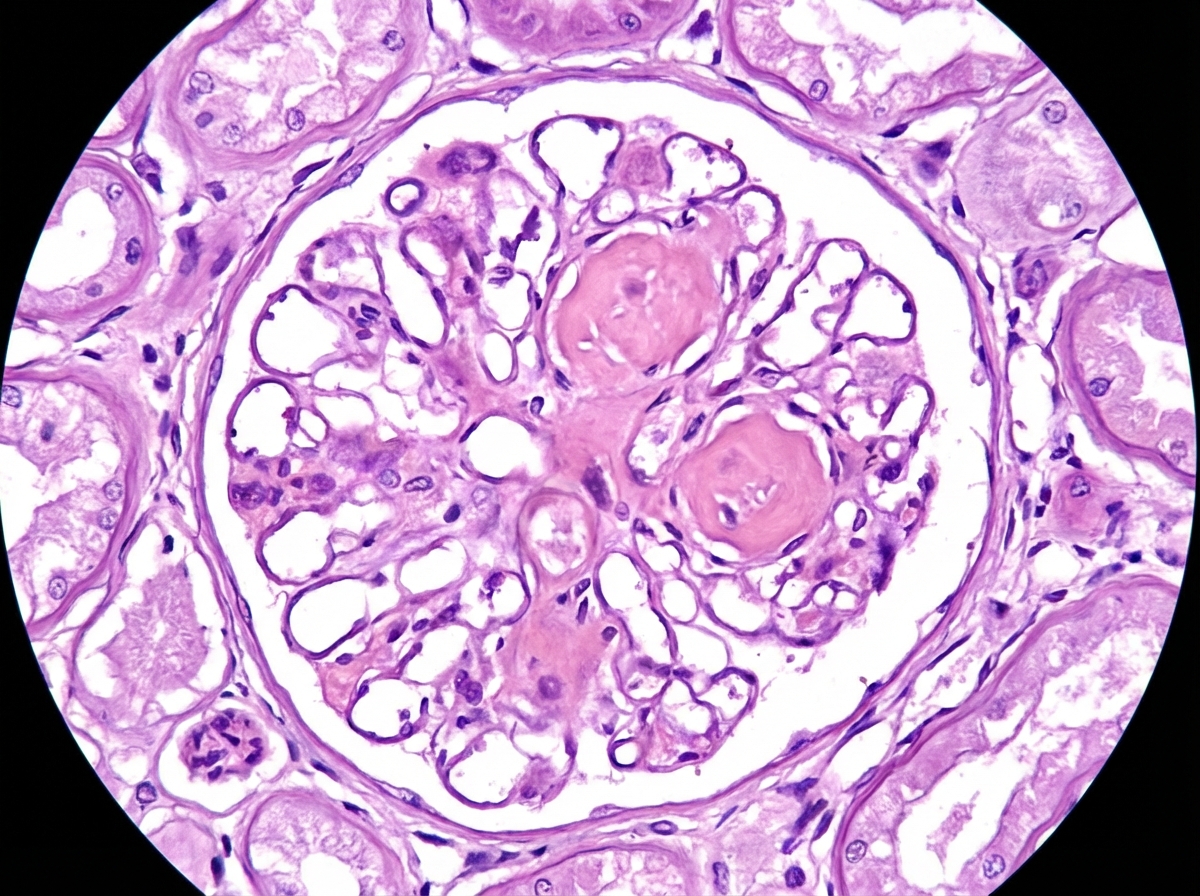
A 62-year-old man comes to the physician because of fatigue and decreased urine output for 2 weeks. He has not been to the physician for many years and takes no medications. Serum studies show a urea nitrogen concentration of 42 mg/dL and a creatinine concentration of 2.3 mg/dL. Urinalysis shows heavy proteinuria. A photomicrograph of a section of a kidney biopsy specimen is shown. Which of the following is the most likely underlying cause of this patient's symptoms?
Want unlimited practice?
Get full access to all questions, explanations, and performance tracking.
Scan to download app