
Obstructive uropathies — MCQs

A 62-year-old man comes to the physician because of increased frequency of urination. He also says that he needs to urinate 4 to 5 times nightly and has difficulty initiating a urinary stream. He has had several episodes of acute cystitis treated with ciprofloxacin during the past year. Digital rectal examination shows a firm, symmetrically enlarged, non-tender prostate. This patient is most likely to develop which of the following complications?
A 70-year-old woman comes to the physician for the evaluation of loss of urine for the last several months. She loses small amounts of urine without warning after coughing or sneezing. She also sometimes forgets the names of her relatives. She is retired and lives at an assisted-living facility. She has type 2 diabetes mellitus and hypertension. Her older sister recently received a ventriculoperitoneal shunt. She does not smoke or drink alcohol. Medications include metformin and enalapril. Vital signs are within normal limits. She walks without any problems. Sensation to pinprick and light touch is normal. Which of the following is the most likely underlying cause of this patient's symptoms?
A 66-year-old G3P3 presents with an 8-year-history of back pain, perineal discomfort, difficulty urinating, recurrent malaise, and low-grade fevers. These symptoms have recurred regularly for the past 5–6 years. She also says that there are times when she experiences a feeling of having a foreign body in her vagina. With the onset of symptoms, she was evaluated by a physician who prescribed her medications after a thorough examination and recommended a vaginal pessary, but she was non-compliant. She had 3 vaginal deliveries She has been menopausal since 51 years of age. She does not have a history of malignancies or cardiovascular disease. She has type 2 diabetes mellitus that is controlled with diet and metformin. Her vital signs include: blood pressure 110/60 mm Hg, heart rate 91/min, respiratory rate 13/min, and temperature 37.4℃ (99.3℉). On physical examination, there is bilateral costovertebral angle tenderness. The urinary bladder is non-palpable. The gynecologic examination reveals descent of the cervix to the level of the introitus. A Valsalva maneuver elicits uterine procidentia. Which pathology is most likely to be revealed by imaging in this patient?
A 37-year-old woman presents to the Emergency Department after 8 hours of left sided flank pain that radiates to her groin and pelvic pain while urinating. Her medical history is relevant for multiple episodes of urinary tract infections, some requiring hospitalization, and intravenous antibiotics. In the hospital, her blood pressure is 125/83 mm Hg, pulse of 88/min, a respiratory rate of 28/min, and a body temperature of 36.5°C (97.7°F). On physical examination, she has left costovertebral tenderness and lower abdominal pain. Laboratory studies include a negative pregnancy test, mild azotemia, and a urinary dipstick that is positive for blood. Which of the following initial tests would be most useful in the diagnosis of this case?
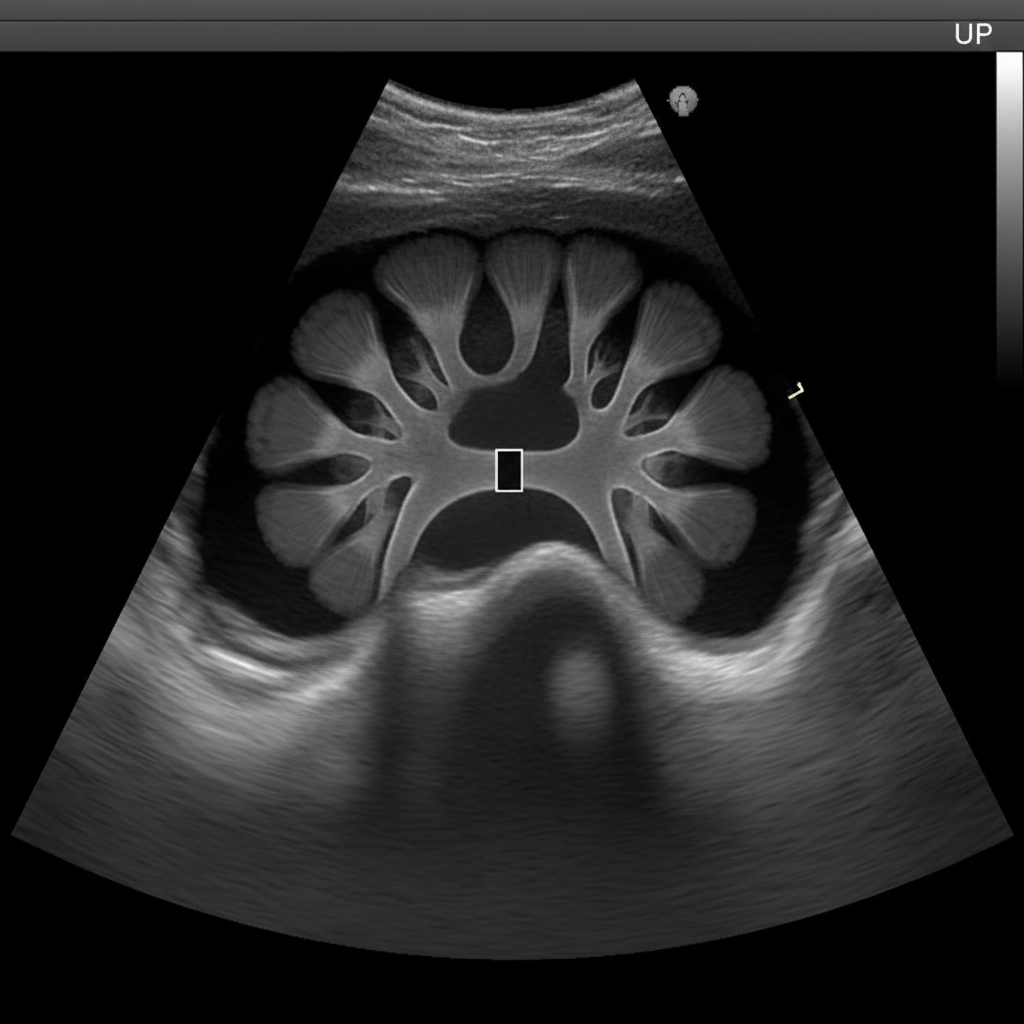
A 32-year-old female presents with acute onset abdominal pain accompanied by nausea, vomiting, and hematuria. She is currently taking glipizide for type 2 diabetes mellitus. Past medical history is also significant for lactose intolerance. She has just started training for a marathon, and she drinks large amounts of sports drinks to replenish her electrolytes and eats a high-protein diet to assist in muscle recovery. She admits to using laxatives sporadically to help her manage her weight. On physical exam, the patient appears distressed and has difficulty getting comfortable. Her temperature is 36.8°C (98.2°F), heart rate is 103/min, respiratory rate is 15/min, blood pressure is 105/85 mm Hg, and oxygen saturation is 100% on room air. Her BMI is 21 kg/m2. CBC, CMP, and urinalysis are ordered. Renal ultrasound demonstrates an obstruction at the ureteropelvic junction (see image). Which of the following would most likely be seen in this patient?
A 58-year-old man presents to the Emergency Department after 3 hours of intense suprapubic pain associated with inability to urinate for the past day or two. His medical history is relevant for benign prostatic hyperplasia (BPH) that has been under treatment with prazosin and tadalafil. Upon admission, he is found to have a blood pressure of 180/100 mm Hg, a pulse of 80/min, a respiratory rate of 23/min, and a temperature of 36.5°C (97.7°F). He weighs 84 kg (185.1 lb) and is 175 cm (5 ft 7 in) tall. Physical exam, he has suprapubic tenderness. A bladder scan reveals 700 ml of urine. A Foley catheter is inserted and the urine is drained. Initial laboratory tests and their follow up 8 hours after admission are shown below. Admission 8 hours after admission Serum potassium 4.2 mmol/L Serum potassium 4.0 mmol/L Serum sodium 140 mmol/L Serum sodium 142 mmol/L Serum chloride 102 mmol/L Serum chloride 110 mmol/L Serum creatinine 1.4 mg/dL Serum creatinine 1.6 mg/dL Serum blood urea nitrogen 64 mg/dL Serum blood urea nitrogen 62 mg/dL Urine output 250 mL Urine output 260 mL A senior attending suggests a consultation with Nephrology. Which of the following best justifies this suggestion?
A 43-year-old man presents with acute-onset left flank pain for the past 6 hours. He describes the pain as severe, intermittent, colicky, and “coming in waves”, and he points to the area of the left costovertebral angle (CVA). He says he recently has been restricting oral liquid intake to only 2 glasses of water per day based on the advice of his healer. He also reports nausea and vomiting. The patient has a history of hypertension, gout, and type 2 diabetes mellitus. He is afebrile, and his vital signs are within normal limits. On physical examination, he is writhing in pain and moaning. There is exquisite left CVA tenderness. A urinalysis shows gross hematuria. Which of the following is the next best step in the management of this patient?
A 67-year-old man presents to his primary care physician complaining of frequent urination overnight. He states that for several years he has had trouble maintaining his urine stream along with the need for frequent urination, but the nighttime urination has only recently started. The patient also states that he has had 2 urinary tract infections in the last year, which he had never had previously. On exam, his temperature is 98.8°F (37.1°C), blood pressure is 124/68 mmHg, pulse is 58/min, and respirations are 13/min. On digital rectal exam, the prostate is enlarged but feels symmetric and smooth. Which of the following is a possible consequence of this condition?
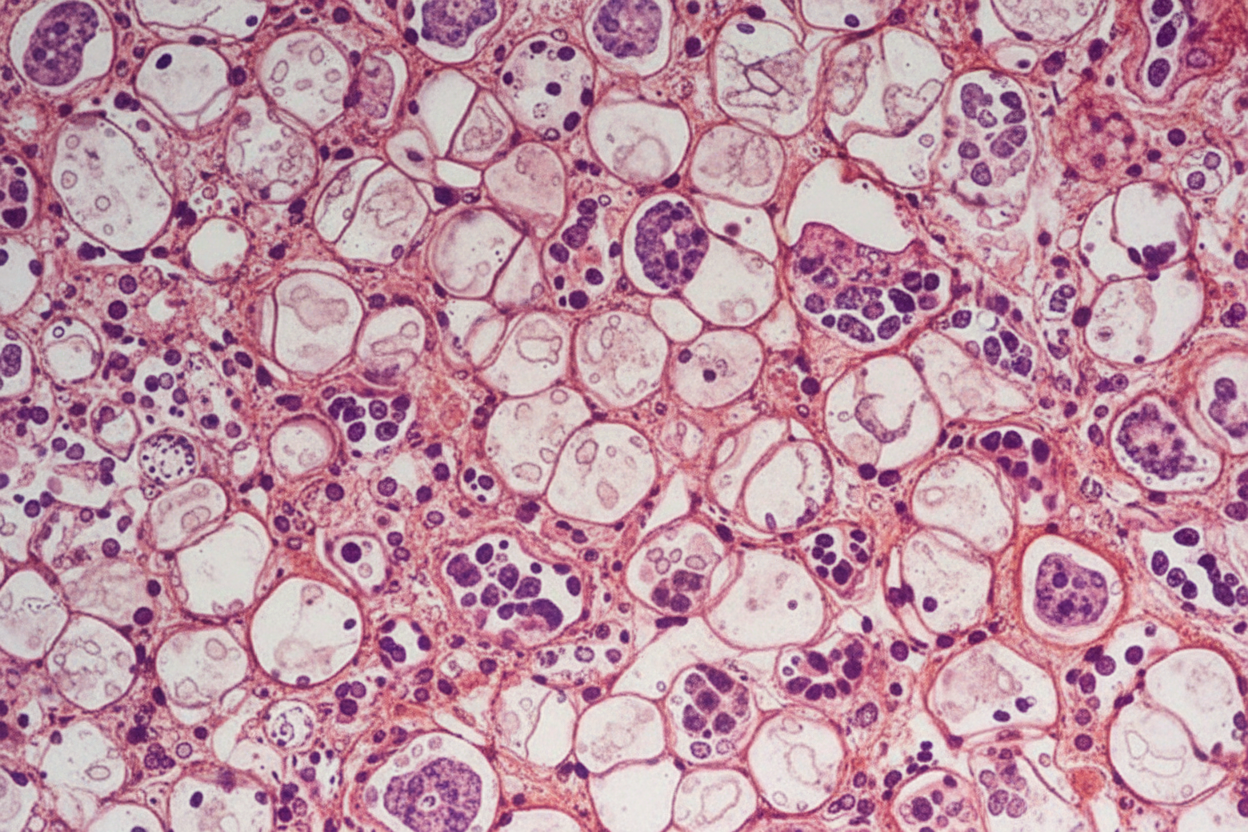
An 82-year-old woman presents to the emergency department because of excruciating right flank pain and fever for the past 2 days. She states that she is having trouble urinating. Her past medical history is unremarkable. A urinalysis is performed and comes back positive for leukocytes and gram-negative bacilli. A contrast computed tomography of the abdomen is performed and reveals a large retroperitoneal mass compressing the right ureter, leading to hydronephrosis of the right kidney. The mass is excised. Histopathologic evaluation of the mass is shown in the image below, and it is determined to be malignant. Which of the following is the most likely diagnosis in this patient?
A 12-year-old boy presents to your office with facial swelling and dark urine. He has no other complaints other than a sore throat 3 weeks ago that resolved after 6 days. He is otherwise healthy, lives at home with his mother and 2 cats, has no recent history of travel, and no sick contacts. On physical examination his temperature is 99°F (37.2°C), blood pressure is 130/85 mmHg, pulse is 80/min, respirations are 19/min, and pulse oximetry is 99% on room air. Cardiopulmonary and abdominal examinations are unremarkable. There is mild periorbital and pedal edema. Urinalysis shows 12-15 RBC/hpf, 2-5 WBC/hpf, and 30 mg/dL protein. Which additional finding would you expect to see on urinalysis?
Want unlimited practice?
Get full access to all questions, explanations, and performance tracking.
Scan to download app