
Acute tubular necrosis — MCQs

A 78-year-old man dies suddenly from complications of acute kidney failure. An autopsy is performed and microscopic evaluation of the kidneys shows pale, swollen cells in the proximal convoluted tubules. Microscopic evaluation of the liver shows similar findings. Which of the following is the most likely underlying mechanism of these findings?
An 84-year-old man is brought to the physician by the staff of a group home where he resides because of worsening confusion and decreased urinary output. His nurse reports that the patient has not been drinking much for the last 3 days. Examination shows a decreased skin turgor and dry oral mucosa. His pulse is 105/min and blood pressure is 100/65 mm Hg. His serum creatinine is 3.1 mg/dL and a urea nitrogen is 42 mg/dL. Urine studies show multiple brownish granular casts. Which of the following processes is most likely involved in the pathogenesis of this patient's condition?
Nine days after being treated for a perforated gastric ulcer and sepsis, a 78-year-old woman develops decreased urinary output and malaise. She required emergency laparotomy and was subsequently treated in the intensive care unit for sepsis. Blood cultures grew Pseudomonas aeruginosa. The patient was treated with ceftazidime and gentamicin. She has type 2 diabetes mellitus, arterial hypertension, and osteoarthritis of the hips. Prior to admission, her medications were insulin, ramipril, and ibuprofen. Her temperature is 37.3°C (99.1°F), pulse is 80/min, and blood pressure is 115/75 mm Hg. Examination shows a healing surgical incision in the upper abdomen. Laboratory studies show: Hemoglobin count 14 g/dL Leukocyte count 16,400 mm3 Segmented neutrophils 60% Eosinophils 2% Lymphocytes 30% Monocytes 6% Platelet count 260,000 mm3 Serum Na+ 137 mEq/L Cl- 102 mEq/L K+ 5.1 mEq/L Urea nitrogen 25 mg/dL Creatinine 4.2 mg/dL Fractional excretion of sodium is 2.1%. Which of the following findings on urinalysis is most likely associated with this patient's condition?
A 53-year-old woman presents to her physician for evaluation of sudden onset respiratory distress for the past few hours. The past medical history includes a myocardial infarction 2 years ago. The vital signs include a blood pressure 70/40 mm Hg, pulse 92/min, respiratory rate 28/min, and SpO2 92% on room air. The physical examination reveals bilateral basal crepitations on auscultation. The echocardiogram reveals an ejection fraction of 34%. She is admitted to the medical floor and started on furosemide. The urine output in 24 hours is 400 mL. The blood urea nitrogen is 45 mg/dL and the serum creatinine is 1.85 mg/dL. The fractional excretion of sodium is 2.4%. Urinalysis revealed muddy brown granular casts. Which of the following is the most likely cause of the abnormal urinalysis?
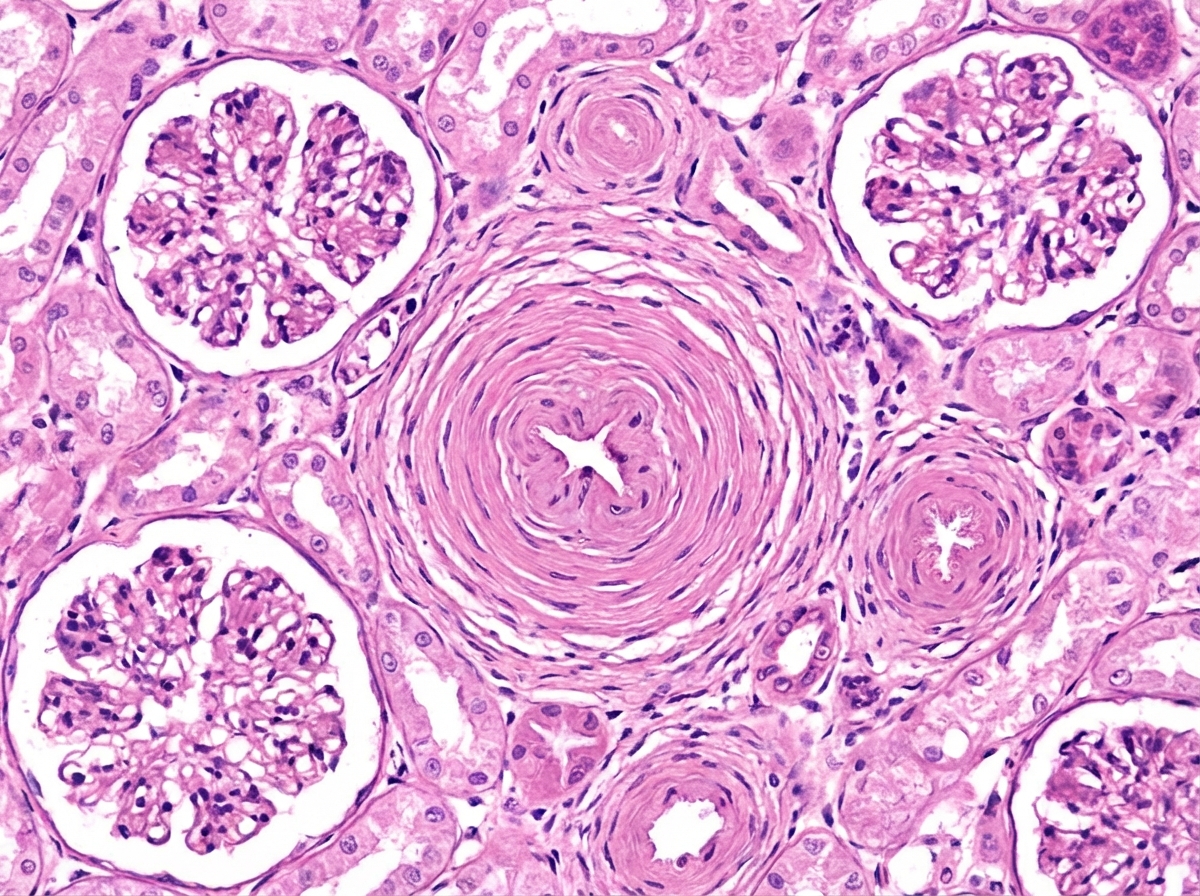
A 53-year-old man is brought to the emergency department by his wife because of a 1-day history of headache, blurry vision, and confusion. His wife also says that he hasn't urinated in the past 24 hours. Despite appropriate measures, the patient dies shortly after admission. A photomicrograph of a section of the kidney obtained at autopsy is shown. Which of the following is the most likely explanation for the findings indicated by the arrow?
A 39-year-old woman is brought to the emergency department in a semi-unconscious state by her neighbor who saw her lose consciousness. There was no apparent injury on the primary survey. She is not currently taking any medications. She has had loose stools for the past 3 days and a decreased frequency of urination. No further history could be obtained. The vital signs include: blood pressure 94/62 mm Hg, temperature 36.7°C (98.0°F), pulse 105/min, and respiratory rate 10/min. The skin appears dry. Routine basic metabolic panel, urine analysis, urine osmolality, and urine electrolytes are pending. Which of the following lab abnormalities would be expected in this patient?
A 32-year-old man is brought to the Emergency Department after 3 consecutive days of diarrhea, fatigue and weakness. His stool has been soft and mucoid, with no blood stains. The patient just came back from a volunteer mission in Guatemala, where he remained asymptomatic. His personal medical history is unremarkable. Today his blood pressure is 98/60 mm Hg, pulse is 110/min, respiratory rate is 19/min, and his body temperature is 36.7°C (98.1°F). On physical exam, he has sunken eyes, dry mucosa, mild diffuse abdominal tenderness, and hyperactive bowel sounds. Initial laboratory tests are shown below: Serum creatinine (SCr) 1.8 mg/dL Blood urea nitrogen (BUN) 50 mg/dL Serum sodium 132 mEq/L Serum potassium 3.5 mEq/L Serum chloride 102 mEq/L Which of the following phenomena would you expect in this patient?
A 49-year-old woman presents to the emergency room with bloody stool and malaise. She developed a fever and acute left lower quadrant abdominal pain earlier in the day. She has had 2 bowel movements with bright red blood. Her past medical history is notable for hyperlipidemia, hypertension, and diabetes mellitus. She takes lovastatin, hydrochlorothiazide, metformin, glyburide, and aspirin. Her temperature is 102.9°F (39.4°C), blood pressure is 101/61 mmHg, pulse is 110/min, and respirations are 22/min. On exam, she is fully alert and oriented. She is tender in the left lower quadrant. A computerized tomography (CT) scan is performed demonstrating acute diverticulitis. She is admitted and started on broad-spectrum antibiotics. 48 hours later, her urine output is significantly decreased. Her abdominal pain has improved but she has started vomiting and appears confused. She has new bilateral lower extremity edema and decreased breath sounds at the lung bases. Laboratory analysis upon admission and 48 hours later is shown below: Admission: Hemoglobin: 11.9 g/dl Hematocrit: 34% Leukocyte count: 11,500/mm^3 Platelet count: 180,000/ mm^3 Serum: Na+: 141 mEq/L Cl-: 103 mEq/L K+: 4.5 mEq/L HCO3-: 23 mEq/L BUN: 21 mg/dL Glucose: 110 mg/dL Creatinine: 0.9 mg/dL 48 hours later: Hemoglobin: 10.1 g/dl Hematocrit: 28% Leukocyte count: 11,500 cells/mm^3 Platelet count: 195,000/ mm^3 Serum: Na+: 138 mEq/L Cl-: 100 mEq/L K+: 5.1 mEq/L HCO3-: 24 mEq/L BUN: 30 mg/dL Glucose: 120 mg/dL Creatinine: 2.1 mg/dL Which of the following findings would most likely be seen on urine microscopy?
A 53-year-old woman presents to the emergency room with severe chest pain radiating to the back. She was diagnosed with acute aortic dissection. A few hours into the resuscitation, she was having oliguria. Laboratory findings show a serum creatinine level of 5.3 mg/dL. Which of the following casts are most likely to be seen on urinalysis?
A 29-year-old woman comes to the physician because of a 2-day history of intermittent dark urine and mild flank pain. She has also had a cough, sore throat, and runny nose for the past 5 days. She has not had dysuria. She takes no medications. She has no known allergies. Her temperature is 37°C (98.6°F). Examination of the back shows no costovertebral angle tenderness. Laboratory studies show: Hemoglobin 10.4 g/dL Leukocyte count 8,000/mm3 Platelet count 200,000/mm3 Serum Na+ 135 mEq/L K+ 4.9 mEq/L Cl- 101 mEq/L HCO3- 22 mEq/L Urea nitrogen 18 mg/dL Creatinine 1.1 mg/dL Urine Color yellow Blood 3+ Protein 1+ Leukocyte esterase negative An ultrasound of the kidney and bladder shows no abnormalities. Which of the following is the most likely cause of this patient's symptoms?
Want unlimited practice?
Get full access to all questions, explanations, and performance tracking.
Scan to download app