
Pulmonary edema — MCQs

A 48-year-old female suffers a traumatic brain injury while skiing in a remote area. Upon her arrival to the ER, she is severely hypoxemic and not responsive to O2 therapy. She is started on a mechanical ventilator and 2 days later upon auscultation, you note late inspiratory crackles. Which of the following is most likely normal in this patient?
A 41-year-old man comes to the emergency department because of fatigue, worsening abdominal discomfort, and progressive swelling of his legs for 3 months. The swelling is worse in the evenings. His only medication is ibuprofen for occasional joint pain. The patient does not smoke and drinks 2–3 beers each weekend. His temperature is 36°C (96.8°F), pulse is 88/min, respirations are 18/min, and blood pressure is 130/80 mm Hg. Pulmonary examination shows no abnormalities. Abdominal examination shows a mildly distended abdomen with shifting dullness. The liver is palpated 2–3 cm below the right costal margin. When pressure is applied to the right upper quadrant, the patient's jugular veins become visibly distended for 15 seconds. The 2nd and 3rd metacarpophalangeal joints of both hands are tender to palpation. There is 2+ edema in the lower extremities. Which of the following is the most likely underlying cause of this patient's edema?
The serum brain natriuretic peptide and N-terminal pro-BNP are elevated. A diagnosis of heart failure with preserved ejection fraction is made. In addition to supplemental oxygen therapy, which of the following is the most appropriate initial step in management?
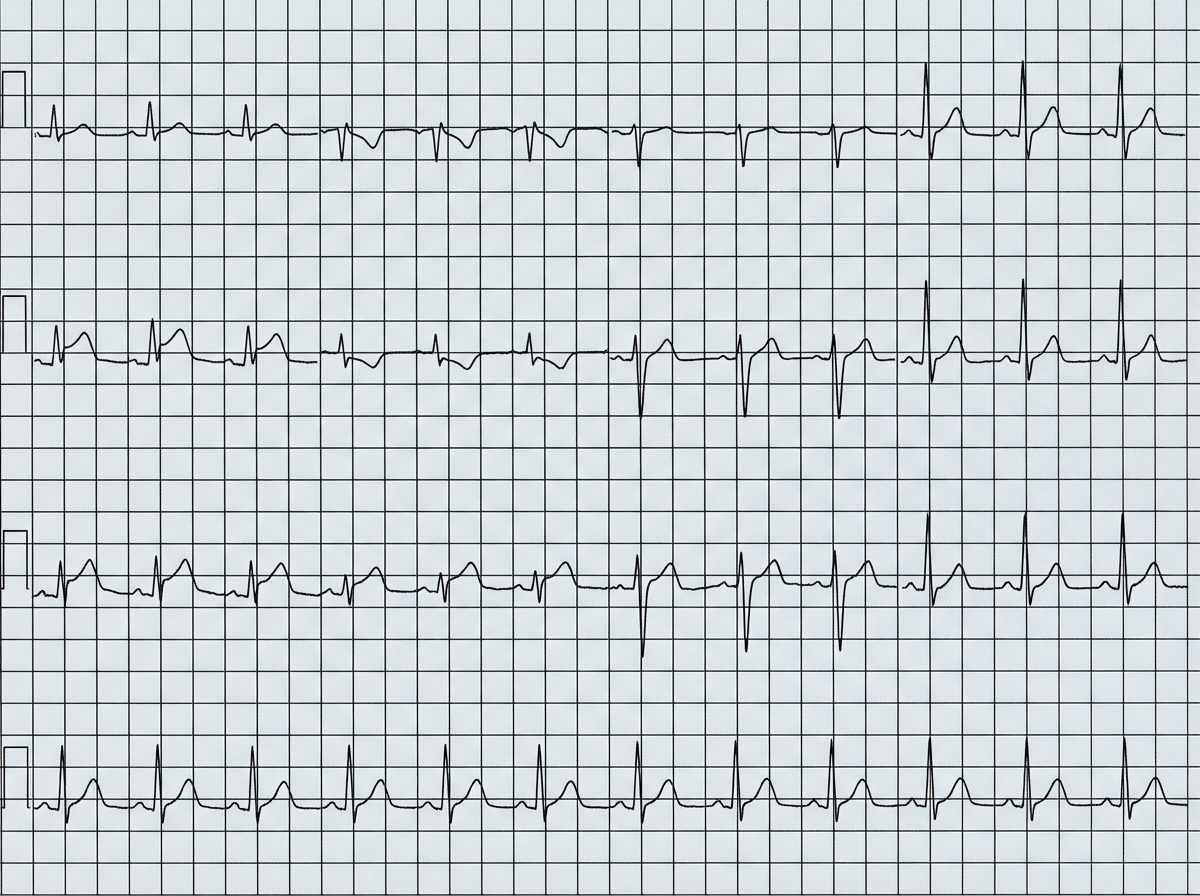
A 54-year-old man is brought to the emergency department 1 hour after the sudden onset of shortness of breath, epigastric pain, and sweating. He has no history of similar symptoms. He has hypertension and type 2 diabetes mellitus. Current medications include amlodipine and metformin. He has smoked one pack of cigarettes daily for 20 years. He appears weak and pale. His pulse is 56/min, respirations are 18/min, and blood pressure is 100/70 mm Hg. Cardiac examination shows normal heart sounds. The lungs are clear to auscultation. The skin is cold to the touch. An ECG is shown. Bedside transthoracic echocardiography shows normal left ventricular function. High-dose aspirin is administered. Administration of which of the following is most appropriate next step in management?
An investigator is studying early post-mortem changes in the lung. Autopsies are performed on patients who died following recent hospital admissions. Microscopic examination of the lungs at one of the autopsies shows numerous macrophages with brown intracytoplasmic inclusions. A Prussian blue stain causes these inclusions to turn blue. These findings are most consistent with a pathological process that would manifest with which of the following symptoms?
A 37-year-old male presents to your clinic with shortness of breath and lower extremity edema. He was born in Southeast Asia and emigrated to America ten years prior. Examination demonstrates 2+ pitting edema to the level of his knees, ascites, and bibasilar crackles, as well as an opening snap followed by a mid-to-late diastolic murmur. The patient undergoes a right heart catheterization that demonstrates a pulmonary capillary wedge pressure (PCWP) of 24 mmHg. The patient is most likely to have which of the following?
A 55-year-old man presents to the emergency department with shortness of breath and weakness. Past medical history includes coronary artery disease, arterial hypertension, and chronic heart failure. He reports that the symptoms started around 2 weeks ago and have been gradually worsening. His temperature is 36.5°C (97.7°F), blood pressure is 135/90 mm Hg, heart rate is 95/min, respiratory rate is 24/min, and oxygen saturation is 94% on room air. On examination, mild jugular venous distention is noted. Auscultation reveals bilateral loud crackles. Pitting edema of the lower extremities is noted symmetrically. His plasma brain natriuretic peptide level on rapid bedside assay is 500 pg/mL (reference range < 125 pg/mL). A chest X-ray shows enlarged cardiac silhouette. He is diagnosed with acute on chronic left heart failure with pulmonary edema and receives immediate care with furosemide. The physician proposes a drug trial with a new BNP stabilizing agent. Which of the following changes below are expected to happen if the patient is enrolled in this trial?
A 72-year-old man with type 2 diabetes mellitus, hypertension, and systolic heart failure comes to the physician because of a 5-day history of progressively worsening shortness of breath at rest. Physical examination shows jugular venous distention, diffuse crackles over the lower lung fields, and bilateral lower extremity edema. As a part of treatment, he is given a derivative of a hormone that acts by altering guanylate cyclase activity. This drug has been found to reduce pulmonary capillary wedge pressure and causes systemic hypotension as an adverse effect. The drug is most likely a derivative of which of the following hormones?
A 25-year-old man is in the middle of an ascent up a mountain, at an elevation of about 4,500 meters. This is the 4th day of his expedition. His friend notices that in the last few hours, he has been coughing frequently and appears to be short of breath. He has used his albuterol inhaler twice in the past 4 hours, but it does not seem to help. Within the past hour, he has coughed up some frothy, slightly pink sputum and is now complaining of nausea and headache. Other than his asthma, which has been well-controlled on a steroid inhaler, he is healthy. Which of the following is the most likely cause of this man’s symptoms?
An 82-year-old woman is admitted to the hospital because of wet gangrene on her right leg. Two days after admission, she becomes increasingly confused and tachypneic. She is intubated and ventilatory support is initiated. Her temperature is 39.6°C (102.5°F), pulse is 127/min, and blood pressure is 83/47 mm Hg. The ventilator is set at a FiO2 of 100% and a respiratory rate of 20/min. An arterial blood gas checked 30 minutes after intubation shows a PCO2 of 41 mm Hg and a PO2 of 55 mm Hg. Despite appropriate care, the patient dies from respiratory failure. Further evaluation of this patient is most likely to show which of the following findings?
Want unlimited practice?
Get full access to all questions, explanations, and performance tracking.
Scan to download app