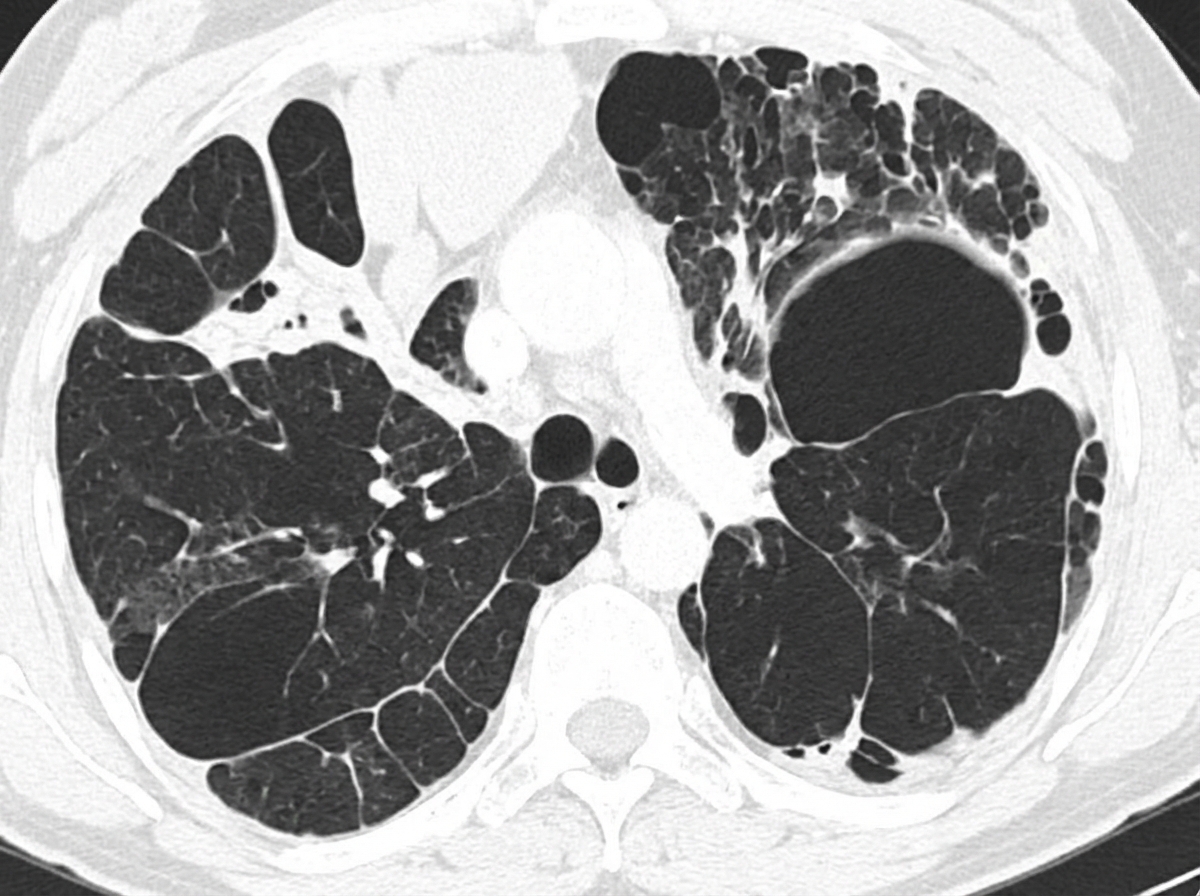
A lung mass of a 50 pack-year smoker is biopsied. If ADH levels were grossly increased, what would most likely be the histologic appearance of this mass?
Q22
A 73-year-old man is brought to the emergency department because of fever, malaise, dyspnea, and a productive cough with purulent sputum for the past day. His temperature is 39.2°C (102.6°F). Pulmonary examination shows crackles over the right upper lung field. Sputum Gram stain shows gram-positive cocci. Despite the appropriate treatment, the patient dies 5 days later. At autopsy, gross examination shows that the right lung has a pale, grayish-brown appearance and a firm consistency. Microscopic examination of the tissue is most likely to show which of the following?
Q23
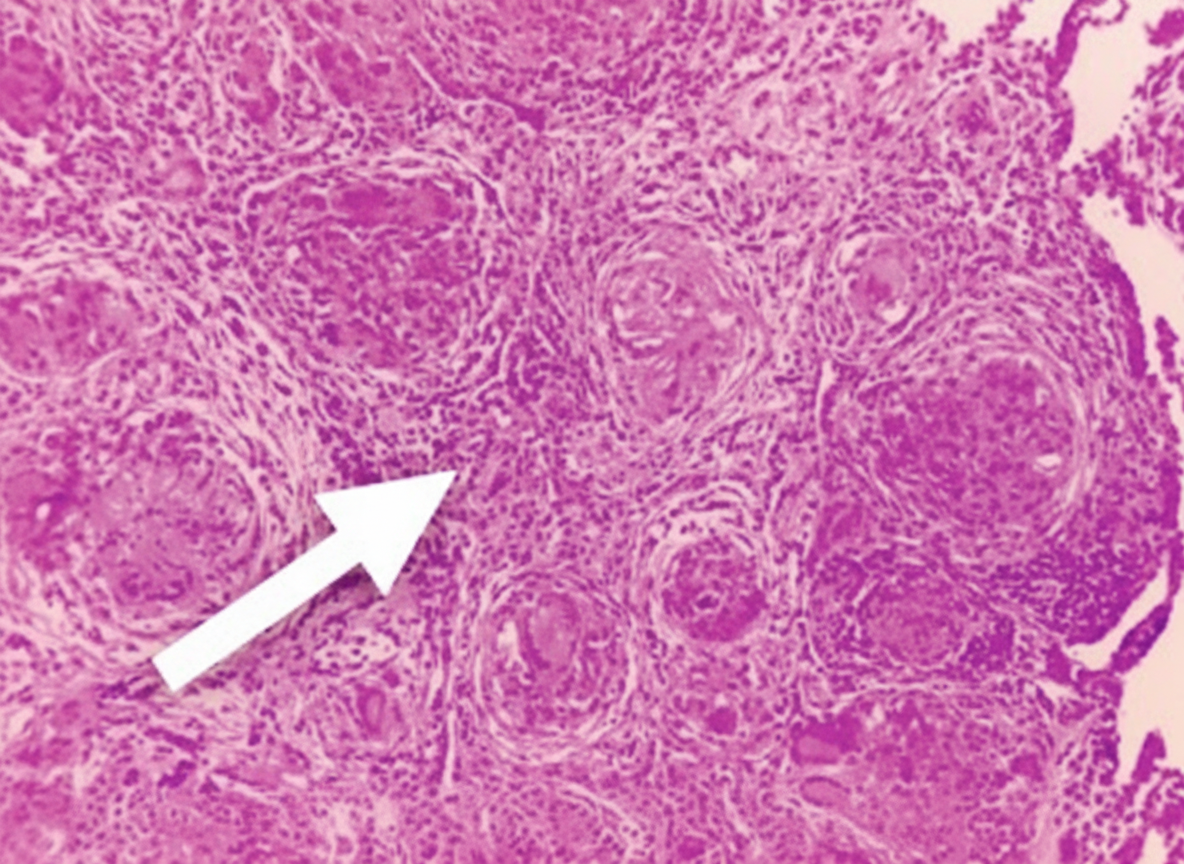
A 38-year-old man comes to the physician because of fever, malaise, cough, and shortness of breath for 2 months. He has had a 4-kg (9-lb) weight loss during the same period. He works at a flour mill and does not smoke cigarettes. His temperature is 38.1°C (100.6°F) and pulse oximetry shows 95% on room air. Diffuse fine crackles are heard over both lung fields. A chest x-ray shows patchy reticulonodular infiltrates in the mid and apical lung fields bilaterally. A photomicrograph of a lung biopsy specimen is shown. Which of the following cytokines have the greatest involvement in the pathogenesis of the lesion indicated by the arrow?
Q24
A 61-year-old man presents with gradually increasing shortness of breath. For the last 2 years, he has had a productive cough on most days. Past medical history is significant for hypertension and a recent admission to the hospital for pneumonia. He uses a triamcinolone inhaler and uses an albuterol inhaler as a rescue inhaler. He also takes lisinopril and a multivitamin daily. He has smoked a pack a day for the last 32 years and has no intention to quit now. Today, his blood pressure is 142/97 mm Hg, heart rate is 97/min, respiratory rate is 22/min, and temperature is 37.4°C (99.3°F). On physical exam, he has tachypnea and has some difficulty finishing his sentences. His heart has a regular rate and rhythm. Auscultation of his lungs reveals wheezing and rhonchi that improves after a deep cough. Fremitus is absent. Pulmonary function tests show FEV1/FVC of 55% with no change in FEV1 after albuterol treatment. Which of the following is the most likely pathology associated with this patient's disease?
Q25
A 53-year-old man is admitted to the intensive care unit from the emergency department with severe pancreatitis. Overnight, he starts to develop severe hypoxemia, and he is evaluated by a rapid response team. On exam the patient is breathing very quickly and has rales and decreased breath sounds bilaterally. He is placed on 50% FiO2, and an arterial blood gas is collected with the following results:
pH: 7.43
pCO2: 32 mmHg
pO2: 78 mmHg
The oxygen status of the patient continues to deteriorate, and he is placed on ventilator support. Which of the following would most likely be seen in this patient?
Q26
A 73-year-old female with no past medical history is hospitalized after she develops a fever associated with increasing shortness of breath. She states that 1 week prior, she had a cold which seemed to be resolving. Yesterday, however, she noticed that she started to feel feverish, measured her temperature to be 101.5°F (38.6°C), and also developed an unproductive dry cough and difficulty breathing. On exam, her temperature is 100.8°F (38.2°C), blood pressure is 110/72 mmHg, pulse is 96/min, and respirations are 16/min. Her exam demonstrates decreased breath sounds at the right lung base. The chest radiograph shows a right-sided pleural effusion with an opacity in the right lower lobe that is thought to be a bacterial pneumonia. Which of the following can be expected on a sample of the effusion fluid?
Q27
A 48-year-old woman with alpha-1-antitrypsin deficiency undergoes a lung transplant. She tolerates the surgery well, but 3 years later develops inflammation and fibrosis in her terminal bronchioles. Which of the following best describes the pathophysiology of this patient's deterioration?
Q28
In which of the following pathological states would the oxygen content of the trachea resemble the oxygen content in the affected alveoli?
Q29
An 82-year-old woman is admitted to the hospital because of wet gangrene on her right leg. Two days after admission, she becomes increasingly confused and tachypneic. She is intubated and ventilatory support is initiated. Her temperature is 39.6°C (102.5°F), pulse is 127/min, and blood pressure is 83/47 mm Hg. The ventilator is set at a FiO2 of 100% and a respiratory rate of 20/min. An arterial blood gas checked 30 minutes after intubation shows a PCO2 of 41 mm Hg and a PO2 of 55 mm Hg. Despite appropriate care, the patient dies from respiratory failure. Further evaluation of this patient is most likely to show which of the following findings?
Pulmonary US Medical PG Practice Questions and MCQs
Question 21: A lung mass of a 50 pack-year smoker is biopsied. If ADH levels were grossly increased, what would most likely be the histologic appearance of this mass?
A. Layered squamous cells with keratin pearls
B. Pleomorphic giant cells with leukocyte fragments in cytoplasm
C. Hyperplasia of mucin producing glandular tissue
D. Tall columnar cells bordering the alveolar septum
E. Sheets of small round cells with hyperchromatic nuclei (Correct Answer)
Explanation: ***Sheets of small round cells with hyperchromatic nuclei***
- Grossly increased **ADH levels** in a smoker suggest **syndrome of inappropriate antidiuretic hormone (SIADH)**, which is commonly associated with **small cell lung carcinoma (SCLC)**.
- SCLC is characterized histologically by sheets of **small (lymphocyte-like) cells** with scant cytoplasm and **hyperchromatic nuclei**.
*Layered squamous cells with keratin pearls*
- This description corresponds to **squamous cell carcinoma**, which is associated with smoking but typically causes **hypercalcemia** due to parathyroid hormone-related peptide (PTHrP) production, not elevated ADH.
- Key histological features are **keratin pearls** and **intercellular bridges**.
*Pleomorphic giant cells with leukocyte fragments in cytoplasm*
- This describes **large cell carcinoma**, which is a diagnosis of exclusion and does not typically manifest with paraneoplastic SIADH.
- **Large cell carcinoma** is characterized by large, anaplastic cells without differentiation towards squamous, glandular, or small cell features.
*Hyperplasia of mucin producing glandular tissue*
- This appearance is characteristic of **adenocarcinoma**, which often arises in non-smokers and is not typically associated with SIADH.
- **Adenocarcinoma** exhibits glandular differentiation and often produces mucin.
*Tall columnar cells bordering the alveolar septum*
- This refers to **lepidic growth pattern** often seen in some subtypes of **adenocarcinoma (e.g., adenocarcinoma in situ or minimally invasive adenocarcinoma)**.
- While it is a type of lung cancer, it is not primarily associated with SIADH as a paraneoplastic syndrome.
Question 22: A 73-year-old man is brought to the emergency department because of fever, malaise, dyspnea, and a productive cough with purulent sputum for the past day. His temperature is 39.2°C (102.6°F). Pulmonary examination shows crackles over the right upper lung field. Sputum Gram stain shows gram-positive cocci. Despite the appropriate treatment, the patient dies 5 days later. At autopsy, gross examination shows that the right lung has a pale, grayish-brown appearance and a firm consistency. Microscopic examination of the tissue is most likely to show which of the following?
A. Dilation of alveolar capillaries and serous exudate with abundant bacteria
B. Fibrinous exudate with erythrocytes, leukocytes, and bacteria
C. Fibrinopurulent leukocytic exudate with lysed erythrocytes (Correct Answer)
D. Resorbed exudate with aerated alveoli
E. Neutrophilic infiltrate in the bronchiolar walls and adjacent alveoli
Explanation: **Fibrinopurulent leukocytic exudate with lysed erythrocytes**
- This description aligns with the **gray hepatization** stage of lobar pneumonia, characterized by the accumulation of **fibrin**, **neutrophils**, and **lysed red blood cells** in the alveolar spaces, giving the lung a firm, grayish-brown appearance.
- The patient's presentation of **fever, dyspnea, productive cough with purulent sputum**, and Gram-positive cocci points to bacterial pneumonia, and the severe outcome suggests a progression to this advanced stage.
*Dilation of alveolar capillaries and serous exudate with abundant bacteria*
- This describes the stage of **congestion**, which is the initial phase of pneumonia.
- While it includes bacterial presence, it does not account for the **firm, grayish-brown appearance** of the lung found at autopsy.
*Fibrinous exudate with erythrocytes, leukocytes, and bacteria*
- This describes the stage of **red hepatization**, which follows congestion.
- In red hepatization, the lung appears red and firm due to engorged capillaries and intra-alveolar hemorrhage, which is distinct from the **pale, grayish-brown appearance** mentioned in the autopsy findings.
*Resorbed exudate with aerated alveoli*
- This describes the stage of **resolution**, where the inflammatory exudate is cleared, and the lung tissue returns to normal.
- Given the patient's death and autopsy findings of a firm, discolored lung, resolution had **not occurred**.
*Neutrophilic infiltrate in the bronchiolar walls and adjacent alveoli*
- This pattern is more characteristic of **bronchopneumonia**, which presents as patchy consolidation centered around bronchioles.
- The description of a **pale, grayish-brown, firm lung** suggests a more widespread lobar involvement rather than a patchy bronchopneumonia.
Question 23: A 38-year-old man comes to the physician because of fever, malaise, cough, and shortness of breath for 2 months. He has had a 4-kg (9-lb) weight loss during the same period. He works at a flour mill and does not smoke cigarettes. His temperature is 38.1°C (100.6°F) and pulse oximetry shows 95% on room air. Diffuse fine crackles are heard over both lung fields. A chest x-ray shows patchy reticulonodular infiltrates in the mid and apical lung fields bilaterally. A photomicrograph of a lung biopsy specimen is shown. Which of the following cytokines have the greatest involvement in the pathogenesis of the lesion indicated by the arrow?
A. Tumor necrosis factor alpha and interleukin-4
B. Interferon alpha and interleukin-1
C. Interleukin-4 and interleukin-10
D. Interferon gamma and interleukin-2 (Correct Answer)
E. Transforming growth factor beta and interleukin-12
Explanation: ***Interferon gamma and interleukin-2***
- The photomicrograph shows a **granuloma**, characterized by a collection of activated macrophages (epithelioid cells), often with multinucleated giant cells, surrounded by lymphocytes. This is typical of **Type IV hypersensitivity reactions**.
- **Interferon gamma (IFN-γ)**, produced primarily by T-helper 1 (Th1) cells and NK cells, is **the most critical cytokine** for activating macrophages, promoting their differentiation into epithelioid cells, and driving granuloma formation.
- **Interleukin-2 (IL-2)** is produced by activated T cells and promotes T-cell proliferation and differentiation, sustaining the Th1 cell-mediated immune response essential for granuloma formation and maintenance.
- Together, these Th1 cytokines represent the primary effector mechanisms in granulomatous inflammation.
*Tumor necrosis factor alpha and interleukin-4*
- While **TNF-α** is indeed important for granuloma formation and maintenance (recruiting macrophages and promoting epithelioid transformation), **interleukin-4 (IL-4)** is associated with **Th2 cell responses** and allergic reactions, promoting IgE production and eosinophil differentiation, which is not characteristic of granulomatous inflammation.
- The pairing with IL-4 makes this option incorrect despite TNF-α's involvement.
*Interferon alpha and interleukin-1*
- **Interferon alpha (IFN-α)** is an antiviral cytokine mainly produced by plasmacytoid dendritic cells, playing a role in antiviral immunity rather than granuloma formation.
- **Interleukin-1 (IL-1)** is a pro-inflammatory cytokine involved in acute inflammation and fever, but it is not a primary mediator of granuloma formation.
*Interleukin-4 and interleukin-10*
- **IL-4** is associated with **Th2 responses** and allergic reactions, not granulomatous inflammation.
- **Interleukin-10 (IL-10)** is an anti-inflammatory cytokine that downregulates the immune response, suppressing Th1 cytokine production and macrophage activation, thus working *against* granuloma formation.
*Transforming growth factor beta and interleukin-12*
- **Interleukin-12 (IL-12)** is produced by antigen-presenting cells and stimulates the differentiation of naive T cells into Th1 cells, promoting IFN-γ production. While important, it is an *upstream initiator* rather than a direct effector of granuloma formation.
- **Transforming growth factor-beta (TGF-β)** plays a role in tissue remodeling and fibrosis, which can occur as a sequela of chronic granulomatous inflammation, but it's not a primary effector cytokine for granuloma formation.
Question 24: A 61-year-old man presents with gradually increasing shortness of breath. For the last 2 years, he has had a productive cough on most days. Past medical history is significant for hypertension and a recent admission to the hospital for pneumonia. He uses a triamcinolone inhaler and uses an albuterol inhaler as a rescue inhaler. He also takes lisinopril and a multivitamin daily. He has smoked a pack a day for the last 32 years and has no intention to quit now. Today, his blood pressure is 142/97 mm Hg, heart rate is 97/min, respiratory rate is 22/min, and temperature is 37.4°C (99.3°F). On physical exam, he has tachypnea and has some difficulty finishing his sentences. His heart has a regular rate and rhythm. Auscultation of his lungs reveals wheezing and rhonchi that improves after a deep cough. Fremitus is absent. Pulmonary function tests show FEV1/FVC of 55% with no change in FEV1 after albuterol treatment. Which of the following is the most likely pathology associated with this patient's disease?
A. Airway hypersensitivity
B. Chronic granulomatous inflammation with bilateral hilar lymphadenopathy
C. Consolidation and red hepatization
D. Inflamed bronchus with hypertrophy and hyperplasia of mucous glands (Correct Answer)
E. Permanent bronchial dilation
Explanation: ***Inflamed bronchus with hypertrophy and hyperplasia of mucous glands***
- The patient's history of a **productive cough for 2 years**, a **32-pack-year smoking history**, and **irreversible obstructive lung disease** (FEV1/FVC of 55% with no change after albuterol) are classic signs of **chronic bronchitis**.
- The defining pathological feature of chronic bronchitis involves **inflammation of the large airways**, leading to **mucous gland hypertrophy** and **hyperplasia**, resulting in excessive mucus production and airway obstruction.
*Airway hypersensitivity*
- **Airway hypersensitivity** is characteristic of **asthma**, where triggers cause sudden bronchoconstriction, which is typically **reversible** with bronchodilators.
- The patient's FEV1/FVC ratio **did not improve with albuterol**, indicating an irreversible obstruction not typical of hypersensitivity alone.
*Chronic granulomatous inflammation with bilateral hilar lymphadenopathy*
- This description is characteristic of **sarcoidosis**, a systemic inflammatory disease.
- While sarcoidosis can cause respiratory symptoms, it does not fit the typical presentation of **chronic productive cough** in a heavy smoker, and the classic PFT findings for sarcoidosis are **restrictive**, not obstructive.
*Consolidation and red hepatization*
- **Consolidation** and **red hepatization** are pathological features seen in the acute phase of **lobar pneumonia**, reflecting alveolar inflammation and exudation.
- The patient had a recent admission for pneumonia, but his current chronic symptoms and PFT results point to an underlying **obstructive lung disease (chronic bronchitis)**, not acute pneumonia.
*Permanent bronchial dilation*
- **Permanent bronchial dilation** is known as **bronchiectasis**, which results from chronic inflammation and infection leading to destruction of the bronchial walls.
- While chronic bronchitis can sometimes lead to bronchiectasis, the primary and most direct pathological finding for the symptoms described (chronic productive cough in a smoker with irreversible obstruction) is the **inflammation and mucous gland changes** within the bronchi.
Question 25: A 53-year-old man is admitted to the intensive care unit from the emergency department with severe pancreatitis. Overnight, he starts to develop severe hypoxemia, and he is evaluated by a rapid response team. On exam the patient is breathing very quickly and has rales and decreased breath sounds bilaterally. He is placed on 50% FiO2, and an arterial blood gas is collected with the following results:
pH: 7.43
pCO2: 32 mmHg
pO2: 78 mmHg
The oxygen status of the patient continues to deteriorate, and he is placed on ventilator support. Which of the following would most likely be seen in this patient?
A. Intra-alveolar hyaline membrane formation (Correct Answer)
B. Diffuse lipid droplets and globules
C. Large clot in pulmonary artery
D. Hemosiderin-laden alveolar macrophages
E. Decreased lecithin to sphingomyelin ratio
Explanation: ***Intra-alveolar hyaline membrane formation***
- The patient's presentation with **severe hypoxemia**, **rales**, decreased breath sounds, and rapid deterioration despite oxygen supplementation is highly suggestive of **Acute Respiratory Distress Syndrome (ARDS)**.
- **Hyaline membranes** form in ARDS due to damage to the alveolar-capillary barrier, leading to fluid and protein exudation into the alveoli, which combines with necrotic epithelial cells.
*Diffuse lipid droplets and globules*
- This finding is characteristic of **fat embolism syndrome**, which typically occurs after long bone fractures or orthopedic procedures.
- While fat embolism can cause respiratory distress, the clinical context of **severe pancreatitis** points away from it.
*Large clot in pulmonary artery*
- A large clot in the pulmonary artery would indicate a **pulmonary embolism**, which can cause sudden onset dyspnea and hypoxemia.
- However, the gradual deterioration, generalized rales, and bilateral decreased breath sounds are more consistent with a diffuse parenchymal lung process like ARDS rather than a localized vascular obstruction.
*Hemosiderin-laden alveolar macrophages*
- Also known as **heart failure cells**, these are seen in conditions involving chronic extravasation of red blood cells into the alveoli, such as **congestive heart failure** or **pulmonary hemorrhage**.
- This patient's acute presentation and primary diagnosis of pancreatitis do not align with chronic conditions causing hemosiderin deposition.
*Decreased lecithin to sphingomyelin ratio*
- A decreased **lecithin to sphingomyelin ratio** is a marker of **fetal lung immaturity** and is seen in **Neonatal Respiratory Distress Syndrome (NRDS)**.
- It is not relevant in an adult patient developing acute respiratory failure due to pancreatitis-induced ARDS.
Question 26: A 73-year-old female with no past medical history is hospitalized after she develops a fever associated with increasing shortness of breath. She states that 1 week prior, she had a cold which seemed to be resolving. Yesterday, however, she noticed that she started to feel feverish, measured her temperature to be 101.5°F (38.6°C), and also developed an unproductive dry cough and difficulty breathing. On exam, her temperature is 100.8°F (38.2°C), blood pressure is 110/72 mmHg, pulse is 96/min, and respirations are 16/min. Her exam demonstrates decreased breath sounds at the right lung base. The chest radiograph shows a right-sided pleural effusion with an opacity in the right lower lobe that is thought to be a bacterial pneumonia. Which of the following can be expected on a sample of the effusion fluid?
A. Malignant cells
B. Protein-rich fluid (Correct Answer)
C. Specific gravity of 1.010
D. Hypocellular fluid
E. Clear fluid
Explanation: ***Protein-rich fluid***
- This patient presents with symptoms and radiographic findings consistent with **bacterial pneumonia** and an associated **pleural effusion**.
- Pleural effusions associated with pneumonia are typically **exudative**, meaning they are rich in **protein** and cells due to inflammation and increased capillary permeability.
*Malignant cells*
- While malignancy can cause pleural effusions, the clinical picture here points strongly to an **infectious etiology** (pneumonia) rather than cancer.
- The presence of **fever** and recent cold-like symptoms transitioning to bacterial pneumonia makes malignancy less likely as the primary cause of the effusion.
*Specific gravity of 1.010*
- A specific gravity of 1.010 or less is characteristic of a **transudative effusion**, which is typically seen in conditions like **heart failure** or **cirrhosis**.
- **Exudative effusions**, like the one expected with bacterial pneumonia, generally have a **higher specific gravity (>1.020)** due to their high protein content.
*Hypocellular fluid*
- An effusion associated with **bacterial pneumonia** is typically **inflammatory** and contains numerous cells, including **neutrophils**, bacteria, and dead cells.
- Hypocellular fluid would be more characteristic of a **transudative effusion**, resulting from hydrostatic pressure imbalances rather than inflammation.
*Clear fluid*
- Pleural effusions from **bacterial pneumonia** are often **turbid** or **cloudy** due to the high concentration of inflammatory cells, proteins, and possibly bacteria.
- **Clear fluid** is more commonly associated with **transudative effusions** or certain non-purulent exudative conditions.
Question 27: A 48-year-old woman with alpha-1-antitrypsin deficiency undergoes a lung transplant. She tolerates the surgery well, but 3 years later develops inflammation and fibrosis in her terminal bronchioles. Which of the following best describes the pathophysiology of this patient's deterioration?
A. Proliferation of grafted immunocompetent T cells
B. Staphylococcus aureus pneumonia
C. Lymphocytic inflammation of the bronchiolar wall (Correct Answer)
D. T-cell mediated vascular damage
E. Cytotoxic T lymphocytes reacting against foreign MHCs
Explanation: ***Lymphocytic inflammation of the bronchiolar wall***
- The development of inflammation and fibrosis in the **terminal bronchioles** years after a lung transplant, despite initial success, is highly suggestive of **chronic rejection**, also known as **bronchiolitis obliterans syndrome (BOS)**.
- Chronic rejection in lung transplantation is primarily characterized by **lymphocytic inflammation** leading to fibrosis and obliteration of the small airways, consistent with the patient's presentation.
*Proliferation of grafted immunocompetent T cells*
- This mechanism describes **graft-versus-host disease (GVHD)**, which occurs when immunocompetent cells in the graft attack recipient tissues.
- While GVHD can occur in organ transplantation, it is more commonly associated with **hematopoietic stem cell transplantation** and typically presents with a broader range of systemic symptoms, not primarily localized bronchiolar inflammation and fibrosis.
*Staphylococcus aureus pneumonia*
- **Bacterial pneumonia** would typically present with acute symptoms such as fever, cough with purulent sputum, and acute infiltrates on imaging.
- While infections are a risk post-transplant, a subacute process leading to **fibrosis** over 3 years is less typical for a bacterial pneumonia, which tends to be more acute and responsive to antibiotics.
*T-cell mediated vascular damage*
- This mechanism is characteristic of **acute humoral rejection** (antibody-mediated rejection) or some forms of acute cellular rejection, which often target the **vasculature** of the graft.
- While vascular damage can occur, the primary pathology described by inflammation and fibrosis in the **bronchioles** specifically points more towards chronic rejection affecting the airways themselves rather than predominantly the blood vessels.
*Cytotoxic T lymphocytes reacting against foreign MHCs*
- This describes the fundamental mechanism for **acute cellular rejection** in transplantation, where recipient T cells recognize foreign **MHC molecules** on donor cells.
- Acute cellular rejection typically occurs earlier (within weeks to months) post-transplant and involves prominent lymphocytic infiltrates, but the primary long-term fibrotic obstructive pathology of the bronchioles (BOS) is specifically the chronic form of T-cell mediated injury.
Question 28: In which of the following pathological states would the oxygen content of the trachea resemble the oxygen content in the affected alveoli?
A. Emphysema
B. Exercise
C. Pulmonary embolism (Correct Answer)
D. Pulmonary fibrosis
E. Foreign body obstruction distal to the trachea
Explanation: ***Pulmonary embolism***
- A pulmonary embolism blocks **blood flow** to a portion of the lung, creating **dead space ventilation** (high V/Q ratio).
- In the affected alveoli, **no blood perfusion** means no oxygen extraction occurs, so the alveolar oxygen content remains **high and similar to tracheal/inspired air**.
- This is the classic physiological state where ventilation continues but perfusion is absent, preventing gas exchange.
*Foreign body obstruction distal to the trachea*
- A complete obstruction **prevents fresh air** from reaching the affected alveoli.
- The trapped gas undergoes **resorption atelectasis**: oxygen is absorbed into capillary blood, CO2 diffuses in, and alveolar gas equilibrates with **venous blood** composition.
- Alveolar oxygen content becomes **very low**, not similar to tracheal air.
*Emphysema*
- Emphysema involves destruction of **alveolar walls** and enlargement of airspaces with impaired gas exchange.
- While V/Q mismatch occurs, oxygen is still extracted by perfusing blood.
- Alveolar oxygen content is **lower than tracheal air** due to ongoing (though inefficient) gas exchange.
*Exercise*
- During exercise, **oxygen consumption increases** dramatically with enhanced cardiac output and oxygen extraction.
- Alveolar oxygen content is **significantly lower** than tracheal air due to increased oxygen uptake by blood.
*Pulmonary fibrosis*
- Pulmonary fibrosis causes **thickening of the alveolar-capillary membrane**, impairing oxygen diffusion.
- Despite diffusion limitation, blood still perfuses the alveoli and extracts oxygen.
- Alveolar oxygen content is **lower than tracheal air**, though the A-a gradient is increased.
Question 29: An 82-year-old woman is admitted to the hospital because of wet gangrene on her right leg. Two days after admission, she becomes increasingly confused and tachypneic. She is intubated and ventilatory support is initiated. Her temperature is 39.6°C (102.5°F), pulse is 127/min, and blood pressure is 83/47 mm Hg. The ventilator is set at a FiO2 of 100% and a respiratory rate of 20/min. An arterial blood gas checked 30 minutes after intubation shows a PCO2 of 41 mm Hg and a PO2 of 55 mm Hg. Despite appropriate care, the patient dies from respiratory failure. Further evaluation of this patient is most likely to show which of the following findings?
A. Fluid in the alveolar space (Correct Answer)
B. Abscess in the lung parenchyma
C. Nodular thickening of the interlobular septa
D. Emboli in the pulmonary vasculature
E. Hyperinflation of the lungs
Explanation: ***Fluid in the alveolar space***
- The patient's presentation with **wet gangrene** and subsequent development of **confusion**, **tachypnea**, **fever**, **tachycardia**, and **hypotension** is consistent with **septic shock**.
- The **severe hypoxemia** (PO2 of 55 mm Hg despite 100% FiO2) in the setting of sepsis strongly suggests **Acute Respiratory Distress Syndrome (ARDS)**, which is characterized by **non-cardiogenic pulmonary edema** or **fluid accumulation in the alveolar space**.
*Abscess in the lung parenchyma*
- A lung abscess typically presents with **purulent sputum**, **fever**, and **cough**, and while it can cause hypoxemia, it usually doesn't lead to such profound widespread respiratory failure with a normal PCO2 in the initial stages.
- The primary issue here is diffuse lung injury causing severe oxygenation impairment, not a localized collection of pus.
*Nodular thickening of the interlobular septa*
- This finding is more characteristic of **lymphangitic carcinomatosis** or certain types of **pulmonary fibrosis**, which are typically chronic conditions.
- It would not explain the acute onset of severe hypoxemia and respiratory failure in a patient with sepsis.
*Emboli in the pulmonary vasculature*
- While a **pulmonary embolism** can cause hypoxemia and could be considered in a patient with immobility, the **clinical context of septic shock** with **systemic inflammatory response** makes **ARDS the most likely diagnosis**.
- The **profound refractory hypoxemia despite 100% FiO2** and the **bilateral diffuse nature** of gas exchange impairment in this septic patient are classic for ARDS rather than PE.
- Additionally, the patient has a clear **source of infection** (wet gangrene) leading to sepsis-induced ARDS.
*Hyperinflation of the lungs*
- **Hyperinflation** is characteristic of **obstructive lung diseases** like **COPD** or **asthma**.
- It does not explain the acute onset of severe hypoxemia and respiratory failure in the context of sepsis, nor would it lead to the specific blood gas findings observed here.