
Neurodegenerative diseases — MCQs

An 81-year-old man is brought to the physician by his daughter after he was found wandering on the street. For the last 3 months, he often has a blank stare for several minutes. He also claims to have seen strangers in the house on several occasions who were not present. He has hypertension and hyperlipidemia, and was diagnosed with Parkinson disease 8 months ago. His current medications include carbidopa-levodopa, hydrochlorothiazide, and atorvastatin. His blood pressure is 150/85 mm Hg. He has short-term memory deficits and appears confused and disheveled. Examination shows bilateral muscle rigidity and resting tremor in his upper extremities. He has a slow gait with short steps. Microscopic examination of the cortex of a patient with the same condition is shown. Which of the following is the most likely diagnosis?
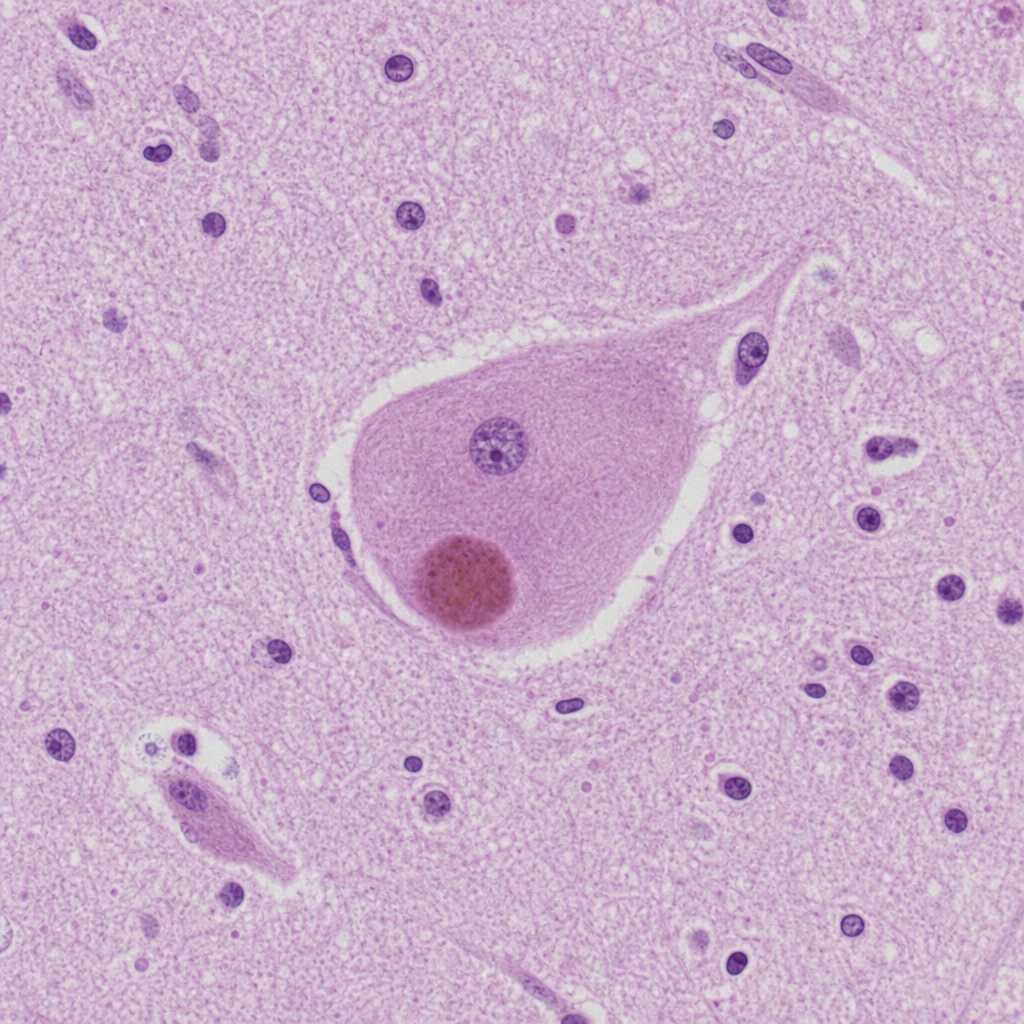
An 80-year-old woman is brought to the physician by her 2 daughters for worsening memory loss. They report that their mother is increasingly forgetful about recent conversations and events. She is unable to remember her appointments and commitments she has made. 3 years ago, the patient was moved into an elder care facility because she was often getting lost on her way home and forgetting to take her medications. The patient reports that she is very socially active at her new home and has long conversations with the other residents about her adventures as an air hostess during her youth. Which of the following cerebral pathologies is most likely present in this patient?
A 70-year-old woman is brought to the office after her nurse noticed her being apathetic, easily distracted, and starting to urinate in bed. Her medical history is relevant for hypertension, under control with medication. Physical examination reveals a blood pressure of 138/76 mm Hg, a heart rate of 70/min, and a respiratory rate 14/min and regular. On neurological examination, she has a broad-based shuffling gait, and increased muscle tone in her limbs that is reduced by distracting the patient. There is decreased coordination with exaggerated deep tendon reflexes, decreased attention and concentration, and postural tremor. Which of the following additional features would be expected to find in this patient?
A 65-year-old man with no significant medical history begins to have memory loss and personality changes. Rapidly, over the next few months his symptoms increase in severity. He experiences a rapid mental deterioration associated with sudden, jerking movements, particularly in response to being startled. He has gait disturbances as well. Eventually, he lapses into a coma and dies approximately ten months after the onset of symptoms. Which of the following would most likely be seen on autopsy of the brain in this patient?
An 81-year-old woman presents to your office accompanied by her husband. She has been doing well except for occasional word finding difficulty. Her husband is concerned that her memory is worsening over the past year. Recently, she got lost twice on her way home from her daughter’s house, was unable to remember her neighbor’s name, and could not pay the bills like she usually did. She has a history of hypertension and arthritis. She has no significant family history. Her medications include a daily multivitamin, hydrochlorothiazide, and ibuprofen as needed. Physical exam is unremarkable. Which of the following is associated with an increased risk of this patient’s disease?
A 68-year-old man is brought to the physician by his wife because she is concerned about his speech being irregular. Specifically, she says that over the last 8 months, her husband has been saying increasingly nonsensical statements at home. In addition, he is no longer able to perform basic verbal tasks such as ordering from a menu or giving directions even though he was an English teacher prior to retirement. She also reports that he has recently started attempting to kiss strangers and urinate in public. Finally, she has also noticed that he has been frequently binge eating sweets even though he was previously very conscientious about his health. When asked about these activities, the patient does not have insight into his symptoms. Which of the following would most likely be seen in this patient?
A 33-year-old man presents to his physician with a 3-year history of gradually worsening tics and difficulty walking. He was last seen by the physician 5 years ago for anxiety, and he has been buying anti-anxiety medications from an internet website without a prescription as he cannot afford to pay for doctor’s visits. Now, the patient notes that his anxiety is somewhat controlled, but motor difficulties are making it difficult for him to work and socialize. Family history is unobtainable as his parents died in an accident when he was an infant. He grew up in foster care and was always a bright child. An MRI of the brain is ordered; it shows prominent atrophy of the caudate nucleus. Repeats of which of the following trinucleotides are most likely responsible for this patient’s disorder?
A 52-year-old man presents with 2 months of diarrhea, abdominal pain, and fatigue. He reports a weight loss of 4 kg (8 lb). He also says his joints have been hurting recently, as well. Past medical history is unremarkable. Review of systems is significant for problems with concentration and memory. Physical examination is unremarkable. A GI endoscopy is performed with a biopsy of the small bowel. Which of the following histologic finding would most likely be seen in this patient?
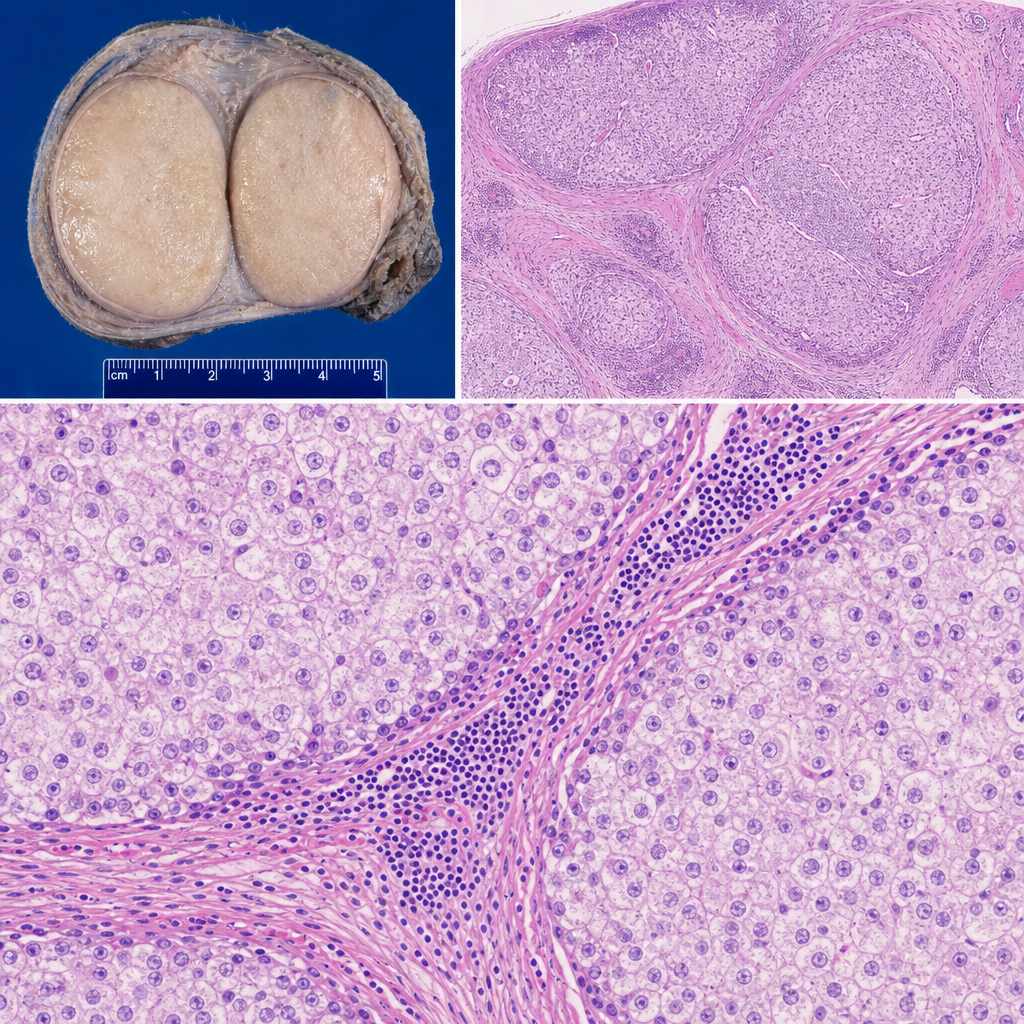
A 28-year-old man presents with a painless right testicular mass. Orchiectomy is performed. Gross examination reveals a 4 cm well-circumscribed, homogeneous, pale tan-gray mass without hemorrhage or necrosis. Histological sections show a monotonous population of large cells with clear, glycogen-rich cytoplasm and central round nuclei with prominent nucleoli, arranged in nests separated by fibrous septa infiltrated by mature lymphocytes. Which of the following best explains why the lymphocytic infiltrate is present within the fibrous septa of this tumor?
A 62-year-old man with poorly controlled type 2 diabetes mellitus for 18 years presents with proteinuria of 4.2 g/day and a serum creatinine of 2.8 mg/dL. Renal biopsy is performed. The biopsy shows PAS-positive, homogeneous, acellular nodular deposits in the mesangium of glomeruli, with associated capillary loop obliteration and diffuse glomerular basement membrane thickening. Immunofluorescence is negative for immune complex deposits and monoclonal light chain staining. Which of the following pathological processes best explains the formation of the nodular deposits seen in this biopsy?
Want unlimited practice?
Get full access to all questions, explanations, and performance tracking.
Scan to download app