A 70-year-old woman presents with a 2-week history of severe fatigue. Over the past month, she has unintentionally lost 2 kg (4.4 lb). Three years ago, she was diagnosed with myelodysplastic syndrome. Currently, she takes no medications other than aspirin for occasional knee pain. She does not smoke or drink alcohol. Her vital signs are within the normal range. On physical examination, her conjunctivae are pale. Petechiae are present on the distal lower extremities and on the soft and hard palates. Palpation reveals bilateral painless cervical lymphadenopathy. Examination of the lungs, heart, and abdomen shows no abnormalities. Laboratory studies show:
Hemoglobin 9 g/dL
Mean corpuscular volume 90 μm3
Leukocyte count 3000/mm3
Platelet count 20,000/mm3
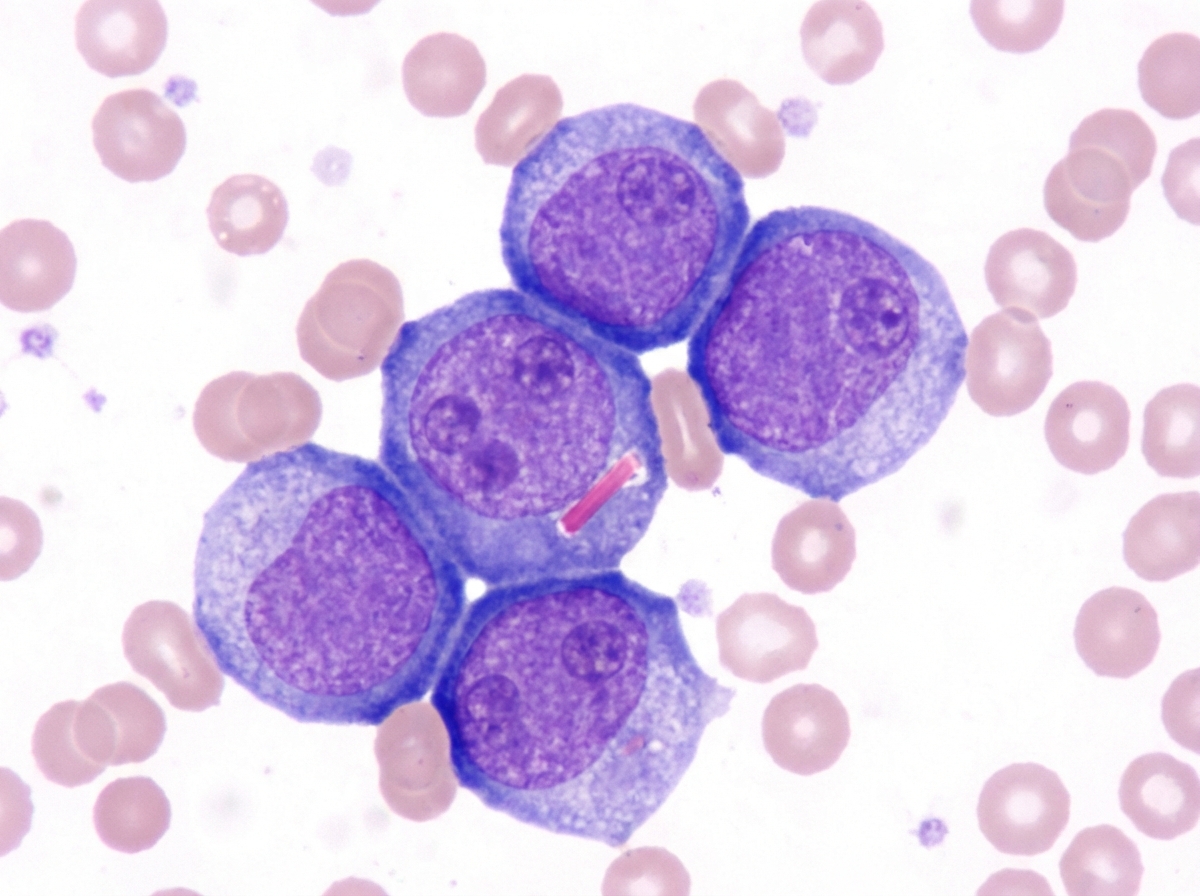
A Giemsa-stained peripheral blood smear is shown in the image. Which of the following best explains these findings?
Q232
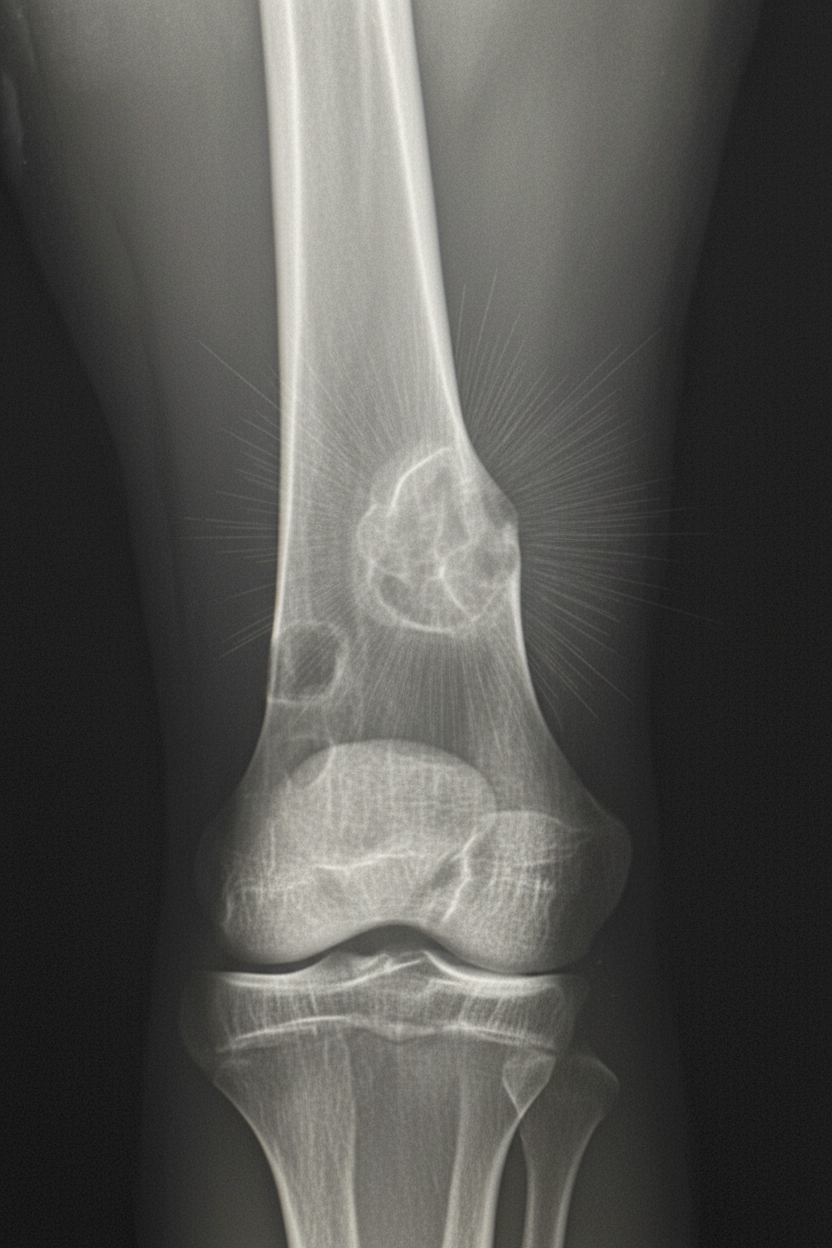
A 17-year-old boy is brought to the physician because of progressive right knee pain for the past 3 months. He reports that the pain is worse at night and while doing sports at school. He has not had any trauma to the knee or any previous problems with his joints. His vital signs are within normal limits. Examination of the right knee shows mild swelling and tenderness without warmth or erythema; the range of motion is limited. He walks with an antalgic gait. Laboratory studies show an alkaline phosphatase of 180 U/L and an erythrocyte sedimentation rate of 80 mm/h. An x-ray of the right knee is shown. Which of the following is the most likely diagnosis?
Q233
A 6-year-old boy presents to your office with loss of his peripheral vision. His mother discovered this because he was almost struck by a vehicle that "he couldn't see at all". In addition, he has been complaining of a headache for the last several weeks and had an episode of vomiting 2 days ago. He has a family history of migraines in his mother and grandmother. He is currently in the 80th percentile for height and weight. On physical exam his temperature is 99°F (37.2°C), blood pressure is 110/75 mmHg, pulse is 100/min, respirations are 19/min, and pulse oximetry is 99% on room air. He is uncooperative for the rest of the physical exam. During workup, a lesion is found in this patient. Which of the following would most likely be seen during histopathologic analysis?
Q234
A 62-year-old man presents to his primary care physician because of abdominal pain that started after he went camping several months ago and drank from a mountain stream. This past year, he also went on a trip around the world, eating local foods at each stop. Furthermore, he has had a history of cholelithiasis and had his gallbladder removed 3 years ago. Otherwise, his medical history is significant for well-controlled hypertension and diabetes. Based on clinical suspicion, an endoscopy and biopsy was performed showing a mix of mononuclear cells and a motile, urease-positive, oxidase-positive, spiral shaped organism. The changes seen on biopsy in this patient most likely predispose him to which of the following pathologies?
Q235
A 22-year-old woman comes to the physician because of hearing loss and unsteadiness while standing and walking for the past 2 months. She needs support from a wall to prevent herself from falling. She has not had any recent injuries and has no history of serious illness. Vital signs are within normal limits. Examination shows an unsteady gait. She sways when asked to stand upright with her feet together. She is unable to hear fingers rubbing next to her ears or repeat words whispered in her ears bilaterally. An MRI of the brain shows a 3-cm tumor in the right cerebellopontine angle and a 4.5-cm tumor in the left cerebellopontine angle. This patient is most likely to develop which of the following in the future?
Q236
A 42-year-old woman presents to her primary care physician with fatigue. She reports that over the past 2 months, she has felt increasingly tired despite no changes in her diet or exercise. Her past medical history is notable for obesity, seasonal allergies, and hypertension. She takes ranitidine as needed and hydrochlorothiazide daily. Her family history is notable for colorectal cancer in her mother and maternal uncle, endometrial cancer in her maternal aunt, and ovarian cancer in her maternal grandmother. Her temperature is 98.8°F (37.1°C), blood pressure is 132/71 mmHg, pulse is 89/min, and respirations are 17/min. On exam, she has conjunctival pallor. A stool sample is hemoccult positive. A colonoscopy reveals a fungating hemorrhagic mass in the ascending colon. Which of the following processes is likely impaired in this patient?
Q237
A 65-year-old man with a 40-pack-year smoking history presents with hemoptysis and a persistent cough. Chest CT shows a 3.5 cm centrally located mass in the right main bronchus. Positron emission tomography confirms a malignant nodule. Bronchoscopy with transbronchial biopsy is performed and a specimen sample of the nodule is sent for frozen section analysis. The tissue sample is most likely to show which of the following tumor types?
Q238
A 70-year-old man is brought to the emergency department by his wife because of progressive confusion for the past 2 weeks. He has also had a 4.5-kg (10-lb) weight loss and fatigue during the last 6 months. Physical examination shows enlarged lymph nodes in the right axilla and faint expiratory wheezing in the right middle lung field. He is only oriented to person. Serum studies show a sodium concentration of 125 mEq/L and increased antidiuretic hormone concentration. An x-ray of the chest shows a right-sided hilar mass with mediastinal fullness. A biopsy of the hilar mass is most likely to show cells that stain positive for which of the following?
Q239
A 61-year-old male presents to the ER with abdominal discomfort and malaise over the past 2 weeks. He states he is married and monogamous. He has a temperature of 39.4°C (102.9°F) and complains of night sweats as well. On physical exam, he has an enlarged spleen with mild tenderness and pale nail beds. There is mild tonsillar erythema and the pulmonary exam demonstrates scattered crackles. A complete blood count demonstrates anemia, thrombocytopenia, and leukocytosis with lymphocytic predominance. A bone marrow aspiration is scheduled the next morning based on the peripheral blood smear findings but was inconclusive due to a low yield. The patient was admitted to the hospital due to the anemia and given a transfusion of packed red blood cells and wide spectrum antibiotics. He is released home the next day with instructions for primary care follow-up. Which of the following laboratory findings is most reliably positive for the primary cause of this illness?
Q240
A 4-year-old girl is brought to the physician because of a 3-week history of generalized fatigue and easy bruising. During the past week, she has also had fever and severe leg pain that wakes her up at night. Her temperature is 38.3°C (100.9°F), pulse is 120/min, and respirations are 30/min. Examination shows cervical and axillary lymphadenopathy. The abdomen is soft and nontender; the liver is palpated 3 cm below the right costal margin, and the spleen is palpated 2 cm below the left costal margin. Laboratory studies show:
Hemoglobin 10.1 g/dL
Leukocyte count 63,000/mm3
Platelet count 27,000/mm3
A bone marrow aspirate predominantly shows immature cells that stain positive for CD10, CD19, and TdT. Which of the following is the most likely diagnosis?
Neoplasia US Medical PG Practice Questions and MCQs
Question 231: A 70-year-old woman presents with a 2-week history of severe fatigue. Over the past month, she has unintentionally lost 2 kg (4.4 lb). Three years ago, she was diagnosed with myelodysplastic syndrome. Currently, she takes no medications other than aspirin for occasional knee pain. She does not smoke or drink alcohol. Her vital signs are within the normal range. On physical examination, her conjunctivae are pale. Petechiae are present on the distal lower extremities and on the soft and hard palates. Palpation reveals bilateral painless cervical lymphadenopathy. Examination of the lungs, heart, and abdomen shows no abnormalities. Laboratory studies show:
Hemoglobin 9 g/dL
Mean corpuscular volume 90 μm3
Leukocyte count 3000/mm3
Platelet count 20,000/mm3
A Giemsa-stained peripheral blood smear is shown in the image. Which of the following best explains these findings?
A. Primary myelofibrosis
B. Chronic myelogenous leukemia
C. Acute myeloid leukemia (Correct Answer)
D. Hairy cell leukemia
E. Aplastic anemia
Explanation: ***Acute myeloid leukemia***
- The patient's history of **myelodysplastic syndrome (MDS)** combined with new symptoms of **fatigue**, unintentional **weight loss**, signs of **pancytopenia** (pallor, petechiae), and the presence of **circulating blasts** (seen as myeloblasts with prominent nucleoli on the Giemsa-stained peripheral smear) strongly indicates transformation to **acute myeloid leukemia (AML)**.
- MDS frequently progresses to AML, characterized by **>20% blasts** in the bone marrow or peripheral blood. The symptoms reflect bone marrow failure due to the proliferation of these immature myeloid cells.
*Primary myelofibrosis*
- While **fatigue**, **weight loss**, and **anemia** can occur, primary myelofibrosis typically presents with **splenomegaly**, **leukoerythroblastosis** (immature myeloid and erythroid precursors in peripheral blood), and **teardrop cells** on the smear, none of which are explicitly mentioned or visible as prominent features.
- The defining feature is **bone marrow fibrosis**, which is not suggested by the presence of a high number of circulating blasts.
*Chronic myelogenous leukemia*
- This condition is characterized by a marked **leukocytosis** (often >100,000/mm³) with a full spectrum of mature and immature granulocytes, and the presence of the **Philadelphia chromosome (BCR-ABL1 fusion gene)**.
- The patient's **leukocyte count is low (3000/mm³)**, and the predominant cells on the smear are blasts, not a range of maturing myeloid cells.
*Hairy cell leukemia*
- Patients with hairy cell leukemia typically present with **fatigue**, **weakness**, and often **splenomegaly**, but their peripheral blood smear is characterized by **lymphocytes with cytoplasmic projections** (hairy cells).
- The patient's smear shows **myeloid blasts**, not hairy cells, and her cell counts (e.g., severe thrombocytopenia) are not typical of classic hairy cell leukemia.
*Aplastic anemia*
- Aplastic anemia presents with **pancytopenia** and symptoms of bone marrow failure (fatigue, bleeding, infections), but it is characterized by a **hypocellular bone marrow** with a **paucity of hematopoietic cells** and a **lack of circulating blasts** on the peripheral smear.
- The presence of **circulating blasts** observed in the image **rules out aplastic anemia**.
Question 232: A 17-year-old boy is brought to the physician because of progressive right knee pain for the past 3 months. He reports that the pain is worse at night and while doing sports at school. He has not had any trauma to the knee or any previous problems with his joints. His vital signs are within normal limits. Examination of the right knee shows mild swelling and tenderness without warmth or erythema; the range of motion is limited. He walks with an antalgic gait. Laboratory studies show an alkaline phosphatase of 180 U/L and an erythrocyte sedimentation rate of 80 mm/h. An x-ray of the right knee is shown. Which of the following is the most likely diagnosis?
A. Chordoma
B. Chondrosarcoma
C. Osteosarcoma (Correct Answer)
D. Osteochondroma
E. Ewing sarcoma
Explanation: ***Osteosarcoma***
- This diagnosis is supported by the **progressive knee pain** worsening at night and with activity, **elevated alkaline phosphatase** and **ESR**, and the X-ray findings typical of an osteosarcoma (e.g., **Codman's triangle**, **sunburst appearance**, or **periosteal elevation**).
- It commonly presents in adolescents, typically in the **metaphysis of long bones** (like the distal femur or proximal tibia), and the presence of mild swelling, tenderness, and limited range of motion align with a rapidly growing bone tumor.
*Chordoma*
- This is a rare, malignant tumor typically arising from notochord remnants, usually seen in the **sacrococcygeal region** or **skull base**, not the knee.
- It usually presents in older adults (30-60 years) and would not have the characteristic X-ray findings seen in this case.
*Chondrosarcoma*
- Characterized by the formation of **cartilage-producing tumors**, typically affecting older adults (40-70 years) and often the **pelvis and proximal long bones**, rather than the knee in an adolescent.
- While it causes pain and swelling, the radiographic features generally show **calcified cartilaginous matrix** (arc and ring pattern) rather than the aggressive periosteal reaction associated with osteosarcoma.
*Osteochondroma*
- This is a **benign cartilaginous tumor** that usually presents as a **painless, solitary mass** near a joint, only causing pain if it irritates surrounding structures or fractures.
- The X-ray image would show a **bony outgrowth covered by cartilage** pointing away from the joint, which is distinctly different from the lytic and blastic changes of an osteosarcoma, and it would not typically cause elevated inflammatory markers.
*Ewing sarcoma*
- While Ewing sarcoma can occur in the knee and presents with pain, swelling, and systemic symptoms, it typically has an **"onion-skin" periosteal reaction** on X-ray, which is distinct from the aggressive sunburst pattern or Codman's triangle seen in osteosarcoma.
- It is more commonly associated with a **diaphyseal location** in long bones and can sometimes show a large soft tissue mass.
Question 233: A 6-year-old boy presents to your office with loss of his peripheral vision. His mother discovered this because he was almost struck by a vehicle that "he couldn't see at all". In addition, he has been complaining of a headache for the last several weeks and had an episode of vomiting 2 days ago. He has a family history of migraines in his mother and grandmother. He is currently in the 80th percentile for height and weight. On physical exam his temperature is 99°F (37.2°C), blood pressure is 110/75 mmHg, pulse is 100/min, respirations are 19/min, and pulse oximetry is 99% on room air. He is uncooperative for the rest of the physical exam. During workup, a lesion is found in this patient. Which of the following would most likely be seen during histopathologic analysis?
A. Perivascular rosettes with rod-shaped blepharoplasts
B. Round nuclei with clear cytoplasm
C. Rosettes and small blue cells
D. Eosinophilic, corkscrew fibers
E. Cholesterol crystals and calcification (Correct Answer)
Explanation: ***Cholesterol crystals and calcification***
- The patient's symptoms (loss of peripheral vision, headache, vomiting) coupled with his age (6 years old) strongly suggest a **craniopharyngioma**. These tumors often contain **cholesterol crystals and calcifications**.
- **Craniopharyngiomas** typically arise from Rathke's pouch remnants and are located in the sellar or suprasellar region, leading to **vision impairment** (e.g., **bitemporal hemianopsia** from optic chiasm compression), **headaches**, and symptoms of **increased intracranial pressure**.
*Perivascular rosettes with rod-shaped blepharoplasts*
- This description is characteristic of an **ependymoma**, which is a glial tumor that typically arises from the ependymal lining of the ventricles or spinal cord.
- While ependymomas can cause increased intracranial pressure, they are less likely to present with isolated **peripheral vision loss** targeting the optic chiasm specifically.
*Round nuclei with clear cytoplasm*
- This describes **oligodendroglioma**, a type of glioma typically found in the cerebral hemispheres of adults.
- Oligodendrogliomas are less common in children and usually present with seizures or focal neurological deficits, rather than primary vision loss and symptoms of increased ICP in this age group.
*Rosettes and small blue cells*
- This is characteristic of **medulloblastoma**, a highly malignant tumor originating in the cerebellum.
- Medulloblastomas often cause hydrocephalus, ataxia, and symptoms of increased intracranial pressure, but **peripheral vision loss** as the primary presenting symptom is less typical compared to craniopharyngioma.
*Eosinophilic, corkscrew fibers*
- This describes **Rosenthal fibers**, which are characteristic of **pilocytic astrocytoma**, a common low-grade glioma in children, often found in the cerebellum or optic pathways.
- While pilocytic astrocytomas of the optic pathway can cause visual deficits, the presence of **cholesterol crystals and calcifications** is more specific to craniopharyngioma, which fits the clinical picture of bitemporal hemianopsia from a suprasellar lesion.
Question 234: A 62-year-old man presents to his primary care physician because of abdominal pain that started after he went camping several months ago and drank from a mountain stream. This past year, he also went on a trip around the world, eating local foods at each stop. Furthermore, he has had a history of cholelithiasis and had his gallbladder removed 3 years ago. Otherwise, his medical history is significant for well-controlled hypertension and diabetes. Based on clinical suspicion, an endoscopy and biopsy was performed showing a mix of mononuclear cells and a motile, urease-positive, oxidase-positive, spiral shaped organism. The changes seen on biopsy in this patient most likely predispose him to which of the following pathologies?
A. Gallbladder adenocarcinoma
B. Esophageal adenocarcinoma
C. Colon adenocarcinoma
D. MALT lymphoma (Correct Answer)
E. Pancreatic adenocarcinoma
Explanation: ***MALT lymphoma***
- The description of a **motile, urease-positive, oxidase-positive, spiral-shaped organism** from an endoscopic biopsy points to **Helicobacter pylori** infection.
- **H. pylori** infection chronic gastritis is a significant risk factor for the development of **MALT (Mucosa-Associated Lymphoid Tissue) lymphoma** of the stomach.
*Gallbladder adenocarcinoma*
- This is primarily associated with chronic inflammation of the gallbladder, often due to **cholelithiasis**, but the patient's gallbladder was removed.
- There is no direct link between **H. pylori infection** of the stomach and gallbladder adenocarcinoma.
*Esophageal adenocarcinoma*
- This is predominantly linked to **Barrett's esophagus**, which is caused by chronic **gastroesophageal reflux disease (GERD)**.
- While H. pylori can sometimes be associated with GERD, it's not a primary direct cause of esophageal adenocarcinoma.
*Colon adenocarcinoma*
- This is primarily associated with genetic predispositions like **familial adenomatous polyposis** or **Lynch syndrome**, as well as environmental factors like diet and inflammatory bowel disease.
- There is no direct causal link between **H. pylori** infection and colon adenocarcinoma.
*Pancreatic adenocarcinoma*
- Risk factors for pancreatic cancer include **smoking, obesity, chronic pancreatitis, and certain genetic syndromes**.
- There is no established direct link between **H. pylori infection** and pancreatic adenocarcinoma.
Question 235: A 22-year-old woman comes to the physician because of hearing loss and unsteadiness while standing and walking for the past 2 months. She needs support from a wall to prevent herself from falling. She has not had any recent injuries and has no history of serious illness. Vital signs are within normal limits. Examination shows an unsteady gait. She sways when asked to stand upright with her feet together. She is unable to hear fingers rubbing next to her ears or repeat words whispered in her ears bilaterally. An MRI of the brain shows a 3-cm tumor in the right cerebellopontine angle and a 4.5-cm tumor in the left cerebellopontine angle. This patient is most likely to develop which of the following in the future?
A. Renal cell carcinoma
B. Telangiectasias
C. Optic glioma
D. Meningioma (Correct Answer)
E. Astrocytoma
Explanation: ***Meningioma***
- This patient's bilateral **vestibular schwannomas** (tumors in the **cerebellopontine angle** causing hearing loss and unsteadiness) are highly suggestive of **Neurofibromatosis type 2 (NF2)**.
- Patients with NF2 are predisposed to developing multiple central nervous system tumors, with **meningiomas** being a common manifestation, alongside schwannomas and ependymomas.
*Renal cell carcinoma*
- This is not typically associated with **Neurofibromatosis type 2**, which primarily involves tumors of the nervous system.
- While various cancer syndromes exist, NF2 does not significantly increase the risk of **renal cell carcinoma**.
*Telangiectasias*
- **Telangiectasias** are dilated small blood vessels, often associated with conditions like **hereditary hemorrhagic telangiectasia** or **ataxia-telangiectasia**.
- They are not a characteristic feature or complication of **Neurofibromatosis type 2**.
*Optic glioma*
- **Optic gliomas** are a hallmark feature of **Neurofibromatosis type 1 (NF1)**, not NF2.
- NF1 is also associated with **café-au-lait spots** and **Lisch nodules**, which are distinct from the presentation of bilateral vestibular schwannomas.
*Astrocytoma*
- While NF2 patients can develop central nervous system tumors, **astrocytomas** are less common than **ependymomas** or **meningiomas** in this syndrome.
- The most characteristic brain tumors in NF2 are **vestibular schwannomas** and **meningiomas**.
Question 236: A 42-year-old woman presents to her primary care physician with fatigue. She reports that over the past 2 months, she has felt increasingly tired despite no changes in her diet or exercise. Her past medical history is notable for obesity, seasonal allergies, and hypertension. She takes ranitidine as needed and hydrochlorothiazide daily. Her family history is notable for colorectal cancer in her mother and maternal uncle, endometrial cancer in her maternal aunt, and ovarian cancer in her maternal grandmother. Her temperature is 98.8°F (37.1°C), blood pressure is 132/71 mmHg, pulse is 89/min, and respirations are 17/min. On exam, she has conjunctival pallor. A stool sample is hemoccult positive. A colonoscopy reveals a fungating hemorrhagic mass in the ascending colon. Which of the following processes is likely impaired in this patient?
A. Mismatch repair (Correct Answer)
B. Non-homologous end joining
C. Homologous recombination
D. Base excision repair
E. Nucleotide excision repair
Explanation: ***Mismatch repair***
- The patient's presentation with **colorectal cancer** at a relatively young age (42), combined with a strong family history of various cancers (colorectal, endometrial, ovarian) suggesting a **hereditary cancer syndrome**, points towards a defect in **mismatch repair (MMR)**.
- Defective MMR leads to an accumulation of **mutations** during DNA replication, particularly in microsatellites, and is characteristic of **Lynch syndrome** (Hereditary Nonpolyposis Colorectal Cancer, HNPCC).
*Non-homologous end joining*
- This pathway is crucial for repairing **double-strand breaks** in DNA but is often error-prone.
- Defects in non-homologous end joining are associated with conditions like **severe combined immunodeficiency** due to impaired V(D)J recombination, not typically Lynch syndrome.
*Homologous recombination*
- Involved in high-fidelity repair of **double-strand breaks** using a homologous DNA template.
- Impairments are linked to increased risk of certain cancers, such as **BRCA1/2 mutations** causing breast and ovarian cancer, but are not the primary defect in Lynch syndrome.
*Base excision repair*
- This pathway is responsible for repairing **small, non-helix-distorting base lesions** caused by oxidation, alkylation, or deamination.
- Defects can lead to increased mutagenicity but are not the primary mechanism underlying the cancer spectrum seen in Lynch syndrome.
*Nucleotide excision repair*
- This system repairs **bulky DNA adducts** and helix-distorting lesions, such as those caused by UV radiation (e.g., **pyrimidine dimers**).
- Defects are associated with conditions like **xeroderma pigmentosum**, characterized by extreme sun sensitivity and skin cancers, which is not consistent with this patient's presentation.
Question 237: A 65-year-old man with a 40-pack-year smoking history presents with hemoptysis and a persistent cough. Chest CT shows a 3.5 cm centrally located mass in the right main bronchus. Positron emission tomography confirms a malignant nodule. Bronchoscopy with transbronchial biopsy is performed and a specimen sample of the nodule is sent for frozen section analysis. The tissue sample is most likely to show which of the following tumor types?
A. Carcinoid tumor
B. Metastasis of colorectal cancer
C. Small cell lung carcinoma
D. Large cell carcinoma
E. Squamous cell carcinoma (Correct Answer)
Explanation: ***Squamous cell carcinoma***
- This is the most likely diagnosis given the **central location** in the main bronchus, **heavy smoking history**, and presentation with **hemoptysis**.
- **Squamous cell carcinoma** accounts for 25-30% of lung cancers and characteristically arises in **central/proximal airways**, making it readily accessible by **bronchoscopy**.
- Histologically, it shows **keratin pearls** and **intercellular bridges** on biopsy.
- The **central endobronchial location** and ability to obtain tissue via transbronchial biopsy strongly favor squamous cell over peripheral tumors.
*Carcinoid tumor*
- **Carcinoid tumors** are **neuroendocrine tumors** that can present as central endobronchial masses and cause hemoptysis.
- However, they are typically **slow-growing** with more indolent presentation, and PET scans show **variable uptake** (often less intense than aggressive carcinomas).
- They represent only **1-2% of lung tumors** and occur more commonly in **younger, non-smoking patients**.
*Metastasis of colorectal cancer*
- While lung is a common site for **colorectal metastases**, these typically present as **multiple peripheral nodules** rather than a solitary central endobronchial mass.
- The clinical presentation strongly suggests **primary lung cancer** rather than metastatic disease.
- Without history of colorectal cancer, this is unlikely.
*Small cell lung carcinoma*
- **Small cell lung carcinoma** (SCLC) represents 15% of lung cancers and typically presents as a **large central mass** with early mediastinal involvement.
- However, SCLC is usually **too extensive at presentation** for transbronchial biopsy alone and often requires mediastinoscopy or CT-guided biopsy.
- Histology shows **small cells with scant cytoplasm**, **salt-and-pepper chromatin**, and **oat-cell morphology**.
- While possible, the single accessible endobronchial mass is more characteristic of squamous cell.
*Large cell carcinoma*
- **Large cell carcinoma** is a **diagnosis of exclusion** made when tumors lack features of adenocarcinoma, squamous cell, or small cell differentiation.
- It typically presents as **large peripheral masses** rather than central endobronchial lesions.
- It represents only **10% of lung cancers** and is less common than squamous cell carcinoma in this clinical scenario.
Question 238: A 70-year-old man is brought to the emergency department by his wife because of progressive confusion for the past 2 weeks. He has also had a 4.5-kg (10-lb) weight loss and fatigue during the last 6 months. Physical examination shows enlarged lymph nodes in the right axilla and faint expiratory wheezing in the right middle lung field. He is only oriented to person. Serum studies show a sodium concentration of 125 mEq/L and increased antidiuretic hormone concentration. An x-ray of the chest shows a right-sided hilar mass with mediastinal fullness. A biopsy of the hilar mass is most likely to show cells that stain positive for which of the following?
A. Neurofilament
B. S-100
C. Desmin
D. Napsin A
E. Neuron-specific enolase (Correct Answer)
Explanation: ***Neuron-specific enolase***
- The patient's presentation with a **right-sided hilar mass**, **mediastinal fullness**, **hyponatremia**, **increased antidiuretic hormone (ADH) concentration**, and **progressive confusion** is highly suggestive of **small cell lung carcinoma (SCLC)**. SCLC commonly produces ADH, leading to **syndrome of inappropriate antidiuretic hormone secretion (SIADH)**.
- SCLC cells are of neuroendocrine origin and therefore typically stain positive for **neuroendocrine markers** such as chromogranin A, synaptophysin, and **neuron-specific enolase (NSE)**.
*Neurofilament*
- **Neurofilament** proteins are intermediate filaments found within the cytoplasm of neurons, forming the neuronal cytoskeleton. They are used as markers for neuronal differentiation and neuronal damage.
- While SCLC cells have neuroendocrine features, **neurofilament** staining is more specific for mature neuronal structures and is less consistently positive in SCLC compared to other neuroendocrine markers like NSE.
*S-100*
- **S-100 protein** is a marker for cells of **neural crest origin**, including melanocytes, Schwann cells, and Langerhans cells, and is commonly used to diagnose melanoma and schwannomas.
- It is not a primary marker for small cell lung carcinoma, which is thought to arise from neuroendocrine cells in the bronchial epithelium.
*Desmin*
- **Desmin** is an intermediate filament protein typically found in **muscle cells** (smooth, skeletal, and cardiac). It is a key marker for the diagnosis of **rhabdomyosarcoma** and other muscle-derived tumors.
- Lung tumors, including small cell carcinoma, are not typically of muscle origin and would not stain positive for desmin.
*Napsin A*
- **Napsin A** is an aspartic proteinase that is a highly sensitive and specific immunohistochemical marker for **adenocarcinoma of the lung**.
- The clinical presentation with a central hilar mass, SIADH, and rapid progression is much more characteristic of **small cell carcinoma** than adenocarcinoma.
Question 239: A 61-year-old male presents to the ER with abdominal discomfort and malaise over the past 2 weeks. He states he is married and monogamous. He has a temperature of 39.4°C (102.9°F) and complains of night sweats as well. On physical exam, he has an enlarged spleen with mild tenderness and pale nail beds. There is mild tonsillar erythema and the pulmonary exam demonstrates scattered crackles. A complete blood count demonstrates anemia, thrombocytopenia, and leukocytosis with lymphocytic predominance. A bone marrow aspiration is scheduled the next morning based on the peripheral blood smear findings but was inconclusive due to a low yield. The patient was admitted to the hospital due to the anemia and given a transfusion of packed red blood cells and wide spectrum antibiotics. He is released home the next day with instructions for primary care follow-up. Which of the following laboratory findings is most reliably positive for the primary cause of this illness?
A. CD 25
B. Quantiferon Gold
C. Monospot
D. Rapid streptococcal antigen
E. Tartrate-resistant acid phosphatase (TRAP) (Correct Answer)
Explanation: ***Tartrate-resistant acid phosphatase (TRAP)***
- The patient's presentation with **splenomegaly**, **pancytopenia** (anemia, thrombocytopenia, leukocytosis with lymphocytic predominance), and an **inconclusive bone marrow aspiration due to low yield** (known as a "dry tap") is highly suggestive of **hairy cell leukemia**.
- **TRAP staining** is a classic and highly reliable diagnostic marker for hairy cell leukemia, where the neoplastic B cells exhibit strong TRAP activity.
*CD 25*
- While **CD25** (the alpha chain of the IL-2 receptor) can be expressed on some leukemic cells, its presence is not uniquely diagnostic for hairy cell leukemia, as it can be found on other activated lymphocytes and some other leukemias/lymphomas.
- The most characteristic immunophenotypic markers for hairy cell leukemia include **CD11c, CD20, CD22, CD103, and CD123**, in addition to CD25, but TRAP is a more specific enzymatic marker.
*Quantiferon Gold*
- **Quantiferon Gold** is an interferon-gamma release assay used to detect latent or active **tuberculosis infection**.
- The patient's symptoms are not classic for tuberculosis, and while crackles are noted, there is no mention of cough or typical pulmonary involvement beyond general symptoms that could be attributed to infection or malignancy.
*Monospot*
- The **Monospot test** is used to detect heterophile antibodies associated with **infectious mononucleosis**, typically caused by the Epstein-Barr virus (EBV).
- While leukocytosis with lymphocytic predominance and splenomegaly can occur in mononucleosis, the patient's age (61 years old) makes it a less likely primary diagnosis, and the overall clinical picture, particularly the "dry tap" bone marrow aspiration, points more strongly to a hematologic malignancy.
*Rapid streptococcal antigen*
- A **rapid streptococcal antigen test** is used to diagnose **Streptococcus pyogenes (Group A Strep)** pharyngitis.
- While the patient has mild tonsillar erythema, his systemic symptoms (splenomegaly, pancytopenia, constitutional symptoms) are far broader and more severe than typical pharyngitis, making Strep throat an insufficient explanation for his overall condition.
Question 240: A 4-year-old girl is brought to the physician because of a 3-week history of generalized fatigue and easy bruising. During the past week, she has also had fever and severe leg pain that wakes her up at night. Her temperature is 38.3°C (100.9°F), pulse is 120/min, and respirations are 30/min. Examination shows cervical and axillary lymphadenopathy. The abdomen is soft and nontender; the liver is palpated 3 cm below the right costal margin, and the spleen is palpated 2 cm below the left costal margin. Laboratory studies show:
Hemoglobin 10.1 g/dL
Leukocyte count 63,000/mm3
Platelet count 27,000/mm3
A bone marrow aspirate predominantly shows immature cells that stain positive for CD10, CD19, and TdT. Which of the following is the most likely diagnosis?
A. Aplastic anemia
B. Hodgkin lymphoma
C. Acute lymphoblastic leukemia (Correct Answer)
D. Acute myeloid leukemia
E. Hairy cell leukemia
Explanation: ***Acute lymphoblastic leukemia***
- The constellation of **generalized fatigue**, **easy bruising** (due to **thrombocytopenia**), fever, **severe leg pain** (bone marrow infiltration), **hepatosplenomegaly**, and **lymphadenopathy** in a child is highly suggestive of **acute leukemia**.
- The laboratory findings of **anemia** (Hb 10.1 g/dL), **thrombocytopenia** (platelet count 27,000/mm³), and a **markedly elevated leukocyte count** (63,000/mm³) with **immature cells** (blasts) in the bone marrow, staining positive for **CD10, CD19, and TdT**, are pathognomonic for **B-cell acute lymphoblastic leukemia (ALL)**.
*Aplastic anemia*
- This condition is characterized by **pancytopenia** (low levels of all blood cell types) due to bone marrow failure, but it would not typically present with **lymphadenopathy**, **hepatosplenomegaly**, or an extremely high leukocyte count with immature cells.
- The bone marrow would be **hypocellular** rather than hypercellular with blasts, as seen in this patient.
*Hodgkin lymphoma*
- While Hodgkin lymphoma can cause **lymphadenopathy** and systemic symptoms like fever and fatigue (B symptoms), it is less common in this age group and does not present with **pancytopenia** or an overwhelming presence of immature cells in the bone marrow.
- Diagnosis relies on the identification of **Reed-Sternberg cells** in lymph node biopsy.
*Acute myeloid leukemia*
- **AML** can also present with similar symptoms and pancytopenia with elevated blasts, but the immunophenotype would differ, typically showing markers like **CD13, CD33, and myeloid-specific markers**, not **CD10, CD19, and TdT**.
- **TdT** positivity is characteristic of lymphoid progenitors.
*Hairy cell leukemia*
- This is a rare, **chronic B-cell leukemia** primarily affecting older adults, not children, and is characterized by cells with **"hairy" projections**, **massive splenomegaly**, and typically **pancytopenia** without a high blast count.
- The immunophenotype involves **CD11c, CD25, CD103, and CD123**.